Minnesota No Registration Weekend and the Pass
Minnesota’s No Registration Weekend can make a short ride possible without registering an eligible ATV first, but it is a limited exception—not a free pass from every riding requirement. The key is knowing who qualifies, where the exception applies, and whether a trail pass is still needed. Here’s how to plan without confusing registration rules with trail-access rules.
What Minnesota’s No Registration Weekend Allows
Minnesota’s No Registration Weekend is a temporary exception to the usual ATV registration requirement for eligible riders. It is intended to let qualifying Minnesota residents operate an ATV without registering it for that specific weekend, subject to the conditions announced by the Minnesota Department of Natural Resources (DNR).
That does not mean every ATV can be ridden anywhere without paperwork. The exemption is narrow: it applies only to the eligible riders, machines, dates, and locations described by the DNR. The event does not turn public trails into unrestricted routes, and it does not override local ordinances, landowner permission, safety rules, or other requirements.
Before setting out, check the current DNR notice for the weekend. Confirm the dates, who may participate, and which kinds of trails or public land are included. A past year’s schedule or an old social media post is not enough to establish that the same terms apply now. For the event’s basic purpose and eligibility, see Minnesota’s No Registration Weekend.
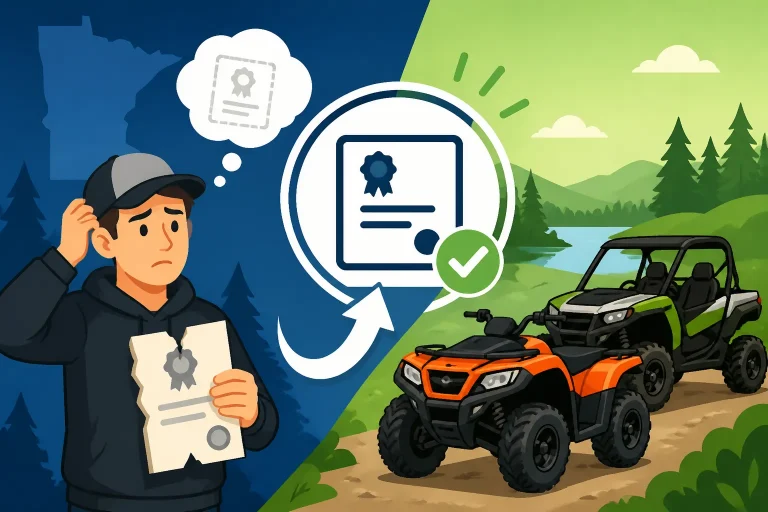
Registration and trail passes are different
Registration is connected to the machine and its authorized use. A trail pass is a separate access requirement that can apply to certain riders or machines on particular trails. One does not automatically replace the other.
This distinction matters most for visitors. The no-registration exception is not a general waiver for out-of-state riders. Visitors should plan to meet the registration requirements that apply to their machine and check whether they need a Minnesota nonresident ATV trail pass for the routes they intend to ride. The weekend’s registration exception should not be treated as permission to ride a public trail without a required pass.
Minnesota residents generally do not buy the nonresident trail pass simply because they ride on a public trail. But that does not mean every resident may ride every machine without documentation: the weekend’s conditions still matter, and ordinary registration rules apply outside the exemption. For the wider distinction between registration categories, see Minnesota Public Use Versus Private Use Registration and Minnesota’s Non-Resident ATV Trail Pass.
The exemption is not the same as riding on private land
A machine used only on land where public-use registration is not required may be subject to different rules from one operated on a public trail. But “private land” is not a catch-all answer. The property must actually be private, and the rider needs permission to use it. If a route connects private property to a public trail, the public portion can bring separate requirements into play.
The weekend does not grant access to private property, and it does not create permission to cross land that is posted, leased, or otherwise controlled by someone else. It also does not change rules for state forest roads, grant-in-aid trails, or other public routes. If your plan includes both private property and a public trail, check the requirements for each part of the ride. Do You Need Registration on Your Own Minnesota Land? explains the private-land question in more detail.
Does the Weekend Waive the Trail Pass Requirement?
Do not assume that “no registration” means “no pass.” The weekend is primarily a registration exception for eligible Minnesota residents; trail-pass requirements are separate. Whether a pass is required depends on the rider, machine, and trail.
For a Minnesota resident who meets the event conditions, the weekend may remove the registration barrier for the ride described by the DNR. It does not create an equivalent exception for visitors who would otherwise need a nonresident trail pass. If you are coming from another state, check the pass rules before loading your machine. The same is true if you are riding a borrowed or rented ATV: the owner’s registration status does not, by itself, settle every pass question for the operator.
| Situation | What to check before riding |
|---|---|
| Minnesota resident using an unregistered ATV | Confirm that the rider, machine, date, and route qualify under the DNR’s current No Registration Weekend notice. |
| Out-of-state visitor | Confirm the machine’s registration status and whether a Minnesota nonresident trail pass is required for the planned trails. |
| Minnesota resident using a registered machine | Confirm the machine’s registration is current and that the route is open to that machine. |
| Rider using private property | Get the landowner’s permission and check whether any part of the route enters a public trail or right of way. |
| Rider using a borrowed ATV | Check the machine’s paperwork and the operator’s separate trail-pass obligations. |
A trail pass is not a substitute for registration when registration is required. Likewise, a registration or temporary exemption does not automatically satisfy a pass requirement. Keep those questions separate when planning: first determine whether the machine may be operated, then determine whether the rider has the access credential required for the specific trail.
If you are visiting from a neighboring state, do not rely on the fact that your ATV is registered at home as proof that all Minnesota requirements are met. Registration reciprocity and trail-pass rules are separate issues. Minnesota Rules for Visiting Riders and Reciprocity Minnesota Does Not Offer can help clarify what to check for a cross-border trip.
The trail still has to be open and suitable
An eligible machine and rider still need a legal route. Trails can close for seasonal conditions, maintenance, weather, or other management reasons. A trail shown on an older map may not be open on the day you ride, and a route that allows one type of off-highway vehicle may not allow another.
Check current trail information shortly before leaving. Look for closures, restrictions, and any notice specific to the route. Pay attention to spring-thaw closures and other temporary limits rather than assuming the special weekend overrides them. For help locating and reading route information, see Reading a Minnesota OHV Trail Map and Checking Minnesota Trail Status Before You Drive.
What the Weekend Does Not Change
The registration exception does not suspend the rest of Minnesota’s riding rules. Riders remain responsible for operating safely, using only routes open to their machine, respecting private property, and following applicable age, equipment, and road-use requirements.
A public trail may have rules about vehicle class or width, and local access can be more limited than the statewide event description suggests. The weekend does not make a road legal to ride, authorize travel on a trail closed to ATVs, or permit access through a private parcel. It also does not make a machine compliant if it lacks equipment required for the route.
For road use, distinguish riding a trail from riding in a road right of way or crossing a road. Those activities have their own rules. Do not assume that a registration exemption changes where an ATV may travel. See Riding an ATV on the Road in Minnesota for the separate road-use rules.
Age and safety requirements still matter
Age-related requirements and safety rules continue to apply during the event. The registration exception is not a substitute for any training, supervision, helmet, or operating requirement that applies to the rider. Parents and guardians should check the rules for the youth rider’s age and the type of route before the trip, rather than treating the weekend as an exception to those standards.
A rider should also use a machine suited to their size and ability. No registration weekend can attract new or occasional riders, but a free or temporary opportunity does not make an unfamiliar machine easier to control. Review the route, ride at a manageable speed, and keep children within the supervision required for the situation.
Keep useful documents and information available
Even when an eligible Minnesota resident is not required to register the machine for the event, it is sensible to have information that helps establish who owns or is responsible for the ATV. For a visitor, carry the registration and any trail-pass documentation required for the trip. Be prepared to show that the machine and rider meet the rules that apply.
Do not rely on a photograph of a pass or a registration record unless the applicable rules allow that form of proof. Check the DNR’s instructions for what must be displayed or carried. For practical details about papers and trail interactions, see Do You Carry Papers on a Minnesota Trail? and What a Minnesota Conservation Officer Asks For.
A Practical Checklist Before You Ride
The easiest way to use the weekend correctly is to check each requirement in order. This avoids the common mistake of treating one temporary exception as an all-purpose permission slip.
- Verify the event details. Use the current DNR announcement to confirm the dates and eligibility. Check that the rider and ATV meet the stated conditions.
- Identify the route. Confirm that the trail or public land is open and permits the machine you plan to use. Check for temporary closures or restrictions.
- Work out the pass requirement separately. If you are a nonresident, confirm whether you need a Minnesota ATV trail pass for the specific trails. Do not assume the registration weekend waives it.
- Check the machine’s ordinary status. If the ATV is registered, verify that its registration is current. If it is unregistered, make sure the weekend exception actually covers it.
- Confirm land access. Get permission before riding private land, and do not assume a route across someone else’s property is included in the event.
- Review rider and equipment rules. Check any age, supervision, helmet, or operating requirements that apply to the rider and route.
- Save the relevant information. Keep the DNR event notice, route information, and required documents accessible during the trip.
If you cannot confirm that the machine and rider qualify, the safer choice is to register the ATV before using it where registration is required. An informal understanding that “it’s the free weekend” is not a reliable substitute for meeting the stated conditions. For step-by-step registration options, see Registering an ATV in Minnesota and Registering Online Through Minnesota eLicense.
The weekend is most useful when it is planned as a limited opportunity: confirm the current exception, choose an open legal route, and handle any separate trail-pass requirement. That approach lets eligible Minnesota residents take advantage of the event while helping visitors avoid arriving with an incomplete understanding of Minnesota’s rules.
Disclaimer
This article is for general informational purposes only and does not constitute professional advice. Laws, prices and regulations vary by location and change over time. Consult a qualified professional for guidance on your specific situation.