Replacing a Lost Training Certificate
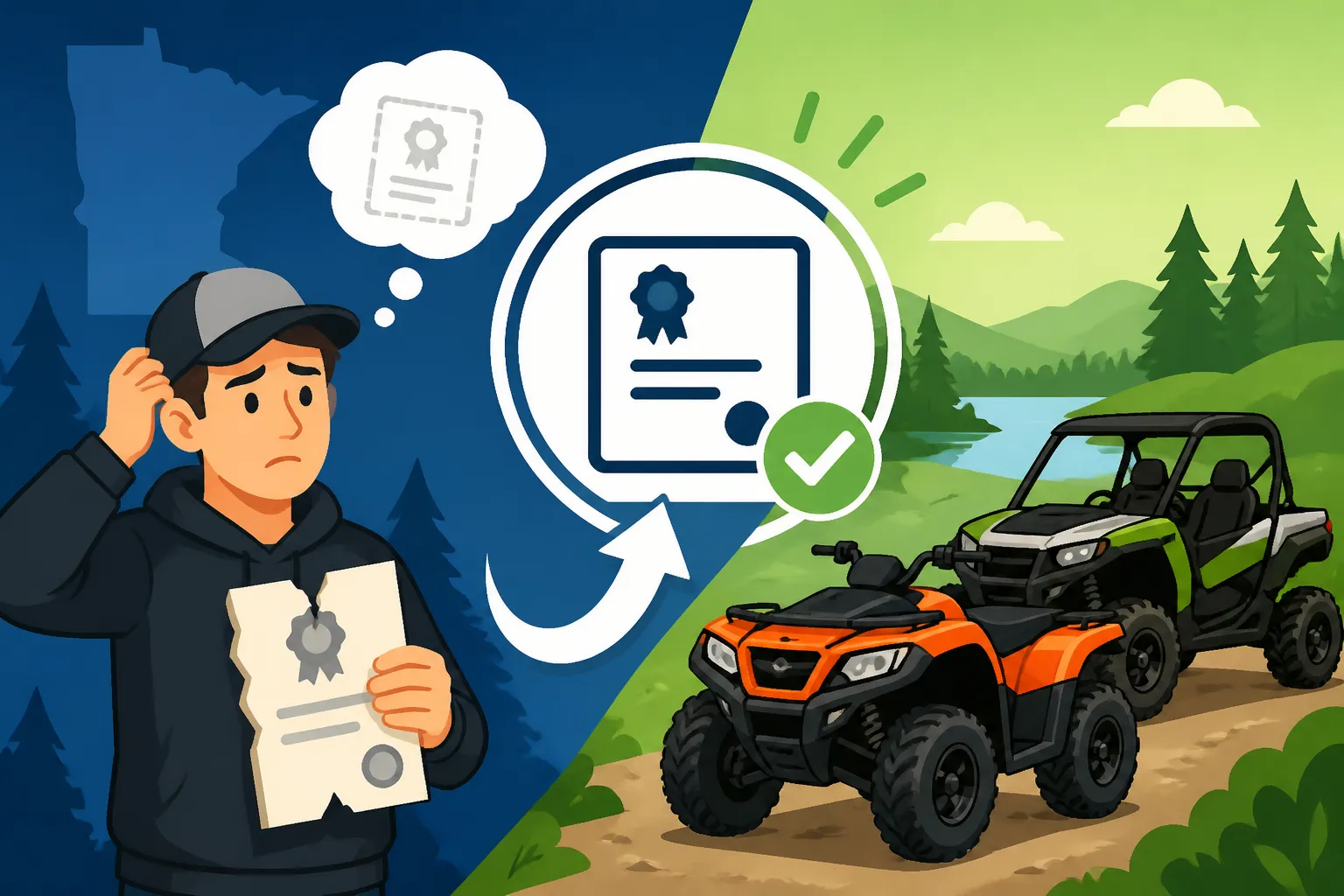
A missing ATV safety certificate can become a problem when you are planning a ride, trying to prove you completed training, or sorting out paperwork for a young rider. In Minnesota, the best first step is usually to trace the course you took and ask the course provider how to retrieve your record. Here’s how to do that and what to check before riding.
First, check whether you need the certificate for your ride
A lost certificate matters most when a rider is required to have completed ATV safety training and needs to show proof. Minnesota’s requirements depend on factors such as the rider’s age, birth date, and where and how the machine is being operated. A missing card does not necessarily mean you need to take the course again, but you should not assume that another document will serve as proof.
Before spending time tracking down a record, identify who needs it and why. Is the rider planning to use a public trail? Is a club, event organizer, or other authority asking to see proof? Is the rider a child who will be operating under Minnesota’s youth rules? The answer helps you determine whether you need a replacement document now and what kind of proof will be useful.
For an overview of who may need training, see Minnesota ATV Safety Training Requirements. The requirements for young riders are also covered in Safety Certification for Riders Twelve and Over and Minnesota Age Rules for Twelve and Sixteen. Rules can differ by situation, so confirm the current requirement with the Minnesota DNR before relying on an old card or an informal description of the rule.
It also helps to distinguish a training certificate from other ATV paperwork. The certificate shows completion of safety training; it is not a registration, trail pass, ownership record, or permit. Replacing it will not resolve a missing registration or pass, and having those documents does not prove that a rider completed training.
| What you need to prove | What to look for |
|---|---|
| Completion of safety training | Course record, certificate, or other proof accepted by the Minnesota DNR |
| Permission to use a machine on a trail | Applicable registration and trail-pass requirements |
| Ownership or registration status | The machine’s registration and ownership documents |
| Eligibility for a particular ride | Current rules for the rider’s age and the location |
A photocopy, phone photo, saved PDF, or course-provider account may help you recover the information, but do not assume every format will be accepted in every situation. Ask the Minnesota DNR or the organization requesting proof whether a digital record is sufficient and whether it must show specific details.
How to find a replacement certificate
Start with the organization that delivered the course. The recovery process can differ depending on whether you completed an online course, attended a classroom or hands-on program, or took training through another state or provider. The course provider may be able to retrieve your completion record, issue a replacement certificate, or explain how to request one.
Search your own records first
Before contacting anyone, look for clues that identify the course and provider. Search email accounts for terms such as “ATV safety,” “certificate,” “course completion,” or the name of the provider, if you remember it. Check spam and archived messages too. If the course was taken online, try any email addresses you might have used to create the account.
Also look through:
- A phone’s downloads folder or saved files
- A computer’s downloads and documents folders
- Cloud storage or backups
- Printed course materials and household files
- Messages from a parent or guardian who helped register the rider
- Old photos or scans of the certificate
A certificate number, completion date, or account login can make a provider’s search much easier. If the rider was a minor when the course was taken, check whether a parent or guardian created the account or used their email address.
Contact the course provider
If you know who delivered the training, use the provider’s official support or records process. Explain that you completed Minnesota ATV safety training and need a replacement certificate or confirmation of completion. Ask whether the provider can send a digital copy, restore access to the original account, or provide instructions for requesting a new document.
Give the provider only the information it needs to locate the record. It may ask for details such as the rider’s full name at the time of the course, date of birth, approximate course date, email used to register, or certificate number. If the rider’s name has changed, mention both the name used during training and the current name.
Avoid sending sensitive personal information through an unverified email address or social media message. Use the provider’s official contact channel, and ask what secure method it recommends if it needs documents to confirm identity.
If you cannot remember the provider, check your email, bank or payment records if available, and any course confirmation saved by the rider or family. If that still does not identify it, contact the Minnesota DNR and ask where to direct a record-search request. The DNR may be able to explain the appropriate next step, but it may not hold or issue every provider’s course records.
Ask what the replacement will show
A replacement should make it possible to identify the rider and verify completion. Check that the spelling of the rider’s name and other identifying information is correct. If the record is incomplete or has a different name than the rider’s current identification, ask the provider how to correct or explain the difference.
Keep the replacement in more than one place. Save the digital file in a secure location, print a copy if useful, and store the provider’s contact details with it. If a ride organizer or officer asks for proof, having a recoverable copy is better than depending on a single paper card that can be lost again.
What to do if the provider cannot find your record
A missing search result does not automatically mean the rider never completed training. Records can be filed under another email address, an earlier spelling of a name, or a parent’s account. If the first search fails, send the provider the most complete set of details you can and ask whether it can search by additional information, such as date of birth or an approximate course date.
If the course provider cannot locate the record, contact the Minnesota DNR for guidance on where to check next. Include a concise explanation of what kind of course you took, roughly when you took it, and whether it was online or in person. Do not send more personal information than requested. If the course was completed outside Minnesota, explain that as well; out-of-state credentials may have different verification steps. See Out-of-State Certificates Minnesota Accepts for related guidance.
Keep a note of who you contacted and when, along with any case or request number the provider gives you. That makes follow-up easier and reduces the chance of repeating the same search. If the certificate is needed for an upcoming event, tell the organizer that you are retrieving the official record and ask what temporary proof, if any, it will accept. Do not treat an informal email or an old photo as accepted proof unless the relevant authority confirms that it is.
If no record can be found, ask the DNR or course provider whether retaking the training is necessary or simply the most practical way to establish proof. Do not pay for or repeat a course based only on a guess. First find out whether the previous completion can be verified, whether a duplicate can be issued, and whether a new course would meet the applicable Minnesota requirement.
A certificate generally documents that training was completed; it is not a permit that is renewed every time a rider registers a machine or buys a trail pass. Still, ask the relevant authority whether your particular course record remains valid and acceptable. For more on that distinction, see Does a Minnesota Certificate Expire?. When you recover the record, keep it with the rider’s essential paperwork rather than with documents that only relate to the machine.
How to avoid another paperwork problem
Once you have replacement proof, make a small record-keeping plan that works for the rider and whoever helps manage the machine. Save the certificate under a clear file name, such as the rider’s name and “ATV safety certificate,” and store it somewhere accessible to the parent or guardian as well as the rider. A printed copy in a home file can be useful, but it should not be the only copy.
Keep training proof separate from the machine’s registration and trail pass. They are different records and may be requested for different reasons. A simple folder—digital or paper—can hold the certificate, machine registration details, trail-pass information, and emergency contacts without suggesting that one document replaces another. For an explanation of pass requirements, see What Minnesota Riders Need Before They Ride.
Before a ride, check what proof the location or organizer expects. If the rider is approaching an age milestone or will be riding somewhere new, review the applicable rules rather than relying on what was required for the last trip. A certificate may settle the training question, but it does not automatically make every route or machine use lawful.
If the rider takes another safety course, keep the new completion record even if the original certificate turns up later. Use the provider’s instructions to preserve both records, and make sure the rider’s name and date of birth are consistent where possible. Keeping the provider’s confirmation email can also help if the paper certificate is misplaced again.
The simplest approach is to recover the course record from its source, verify that the replacement has the correct details, and confirm that the proof meets the requirement for the ride ahead. That avoids unnecessary repeat training and prevents a lost card from being confused with a missing permit or registration.
Disclaimer
This article is for general informational purposes only and does not constitute professional advice. Laws, prices and regulations vary by location and change over time. Consult a qualified professional for guidance on your specific situation.