Reporting a Blocked Club Trail
A blocked Minnesota club trail can mean anything from a fallen tree to a seasonal closure or a damaged crossing. The right response depends on what you find: check whether the route is officially closed, report the location to the trail maintainer or land manager, and avoid moving barriers or riding around them. A clear, safe report helps crews respond without creating more trail damage.
First confirm what is blocking the trail
A trail that appears blocked is not always a trail that needs to be cleared. A downed tree, washout or damaged bridge may be an unexpected obstruction, but a gate, sign or barricade may mark a deliberate closure. Treat any posted closure or physical barrier as intentional unless the responsible agency or club confirms otherwise.
Minnesota’s Grant-in-Aid trail system involves local clubs and public land managers. The group that maintains a route may not be the same entity that owns the land or decides when the route is open. Learn more about Minnesota’s Grant-in-Aid Trail System and Grant-in-Aid Trails and Who Maintains Them before assuming that a club can authorize access or remove a closure.
Before reporting a blockage, consider whether the trail may be closed for a reason such as wet conditions, spring thaw, fire danger, construction, maintenance or resource protection. Trail status can change, so check current notices from the managing agency or club. Where Minnesota Closure Notices Are Posted and Checking Minnesota Trail Status Before You Drive can help you identify where to look.
Common situations include:
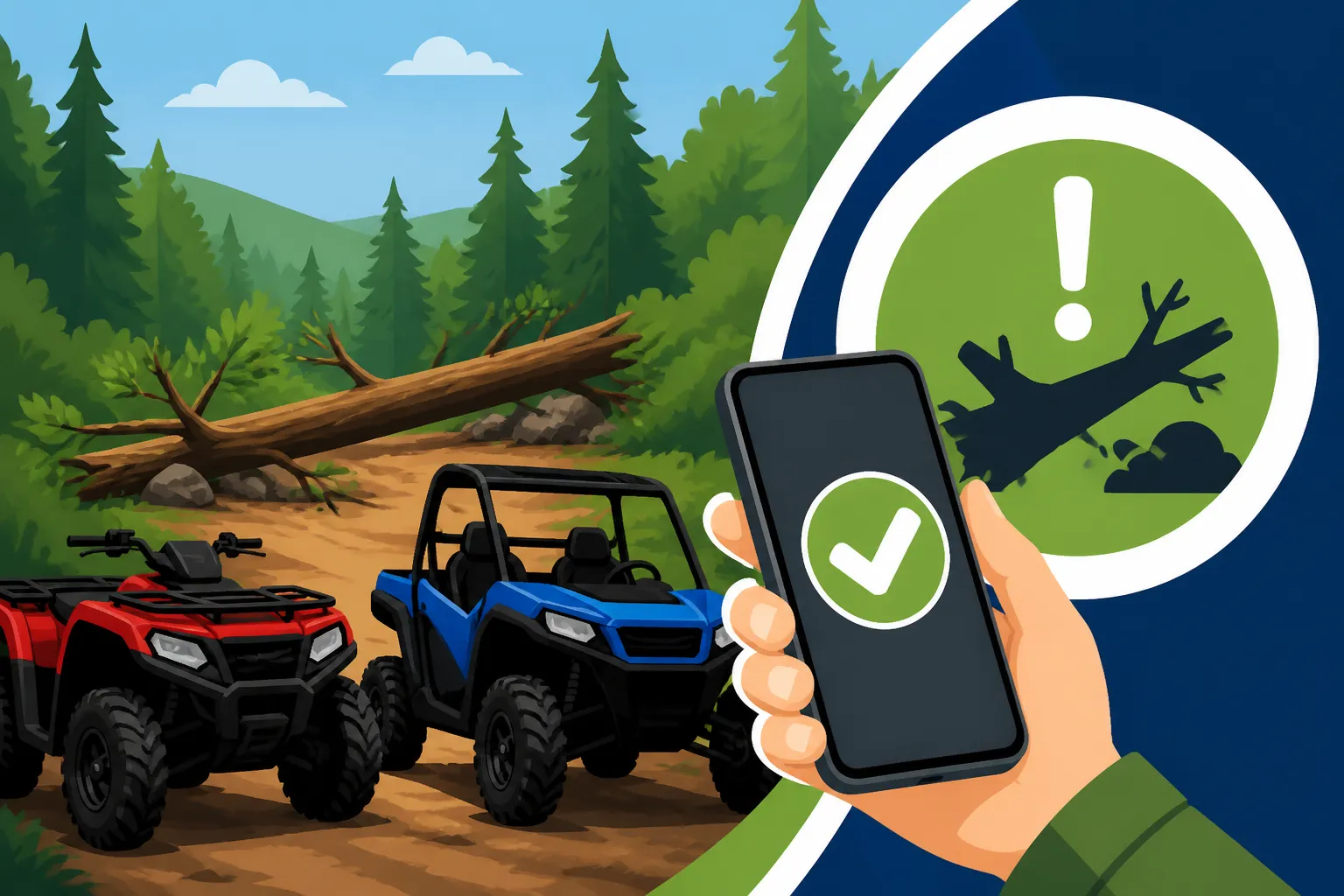
- A fallen tree or branches: This may be a maintenance issue, but don’t assume it is safe to cut or move the obstruction yourself.
- A washout, flooded section or damaged culvert: The route may be unsafe or vulnerable to additional damage, even if riders can get through.
- A gate or barricade with a sign: It may indicate a closure, permitted work or a boundary. Don’t go around it.
- A trail that disappears or becomes impassable: The route may be unmarked, temporarily closed or damaged. Don’t create a new route to get past the problem.
- A blockage caused by another person: Report what you observed without confronting the person or disturbing the site.
A helpful distinction is whether the obstacle is an unexpected hazard or an apparent restriction:
| What you find | Best first step | What to avoid |
|---|---|---|
| Fallen tree or other unexpected obstacle | Note the location and report it to the club or land manager | Cutting, dragging or driving around it |
| Washout, soft ground or damaged crossing | Report the damage and describe the risk | Riding through or widening the damaged area |
| Posted closure, gate or barricade | Follow the closure and check the managing agency’s notice | Moving the barrier or entering from another access point |
| Unclear trail status | Check official updates or contact the responsible organization | Assuming the route is open because other tracks are visible |
| Immediate danger to a person | Contact emergency services if the situation warrants it | Putting yourself at risk to investigate or assist |
If the trail is clearly closed, you can still report an issue with the closure sign or barrier if it appears damaged, missing or difficult to see. Report the condition, not a request to bypass the closure.
Report it to the right organization
For an unexpected blockage on a club trail, start with the club that maintains the route when you can identify it. Club members often know which trail segment they are responsible for and can pass maintenance concerns to the appropriate land manager. Minnesota ATV Clubs and the Trails They Keep explains why clubs are often the practical first contact for trail conditions and upkeep.
If the club is not identifiable, the trail crosses public land, or the problem involves a closure or land-use concern, contact the agency responsible for managing that land. The responsible organization may be a state, county or federal land manager. Check signs at the trailhead, posted notices, official trail information or the land manager’s contact directory. For a state-managed OHV trail, Minnesota DNR OHV Contacts is a useful starting point.
A few details can help you choose where to send the report:
- Routine maintenance issue: Contact the club or trail-maintenance organization listed for that route.
- Public-land access, closure or safety concern: Contact the land manager responsible for the trail.
- Possible illegal activity or intentional damage: Report the facts to the appropriate land manager or enforcement authority. Don’t investigate or confront anyone.
- Urgent danger: Use emergency services when there is an immediate threat to someone’s safety. A routine maintenance report is not a substitute for emergency response.
If you are uncertain, send the report to the organization responsible for the land and ask whether it should be forwarded to a club or another office. Keep the description neutral. For example, “A large tree is across the trail near the north entrance” is more useful than guessing who put it there or why.
For concerns about trail damage, Reporting Trail Damage in Minnesota offers related guidance. If a situation appears to involve an enforcement issue rather than a simple obstruction, Conservation Officer Enforcement in Minnesota can help you understand the role of enforcement, but a conservation officer is not necessarily the crew that will clear a trail.
What to include in a useful report
A report is more likely to help if someone can find the blockage without guessing. Give the most precise location you can, then describe what is there and whether you observed a specific safety risk. You do not need to approach a hazard or travel farther into a closed area to collect details.
Include:
- Trail and area name. Use the name shown on a map, sign or official trail information. If you don’t know it, describe the nearest trailhead or access point.
- Location. Share a GPS pin or coordinates if available. You can also give the nearest intersection, mile marker, bridge, sign or other recognizable feature.
- What is blocking the route. Describe the obstacle plainly: for example, a fallen tree, standing water, washed-out trail edge, damaged crossing, locked gate or posted closure.
- Extent of the problem. Say whether it fully blocks passage, narrows the route, affects one direction or makes the section appear unsafe.
- When you saw it. Include the date and approximate time so the recipient can judge how current the information is.
- Photos, if safe. A picture of the obstacle and a separate picture of a nearby trail marker can make the location easier to identify. Don’t step into traffic, unstable ground or a hazardous area to get one.
- A way to follow up, if you choose. You may provide contact details in case the club or agency needs clarification.
A map pin is useful, but don’t rely on it alone. Phone location can be imprecise in wooded areas, and different mapping apps may label the same route differently. Pair coordinates with a nearby sign or landmark. If you are unsure how to identify the route, Trail Signs and Markers in a State Forest may help you describe what you see.
Keep the report factual and concise. Say what you observed rather than inferring the cause. For example, describe a muddy rut or a missing sign without claiming who caused it. If you believe a barrier was intentionally moved or damage was deliberate, explain what you personally saw and let the responsible authority assess it.
You can use this simple outline when contacting a club or agency:
- Trail or area:
- Nearest access point or landmark:
- Location pin or coordinates:
- What is blocking or damaging the trail:
- Whether the route appears passable or unsafe:
- Date and time observed:
- Photos available:
Don’t post exact access details publicly if doing so could draw more riders to a closed or damaged section. Send the location directly to the responsible organization.
What to do while you’re there
The safest response is usually to stop, avoid disturbing the site and turn back by a legal route. Don’t move a gate, sign, barricade or other closure marker, even if it looks temporary. Don’t create a bypass through brush, wet ground or private property. A short detour made by riders can become a wider unauthorized route, damage vegetation or create a new safety problem.
If the obstruction is a fallen tree, cutting it may seem straightforward, but trail crews may need to assess the site first. A tree can be under tension, tangled with overhead branches or blocking access to a damaged section. Cutting, winching or dragging it can cause injury or make the trail harder to repair. Leave equipment work to people authorized and equipped to do it.
If you encounter standing water, a washout or a failing bridge, don’t test it with your machine. A section that looks passable from the trail may have a weak edge or hidden damage. Turning around is usually safer than risking a rollover, getting stuck or worsening the break. Minnesota Trails Close for Thaw and Minnesota Trail Conditions After a Wet Spring explain why vulnerable trail surfaces may need protection when conditions are poor.
If another rider is already trying to pass the blockage, keep a safe distance and don’t join in. If you can do so without putting yourself at risk, calmly point out the closure or damage and explain that you are reporting it. Avoid arguments, threats or attempts to physically stop someone. If there is an immediate danger, contact emergency services; for non-emergency concerns, report the facts to the responsible agency.
When you turn around, use the established trail rather than making a new track. If you cannot safely reverse direction or reach a known route, stop in a safe place and seek help. Don’t continue through a closed section just because the blockage is behind you or the route looks open beyond it.
After you submit the report
A report does not mean the trail will be cleared right away. The responsible organization may need to confirm the location, check whether the route is officially open, assess the damage, arrange equipment or wait for conditions to improve. A closure may remain in place even after a specific obstacle is addressed.
If the trail remains blocked on a later ride, check for an official update before sending another report. If the issue has changed or become more dangerous, send a new note with the updated conditions and location. Avoid repeatedly contacting multiple organizations with conflicting descriptions; when possible, ask the first contact whether the report has been forwarded.
Before your next trip, check current trail status rather than relying on an older report or another rider’s post. For planning and navigation, Reading a Minnesota OHV Trail Map can help you identify official routes and access points. Stay on the signed trail, obey closures and use a designated alternate route only when the responsible agency confirms it is open.
Reporting a blocked club trail is most useful when it is safe, specific and sent to the group responsible for the route. A precise location and neutral description give trail crews a practical starting point, while leaving barriers and damaged areas untouched helps prevent further harm.
Disclaimer
This article is for general informational purposes only and does not constitute professional advice. Laws, prices and regulations vary by location and change over time. Consult a qualified professional for guidance on your specific situation.