Minnesota Helmet Requirements Under 18
Minnesota Helmet Requirements Under 18
A young rider may need more than a helmet to ride legally in Minnesota, and the helmet rule depends partly on where the machine is being used. The key point is that riders under 18 generally must wear protective headgear on public riding areas and road rights-of-way. Here’s how to understand that requirement, choose a suitable helmet, and keep helmet rules separate from permits, training and road-riding rules.
Who Must Wear a Helmet Under Minnesota’s Rule
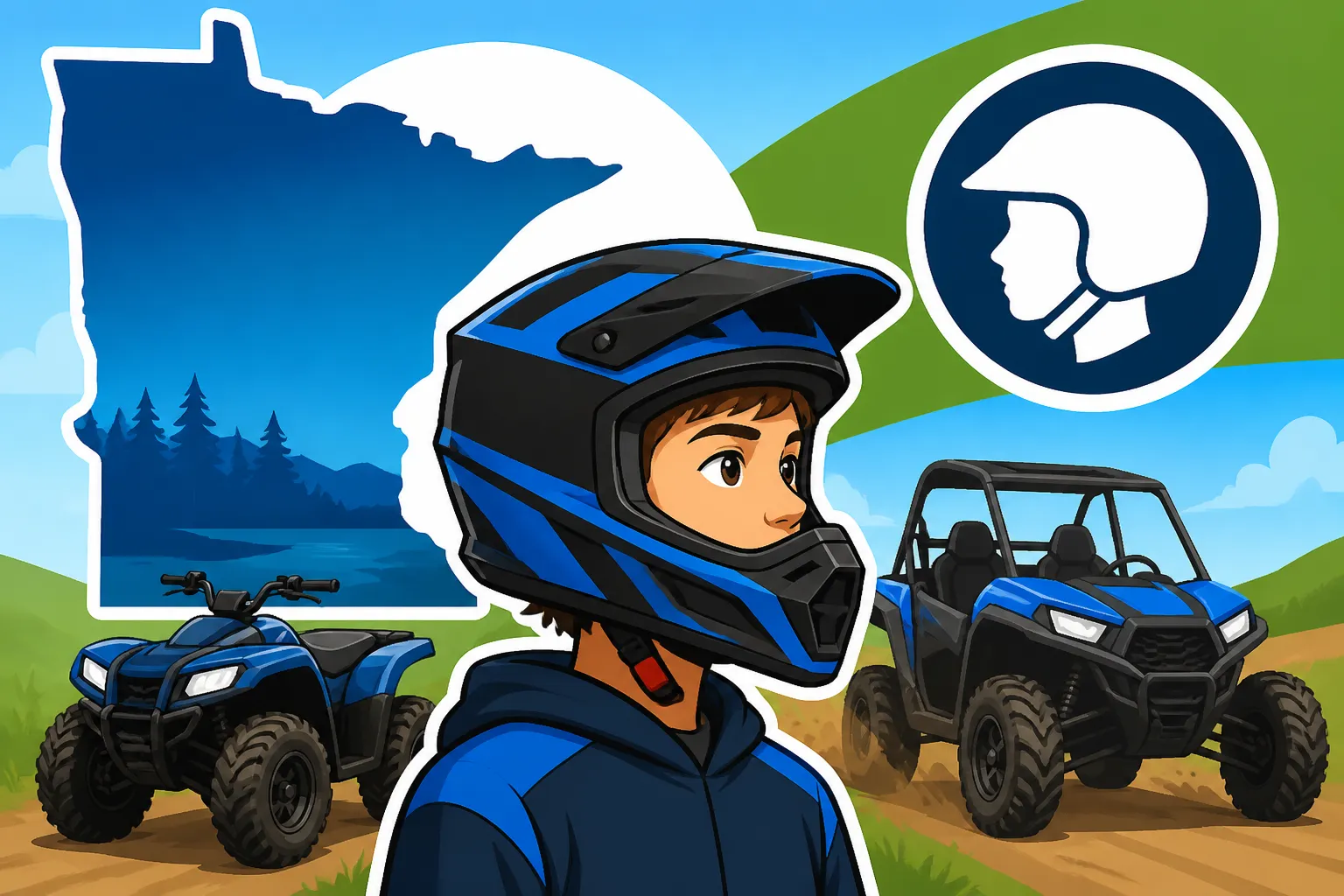
In Minnesota, ATV operators and passengers under 18 must wear protective headgear when riding on public lands or waters, or on a public road right-of-way. That includes young people riding as passengers, not just the person driving. A passenger’s age matters even when an adult is operating the machine.
The rule applies to ATVs as defined under Minnesota law. That category includes many quads and side-by-sides, but not every off-road vehicle is legally classified the same way. If you are unsure how a particular machine is classified, check its registration information and the current Minnesota DNR rules rather than assuming that a familiar nickname, such as “UTV,” settles the question.
For the helmet itself, use a helmet that meets the applicable Department of Transportation standard. A fashion helmet, bicycle helmet or unverified novelty helmet is not a safe substitute. A helmet with the required DOT marking is a useful starting point, but it still needs to fit properly and be in sound condition.
The age threshold is straightforward: the rule applies to riders who have not yet turned 18. Turning 16 does not, by itself, remove the helmet requirement for a 16- or 17-year-old riding in a place covered by the rule. A supervising adult’s helmet use also does not change the young rider’s obligation.
| Rider or situation | Helmet rule to plan for |
|---|---|
| Operator under 18 on public land or water | Wear a helmet that meets the applicable DOT standard |
| Passenger under 18 on public land or water | Wear a helmet that meets the applicable DOT standard |
| Rider under 18 on a public road right-of-way | Wear a helmet that meets the applicable DOT standard |
| Rider under 18 on private property | The public-area rule may not apply, but wearing a helmet remains the safer choice; confirm any landowner or event rules |
| Rider who has turned 18 | The under-18 requirement no longer applies, but other site or event rules may still require a helmet |
The table is a practical summary, not a substitute for checking rules that apply to a specific trail, event or property. A trail operator or landowner may set conditions beyond the statewide baseline. For more about the broader age-related helmet rules, see Minnesota Helmet Standards and Who Must Wear One. For the passenger-specific issue, [Minnesota Helmet Rules for a Passenger Under 18] may help clarify what to check before a group ride.
Where the Requirement Applies
The rule is tied to the place of operation. Public riding areas and public road rights-of-way are the main settings to keep in mind. A designated trail, public forest riding area, or roadside ditch may be subject to rules that do not apply in the same way on a privately owned yard or field. The distinction can be less obvious than it sounds: a route that looks like open ground may still be a public right-of-way or part of a public riding area.
When a route crosses from private ground onto a public trail or road right-of-way, a young rider should have a compliant helmet on before entering the public area. Do not rely on a plan to put it on later once the trail is underway. A single ride can cross different types of land, and the rule may apply as soon as the machine enters a covered place.
Public trails and riding areas
For a public trail ride, the simplest approach is to have every rider under 18 wear a properly fitted DOT-compliant helmet throughout the ride. That avoids uncertainty about the boundaries of public land and makes it easier for a parent or trip leader to check everyone before moving out.
Helmet rules do not establish that a trail is open to riding or that the machine is permitted there. Riders still need to follow the trail’s access requirements, registration and pass rules, and any posted restrictions. A helmet is one part of legal preparation, not a replacement for it. If the ride includes state forest or grant-in-aid trails, review Minnesota Trail Pass Rules at a State Forest and Which Minnesota Trails Require a Pass to understand the separate access requirements.
Trail access and helmet requirements can also differ by vehicle type. A machine described casually as a side-by-side may be treated under a different set of rules than a quad, depending on its legal classification. Confirm the machine’s category before applying ATV rules to it.
Road rights-of-way and ditch riding
A public road right-of-way is not the same as the paved road surface. Minnesota’s rules for riding beside or crossing roads are separate from the helmet requirement. Under-18 riders must still wear the required helmet in a covered right-of-way, even if the route is a legal ditch ride or a permitted crossing.
Do not treat the helmet rule as permission to ride along a road. Whether an ATV may use a particular right-of-way depends on additional restrictions, including road type, local rules, rider qualifications and machine requirements. See Minnesota’s Ditch Riding Rules and Crossing a Minnesota Road on an ATV before planning a route that uses roads or roadside ditches.
Private land and mixed routes
The statewide helmet requirement described here focuses on public land, public waters and public road rights-of-way. That does not make helmet-free riding on private property a good idea. A landowner, club, organized event or insurance policy may have its own requirements. A private trail may also connect to public land, making a helmet necessary for at least part of the trip.
If a rider’s route changes, make the helmet decision based on the most restrictive part of the ride. For a child who will travel between a private field and a public trail, wearing the helmet for the whole outing is the sensible option. It prevents a brief public section from becoming a missed-rule problem and avoids taking the helmet on and off around dust, branches or traffic.
Choosing and Fitting a Helmet
A compliant helmet only helps if it fits and stays in place. Children and teenagers can outgrow helmets, and a helmet that fit well last season may now shift or pinch. Check fit before each season and after a rider has grown noticeably.
Look for a helmet intended for motorized riding and carrying the appropriate DOT compliance marking. Motorcycle helmets are commonly marked to indicate that they meet the applicable federal standard. Avoid relying only on a product title or a seller’s description. A label saying “racing style,” “ATV style” or “motorcycle look” does not establish that the helmet meets the standard.
If shopping through a marketplace such as Amazon, examine the actual helmet and its labeling rather than taking a listing headline as proof of compliance. Check that the item is sold as a compliant helmet, inspect the manufacturer’s information, and make sure the return option will allow a fit check. For a young rider, trying a helmet on in person can be especially useful.
A practical fit check
A helmet should feel snug all around, without painful pressure points. When the rider moves their head, the helmet should move with it rather than sliding freely. The chin strap should fasten securely and hold the helmet in place. Follow the manufacturer’s instructions for fitting and strap adjustment, since helmet shapes and fastening systems vary.
Check that the helmet does not block the rider’s vision or make it difficult to hear nearby machines and instructions. A young rider should be able to wear the helmet comfortably for the length of the planned ride, while still keeping the strap fastened. If the helmet is loose, excessively tight or unstable, try another size or model rather than relying on a thick cap or improvised padding to make it fit.
A helmet that has taken a significant impact should be assessed according to its manufacturer’s replacement guidance. Damage may not always be obvious from the outside. Cracks, broken parts, worn straps or a poor fit are reasons not to use it. Do not buy a used helmet if you cannot verify its history and condition.
Helmet style, eye protection and weather
Full-face and open-face helmets can both be appropriate choices when they meet the required standard and fit properly. A full-face model offers more coverage around the face and chin. An open-face model leaves more of the face exposed, so riders typically need suitable eye protection to guard against dust, insects and debris. The right style depends on fit, comfort and the rider’s needs, but appearance should not be the deciding factor.
Goggles or other suitable eye protection are particularly useful on dusty trails or when riding behind another machine. Eye protection and helmets are separate considerations: goggles do not make a noncompliant helmet acceptable, and a helmet does not necessarily protect the eyes.
Cold weather can make a helmet uncomfortable, but bulky clothing should not interfere with the fit or fastening system. Choose layers that work with the helmet, and check that the chin strap remains secure. In warm weather, take breaks and encourage the rider to drink water. Removing the helmet while stopped in a safe place is different from riding without it in a place where the rule applies.
Helmets Are Only One Part of Youth Riding Rules
Parents sometimes focus on helmets because they are visible and easy to check. But a helmet does not satisfy the other requirements that may apply to a young operator. Before a ride, confirm the rider’s age-related operating rules, training or safety certification requirements, supervision requirements, machine suitability and route access.
Minnesota’s age and training rules can depend on the rider’s age and where the ATV is being used. A rider may need to meet training requirements even when wearing a compliant helmet. Similarly, an adult’s presence does not automatically make every route or riding situation lawful. Review Minnesota ATV Safety Training Requirements and Minnesota Age Rules at Twelve and Sixteen when planning for a young operator.
Operator and passenger rules are different questions
A helmet requirement can apply to both an operator and a passenger under 18, but that does not mean a child is allowed to operate or ride as a passenger on every machine. Passenger rules may depend on the machine’s seating, its design and the place of operation. A side-by-side with a passenger seat and restraints presents a different setup from a one-seat quad.
Never carry a passenger on a machine that is not designed to carry one. Do not assume that adding a helmet makes a passenger arrangement safe or lawful. Check the machine’s owner information and applicable riding rules, and make sure the passenger can sit securely and reach the required restraints or handholds.
For side-by-sides, seat belts or nets may be required or strongly advised depending on the machine and setting. A helmet does not replace a belt or cab restraint. Conversely, a belt does not remove the under-18 helmet requirement in a covered riding area.
Training, certification and trail access
Training and certification requirements are separate from helmet standards. A youth rider can be wearing the correct helmet and still be missing a required certificate or permit. Before traveling, check whether a trail pass is needed for the machine and location, whether the rider must carry evidence of training, and whether the route has age or supervision limits.
These requirements can vary with the machine, where it is registered, and whether it is being used on public trails, private land or a road right-of-way. A visiting rider should not assume that a permit or certificate from another state automatically settles every Minnesota requirement. Minnesota Rules for Visiting Riders offers a related starting point for out-of-state visitors.
Adult supervision and route planning
A responsible adult should set clear boundaries before the ride: where the group will go, where it will stop, how riders will communicate, and what to do if someone becomes separated. Keep the route within the young rider’s ability and the machine’s intended use. A novice rider can be overwhelmed by traffic, deep mud, rough terrain or a group moving at an adult pace.
If the ride includes a road crossing or a section of right-of-way, explain the plan before arriving there. The rider should know to slow down, remain in control and follow the crossing rules. A helmet can reduce some injury risk, but it cannot compensate for poor visibility, excessive speed or an unsafe route.
A Pre-Ride Helmet and Compliance Check
A short check before departure can catch common problems. Make it part of the same routine as checking fuel, tires and the machine’s restraints.
- Confirm the rider’s age and route. If the rider is under 18 and will use public land, public waters or a public road right-of-way, plan on a helmet that meets the applicable DOT standard.
- Check the helmet’s marking and condition. Look for the compliance marking and examine the shell, liner, strap and fastening parts. Do not use a helmet with damage or an unknown crash history.
- Check fit and fastening. Make sure the helmet is snug, stable and fastened according to its instructions. Recheck the fit if the rider has grown since the last outing.
- Add suitable eye protection. Use goggles or other appropriate protection where dust, wind or debris could affect the rider’s vision.
- Check the machine and passenger setup. Confirm that the machine is suitable for its riders, that passengers have proper seating and restraints, and that the machine is not carrying someone in an unsafe position.
- Verify separate riding requirements. Check applicable registration, trail-pass, training, supervision and route rules. A helmet does not take the place of any of these.
- Agree on what happens if the helmet becomes loose or damaged. Stop in a safe place and fix the problem before riding again. Do not continue on a public trail or right-of-way with a young rider wearing a helmet that is no longer secure.
For families with several machines, check each rider’s helmet against the machine and trip plan. A helmet that fits one child may not fit another, and a helmet left in a trailer may not be the right size for the person who needs it. Pack the helmet where it can be inspected and worn before the machine enters a covered area.
If a local event, club or private landowner has a stricter helmet rule, follow the stricter rule. When there is uncertainty about a route boundary, a vehicle’s classification or a specific requirement, confirm it with the appropriate land manager or Minnesota DNR before riding. Rules can depend on details that are easy to miss from a map or a general description of the machine.
Frequently Asked Questions
Does a 17-year-old need a helmet on a Minnesota ATV trail?
Yes, plan on a compliant helmet. Riders under 18 must wear protective headgear when operating or riding as a passenger on public land or water, or on a public road right-of-way.
Does a passenger under 18 need a helmet if the driver is an adult?
Yes. The passenger’s age matters. An adult operator does not exempt a rider under 18 from the helmet requirement in a covered area.
Is a helmet required on private land?
The statewide rule discussed here applies to public lands or waters and public road rights-of-way. Private land may have separate landowner, event or insurance conditions. Wearing a helmet is still the safer choice.
Does a helmet replace an ATV safety certificate or trail pass?
No. Helmet use, training or certification, registration and trail-pass requirements are separate. Check each requirement that applies to the rider, machine and route.
Disclaimer
This article is for general informational purposes only and does not constitute professional advice. Laws, prices and regulations vary by location and change over time. Consult a qualified professional for guidance on your specific situation.