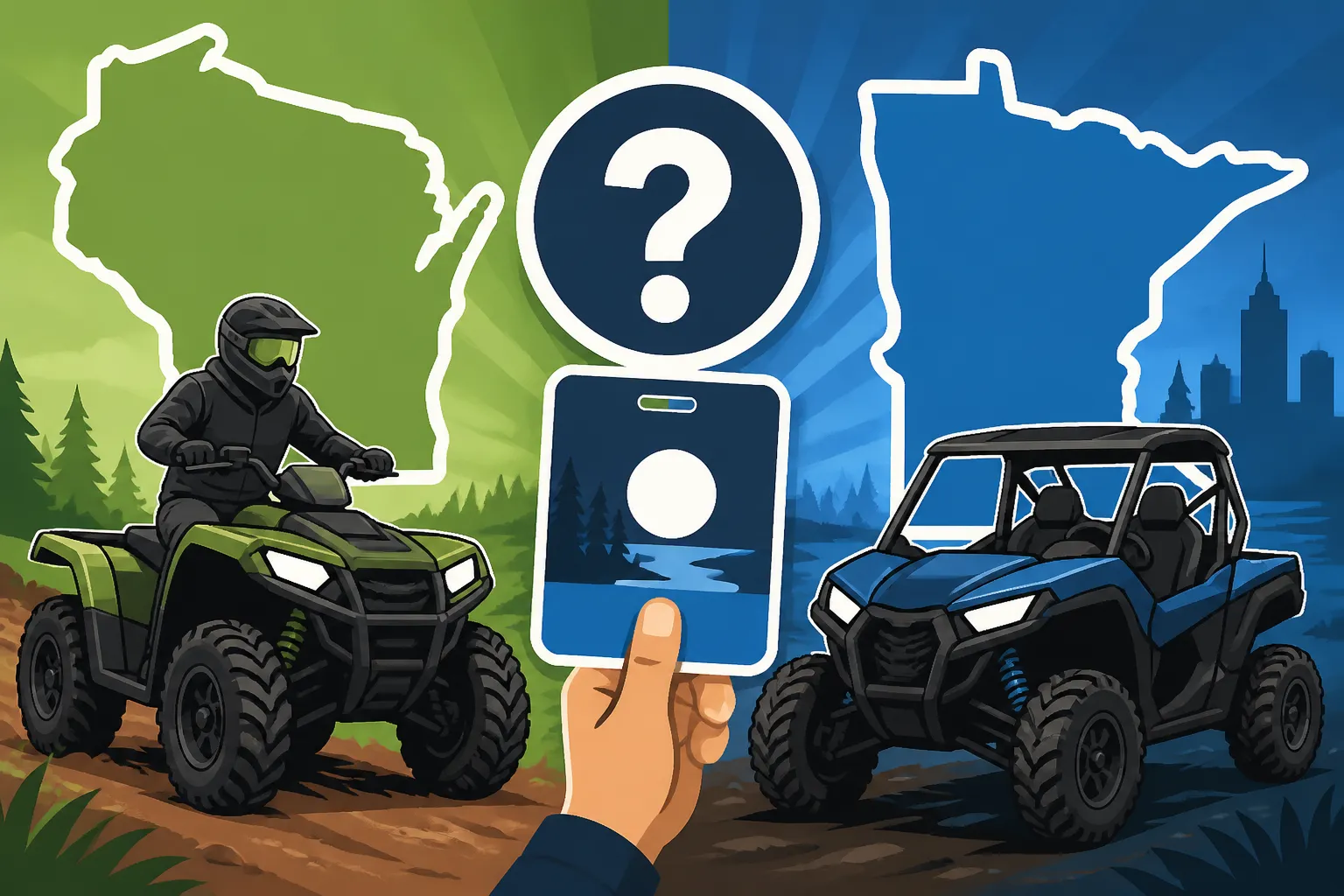
Do Wisconsin Riders Need a Minnesota Pass?
Wisconsin riders planning a Minnesota trail day may assume their home-state registration covers every requirement across the border. It may not. The key question is where you plan to ride and how Minnesota classifies your machine. Here’s how to tell when a Minnesota trail pass is generally needed, what it does not replace, and what to check before you leave.
When Wisconsin riders generally need a Minnesota pass
A Wisconsin registration does not automatically serve as a Minnesota trail pass. If you bring a Wisconsin-registered ATV to ride Minnesota’s public ATV trails, plan on needing Minnesota’s nonresident ATV trail pass unless a specific exemption applies. This can include designated trails maintained through Minnesota’s Grant-in-Aid system, as well as other public trails where a pass is required.
The pass and your Wisconsin registration do different jobs. Your home-state registration identifies the machine under Wisconsin’s system. The Minnesota nonresident pass is a separate requirement for eligible out-of-state machines using Minnesota trails. Having one does not necessarily satisfy the other.
Minnesota’s requirements depend on the trail and the machine, so do not treat “public land” as a single category. A trail in a state forest, a club-maintained Grant-in-Aid trail, a public road right-of-way, and a route across private property can have different rules. For more on the types of trails covered, see Which Minnesota Trails Require a Pass and Grant-in-Aid Trails and the Trail Pass.
A quick way to think about the most common situations:
| Where and how you ride | Is a Minnesota nonresident ATV trail pass generally needed? | What else to check |
|---|---|---|
| Wisconsin-registered ATV on a Minnesota public ATV trail | Generally, yes | Trail access, machine registration and any rider requirements |
| ATV on private land with the owner’s permission | A public-trail pass is generally not the issue | Permission, property rules and any applicable safety or operating rules |
| ATV on a public road or right-of-way | A trail pass does not make the ride legal | Whether that road section is open to ATVs and what road rules apply |
| Machine registered in Minnesota | The nonresident pass generally does not apply in the same way | Whether the Minnesota registration and machine category suit the route |
| Side-by-side or other machine whose Minnesota category is unclear | Confirm before riding | The machine’s classification, registration and the trail’s allowed vehicle types |
The words “generally” and “confirm” matter. A route can pass through areas with different access rules, and some vehicle categories have requirements separate from the ATV trail pass. Check the rules for your particular route and machine rather than relying on a pass requirement you heard about for a different trail.
Minnesota does not simply treat every out-of-state registration as interchangeable with its own trail-access requirements. The broader issue is covered in Reciprocity Minnesota Does Not Offer. If you are visiting with a Wisconsin machine, read the nonresident-specific information in Minnesota’s Non-Resident ATV Trail Pass and Minnesota Rules for Visiting Riders before setting out.
Check your machine’s category and registration
“ATV” is often used casually to mean any four-wheeled off-road machine. Minnesota’s requirements are based on the machine’s legal classification, not just what the owner calls it. A traditional quad, a side-by-side, and a larger off-road vehicle may not all be treated the same way for registration, trail access, or pass purposes.
This matters especially for side-by-sides. Some machines commonly called UTVs may fall within Minnesota’s ATV framework, while others may be classified differently. Do not assume a rule for one kind of ATV automatically covers every UTV. Check the machine’s documentation and the applicable Minnesota definition, then make sure the trail is open to that vehicle type. The overview in Minnesota ATV Classes and What They Mean can help you identify why classification matters.
Before your trip, gather the details that make it easier to check the rules:
- The make, model, year and vehicle identification number.
- The registration status and registration documents from Wisconsin.
- The machine’s width and other specifications that may affect its Minnesota classification.
- The name or map of the trail system you plan to ride.
- Any Minnesota pass or registration information you have already obtained.
If you are unsure which category applies, ask the Minnesota agency or pass seller about the specific machine. A broad question such as “Do UTVs need a pass?” can lead to an incomplete answer because vehicle designs and categories vary. Give the make and model, explain where you intend to ride, and ask what registration and pass requirements apply to that machine on that route.
Also keep the vehicle’s Wisconsin registration current and carry its documentation as required. A Minnesota trail pass does not replace registration, prove ownership, or fix a registration problem in your home state. Similarly, a Wisconsin registration does not necessarily eliminate Minnesota’s trail-pass requirement. The two checks should be treated separately.
There is a different situation when a machine is registered in Minnesota rather than Wisconsin. Minnesota’s resident registration system and its nonresident pass system are not identical; see Machines Registered in Minnesota and the Pass for that distinction. If you recently moved, bought a machine in another state, or are considering changing its registration, check the rules for that situation rather than assuming that buying a pass settles every registration question.
Where the pass applies, and what it does not do
A trail pass is permission tied to the applicable trail-pass rules. It is not a general permit to operate anywhere in Minnesota. Even when you have the correct pass, you still need to use a route open to your type of machine and follow signs, closures and local restrictions.
A pass does not, by itself:
- Make an ATV legal on a road or road right-of-way that is closed to it.
- Give permission to cross private land.
- Override a trail closure, seasonal restriction or posted vehicle limit.
- Replace Wisconsin registration or any other required vehicle paperwork.
- Satisfy rider age, training, helmet or other safety requirements.
- Guarantee that a route is suitable for your machine’s size or equipment.
This distinction can prevent a common planning mistake: finding a trail on a map and assuming that a valid pass makes the entire route available. A mapped trail may have connections, road crossings, private-land sections or vehicle restrictions that require separate attention. Check the current trail map and local notices, and follow posted instructions when you arrive.
Private land needs a separate answer from public trails. If you are riding solely on private property with the owner’s permission, a public-trail pass requirement may not apply in the same way. But that does not mean every other rule disappears. Permission must cover the route you use, and local requirements or rules for the machine and rider may still matter. A route that begins on private property and continues onto a public trail can trigger the public-trail requirements once you enter that trail.
Road riding is separate as well. A trail pass does not open a public road to ATV use. Minnesota has rules for where ATVs may operate on road rights-of-way and how riders must travel where use is allowed. Confirm every road connection on your planned route; do not assume a short paved stretch or roadside ditch is automatically open. If road riding is part of the trip, review Riding an ATV on the Road in Minnesota before you go.
For a Wisconsin visitor, the practical rule is to consider each part of the ride independently:
- Identify whether the route is a public ATV trail, another type of public route, private land or a road right-of-way.
- Confirm the machine is allowed on that type of route.
- Check whether a Minnesota nonresident trail pass applies to that machine and route.
- Separately confirm registration, rider and safety requirements.
- Review closures and local signs on the day of the ride.
This approach is more reliable than deciding based only on the trailhead’s location or the fact that the machine is registered in Wisconsin.
Get the pass and prepare before leaving Wisconsin
Once you confirm that your machine and route require a Minnesota nonresident ATV trail pass, use an authorized Minnesota sales channel and follow the current instructions for purchase and display. Pass options, instructions and locations can change, so check the Minnesota DNR’s current guidance rather than relying on an old receipt, an expired pass, or information from a previous trip.
Visitors may be able to buy through Minnesota’s online licensing system or through participating license agents. The details are covered in Buying a Minnesota Trail Pass Online and Where Visitors Buy a Minnesota Pass. Check that the selection matches your machine and your intended use. If the machine is a side-by-side or another less straightforward category, resolve that question before purchasing rather than guessing at the pass type.
After purchase, read the instructions about how to display the pass and whether you need to carry proof of purchase. Keep the confirmation accessible, and make sure the pass is attached in the required place if the instructions call for a decal. A pass left in a truck or stored with trip paperwork may not meet display requirements. See Carrying the Pass While You Ride for practical guidance on keeping proof available.
Use this pre-trip checklist:
- Confirm the classification. Verify whether Minnesota treats your quad or side-by-side as an ATV for the route you chose.
- Check Wisconsin registration. Make sure the machine’s home-state paperwork is current and available.
- Review the trail rules. Confirm the route is open to your machine, including any connecting sections.
- Buy the correct pass if required. Use current official instructions and check the pass category.
- Follow display and proof instructions. Do not assume an electronic receipt alone is enough if a decal or other display is required.
- Check rider requirements. Pass rules are not the same as age, training, helmet or equipment rules.
- Recheck conditions. Closures, access restrictions and trail conditions can change, so check again before loading up.
If your trip includes more than one machine, check each one. A pass for one vehicle should not be assumed to cover another, and a passenger’s presence does not resolve the operator’s pass or registration requirements. Likewise, a pass bought for an ATV should not be assumed to cover a different vehicle category.
A little preparation helps avoid a frustrating arrival at the trailhead. The essential takeaway is straightforward: Wisconsin registration alone may not be enough for a Wisconsin ATV on a Minnesota public trail. Confirm the machine’s Minnesota classification, check the specific route, and obtain the applicable nonresident pass before riding where it is required.
Disclaimer
This article is for general informational purposes only and does not constitute professional advice. Laws, prices and regulations vary by location and change over time. Consult a qualified professional for guidance on your specific situation.