Passes for Farm Work Machines
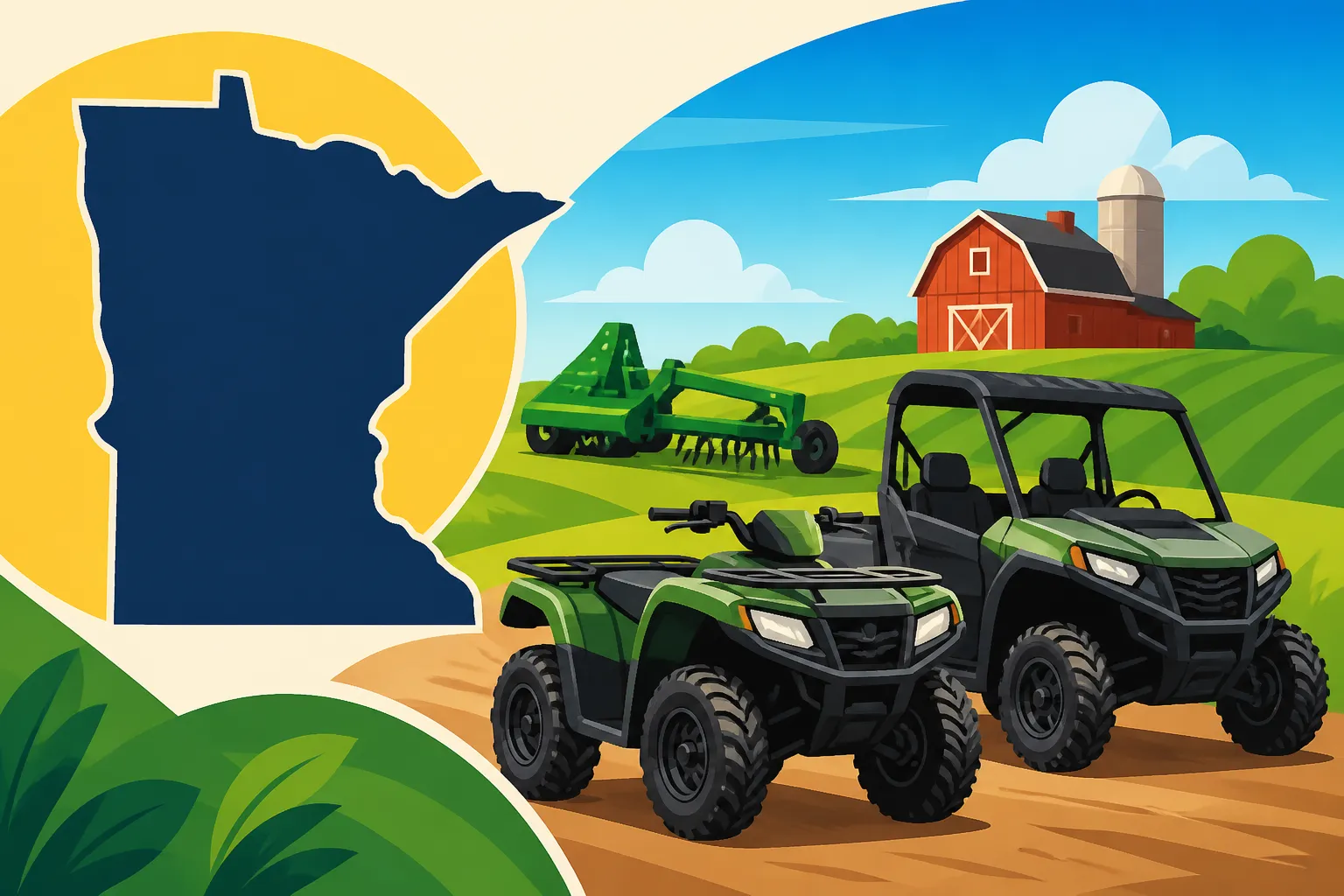
Farm use can change what paperwork a Minnesota ATV needs, but it does not automatically give a machine access to public trails. The key questions are where you ride, whether the machine is genuinely being used for agricultural work, and how it is registered. Here’s how to separate a farm-use exception from the permits and trail access rules that apply elsewhere.
Farm work does not automatically cover trail riding
A machine used for farm work may qualify for an exception from some registration or pass requirements in specific circumstances. That exception is not a general permission to ride anywhere without paperwork. The rules can depend on the machine, its use, the operator’s residence and the route being ridden.
The most important distinction is between work on farm property and recreation on a public trail. Driving across land you own or lease to move supplies, check livestock or do other agricultural work is different from taking the same machine onto a state trail or a grant-in-aid trail. A machine’s farm role does not, by itself, turn a public trail into farm property or make every ride agricultural.
| Where and why you ride | What to check |
|---|---|
| On land you own or lease, for farm work | Whether the machine and use qualify for an agricultural exception, and whether any other local or landowner rules apply |
| On a public or grant-in-aid trail for recreation | Registration and trail-pass requirements for your residence and machine |
| Between farm sites using a public route | Whether that route permits the machine, and whether the required registration, pass and road-use rules are met |
| On another person’s land | The owner’s permission and whether the ride is genuinely private-land use rather than access to a public trail |
| On a trail during a workday | Whether the trail is open to your machine and whether its use is allowed; calling the trip “farm work” does not settle either question |
Treat the agricultural exception as narrow and use-specific. A farm-owned machine may still need the ordinary credentials when it is used for a recreational trail ride. Similarly, an ATV that is sometimes used for farm work is not necessarily exempt for every trip. If a ride includes both work and recreation, do not assume the work portion changes the requirements for the recreational portion.
A good starting point is to identify the exact vehicle category. “Farm machine” is an everyday description, not necessarily the legal category that determines trail access. A quad, side-by-side, utility terrain vehicle and other off-highway vehicle may have different classifications or requirements. Review Minnesota Rules for Farm and Utility Machines and Class 1 and Class 2 Machines in Minnesota if you are unsure which rules fit the vehicle.
How registration and trail passes fit together
Registration and a trail pass are related, but they are not interchangeable in every situation. Registration records the machine and can determine whether it is authorized for public use. A trail pass is a separate access requirement in situations where Minnesota requires one, particularly for certain nonresident machines on public trail systems.
For a Minnesota-registered ATV, the registration type matters. Public-use registration is generally the relevant route for a machine used on public trails. A private-use registration is not a substitute for public-trail authorization. Before riding, confirm that the registration category fits the route and activity, rather than relying on the fact that the machine has a current sticker.
For a machine registered outside Minnesota, check whether a Minnesota nonresident ATV trail pass is required for the specific trail system. Nonresident trail-pass rules apply to qualifying public trail use, while private property is a different situation. Do not assume that an out-of-state registration, farm registration or agricultural use in another state automatically satisfies Minnesota’s requirements. The details are explained in Minnesota Permit Rules on Grant-in-Aid Trails, Which Minnesota Trails Require a Pass and Minnesota Rules for Visiting Riders.
Agricultural use can be relevant to an exception, but there are two separate questions to resolve:
- Does this machine and this use qualify for a farm-related exception? Check the current Minnesota rules rather than relying on the machine’s ownership, paint, attachments or use on a farm at other times.
- Is the place you plan to ride covered by that exception? An exception that applies to a qualifying farm activity on private property does not automatically authorize riding on a public trail.
The same caution applies to machines with private-use registration. A private-use status may suit a machine that stays on private land, but it should not be treated as a public trail pass. Read Minnesota Public Use Versus Private Use Registration before choosing a registration type or planning a ride beyond the farm.
If your machine is based outside Minnesota, Minnesota Registration for an Out-of-State Machine can help you sort out registration questions. Trail-pass rules are a separate part of the decision. A machine can have valid registration and still need an additional Minnesota pass for a particular type of trail use.
Decide what your ride requires before leaving the farm
The simplest way to avoid a paperwork mistake is to plan around the actual route and purpose of the ride. “It is a farm machine” is not enough information to answer whether a pass is required. Write down where you will travel, where the public route begins and ends, and whether any part of the trip is recreational.
Check the route and land status
First, determine whether you will remain on land you own or lease, ride on a public trail, or cross a public right-of-way. A private track on a farm is not the same as a state or grant-in-aid trail. A route that crosses a public trail can bring trail-use requirements into the picture even if the trip started as farm work.
Permission matters on private property, too. A neighbor’s land does not become your farm property just because you have permission to cross it. Confirm the landowner’s conditions and keep private access distinct from any public-trail connection.
If your planned ride includes a road or roadside area, check the rules for that route separately. A trail pass does not grant permission to ride on a road, and a farm-use claim does not automatically authorize road travel. See Minnesota Rules on Private Land for the distinction between private-land riding and other access.
Identify the machine and registration
Read the registration record and make sure it corresponds to the vehicle you are taking. If the machine is Minnesota-registered, check whether its registration is appropriate for public use. If it is registered elsewhere, establish whether its operator needs a Minnesota nonresident trail pass for the planned trail.
For a side-by-side, do not rely on the label “UTV” alone. The vehicle’s legal classification, registration and trail eligibility can affect which requirements apply. If you are uncertain whether the machine is treated as an ATV or another type of off-highway vehicle, check the applicable Minnesota DNR guidance before riding.
Confirm whether the farm exception fits this trip
Look at the trip itself, not just the machine’s usual job. A ride to haul equipment or tend livestock on qualifying farm property may be treated differently from a weekend trail ride. If you are carrying tools but also taking a recreational loop, do not assume the cargo makes the entire outing agricultural.
Keep a practical record of the machine’s registration and any information that supports its intended farm use. This will not create an exemption if the rules do not provide one, but it can help you explain the machine’s status if questions come up. Do not alter or misrepresent the machine’s use to avoid a requirement.
Verify current requirements with the official source
Rules, trail access and exceptions can change, and trail systems may have local restrictions or seasonal closures. Before a ride, check the Minnesota DNR’s current ATV registration and trail-pass information, then confirm that the specific trail is open to your vehicle. If the answer depends on whether the trip is exclusively agricultural or whether a particular exception applies, ask the DNR or a qualified registration provider before relying on that exception.
A quick pre-ride check should include:
- Confirm the vehicle’s legal category and registration status.
- Identify whether the route stays on private farm property or uses a public trail or road.
- Check whether the operator’s Minnesota residency and the machine’s registration trigger a trail-pass requirement.
- Verify that any farm-use exception applies to both the machine and the specific activity.
- Check trail access, closures and any additional local restrictions.
These steps are especially useful when a machine has several jobs. A quad might work on a farm during the week and ride public trails on weekends; its status for one activity does not necessarily carry over to the other. For broader registration questions, see Minnesota DNR ATV Registration Explained and Minnesota Exemptions for Farm Machines.
The practical rule for farm owners and visiting riders
If the machine will stay on qualifying private farm property and is being used for agricultural work, investigate whether the relevant Minnesota exception applies. If you plan to ride a public trail, assume that trail access needs a separate check. Confirm the registration category, determine whether a Minnesota trail pass is required for that operator and machine, and verify that the trail allows the vehicle.
For visiting riders, an out-of-state farm machine does not automatically receive Minnesota trail privileges because it is used for agricultural work at home. For Minnesota owners, an agricultural-use exception should not be treated as public-use registration. In both cases, base the decision on the route and purpose of the specific ride.
If the rules are unclear, pause before using the trail. Confirm the requirement with the Minnesota DNR or a deputy registrar that handles ATV registration. That short check is safer than relying on an informal understanding of “farm use,” especially when the trip leaves private property.
Disclaimer
This article is for general informational purposes only and does not constitute professional advice. Laws, prices and regulations vary by location and change over time. Consult a qualified professional for guidance on your specific situation.