Minnesota Exemptions for Farm Machines
It's incredibly frustrating when you rely on your ATV or UTV for essential farm tasks, only to wonder if you're breaking the rules every time you fire it up. Minnesota's regulations can feel like a tangled hay bale, leaving many farm owners scratching their heads about whether their workhorse machines need to be registered. This guide is here to untangle those rules, specifically addressing the exemptions available for farm machines.
Understanding Minnesota's Farm Machine Exemptions
Minnesota's Department of Natural Resources (DNR) recognizes that ATVs and UTVs aren't always just for recreation. For many folks across our great state, from the Red River Valley to the rolling hills of the southeast, these machines are vital tools for daily chores, herd management, and field work. Because of this practical necessity, there are specific exemptions that can save you the hassle and cost of registration, but it's critical to understand exactly what those are and, perhaps more importantly, what they are not.
What Qualifies as a Farm Machine?
First things first, let's talk about what the state generally considers a "farm machine" in the context of these exemptions. It's not just about the make and model of your quad or side-by-side; it's fundamentally about its primary use. If your ATV or UTV is being used for activities directly related to the operation, cultivation, or maintenance of a farm, it's generally considered a farm machine. This can include a wide range of tasks: herding livestock, checking fences, hauling feed or tools, spraying small fields, or even plowing snow from farm access roads.
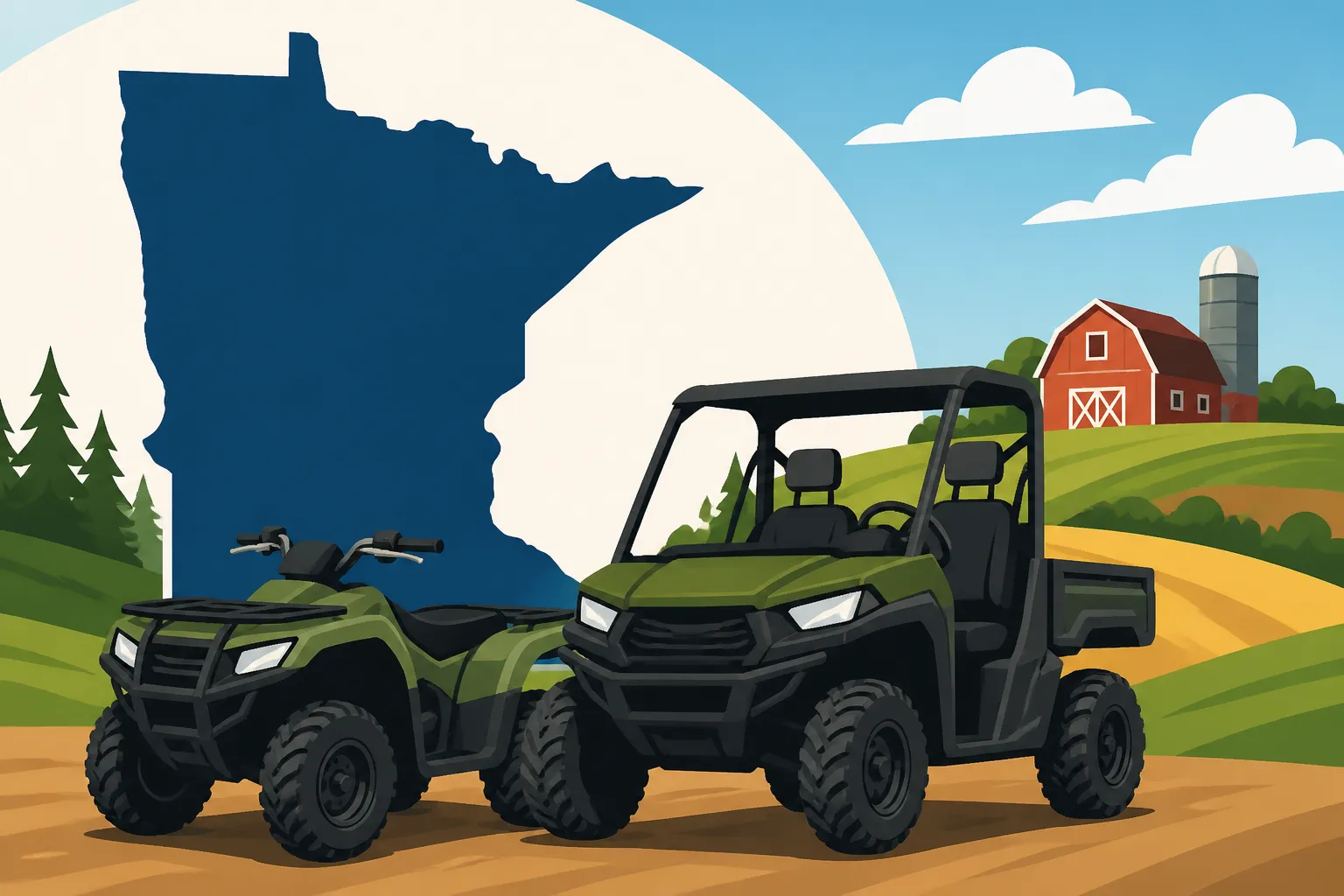
Think of the old Polaris Ranger sitting by the barn, caked in mud from bringing supplies out to the back forty. Or the Honda Foreman with a small trailer hitched up, moving hay bales to the horses. These are classic examples of machines primarily dedicated to agricultural operations. The key is "primarily used for." If you only use it to check your irrigation pivot twice a year but spend every other weekend tearing up the trails, that primary use argument starts to fall apart.
Specific Exemption Criteria
Now, let's get into the nitty-gritty of the actual exemption criteria. In Minnesota, an ATV or UTV used exclusively for agricultural purposes is exempt from registration if it meets certain conditions. The most significant condition is that its operation is confined to private land owned or leased by the farm operator. This means if you're only using your machine on your own fields, pastures, and private farm roads, you likely don't need to register it.
However, the moment that machine touches public land—even a public ditch, a grant-in-aid trail, or a county road for anything other than very specific, limited crossings—you're usually looking at needing a registration. The intention behind the exemption is to support farming operations, not to provide a loophole for recreational riding without a permit. It's a fine line, and understanding this distinction is vital to avoid potential penalties for an unregistered ATV. Even if you're just driving it a short distance down a public road to get to another field, you need to be aware of [Minnesota Agricultural Right-of-Way Exemptions] and other specific rules.
The Line Between Farm Use and Recreational Use
This is where many farm owners can get into a bind. It's easy to blur the lines, especially if your machine pulls double duty. Let's say you use your UTV all week long for farm chores, but on Saturday, you load up the kids and head down the road to access a public trail network or the lake for ice fishing. In that scenario, that same machine, which was exempt for farm use, would now require standard registration for its recreational outing.
The DNR's perspective is generally that if your machine is capable of being used recreationally on public lands or designated trails, and you intend to use it that way, then it should be registered. The exemption is really for machines that are kept on private land for private farm work. If you're pondering [Do You Need Registration on Your Own Minnesota Land?], the answer is almost always no, if it's only on your land. But if you're taking it out for a spin on the [Minnesota's Grant-in-Aid Trail System], even once, you'll need that registration. This is why some farm owners opt to have a dedicated "farm machine" and a separate "recreational machine," or they just bite the bullet and register their multi-purpose ATV to cover all bases.
Navigating the Nuances of Farm Machine Use on Public Roads
While the primary exemption for farm machines hinges on private land use, Minnesota does make some allowances for farm equipment, including ATVs and UTVs when used for legitimate farm purposes, to operate on public roads under very specific circumstances. However, these are not blanket permissions to ride freely; they are narrow exceptions that require careful adherence to rules to ensure safety and legality.
Limited Road Access for Farm Work
So, you're moving between fields, and there's a county road separating them. Can you just drive your unregistered farm ATV across or down that short stretch? Minnesota law does allow farm machinery, including ATVs and UTVs when engaged in farm operations, to use public roads for limited purposes. This usually includes crossing a road to access another field or moving a short distance along the shoulder of a road to get from one part of the farm to another. It's crucial that this travel is incidental to the farming operation and not a regular means of transportation or recreation.
The operative word here is "limited." You can't just take your farm machine to the hardware store in town on the county road, even if you're picking up parts for the combine. That would typically fall outside the scope of the exemption. If your machine is registered for public use, then [Minnesota Rules on County Roads] would apply more broadly. Without registration, your road use must be directly tied to moving between different parcels of your farm for agricultural work. Understanding these strict boundaries is essential because violating them can lead to fines for illegal road riding.
Important Safety Considerations for Road Travel
Even when your farm machine is legally operating on a public road under an exemption, safety should be your absolute top priority. These machines are not designed or equipped like typical road vehicles, and public roads, even quiet rural ones, present inherent dangers. It's important to consider what a conservation officer or sheriff's deputy might expect to see if they encounter your machine on the road.
Firstly, ensure your machine is highly visible. This means using any available lights, particularly a flashing amber light if equipped, and often an SMV (Slow-Moving Vehicle) emblem displayed prominently on the rear. You’d be surprised how quickly a driver can come upon an ATV or UTV, especially at dusk or dawn. Secondly, maintain a slow, predictable speed and stay as far to the right of the road as safely possible. Be acutely aware of other traffic, pedestrians, and cyclists. Even if you're exempt from registration, you're not exempt from common sense or safety laws. If your side-by-side is used for farm work, you might want to review [Registering a Side-by-Side Used on a Farm] for additional context, even if you are ultimately exempt.
Essential Documentation and Best Practices for Farm Machine Owners
Even if your ATV or UTV is primarily used for farm work and you believe it qualifies for an exemption, it's not a "set it and forget it" situation. Having your ducks in a row can save you a lot of headache if you're ever questioned about your machine's status. Law enforcement officers, whether DNR conservation officers or county sheriffs, have a job to do, and being able to quickly and clearly explain why your machine is exempt can make a world of difference.
Why Proof of Farm Use Matters
Imagine this scenario: you're moving your UTV from one field to another, briefly using the ditch of a township road. A local law enforcement officer sees you and pulls you over, asking for your registration. You explain it's a farm machine and exempt. While most officers are familiar with these exemptions, having some readily available proof of your claim can quickly resolve the situation. Without it, you might find yourself facing questions about [Fines for an Unregistered ATV in Minnesota] or having to explain your situation at length.
Proof isn't necessarily a specific government form for farm exemptions (because there isn't one for ATVs/UTVs in Minnesota), but rather anything that corroborates your statement. This could include a copy of your farming operation's business registration, property tax statements showing agricultural classification for your land, or even a simple letter you've drafted outlining the machine's primary use and the parcels of land it operates on. The goal is to avoid ambiguity and clearly establish the machine's role in your agricultural enterprise.
Creating a Farm Use Declaration
While there isn't a single "farm use exemption certificate," you can proactively create documentation that helps your case. Consider drafting a simple, clear declaration of use for your specific ATV or UTV. This document would state the machine's VIN, make, and model, and formally declare that its primary and exclusive use is for agricultural purposes on specific private land parcels. You could outline the types of farm activities it's used for (e.g., "hauling feed," "fence repair," "livestock management").
You might even find resources like LawDepot useful for creating a basic affidavit or declaration template that you can customize. They offer various legal document templates that can be adapted to situations where you need to formally declare a specific use or status. Having such a document, signed and perhaps even notarized, could serve as strong evidence if ever questioned. Keep a copy with your machine or in your glove box, especially if you anticipate any brief, legal road crossings. It’s also good practice to keep any [Proof of Ownership for a Minnesota ATV] with you.
Keeping Up-to-Date on Regulations
The world of laws and regulations is constantly evolving, and Minnesota's ATV and UTV rules are no exception. What's true today might have a slight modification next year. It's always a good idea to periodically check the Minnesota DNR website or consult with your local Deputy Registrar's office for any updates or clarifications regarding farm machine exemptions.
Local townships or counties might also have specific ordinances regarding agricultural equipment on their roads, so it never hurts to check with your county highway department as well. Being proactive and staying informed is the best way to ensure you're always operating within the bounds of the law, protecting yourself from potential citations, and ensuring your farm operations continue smoothly. If you ever decide to register your machine for broader use, understanding [Registering a Machine for Public Use in Minnesota] is a good next step.
Here’s a quick summary table to help clarify common scenarios:
| Scenario | Is Minnesota Registration Typically Required? | Key Considerations |
|---|---|---|
| Exclusively on Your Own Farm Land | No | Machine's primary use must be agricultural. No public land access. |
| Crossing a Public Road Between Fields | No (under specific conditions) | Must be directly incidental to farm work; requires safety measures (SMV, lights). |
| Riding a Public Ditch to Access a Field | No (under specific conditions) | Similar to road crossing; must be direct, short, and for farm access only. |
| Riding Designated Public ATV Trails | Yes | Even if used for farm work, public trail access requires registration. |
| Operating on a County Road to Town | Yes | This is considered general public use, not an agricultural exemption. |
| Used for Hunting or Recreational Riding | Yes | Any primary recreational use, even if minor farm use occurs, typically requires registration. |
| Plowing Snow from Your Own Driveway | No | Considered private land use. |
| Plowing Snow from a Neighbor's Driveway (for hire) | Yes (likely) | Commercial use, even if farm-related, often falls outside personal farm exemption. |
Disclaimer
This article is for general informational purposes only and does not constitute professional advice. Laws, prices and regulations vary by location and change over time. Consult a qualified professional for guidance on your specific situation.