Minnesota Public Use Versus Private Use Registration
Navigating the world of ATV and UTV registration in Minnesota can feel like trying to solve a complicated riddle, especially when you start hearing terms like "public use" and "private use." It's not just semantics; these distinctions dictate where you can legally ride your machine, what kind of sticker you need, and even how much you'll pay. Many riders just want to hit the trails or use their machine around the farm without constantly worrying if they're breaking some obscure rule. This guide is here to untangle the knot, explaining exactly what Minnesota's public versus private use registration means for you and your off-highway vehicle.
Understanding the Core Distinction: Public Versus Private
When it comes to registering your ATV or UTV in Minnesota, the first and most crucial fork in the road is deciding whether your machine will be used for "public" or "private" purposes. This isn't a suggestion; it's a legal requirement with significant implications for how you operate your machine across the state. The choice you make here impacts everything from the type of registration you apply for, to the fees you pay, and even the places you can legally take your rig. It's a fundamental difference that can either open up a world of riding opportunities or keep your machine confined to very specific, limited areas.
What "Public Use" Really Means in Minnesota
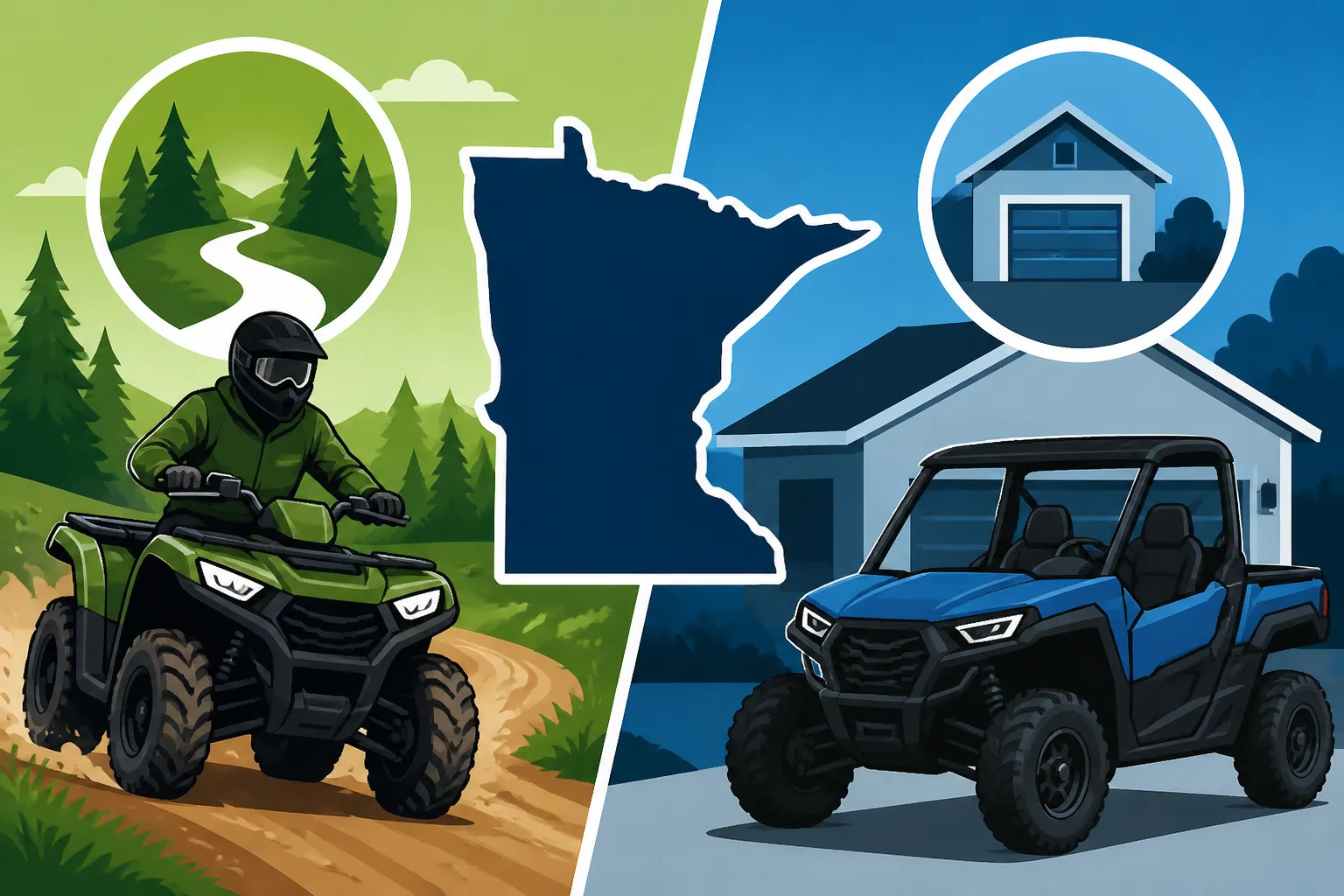
For most Minnesota ATV and UTV owners, "public use" registration is the standard and often the most sensible choice. When your machine is registered for public use, it means you intend to operate it on any public land or trails designated for OHV use across the state. This includes the vast network of state forest trails, grant-in-aid trails maintained by local clubs, public lands managed by the Department of Natural Resources (DNR), and even certain road rights-of-way where permitted. Think of it as your passport to explore the incredible outdoor recreation Minnesota has to offer. Without this public registration, those scenic trails and designated riding areas are effectively off-limits.
Beyond just trails, "public use" also covers riding on frozen public waters for ice fishing or travel, or for crossing road rights-of-way to access another trail or private property. It encompasses almost any scenario where you're operating your machine outside of your own, exclusively private land. This type of registration ensures that you're contributing to the upkeep of these public resources, and it signifies your machine meets the basic legal requirements for shared access. It's truly about enabling responsible enjoyment of Minnesota's natural spaces for everyone.
Defining "Private Use" and Exemptions
Now, "private use" registration is a much more specific, and therefore less common, category. An ATV or UTV is typically eligible for private use registration if it's operated exclusively on private property and never, ever on public land, trails, or frozen public waters. The key word here is "exclusively." This might apply to a machine used solely on your own farm, a large piece of hunting land that you own or lease, or within the confines of a private resort or campground. Essentially, if your tires never touch publicly accessible ground, you might qualify for this exemption or a specialized private use registration.
There are specific exemptions for agricultural and utilitarian purposes on private land. For instance, if you're using your ATV or UTV primarily for farm work – hauling feed, checking fences, moving equipment around your fields – and it rarely, if ever, leaves your property, it might fall under an agricultural exemption, potentially requiring a different type of registration or even none at all for certain uses. However, the moment that farm machine crosses a public road to get to another field, or you decide to take it to the state forest trail on the weekend, it immediately falls under the public use category. It’s a very fine line, and misunderstanding it can lead to trouble.
Why This Distinction Matters So Much
The public versus private distinction isn't just bureaucratic red tape; it's fundamental to Minnesota's OHV management and safety. For starters, public use registration fees directly support the maintenance and development of the trails and riding areas we all enjoy. When you register for public use, you're investing in the future of the sport. It's also about accountability. Publicly registered machines are expected to adhere to all state laws regarding equipment, operation, and safety, as they share space with other riders, hikers, and wildlife. [Minnesota DNR ATV Registration Explained] clarifies much of this oversight.
For private use machines, the state takes a different approach because the risk profile is different. If your machine never leaves your private land, the state's direct interest in its operation is significantly reduced. However, this doesn't mean you're free from all rules. Even on private land, responsible operation is crucial, especially regarding safety and environmental impact. The distinction also determines what decals you receive, where they must be placed, and the renewal cycle. It’s a system designed to ensure fair access, fund trail maintenance, and promote safe riding practices wherever ATVs and UTVs are operated.
Minnesota's Public Use Registration: What It Entails
For the vast majority of ATV and UTV enthusiasts in Minnesota, public use registration is the path you'll take. It's the standard, comprehensive registration that allows you to fully enjoy the extensive network of trails and public lands across the state. Understanding the ins and outs of this type of registration is crucial for any rider who plans to venture beyond their own backyard. It’s more than just a piece of paper; it’s your key to exploring Minnesota's beautiful outdoors, all while contributing to the infrastructure that makes it possible.
The Full Scope of Publicly Registered Machines
When your ATV or UTV holds public use registration in Minnesota, it gains the legal right to operate on any state-maintained or grant-in-aid ATV/UTV trail. This includes popular destinations like the Iron Range OHV Area, Nemadji State Forest, and countless miles of connecting routes across the state. This means you can confidently plan multi-day trips, join organized club rides, and explore diverse terrain from forested paths to open fields, knowing your machine is compliant. It also permits legal crossings of public roads and ditches where allowed, connecting trails or accessing private property. [Where to Ride an ATV in Minnesota] offers a fantastic overview of these opportunities.
However, "public use" extends beyond just designated trails. It also covers using your machine on frozen public waters, such as lakes and rivers, for ice fishing or simply traveling from one point to another. Many Minnesotans rely on their ATVs and UTVs to access remote ice fishing spots, and public registration is a must for this. This comprehensive scope means that if there’s any chance your machine will leave truly private, deeded land and enter shared public spaces, you need this type of registration. It's about being a responsible member of the riding community and ensuring you have the broadest legal access to Minnesota's outdoor adventures.
Fees, Stickers, and Renewal Cycles
Public use registration in Minnesota comes with a set fee, which typically covers a three-year period. This fee is a vital component of funding the state's OHV program, supporting trail maintenance, enforcement, and safety initiatives. It's a small investment that makes a huge difference in keeping our trails rideable and enjoyable. Along with your registration certificate, you'll receive a distinctive registration sticker (decal) that must be prominently displayed on your machine. [Where a Minnesota ATV Registration Sticker Goes] provides detailed instructions on correct placement, which is important for easy identification by conservation officers.
The renewal cycle is straightforward: every three years. The Minnesota DNR usually sends out renewal reminders, but it’s ultimately the owner’s responsibility to keep track of their expiration date. You can typically renew your registration online through Minnesota eLicense, at a local Deputy Registrar office, or by mail. Missing your renewal can lead to penalties if you're caught riding publicly with an expired sticker. It's a system designed to be efficient and user-friendly, ensuring continuous support for the state's OHV infrastructure.
Public Use Beyond the Trails
While trails are often the first thing that comes to mind with public use registration, its utility extends to many other scenarios. Consider accessing public hunting lands during deer season; an ATV or UTV can be invaluable for transporting gear or retrieving game, and public registration makes this legal on designated access routes. Similarly, if you maintain a cabin on public lease land, or often use your machine to access a boat launch on a public lake, your machine needs to be publicly registered. [Riding an ATV on the Road in Minnesota] offers further nuance about limited road use.
Even simple tasks like moving your machine from your garage to a trailer parked on a public street, or briefly riding down a public ditch to reach a friend’s property, technically fall under public use scenarios. The general rule of thumb is: if it's not exclusively on your own private property, it needs public registration. This comprehensive coverage ensures that wherever your adventures take you, as long as it's within legal parameters for OHV use, your machine is ready to go.
The Niche of Private Use Registration in Minnesota
While public use registration is the standard for most Minnesota ATV and UTV riders, there exists a specific, narrower category of "private use" or, more accurately, exemptions that mean a machine doesn't need full public registration. This isn't a separate type of registration in the same vein as public use, but rather a set of circumstances where the requirement for public registration is waived because the machine's operation is so limited. It's essential to understand these nuances, as misinterpreting them can lead to significant fines.
What Qualifies for Private Use Only
An ATV or UTV might not require public registration if it is operated solely on private property. This means the machine never touches public land, public trails, public road rights-of-way, or frozen public waters. This is an incredibly strict definition. Examples might include a small machine used exclusively on a very large, fenced-in farm for agricultural purposes, or a UTV used within the confines of a private industrial facility. If you own hundreds of acres and your machine never leaves that property, you might fall into this category.
However, the moment your machine ventures even a few feet onto a public ditch to get to a neighbor's property, or crosses a township road, it technically enters public domain and would then require public registration. Even riding on private land accessible by a public road might be a grey area if the assumption is that the machine got there by using the public right-of-way. The intent is clear: if your machine ever enters public space, it needs public registration.
The Specific Limitations and Privileges
The main "privilege" of private use is avoiding the public registration fee and the need for a registration sticker. However, this comes with extreme limitations. Your machine cannot be used on any of Minnesota’s extensive public trail systems, for ice fishing on public lakes, or for any travel on public road shoulders or ditches. Even incidental crossing of a public road to get from one section of your property to another can be problematic if you don't have public registration. [Do You Need Registration on Your Own Minnesota Land?] delves into some of these specific scenarios.
Essentially, a machine kept purely for private use is treated much like any other piece of private equipment – it's your property, and what you do with it on your land is generally your business, within safety and local ordinance limits. But the state draws a very clear line at the property boundary when it comes to OHV registration. If you're using your machine for agricultural purposes, there are often specific exemptions that are worth exploring, which can be different from simply "private use." [Minnesota Rules for Farm and Utility Machines] can provide more information here.
Scenarios Where Private Use Registration Makes Sense
Given the strict definition, scenarios where purely private use without public registration makes sense are quite limited.
- Large Private Farms/Ranches: If you operate a vast agricultural property and your ATV/UTV is used exclusively for farm work within its boundaries, without ever needing to cross or travel on public roads or access public trails.
- Industrial Sites/Closed Campuses: Machines used strictly within the confines of private industrial complexes, construction sites, or large private resorts where they never interface with public thoroughfares.
- Collector Machines/Display Only: If you own an ATV/UTV purely as a collector's item or for display, and it's never actually operated, then registration is irrelevant.
For nearly everyone else who plans to actually ride their ATV or UTV in Minnesota, the likelihood is that public use registration will be necessary at some point. It's far safer to assume you need public registration unless you are absolutely certain your machine will never, ever leave private, non-publicly accessible land. The convenience of a three-year public registration and the freedom to explore almost always outweigh the minor cost savings of trying to squeeze into the private use exception.
Making the Right Choice: Factors to Consider
Deciding between public and private use registration (or a lack thereof) isn't just about what's cheapest or easiest at first glance. It's about realistically assessing how you intend to use your ATV or UTV in Minnesota. The wrong choice can lead to frustration, missed riding opportunities, or even costly fines. Take a moment to think through your typical riding habits, the types of locations you frequent, and your long-term plans for your machine. This foresight will save you headaches down the road.
Your Primary Riding Intentions
The absolute first question you need to ask yourself is: "Where do I really plan to ride this machine?"
- Trail Enthusiast: If your vision involves exploring Minnesota's extensive state trails, joining group rides, or heading to popular OHV parks like the Iron Range OHV Area, then public use registration is non-negotiable. You'll need it to legally access virtually all designated public riding areas.
- Farm & Work Use: If your machine is primarily a workhorse on your farm – hauling hay, checking fences, moving tools – and never leaves your property, then you might qualify for an exemption. However, if you ever take it on the shoulder of a public road to get to another field, even briefly, public registration is required. [Registering a Side-by-Side Used on a Farm] covers specifics here.
- Ice Fishing & Hunting Access: If you plan to use your ATV or UTV to access frozen public lakes for ice fishing or travel, or to reach public hunting grounds via designated routes, public registration is essential.
- Cabin Life: If you keep your machine at a cabin and primarily ride on your own property but occasionally traverse a public ditch or local access road to get to a nearby trail or town, you'll need public registration. [Keeping a Quad at a Minnesota Cabin] discusses this common scenario.
Be honest with yourself. It's easy to say "I'll only ride on my land," but then find yourself wanting to join friends on a public trail or quickly run to the bait shop. Public registration offers far greater flexibility for most riders.
The Type of Land You'll Be On
Consider the specific characteristics of the land where you'll be operating your machine.
- Deeded Private Property: If you own a large parcel of land, and your machine never leaves its boundaries – meaning it doesn't cross or even briefly enter a public road right-of-way, public ditch, or designated trail – then you may not need public registration. This is the strictest definition of private use.
- Leased Land / Friend's Property: If you ride on land you lease for hunting or recreation, or on a friend's property, the rules of access still apply. If the only way to get to that land is via public roads or ditches, your machine will need public registration. [Riding a Friend's Property in Minnesota] discusses the nuances.
- Public Lands and Trails: Any state forest, DNR-managed land, county forest, or grant-in-aid trail falls under the public use umbrella. If you're on these, your machine must have public registration.
The distinction often boils down to whether your tires will ever touch ground that is legally considered public. Even if you only ride private trails, if those trails are accessed by crossing or traveling on public land, you'll need public registration.
Future Flexibility and Potential Changes
Life changes, and so might your riding habits. What if you decide next year that you want to start exploring Minnesota's amazing trail system? Or what if you sell your farm and move to a house with less acreage, meaning you'll need to trailer your machine to ride?
- Avoid Reregistration Hassle: Getting public registration upfront, even if you primarily ride private land now, saves you the hassle and potential delay of having to register for public use later. You won't have to worry about being caught off-guard if an opportunity for public riding arises.
- Easier Sale/Transfer: A machine that is already publicly registered or has a clear registration history is often easier to sell. Potential buyers won't have to wonder about its registration status or worry about penalties if they intend to ride publicly. When selling, make sure to provide a proper bill of sale. Services like LawDepot can provide templates for these legal documents, ensuring all necessary details are covered for a smooth transfer of ownership. [What a Minnesota Bill of Sale Should Carry] offers guidance.
- Peace of Mind: Knowing your machine is fully registered for public use provides unparalleled peace of mind. You won't have to second-guess yourself every time you approach a road crossing or consider a new riding destination.
Ultimately, opting for public use registration from the outset is often the most practical and flexible choice for the vast majority of Minnesota ATV and UTV owners. It simplifies things greatly and opens up a world of legal riding opportunities.
Registration Process: Public Versus Private Use
While the decision between public and private use dictates if and where you can ride, the process of actually getting your machine registered has some commonalities regardless of your choice. However, there are also distinct requirements and venues depending on whether you're seeking a full public registration or trying to understand an exemption. Knowing these steps helps ensure a smooth, penalty-free experience.
Required Documents for Either Path
Whether you're registering for public use or simply verifying an exemption, certain documents are almost always needed to establish ownership and machine identification.
- Proof of Ownership: This is paramount. For a new machine, you'll typically have a Manufacturer's Statement of Origin (MSO) or Certificate of Origin (MCO). For a used machine, you'll need a properly executed bill of sale from the previous owner. This document must clearly identify the machine, the buyer, the seller, and the purchase price. [Buying a Used ATV in Minnesota: The Paperwork] explains this in detail.
- Machine Information: You'll need the machine's Vehicle Identification Number (VIN), make, model, and year. This information is crucial for accurate record-keeping and for ensuring the correct registration type is applied.
- Personal Identification: Be prepared to present a valid driver's license or state ID.
- Sales Tax Payment: If you purchased your machine, you’ll typically need to provide proof that Minnesota sales tax has been paid, or be ready to pay it during the registration process. This applies to both dealer purchases and private sales, though the collection method differs. [Minnesota Sales Tax on an ATV Purchase] elaborates on this.
For those claiming a private use exemption, you won't be submitting these documents for a "private use registration" in the same way you would for public use. Instead, you'd be notifying the DNR or a Deputy Registrar that your machine qualifies for an exemption from public registration based on its exclusive private use. However, having your proof of ownership handy is still a good idea to confirm your legitimate ownership should any questions arise from authorities.
Where to Go: DNR, Deputy Registrars, Online
Minnesota offers several convenient avenues for handling your ATV or UTV registration.
- Online via Minnesota eLicense: This is often the quickest and easiest option for renewals or for initial registrations of certain types of machines. The eLicense system allows you to submit information, pay fees, and even print temporary documentation. [Registering Online Through Minnesota eLicense] walks you through this process.
- Deputy Registrar Offices: These local offices, often found within county government buildings or private businesses, are authorized to process ATV and UTV registrations. They can handle new registrations, renewals, transfers, and answer specific questions. Many people prefer this option for new registrations or transfers of ownership because you can get immediate assistance and walk out with your new registration certificate and sticker. [Deputy Registrars That Handle ATV Registration] provides more information on finding a location near you.
- Minnesota DNR Offices: While less common for direct walk-in registration, the DNR is the overarching authority. They can provide guidance, answer complex questions, and process certain types of registrations.
For machines falling under a "private use" exemption, you wouldn't typically "register" it through these channels in the same way. Instead, you'd ensure you have documentation proving your exclusive private use, often through a bill of sale, property deed, or lease agreement. If an officer were to question the lack of public registration, this documentation would be your defense.
Proof of Ownership and Bills of Sale
A critical element for any registration is robust proof of ownership. This isn't just a formality; it prevents theft and ensures the rightful owner is recorded. When buying a used machine, especially from a private seller, a comprehensive bill of sale is non-negotiable. This document should include:
- The full names and addresses of both the buyer and the seller.
- The date of the sale.
- A detailed description of the ATV or UTV, including make, model, year, and crucially, the VIN.
- The agreed-upon purchase price.
- Signatures of both parties.
Having a professionally prepared or at least a thorough bill of sale is vital. Websites like LawDepot offer customizable legal forms, including bills of sale, which can help ensure all the necessary information is included and legally sound. This minimizes issues later, whether you're registering the machine for public use or simply need to prove ownership for private use. Without proper documentation, you might find yourself in a bind when trying to register, sell, or even prove that a machine is legitimately yours, regardless of how you intend to use it. [Proof of Ownership for a Minnesota ATV] delves deeper into these requirements.
| Feature / Scenario | Public Use Registration | Private Use (Exemption) |
|---|---|---|
| Trail Access | Legal on all designated public OHV trails | Not permitted on public trails or land |
| Public Road Use | Legal for crossing or limited ditch riding where permitted | Not permitted on public roads, ditches, or rights-of-way |
| Frozen Public Waters | Legal for ice fishing/travel | Not permitted |
| Registration Fee | Required (typically 3-year) | Not required |
| Decal/Sticker | Required, must be displayed | Not required |
| Primary Use Case | Recreation, hunting, fishing, general transportation | Exclusive farm work, private property use only |
| Legal Document | DNR Registration Certificate | Proof of ownership (bill of sale, deed, etc.) |
| Flexibility | High | Extremely Low |
| Enforcement Risk | Penalties for expired/improper registration | Penalties if found on public land without registration |
The Consequences of Misunderstanding
Misinterpreting Minnesota’s ATV and UTV registration rules, especially the public versus private use distinction, is not a minor oversight. It can lead to significant financial penalties, legal complications, and a lot of frustration. Many riders assume that if they’re just "out in the woods" or "on the side of the road for a minute," it doesn't really count as public use. That assumption can be a very expensive lesson.
Penalties for Improper Public Use
If you operate an ATV or UTV on public land, designated trails, road rights-of-way, or frozen public waters without proper public use registration, you are in violation of Minnesota state law. Conservation officers and local law enforcement are authorized to issue citations for unregistered machines. These penalties can include substantial fines, which can quickly outweigh the cost of a three-year registration fee. [Penalties for an Unregistered ATV in Minnesota] gives a clear overview of these potential costs.
Furthermore, an unregistered machine could be impounded, adding towing and storage fees to your woes. If you're involved in an accident with an unregistered machine on public land, your insurance coverage could be jeopardized, leaving you personally liable for damages or injuries. It's a risk that simply isn't worth taking for the sake of avoiding a relatively small registration fee. Ignorance of the law is generally not considered a valid excuse, and officers are trained to identify machines lacking proper decals.
The Risks of Unregistered "Private" Machines
Even if you firmly believe your machine is used exclusively for private purposes and therefore exempt from public registration, there are still risks. The primary risk is that if you are ever found operating your "private use" machine in what an officer deems to be a public area – even a ditch, a road crossing, or a lake access point – you could face the same penalties as someone with a clearly expired or non-existent public registration. The burden of proof that your machine never enters public domain can be challenging, especially if you're traveling anywhere beyond your immediate property lines.
Consider a scenario where your property abuts a public ditch, and you ride the ditch for a hundred feet to reach a different section of your land. From your perspective, you're still on your property or merely accessing it. From an officer's perspective, you're operating an unregistered machine on a public right-of-way. This grey area is precisely why most Minnesota riders choose public registration for peace of mind, even if their public use is occasional. The definition of "private" is incredibly strict and leaves very little room for error.
Enforcement and Officer Discretion
Minnesota's DNR conservation officers, along with county sheriffs and local police, are well-versed in OHV laws and actively patrol trails, public lands, and even rural road rights-of-way. They are specifically looking for properly displayed registration decals. When they encounter an ATV or UTV without a current public registration sticker, they will stop the operator to investigate. While some officers might offer a warning for minor infractions, especially if it's a first offense or there are truly mitigating circumstances, most will issue a citation.
The discretion an officer has typically revolves around the severity of the offense and the attitude of the operator. Arguing that you thought you were on private land, or that you were "just quickly crossing," might not sway an officer who has seen similar excuses countless times. The easiest way to avoid any potential misunderstanding or confrontation is to ensure your ATV or UTV is always properly registered for public use if there's any chance it will leave genuinely private, deeded land. It's a small step that ensures you can enjoy Minnesota's beautiful landscapes without the looming worry of legal trouble.
Disclaimer
This article is for general informational purposes only and does not constitute professional advice. Laws, prices and regulations vary by location and change over time. Consult a qualified professional for guidance on your specific situation.