Rules for an Event on Private Land
An ATV or UTV event on private land may seem simpler than a ride on public trails, but permission to use the property is only one part of the plan. The route, event size, machine use, and any connection to public roads or trails can change which rules apply. Here’s how to check the important details before inviting riders.
Start with the land, the route, and written permission
Get permission from the landowner before advertising or opening the event to riders. If the property has more than one owner, or the event will cross adjoining parcels, confirm that each owner agrees to the use. A casual “yes” may not settle practical questions about parking, access, cleanup, or damage, so put the agreement in writing.
The agreement should identify the property and event area, the date and hours, who may attend, and which routes or areas are off limits. It can also address:
- Where participants may park, unload, and stage machines
- Whether guests may bring passengers or additional riders
- Speed limits and one-way travel on the property
- No-go areas such as wetlands, crops, steep slopes, buildings, and livestock areas
- Who handles gates, signs, litter, and damage
- Whether the landowner expects proof of insurance
- What happens if weather or trail conditions make the event unsafe
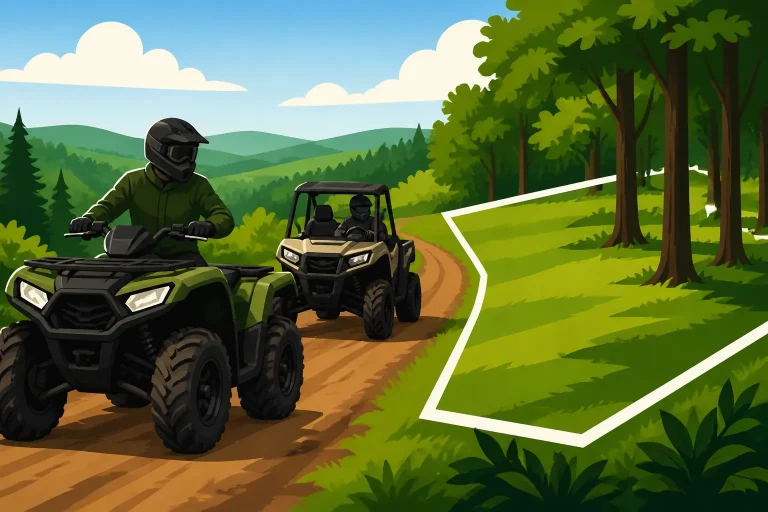
A private parcel is not automatically a suitable riding venue. Walk or inspect the planned route before the event, including entrances, blind corners, soft ground, water crossings, and spots where riders could leave the property. Mark boundaries clearly. If the route depends on a neighbor’s driveway or a connecting strip of land, obtain permission for that section too.
Be especially careful with routes that touch a public road, right of way, state forest, or grant-in-aid trail. A private event does not make a public segment private, and permission from one landowner does not authorize riders to travel across someone else’s property. If the planned route includes public trail riding, check the requirements for an organized ride on Minnesota trails and for a club poker run on trails. Those are different situations from riding solely within a private parcel.
It also helps to decide what “private land” means for your event. A family gathering on a deeded parcel is different from a club event that invites the public, collects fees, brings in vendors, or draws a large crowd. The larger or more formal the event, the more useful it is to check local land-use requirements and event conditions in advance. Ask the county or city that has jurisdiction over the property whether temporary-event, parking, noise, fire, or sanitation rules may apply. Requirements can vary by location and event details.
Check which permits and riding rules may apply
There is no safe blanket answer that every event on private land needs a permit—or that none do. The relevant question is what activities the event includes and where they take place. An event limited to a private parcel may be treated differently from a ride that uses public trails, roads, or public land. A paid guided outing or a large organized gathering may also raise different questions from an informal get-together.
Before finalizing the route, make a map that shows the property boundary, the riding course, entrances, staging areas, and any public-road or public-trail connection. Then check the rules with the agency or local authority responsible for each part. If a segment enters state forest land or uses a public trail system, ask about any special-use or event permission that may be required. Do not assume the landowner can authorize use of public land.
| Event setup | What to check | Practical next step |
|---|---|---|
| Riding stays entirely on one private parcel | Owner permission, property limits, local event conditions, and safety rules | Keep a written agreement and a property map |
| Route crosses neighboring private property | Permission from every affected owner | Get written approval for each segment |
| Route joins a public trail or public land | Trail access, pass, event, and land-manager requirements | Confirm rules with the responsible agency before advertising |
| Route uses or crosses a public road | Road-use restrictions and crossing rules | Plan a legal crossing and check the relevant local rules |
| Event is guided, commercial, or open to the public | Whether permits, insurance, or local approvals are triggered | Describe the event accurately when asking officials |
| Riders bring machines registered elsewhere | Registration and visitor trail-pass requirements for the planned use | Check each rider’s situation and the current Minnesota requirements |
A trail pass and permission to enter land are separate things. A pass does not grant access to private property, and a landowner’s permission does not replace a pass required for a trail where one applies. For a private-property-only event, don’t assume a public-trail pass is needed just because riders are using ATVs or UTVs. Conversely, don’t assume that calling the event private removes pass requirements if the course includes a trail that requires one. Review Minnesota’s Non-Resident ATV Trail Pass for visiting riders and confirm how the rules apply to the exact route.
Registration status can also depend on the machine and where it will be operated. A machine used only on private land may be treated differently from one taken onto public riding areas or road rights of way. Check the current requirements for each machine and planned use rather than relying on the event label. The distinction between private-use and public-use registration is worth reviewing if participants are unsure which type applies.
Other rules may still matter even when riders stay on private ground. Consider the rider’s age, machine type, passenger capacity, protective equipment, alcohol use, and whether the course is suitable for the participants. Minnesota’s ATV safety training requirements are a useful starting point, but confirm which provisions apply to the rider and location. A private venue is not a reason to skip age-appropriate supervision or safe-riding expectations.
If the event includes organized instruction, timed competition, a commercial guide, or a large number of participants, explain those details when seeking guidance. A general question such as “Can we ride on private land?” may not give an official enough information to answer. A clearer question is whether a described event, on a particular parcel, using a specific route and format, requires any permit or approval.
Plan for safety, insurance, and event-day control
The organizer should treat safety as part of the event design, not as a sign-in form at the gate. Start by matching the course to the least experienced riders and the machines expected to attend. A narrow, uneven trail that works for a skilled adult on a small quad may be unsuitable for a youth rider, a passenger, or a wide side-by-side.
Set basic rules in writing and explain them before anyone starts riding. Keep them short enough that attendees will read them. Useful items include:
- Ride only on marked routes and obey the posted direction of travel.
- Use a safe speed for visibility, surface conditions, and nearby riders.
- Do not ride alone into restricted areas or beyond the property boundary.
- Stop and report a crash, injury, damaged trail, or unsafe condition.
- Do not ride while impaired.
- Use protective equipment appropriate to the machine and activity.
- Keep passengers within the machine’s intended seating and restraint setup.
Assign people to manage check-in, parking, route signs, and incident response. For a larger gathering, have a designated person who can pause or cancel riding if conditions deteriorate. Make sure organizers know how to contact emergency services and can direct responders to the correct entrance. If phone service is unreliable, agree on a backup communication plan and a physical meeting point.
Inspect the course close to event time. Heavy rain, thawing ground, fallen branches, or a changed water level can make a route unsafe or damaging. Close sections that are muddy or eroding instead of encouraging riders to widen the trail around them. Keep machines away from wetlands, crops, and sensitive areas unless the landowner and applicable rules clearly allow the planned activity. Signs at intersections and property boundaries help prevent wrong turns, but signs do not substitute for a route that is clearly laid out.
Insurance deserves attention even for a private event. Ask the landowner what coverage they expect and contact an insurer to discuss the actual event format. Personal ATV coverage may not answer every question about an organized gathering, business activity, participant injury, or property damage. Don’t assume that a rider’s personal policy covers the organizer or landowner. The article on insurance for a Minnesota club ride can help frame the questions, but coverage depends on the policy and circumstances.
For events with registration or a waiver, use forms to collect practical information such as participant names, emergency contacts, and machine details. A waiver is not a substitute for safe operation, required insurance, or legal advice. Keep any forms and incident records in a secure place and limit collection to information the organizers actually need.
Give visiting riders clear instructions before they arrive
Out-of-state guests may assume their home registration or trail permit is enough for every kind of Minnesota riding. It may not be. The answer can depend on the machine, the rider, and whether the event stays on private land or uses a public trail. Tell guests where the course goes and ask them to check applicable requirements before traveling. For a route that reaches public trails, review Minnesota rules for visiting riders and the state’s non-resident pass requirements.
Send event details ahead of time rather than leaving important rules for the entrance. Include the address and correct access point, arrival and unloading instructions, allowed machines, required gear, property boundaries, event hours, and whether the route touches any public trail or road. Explain that permission applies only to the event and area described; it does not authorize roaming elsewhere on the property or across adjoining land.
A useful planning sequence is:
- Confirm who owns or controls every parcel on the route.
- Get written permission for the event and mark the approved area.
- Identify any public road, trail, or land connection on a map.
- Ask the relevant local authority or land manager about permits and event conditions.
- Check machine registration, trail-pass, and rider requirements for the planned use.
- Set the safety rules, emergency plan, and insurance arrangements.
- Recheck the route and conditions shortly before the event.
- Brief riders at check-in and stop riding if conditions or behavior become unsafe.
Keep a copy of the permission agreement, route map, contact details, and any approvals with the event organizers. If an official gives guidance, note the agency, date, and details you provided so you can follow up if the event plan changes. A change from a small private gathering to a public or commercial event can affect what needs checking.
The simplest way to avoid confusion is to describe the event precisely: private parcel or public trail, invitation-only or open to the public, recreational or commercial, and whether any roads or neighboring properties are involved. Permission, permits, passes, and insurance answer different questions. Checking each one against the actual route is more reliable than assuming that “private land” settles them all.
Disclaimer
This article is for general informational purposes only and does not constitute professional advice. Laws, prices and regulations vary by location and change over time. Consult a qualified professional for guidance on your specific situation.