Minnesota Certificates Accepted Elsewhere
A Minnesota ATV safety certificate can be useful when you travel, but it is not automatically a nationwide riding permit. States set their own rules for rider age, approved training and public-land access, and some places distinguish between completing a course and carrying a recognized certification. Before you ride out of state, check what the destination requires and what your Minnesota document actually proves.
What a Minnesota certificate proves
A safety certificate generally shows that a rider completed an approved course or met a state training requirement. It is evidence of safety education, not a driver’s license, machine registration, trail pass or permission to ride wherever you choose.
That distinction matters because several separate rules can apply to one ride. A state may require a young operator to complete training, require a permit or pass to use certain trails, and require the machine to be registered or otherwise eligible for that location. Having a safety certificate does not replace those other requirements.
Minnesota’s training rules apply to riders in specified age groups and situations. The requirements are not the same for every rider or every kind of land. If you need to confirm who must certify in Minnesota, start with Minnesota ATV Safety Training Requirements and The July 1987 Birthdate Rule. Those rules explain the Minnesota requirement; they do not guarantee that another state treats the certificate the same way.
It also helps to identify which document you have. Depending on how training was completed, you may have a course-completion record, a state-issued safety certificate, or both. A destination might accept one form of proof but not another. If the document is electronic, save a copy that can be opened without a reliable signal, and consider carrying a printed copy as backup.
A certificate is usually about the rider, not the machine. It does not establish ownership, registration status, insurance, or the right to use a specific trail. Keep those questions separate when planning a trip. For Minnesota requirements that may still apply to visitors, see Minnesota Rules for Visiting Riders and What Minnesota Riders Need Before They Ride.
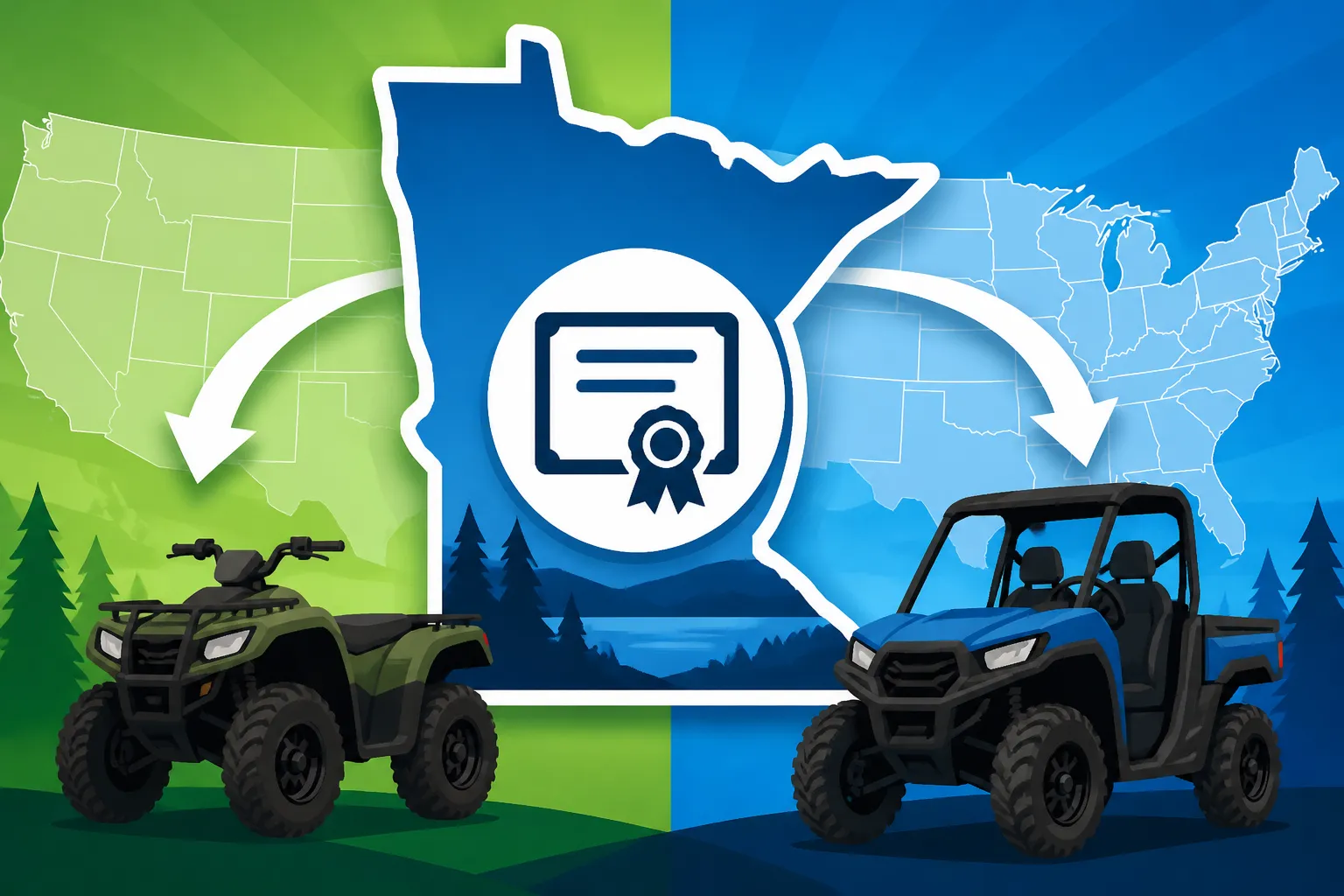
Is a Minnesota certificate accepted in another state?
There is no single answer for every state, trail system or rider. A destination may recognize a Minnesota certificate, accept only certain approved courses, require its own course or documentation, or have no training certificate requirement for your rider’s circumstances. Even within one state, a rule can differ by age, machine type, land manager or riding area.
The safest approach is to confirm acceptance with the agency or land manager responsible for the place you intend to ride. Ask about the exact document, not just whether “out-of-state certificates” are accepted. A course-completion printout and a state-issued card may not be treated as interchangeable.
| Question to check | Why it matters |
|---|---|
| Is training required for this rider’s age? | A destination may set age-based operator rules that differ from Minnesota’s. |
| Does it accept Minnesota-issued proof? | Some places may recognize another state’s credential; others may specify an approved course or format. |
| What document must the rider carry? | An online record, printed certificate or physical card may be treated differently. |
| Does the requirement apply to ATVs and UTVs? | Rules may define machine categories differently or cover only certain types of off-highway vehicles. |
| Is a separate permit or trail pass required? | Training proof does not normally replace access permissions or passes. |
| Are there local land rules? | A state forest, county trail or private riding area may impose additional conditions. |
When contacting an agency, provide the rider’s age, the name shown on the certificate, the course provider or course type if known, and the riding area. Ask whether the document satisfies the training requirement for that particular rider and whether the rider must carry it while operating. If the answer is unclear, request the relevant written rule or an official page to consult.
Do not rely on a friend’s experience as a substitute for checking. They may have ridden a different trail, been in a different age group, or carried a different credential. A certificate accepted at one riding area does not necessarily establish acceptance statewide.
How to verify the rules before a trip
Start with the specific destination rather than a broad search for a state’s ATV rules. Identify the trail, park, forest or other land you plan to use, then find the agency or land manager responsible for it. Where riding crosses jurisdictions, check each one. A route may pass from one trail system to another, and the rules may change along the way.
Use this process to avoid arriving with the wrong paperwork:
- Identify the rider and machine. Note the rider’s age and whether the vehicle is an ATV, side-by-side or another off-highway machine. Descriptions such as “UTV” are used casually, while regulations may use a defined vehicle category.
- Find the rule for the actual riding area. Check the responsible agency’s current information or contact it directly. Do not assume that a statewide rule covers every managed trail.
- Ask whether Minnesota proof qualifies. Give the exact certificate or course details. If you have more than one training record, ask which one to bring.
- Check carrying and display rules. Find out whether proof must be on the rider, on the machine, or available another way. Keep the certificate accessible, but protect it from weather and damage.
- Check separate access requirements. Confirm registration, trail pass, permit, insurance and equipment rules independently. A safety certificate does not satisfy them by itself.
- Save the answer and travel with backup proof. Keep an offline copy of official guidance and a readable copy of the certificate. If you receive an answer by phone, note the office and date so you can follow up if plans change.
If you are traveling with several riders, verify each person separately. A parent’s certificate does not certify a child, and one rider’s age or training status does not settle another rider’s requirements. For youth riders, check supervision, age and helmet rules as well as certification; Minnesota Age Rules for Young Riders and Accompanied Riding for Minnesota Youth explain related Minnesota requirements, while the destination’s own rules still control there.
The same care applies when a rider is visiting Minnesota. A certificate from another state may or may not satisfy Minnesota’s requirement. Minnesota’s rules and the destination state’s reciprocity rules are separate questions. The relevant Minnesota information is covered in Out-of-State Certificates Minnesota Accepts.
What a certificate does not cover
A recognized safety certificate can establish that a rider met a training requirement, but it does not make every ride lawful or safe. Treat it as one item in a trip checklist, not as a general permission slip.
It does not automatically provide:
- Machine registration. Registration rules depend on the machine, its use and where it will be operated. Minnesota registration does not necessarily settle another state’s registration requirements.
- A trail pass or land-use permit. Some public trail systems require an additional pass or permit. Check the destination’s access rules even if the rider’s training is accepted.
- Road permission. Training certification does not authorize road use. Road access, crossings and equipment requirements are governed separately.
- Proof of ownership or insurance. Carry or retain any records needed for the machine and trip. A certificate does not establish either.
- An exemption from age or supervision rules. A trained rider may still be too young to operate independently under local rules, or may need an adult supervisor.
- Permission to use a closed or restricted trail. Seasonal closures, vehicle-width limits and land-specific restrictions remain in force.
A useful way to prepare is to keep the rider’s training proof together with the trip’s other documents, while keeping each document’s purpose clear. If a question comes up during the trip, being able to show the exact certificate and the official rule you checked can make the conversation more straightforward. It is still the operator’s responsibility to follow posted signs and current directions from the land manager.
Check again close to departure if the riding area’s notices or rules may have changed, particularly if the trip depends on a particular trail being open. Keep a backup plan in case the destination does not accept the certificate or a route is closed. That is easier than trying to sort out training, access and machine paperwork at the trailhead.
Disclaimer
This article is for general informational purposes only and does not constitute professional advice. Laws, prices and regulations vary by location and change over time. Consult a qualified professional for guidance on your specific situation.