Accompanied Riding for Minnesota Youth
Accompanied Riding for Minnesota Youth
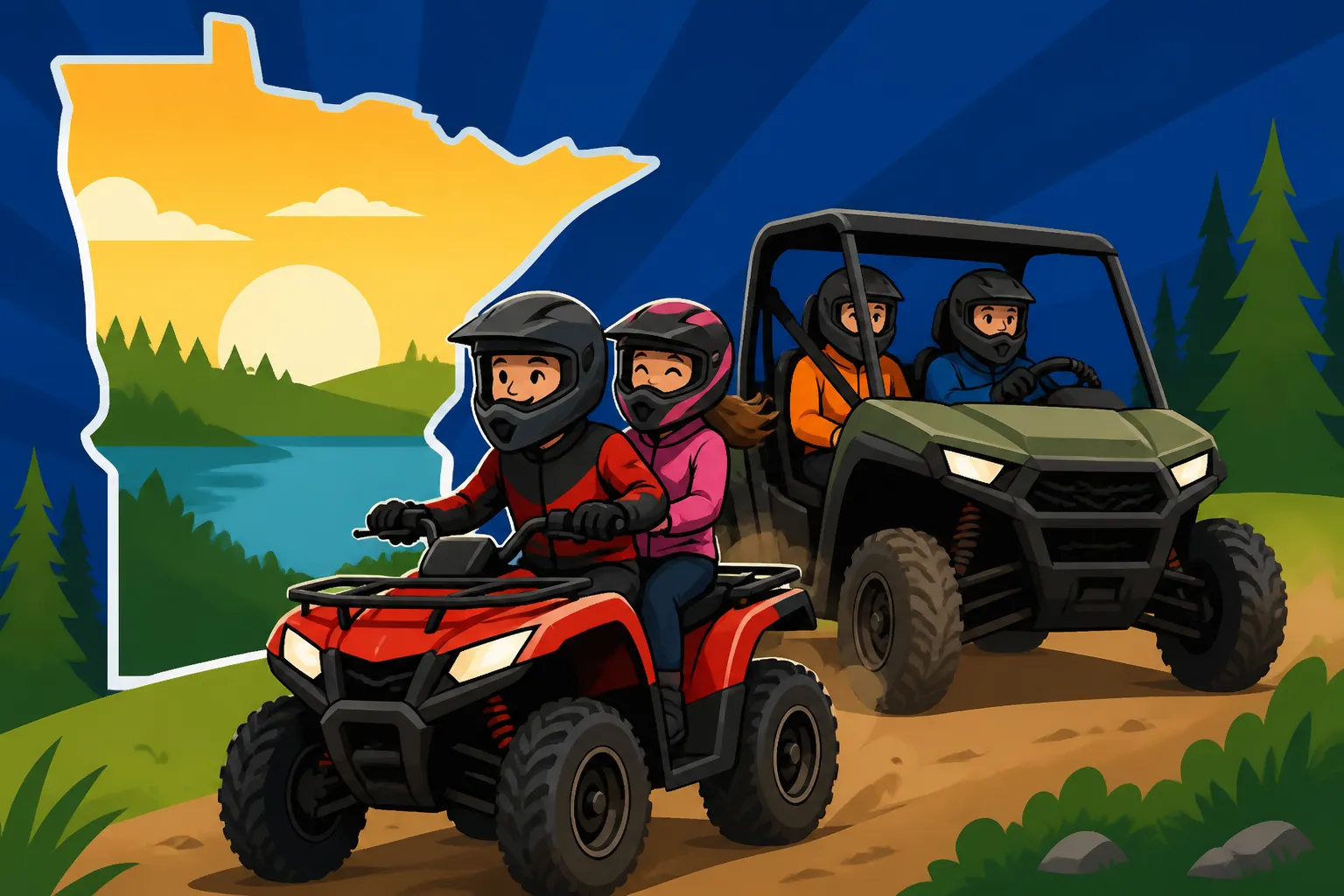
Taking a young rider out in Minnesota can raise a practical question: when does an adult have to accompany them, and what does “accompanied” mean on the trail? The answer depends on the rider’s age, the machine and where it’s being operated. This article explains the key distinctions, how to prepare, and what to confirm before heading out.
What Accompanied Riding Means
In Minnesota, youth ATV rules are not simply a matter of having an adult somewhere in the group. Depending on a rider’s age and the riding situation, an adult may need to accompany them while they operate. For a supervised ride, the adult should be able to keep track of the youth, communicate with them and respond quickly if something goes wrong.
That does not mean every youth ride has the same accompaniment rule. Age, machine class, safety certification and location can all matter. A rule that applies on a public trail may not apply in the same way on private property. And permission to ride a particular machine does not automatically mean a young operator can use it anywhere.
A useful first step is to separate three questions:
- How old is the rider?
- What type of ATV or UTV are they operating?
- Where will they ride?
Minnesota’s age requirements and class distinctions can affect whether a youth may operate a machine and whether an adult must accompany them. For more on the age framework, see Minnesota ATV Age Rules and Minnesota ATV Classes and What They Mean. For safety certification, see Minnesota ATV Safety Training Requirements.
“Accompanied” should also be treated as an active responsibility, not a box to check. An adult who is too far ahead, cannot see the youth, or is focused on managing a different group may not be in a position to supervise effectively. Plan the ride so that the adult can observe the young operator and help them make safe choices.
| Issue to check | Why it matters |
|---|---|
| Rider’s age | Age affects which machines and riding situations are allowed. |
| Machine class and size | Youth rules may distinguish between machine classes, and a youth’s physical ability still matters. |
| Location | Public trails, road rights-of-way, public land and private property can have different requirements. |
| Safety certification | Training requirements may apply to youth riding on public land or trails. |
| Adult’s role | Accompaniment means being available to supervise, not merely being somewhere on the route. |
| Pass and registration | Youth rules do not replace the machine’s separate registration or trail-pass requirements. |
When a rule is unclear, do not rely on what another rider remembers or on a machine’s size alone. Check the Minnesota Department of Natural Resources’ current ATV guidance for the specific rider, vehicle and location. Rules can change, and a planned route may cross areas with different requirements.
How Age, Machine and Location Affect the Rules
Minnesota’s youth rules use age bands, and the permitted riding situation can differ between them. The age of the person operating the machine is not the only factor. Machine class matters too, as does whether the ride takes place on private property or in an area open to public riding.
As a general planning framework, very young children should not be treated as eligible to ride public trails simply because they can reach the controls. Riders under 10 face significant restrictions on public riding. Riders aged 10 and 11 have limited options and should not assume that every machine or public route is available to them. Riders aged 12 to 15 still need to meet the rules that apply to their age and machine; turning 12 does not mean every restriction disappears.
For the exact rules that apply to a child under 12, see [Minnesota Rules for Riders Under 12]. The article [Minnesota Rules for a Rider Turning 16] can help clarify the next age transition, but a birthday does not automatically satisfy other requirements such as training, registration or route access.
Public trails and road rights-of-way
Public riding areas are where age and supervision rules are particularly important. A trail may be part of a state forest, a grant-in-aid trail system or another public riding area. A roadside route may be governed by rules for a public road right-of-way. Do not treat “public land” as one uniform category: a trail, road crossing and right-of-way can have different conditions.
Before setting off, check whether the planned route is open to the machine and rider. Also check whether a trail pass, registration or other permission is needed. A youth may meet an accompaniment requirement and still be unable to ride a route because the machine lacks the required documentation or access permission. See Minnesota Pass Rules for Youth Machines for the separate question of trail passes.
A route that begins on private land can also lead to a public trail or road. Permission to ride on a family member’s property does not carry over automatically to those public sections. Plan for the rules that apply at each point, including road crossings and trail connections.
Private property
Private property is not a blanket exemption from safe operation, and the owner’s permission is essential. Still, the legal framework can differ from rules for public riding. Check the rules that apply to the specific land and machine rather than assuming the requirements for a public trail apply identically.
Even where a particular public-land certificate or accompaniment rule does not apply, an adult should consider whether the youth can handle the machine, terrain and conditions. A quiet, open area on private land is not the same as a narrow trail, a steep slope or a machine carrying a passenger. For more context, see Minnesota Rules on Private Land.
A class label is not a safety assessment
A vehicle’s class helps determine which rules may apply, but it does not tell you whether that machine is appropriate for a particular child. A youth may be legally permitted to operate one type of ATV and still lack the reach, strength, coordination or judgment needed to control it safely.
For a side-by-side, consider the seating position, restraints, visibility and how the child can reach and use the controls. For a quad, check that the rider can sit securely and operate the controls without stretching or shifting their weight dangerously. The adult’s judgment matters even when the minimum legal conditions are met.
What the Accompanying Adult Should Do
Accompaniment works best when the adult treats it as supervision throughout the ride. The adult should know the route, understand the machine’s limits and be ready to adjust the plan if the young rider becomes tired, uncomfortable or overwhelmed.
Before riding, agree on a simple plan:
- Decide who leads and who follows. Keep the youth where the adult can observe them.
- Review basic signals for stopping, slowing down and asking for help.
- Set a pace the young rider can maintain without rushing.
- Choose a route suited to the rider’s experience, not just the adult’s.
- Identify a turnaround point and agree that stopping is always allowed.
- Make sure the adult can communicate with the youth if noise or distance makes conversation difficult.
Do not place the youth so far ahead that the adult cannot see what is happening. A rider around a bend or hidden by a rise may be out of sight at the moment supervision is needed most. On a group ride, the adult should not assume that another participant has taken responsibility unless that has been clearly agreed.
Accompaniment is also not a substitute for safe spacing. Leave room to stop without hitting the machine ahead, and do not crowd a young rider at an obstacle. If the child is uncertain about a hill, rut, water crossing or turn, stop in a safe place and decide together whether to continue. Turning around is a sound riding decision, not a failure.
When an adult is also a passenger
Whether an adult may accompany a youth on the same machine depends on the vehicle’s design, seating and applicable rules. A machine designed for one person should not be made into a two-person ride by squeezing someone onto it. Carrying a passenger where the manufacturer has not provided a proper seat and handholds can affect control and stability.
For a side-by-side, use the designated seat and restraints. Make sure a young passenger can sit properly and remain secured. For a quad, confirm that it is designed and equipped to carry a passenger before anyone rides two-up. Review Minnesota Rules for a Child Passenger for related passenger considerations.
Do not assume that “accompanied” necessarily means the adult must sit on the same vehicle, or that it always permits the adult to ride separately. The applicable rule and the machine’s design matter. See Must a Parent Ride a Separate Machine in Minnesota? for that specific question, and check the current state requirements before choosing how the adult will supervise.
Keep supervision realistic
A supervising adult should be sober, alert and able to respond. Avoid splitting attention between the youth, a phone, a trailer, a second group and route-finding. If the adult needs to stop to deal with another issue, bring the youth to a safe stop too.
Think about the adult’s ability to help if a machine stalls or tips. On a remote trail, a small problem can become more serious if the youth cannot communicate clearly or the adult is out of sight. Make sure everyone knows where the group is going and what to do if separated.
Prepare the Rider and Machine Before the Ride
Good preparation makes it easier for an adult to supervise and for a youth to ride within their ability. Start with the machine, not the trail. Confirm that it is in working condition, suitable for the rider and set up for the intended use.
A pre-ride check should include:
- Tires, wheels and visible suspension components
- Brakes and throttle operation
- Steering, controls and engine stop switch
- Lights and reflectors when relevant to the route or conditions
- Fuel level and any obvious leaks
- Seat, footrests and passenger restraints where applicable
- The machine’s load and passenger limits
Make sure the youth knows how to start, stop and shut down the machine before entering a public riding area. Practice in a controlled, open space first. A child who has only watched an adult operate a machine may not be ready to respond to a sudden stop, a rut or a change in traction.
Protective equipment should fit the rider, not just be available in the group. A properly fitting helmet is central, and eye protection, gloves, sturdy footwear and clothing suited to the weather can help reduce common ride risks. Minnesota has specific helmet requirements for young riders; see Minnesota Helmet Requirements Under 18. Check the current requirements rather than relying on an adult’s experience or assumptions.
Teach the youth a few habits before moving onto a trail:
- Keep both hands and feet in the intended riding position.
- Look ahead rather than focusing only on the front wheels.
- Slow down before turns and obstacles.
- Leave space from the machine in front.
- Stop if they cannot see the adult or do not understand what to do next.
- Never leave the route or enter private property without permission.
The first ride should be short enough that the youth can finish while still attentive. Fatigue, cold, heat and frustration can make a young rider less able to respond safely. Plan a break before the child is exhausted, and be willing to end the ride early.
Training and certification
Training helps a young rider understand controls, trail behavior and hazards. It does not replace adult supervision where the rules require accompaniment, and it does not make an unsuitable machine safe for a child.
Check Minnesota’s current safety-training requirements for the rider’s age and planned use. If the youth needs certification, complete it before the ride and keep the proof accessible. Do not assume that a certificate from another activity or another state automatically meets Minnesota’s requirements; confirm whether it is accepted.
Also check the machine’s registration and any trail-pass requirements. Youth age rules and vehicle paperwork are separate questions. For related registration information, see Registering an ATV in Minnesota.
Plan the Route and Respond to Problems
A youth ride should be planned around the least experienced rider. A route that seems easy to an adult may include deep ruts, loose gravel, sharp turns, steep grades or water that is uncomfortable for a child. Check the route’s current condition and access rules before leaving, especially after weather that could change trail conditions.
For a first outing, choose a route with manageable terrain and clear places to stop. Avoid routes where a young rider would be pressured to keep up with faster or more experienced adults. If the group plans to ride a longer loop, identify places where the adult can turn back with the youth without leaving the rest of the group confused.
Carry what the group needs to handle a minor delay: water, a basic first-aid kit, a phone or other suitable communication device, and any tools or recovery equipment appropriate for the machine and route. In areas with limited service, let someone not riding know the planned route and return time. The adult should be prepared to stop the ride if weather, trail conditions or the youth’s ability changes.
If the youth has difficulty, stop in a safe location and assess the situation. Do not pressure them to continue through an obstacle because other riders are waiting. If a machine is damaged, a rider is injured or the group becomes separated, prioritize safety and communication over finishing the planned route.
Keep required documents and information available. Depending on the ride, that may include registration details, trail-pass information and proof of safety certification. A young rider’s eligibility does not remove the operator’s need to follow route rules, and the adult should confirm that the machine is legal for the area being used.
The adult should also set expectations for behavior. Stay on designated routes, respect closures and private property, yield appropriately and avoid disturbing nearby homes or other trail users. Explain that following the adult’s instructions is part of riding together, but make clear that the youth can always ask to stop or report feeling unsafe.
Frequently Asked Questions
Does an adult have to ride on the same ATV as a young operator?
Not necessarily. “Accompanied” should not be assumed to mean riding on the same machine. The applicable age and riding rules determine the supervision requirement, while the machine’s design determines whether it can safely carry a passenger. Check the specific rule before deciding how the adult will accompany the youth.
Can a young rider use a public trail just because a parent is present?
No. Adult presence alone does not automatically make a youth eligible to operate every machine or ride every route. Age, machine class, safety training, registration, trail-pass rules and route access may all matter. Confirm each requirement before the trip.
Does safety certification remove the need for adult supervision?
Do not assume it does. Certification and accompaniment are separate requirements, and the rules that apply can depend on the rider’s age and situation. Check Minnesota’s current guidance for the specific age and machine.
Are youth rules the same on private property and public trails?
Not always. Public riding areas may have requirements that do not apply in the same way on private land. The owner’s permission is still necessary on private property, and safe supervision remains important in either setting.
What should an adult do if the young rider is struggling?
Stop in a safe place, check how the rider is doing and decide whether to continue, take a break or turn back. Do not pressure a youth to attempt an obstacle or keep riding when they are tired or uncomfortable.
Disclaimer
This article is for general informational purposes only and does not constitute professional advice. Laws, prices and regulations vary by location and change over time. Consult a qualified professional for guidance on your specific situation.