Illinois Riders Heading to Minnesota
Illinois riders heading to Minnesota need to sort out more than the drive and trail map. An Illinois registration does not automatically cover every Minnesota trail requirement, and road access depends on the specific route. Here’s how to check permits, registration, safety requirements, and local restrictions before unloading your ATV or UTV.
Check your registration and Minnesota trail-pass requirements
Start by confirming that your machine has current Illinois registration and that you can show proof of it. Bring the registration card or other official documentation, and make sure the machine’s identification details match the paperwork. Minnesota’s requirements for visiting riders are separate from Illinois registration: an Illinois registration does not automatically serve as a Minnesota trail pass.
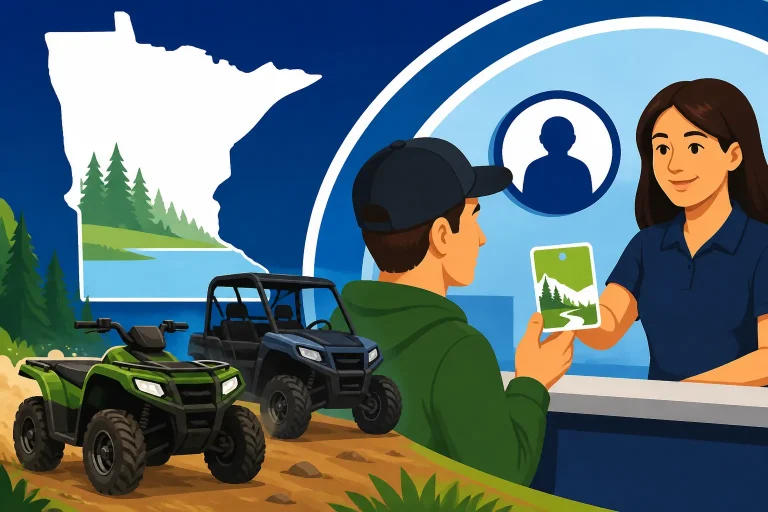
Nonresident ATVs generally need a Minnesota nonresident trail pass to use Minnesota state or grant-in-aid ATV trails. A pass is an added trail-use requirement, not a substitute for valid home-state registration. It also does not give permission to ride on a trail that is closed, restricted to another vehicle type, or otherwise off-limits. Rules can vary by land manager and trail, so check the requirements for your specific destination.
The distinction is easy to miss: registration identifies a machine for legal operation under applicable rules, while a trail pass covers a separate access requirement. The Minnesota’s Non-Resident ATV Trail Pass and Machines Registered in Minnesota and the Pass pages explain how those requirements fit together. For a route-by-route overview, see Which Minnesota Trails Require a Pass.
| What you’re checking | What to have or confirm | What it does not replace |
|---|---|---|
| Illinois registration | Current registration and proof that it belongs to the machine | A Minnesota trail pass where one is required |
| Minnesota nonresident trail pass | A pass for the machine and the trails you plan to ride | Home-state registration |
| Trail access | The trail’s current status, vehicle rules, and any posted restrictions | Permission to use a closed or prohibited route |
| Rider eligibility | Required safety certification and age-related conditions | The operator’s responsibility to follow riding rules |
A Minnesota trail pass is tied to the machine, not simply to the person driving it. If your group brings several machines, check the pass requirement for each one rather than assuming a single pass covers the whole group. The same applies if a friend or family member will operate a machine after you buy a pass: confirm the pass is properly assigned and displayed for that vehicle.
You can look into buying a pass through Minnesota’s official sales channels before you leave, or ask a license agent near your destination about availability. The Buying a Minnesota Trail Pass Online page covers the online option. Follow the current instructions for displaying or carrying proof; do not assume an email receipt, an Illinois registration sticker, or a pass left in the truck will meet every requirement. See Carrying the Pass While You Ride for more on keeping proof with the machine.
Some visitors ride only on private property. A trail pass for a designated public trail is a separate matter from a landowner’s permission to use private ground, but permission alone does not cancel other applicable laws. If your plans mix private land, public roads, and managed trails, check each segment separately.
Prepare the riders and paperwork before you leave
Put the machine’s paperwork somewhere it can be reached without unpacking the entire trailer. Bring your registration documentation, proof of any required Minnesota trail pass, and rider identification. If you have safety-training records, carry those too. Keeping digital copies can be helpful as a backup, but check whether the applicable rule accepts digital proof; do not rely on a phone screen as your only record.
Minnesota has ATV safety-certification requirements for some riders, including requirements connected to age and birth date. The rule commonly refers to a July 1, 1987 birthdate cutoff, but whether certification applies depends on the rider’s age and the type of riding. Do not assume that holding an Illinois certificate automatically settles the question. Check whether Minnesota accepts the specific out-of-state credential and whether it meets the requirement for the activity you have planned. The Minnesota ATV Safety Training Requirements page is a useful starting point.
For a youth rider, check the rules before the trip, not at the trailhead. Minimum ages, supervision, training, and where a young rider may operate can depend on the rider’s age and the riding location. A youth being allowed to operate a machine on private property does not necessarily mean the same rider can use a public trail or roadside right-of-way under the same conditions. Review Minnesota Rules for Visiting Riders and confirm any questions with the relevant Minnesota authority.
Also check equipment rules that may apply to your riders and machine. Helmet and eye-protection requirements can vary with age and riding context. If a machine will be used after dark, confirm its lighting equipment is suitable and legal for the route. Do not treat an accessory as compliant just because it was installed for recreational use.
Before you travel, make a simple document check:
- Match each machine’s identification number to its registration paperwork.
- Confirm the Illinois registration is current and bring proof.
- Buy or verify the Minnesota trail pass for every machine that needs one.
- Check which riders need safety certification and carry acceptable proof.
- Review age-related supervision, helmet, and operating restrictions.
- Save the trail map and current closure information for your riding area.
For machines with an unclear registration status, altered identification number, or paperwork that does not match, resolve the problem before the trip. A trail pass will not repair an ownership or registration issue. If you are bringing a machine recently purchased in Illinois or another state, check the registration and ownership documents before you count on being able to ride it.
Know where you can ride and what roads allow
Minnesota trail access is not the same as permission to use roads. An ATV or UTV cannot be assumed to be street-legal simply because it is registered in Illinois, has lights, or is allowed on certain roads at home. Road rules depend on the road, local ordinances, posted signs, and the reason for using the road. Some routes may allow a defined connection or crossing, while others prohibit ATV use.
Plan your route using current trail maps and official local information. Do not rely on a phone map that shows a road as a convenient connector; it may not show ATV restrictions, seasonal closures, or whether the route is authorized. Before riding into a town, check that town’s rules and any marked ATV route. The Minnesota Road Rules Riders Get Wrong page offers more context on common road-use misunderstandings.
A crossing and a ride along the road are not interchangeable. Where a crossing is permitted, use the designated location and follow signs and traffic controls. Do not continue along the road surface or shoulder unless the route is specifically authorized for your machine. If a trail approaches a road but does not clearly indicate how to proceed, stop and confirm the legal route rather than guessing.
Trail conditions can also change your plans. A route may close because of weather, maintenance, resource protection, or a seasonal restriction. A trail that was open on a previous visit may not be open on the day you arrive. Check current notices shortly before departure, then look again at the trailhead for posted signs. Use Checking Minnesota Trail Status Before You Drive to help plan that last check.
Private land, state-managed land, and grant-in-aid trails may have different access conditions. Stay on signed or mapped routes, respect gates and closure notices, and do not ride across land just because it looks like a shortcut. A trail pass does not grant access to every piece of land the route passes near. For practical details about permitted riding and visitor responsibilities, see Minnesota Rules for Visiting Riders.
A route plan is especially helpful for UTVs and wider ATVs. Trail-width limits can vary, and a machine that fits one route may not be allowed on a narrower one. Check vehicle-class and width restrictions for each trail segment, not just the trail system as a whole. If your group includes different machine sizes, build the route around the most restricted vehicle.
Make a practical trip plan for an Illinois-to-Minnesota ride
Choose the riding area first, then confirm permits, machine eligibility, and access. Minnesota is large, and a pass does not mean every trail is close to your lodging or open when you arrive. Identify a legal trailhead, check parking and staging arrangements, and estimate the ride distance using a current map. If your plan includes fuel or food stops, confirm that those stops are reachable on an authorized route; do not assume you can ride on any connecting public road.
Before loading, inspect the machine and trailer. Check tires, brakes, lights, belt or drivetrain condition, and tie-down points. Carry basic recovery and repair equipment appropriate to the route, along with water, weather gear, and a charged phone. In areas with poor service, download maps in advance and consider another way to communicate in an emergency. A paper map is useful when a device loses power or reception.
At the trailhead, take a moment to confirm that your machine is permitted on the route and that the pass or other required proof is in order. Read the posted notices, including temporary closures and vehicle restrictions. If something conflicts with your downloaded map, follow current signs and verify with the land manager rather than entering a questionable segment.
A compact pre-ride checklist helps keep the trip from turning into a paperwork problem:
- Illinois registration and proof for each machine
- Minnesota trail pass for each machine that needs one
- Safety-training proof for riders who must be certified
- Identification and emergency contacts
- Current trail map and closure information
- Proper helmets and protective gear for the riders
- Machine tools, recovery equipment, and first-aid supplies
- A route that avoids unauthorized roads and restricted trails
If you are unsure whether your Illinois registration, safety credential, or planned route meets Minnesota requirements, confirm it with the appropriate Minnesota agency or land manager before departure. Check official information again close to the ride, because trail status and local restrictions can change. A little preparation makes it easier to spend the day riding the trails you planned for, rather than trying to solve permit and access questions at the staging area.
Disclaimer
This article is for general informational purposes only and does not constitute professional advice. Laws, prices and regulations vary by location and change over time. Consult a qualified professional for guidance on your specific situation.