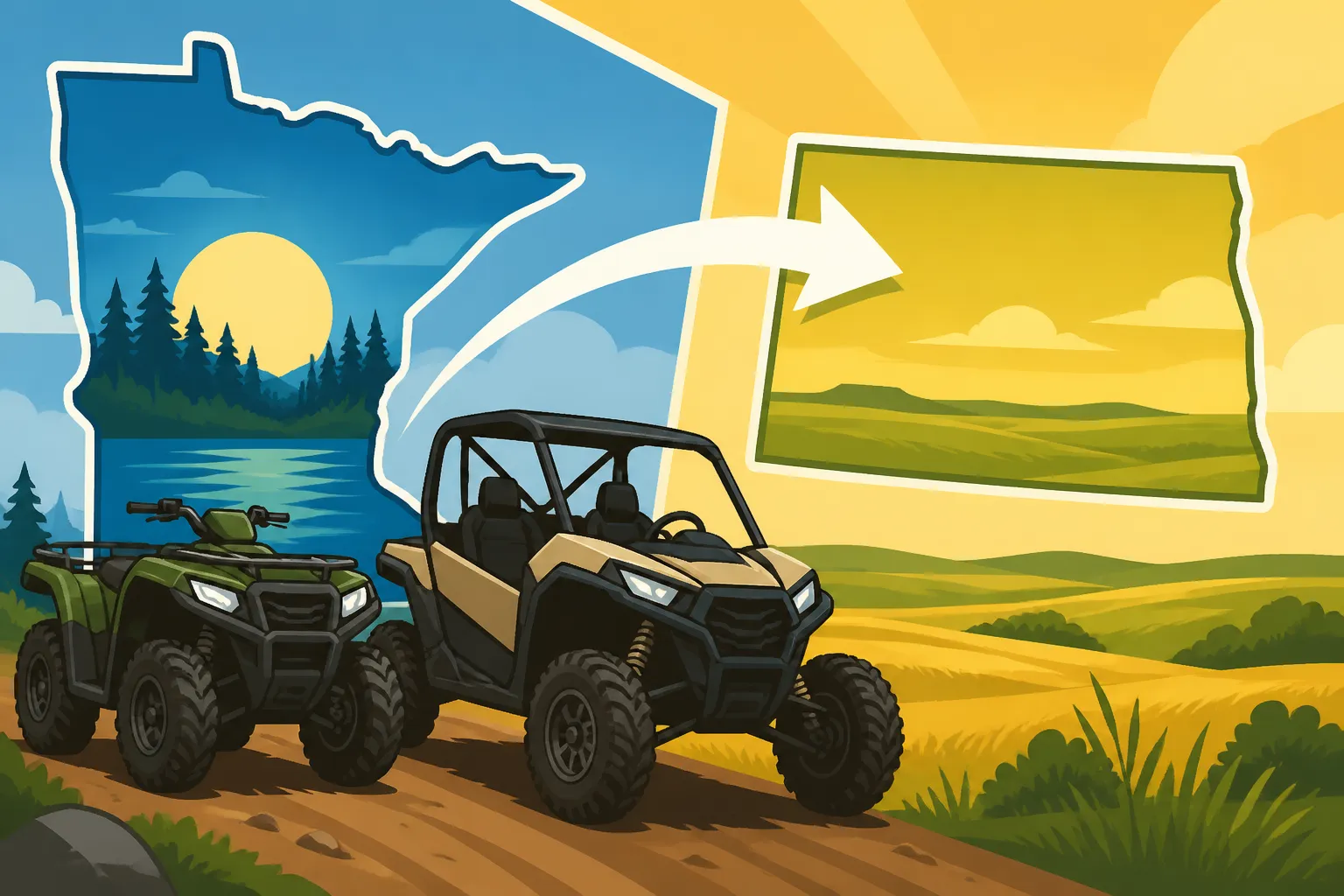
Taking a Minnesota Machine to North Dakota
Taking a Minnesota ATV or UTV into North Dakota takes more than loading it onto a trailer. Your Minnesota registration, any North Dakota nonresident permit, and the rules for the land you plan to ride can all matter. The safest approach is to check the machine’s status and the destination’s requirements before leaving, rather than assuming Minnesota paperwork works everywhere.
Check registration and permit requirements before you go
Start by identifying how your machine is registered in Minnesota and where you intend to ride in North Dakota. A Minnesota registration decal and a North Dakota nonresident OHV permit are different things: one concerns the machine’s registration, while the other may be required for a visiting rider’s use of public land. Neither should be assumed to cover the other.
North Dakota generally requires visiting off-highway vehicle riders to have the appropriate nonresident permit when operating on public land. The exact requirements can depend on the machine type, its registration, and the place you plan to ride. Check current guidance from North Dakota Game and Fish before your trip, and confirm any additional rules with the agency or land manager responsible for your destination.
This matters whether you ride an ATV or a side-by-side. A state’s vehicle categories may not line up exactly with the terms used in another state. If your machine is a utility vehicle, side-by-side, or another less-common type, confirm that the permit or registration information you’re reading applies to it.
| What to check | Why it matters | Where to confirm |
|---|---|---|
| Minnesota registration status | It helps establish how the machine is registered at home, but does not automatically answer every North Dakota requirement. | Minnesota DNR registration information |
| North Dakota nonresident permit | It may be required for visiting OHV riders using public land. | North Dakota Game and Fish |
| Destination rules | Public trails, state-managed land, federal land, and private property can have different requirements. | The land manager or property owner |
| Road access | Permission to use an OHV on a road is separate from permission to ride a trail or public-land route. | The agency responsible for that road |
| Rider requirements | Age, training, helmet, and equipment rules may differ from Minnesota’s. | North Dakota Game and Fish and the land manager |
Don’t treat a Minnesota trail pass as a North Dakota permit. A pass or registration that applies on Minnesota trails does not automatically grant access across the state line. For background on Minnesota’s own requirements, see Minnesota’s Non-Resident ATV Trail Pass and Minnesota ATV Safety Training Requirements. Those are useful for understanding Minnesota rules, not as substitutes for North Dakota’s.
Nor should you assume the reverse: a North Dakota permit, if required and obtained, does not replace Minnesota registration or make a machine legal to operate on every North Dakota route. Check each item separately. Reciprocity Minnesota Does Not Offer explains why an out-of-state permit or registration should not be treated as a universal pass.
If you’re still sorting out the difference between registration types, Minnesota Public Use Versus Private Use Registration can help clarify what your Minnesota record means. A machine registered for limited or private use may raise questions when you plan to use it on public land elsewhere. Don’t rely on the sticker alone to settle those questions; ask the relevant agencies what documentation they recognize.
Match your paperwork to the place you plan to ride
A permit question cannot be answered fully without a destination. “Riding in North Dakota” might mean an established OHV trail, a state recreation area, a public-land route, private property, or a road connection between riding areas. Each can have separate rules.
Before you travel, write down the specific trail system, property, or route. Then check whether it is open to your kind of machine, whether visiting riders need a permit, and whether there are local closures or seasonal restrictions. If your plans include more than one land manager, check with each one. A permit that covers one area may not cover another.
Public land and established trails
For public land, confirm that the area is open to motorized use and that your machine fits its access rules. A trail might have width, vehicle-class, or seasonal limitations. Don’t assume that a route shown on a general map is open to ATVs or UTVs; maps can show roads or paths that are not authorized OHV trails.
Look for current trail information before you leave and again near the start of your ride. Weather, maintenance, fire conditions, or other local factors can affect access. Follow posted signs and barriers even if a route appeared open when you planned the trip.
Private property
Permission to ride private land is a separate matter from state registration or a nonresident permit. Get clear permission from the owner or authorized manager, and ask which areas are open, where to park and unload, and whether any access restrictions apply. A verbal assumption that land is available is not a substitute for permission.
If the property connects to a public trail or road, don’t assume you can ride between them. Confirm the allowed route and whether that connection crosses land with separate rules.
Roads and road crossings
A permit for public-land riding does not automatically make a public road legal for an ATV or UTV. Road use can be restricted by state law, local rules, posted signs, and the road authority. Treat a road connection as a separate question, and verify it before building it into your route.
Crossing a road may also be governed differently from riding along it. If you need to cross a road to reach a trail, find out where and how that crossing is allowed. Avoid planning a route based on the idea that a short distance on a road will be overlooked.
This is a useful distinction for Minnesota riders, too. Riding a Minnesota Machine in Another State covers the broader issue of taking a Minnesota-registered machine across a state line. For your North Dakota trip, focus on the specific destination and the authority that manages it rather than relying on a general assumption about interstate riding.
Prepare documents, machine, and riders
Once you know what the destination requires, prepare the paperwork and equipment before loading. Keeping documents organized can make it easier to respond if a land manager, officer, or permit check asks about your machine or access.
Bring proof of the machine’s Minnesota registration and any North Dakota permit or authorization you need. Keep copies or digital records available as a backup, but check whether the relevant rules require a permit, sticker, or other proof to be carried or displayed on the machine. A photo on a phone may not meet every requirement.
A practical pre-trip checklist:
- Confirm the machine’s Minnesota registration is current and that its registration type fits your intended use.
- Check North Dakota Game and Fish guidance for nonresident OHV requirements.
- Confirm the permit applies to your ATV or UTV and the land you’ll visit.
- Check whether the trail or area is open to your machine’s class, width, and equipment.
- Review the destination’s rules for riders, required safety gear, and road crossings.
- Carry registration and permit documentation in the format the authority requires.
- Save the trail map and contact information for the land manager.
- Inspect the machine, trailer, tie-downs, lights, and tires before departure.
Don’t assume that a Minnesota safety certificate automatically satisfies a North Dakota requirement. Training rules can depend on the rider’s age, the machine, and where it is operated. Confirm the current requirement with North Dakota Game and Fish or the land manager, especially if a young rider is coming along. Minnesota’s age and training rules are explained in Minnesota Age Rules for Young Riders, but they do not determine what North Dakota requires.
It’s also worth checking helmets and other safety equipment for every rider. Use gear that fits properly, and make sure the machine has the equipment required for the place and type of riding planned. A state’s rules may set a minimum, while a trail or event may have additional conditions.
Pack for the trip rather than just the ride. Bring a map that works if cell service drops, water, basic first aid supplies, and the tools or recovery gear appropriate to your machine and route. Tell someone where you plan to ride and when you expect to return. If the route is remote, decide in advance what you’ll do if a machine breaks down or the group gets separated.
If you’re unsure what documents need to stay with the machine or rider, Carrying the Pass While You Ride offers a helpful Minnesota-focused reminder: make access proof easy to find. For North Dakota, follow the state’s own instructions on what must be carried or displayed. Don’t leave a required permit at home simply because you have a purchase receipt or an email confirmation available.
Common mistakes to avoid on a North Dakota trip
The most common paperwork mistake is treating registration, a trail pass, and a nonresident permit as interchangeable. They serve different purposes. A Minnesota registration may identify the machine’s home-state status; a North Dakota permit may address nonresident access; and a trail system can have separate operating rules. Check each requirement instead of assuming one document covers the whole trip.
Another mistake is checking only the state-level rules and not the destination. A machine can meet general requirements but still be barred from a specific trail, road, or property. Confirm that the route is open and suitable for the machine you’re bringing. If your plans change after arrival, pause to check the new area’s rules rather than carrying over assumptions from the first destination.
Avoid relying on outdated screenshots, old forum posts, or another rider’s experience as your final answer. Permit rules and land access can change, and different riders may have different machine types or destinations. Use official state information and the land manager’s current notices. If two sources seem to conflict, ask the responsible agency for clarification before riding.
Finally, don’t assume that a valid permit gives permission to ride anywhere. Stay on authorized routes, obey closures and signs, and get permission before using private land. If riding a road is part of your plan, confirm that exact road and the rules for it. A quick check before departure is easier than finding out at the trailhead that your chosen route is unavailable.
Taking a Minnesota machine to North Dakota can be straightforward when you separate the questions: Is the machine properly registered? Does the rider need a nonresident permit? Is the destination open to that machine? Are the route and riders compliant with local rules? Confirm those points with North Dakota Game and Fish and the destination’s land manager, then carry the documents they require.
Disclaimer
This article is for general informational purposes only and does not constitute professional advice. Laws, prices and regulations vary by location and change over time. Consult a qualified professional for guidance on your specific situation.