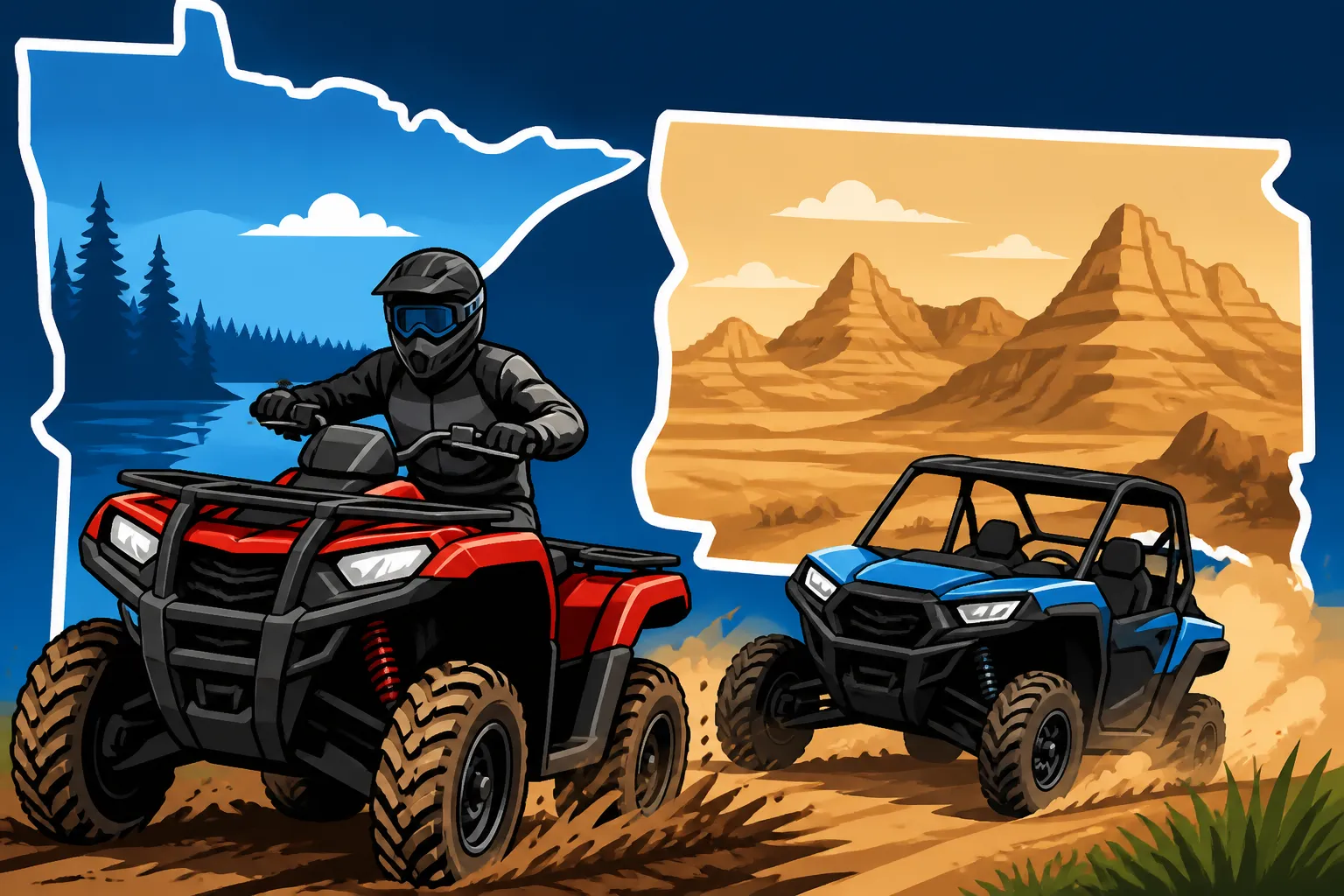
Riding a Minnesota Quad in South Dakota
Taking a Minnesota quad or side-by-side across the border does not automatically give it permission to ride every South Dakota trail or public road. The main challenge is separating your Minnesota registration from South Dakota permits, land-access rules and local road rules. Check each requirement for your machine and destination before you load up, so you know what to carry and where you can legally ride.
Check Your Minnesota Registration and South Dakota Permit Needs
Before planning a route, identify what your machine’s Minnesota paperwork actually covers. Registration, a trail pass and permission to use a particular riding area are different things. Having one does not necessarily satisfy the others.
Minnesota registration documents your machine under Minnesota’s system. A Minnesota trail pass applies to qualifying riding on Minnesota trails; it is not a permit for South Dakota. Likewise, a registration decal should not be treated as proof that a South Dakota trail system has accepted your machine for use.
South Dakota may require an out-of-state operator to obtain a nonresident permit for certain public-land riding. The requirement can depend on the machine, its home-state registration, the land manager and where you intend to ride. Do not assume that a valid Minnesota registration either guarantees an exemption or means you must buy a separate permit. Confirm the current rule with South Dakota Game, Fish and Parks or the agency that manages your destination.
The distinction matters because a permit requirement may apply to a riding area even when the machine is properly registered in Minnesota. Conversely, a trail pass for one system may not cover a different area, a road connection or a private riding venue. For context on how these requirements differ from Minnesota’s rules, see Minnesota’s Non-Resident ATV Trail Pass and Reciprocity Minnesota Does Not Offer. Minnesota’s policy does not determine what South Dakota requires of a Minnesota rider.
Use this checklist before departure:
- Confirm the machine’s Minnesota status. Make sure its registration is current and that you have the documentation associated with it. If you are unsure what kind of Minnesota registration your machine carries, review Minnesota Public Use Versus Private Use Registration.
- Ask whether South Dakota recognizes that status for your planned use. Be specific about whether the machine is an ATV or UTV, whether it has any road-legal equipment or license plate, and whether you plan to ride public trails, public land or private property.
- Ask whether a South Dakota permit is required. Confirm if the answer changes based on the machine’s registration, where you will ride or how long you will be there.
- Check the land manager’s rules separately. A state permit may not replace a federal, county, local or site-specific requirement.
- Save proof of what you confirm. Keep permit records and registration documents accessible, either in a secure location on the machine or with your riding group’s trip documents.
A common mistake is to ask only, “Is my quad registered?” A more useful question is: “With this Minnesota-registered machine, what do I need to ride this specific South Dakota area?” Include the name of the trail or riding area when contacting the relevant agency. It can help staff distinguish a state-managed trail from a federal route, county road or private park.
If the machine is not registered for public use in Minnesota, or if its paperwork is unusual, do not assume that a South Dakota permit will resolve the issue. Check both states’ requirements before traveling. The rules for a machine used only on private land in Minnesota may differ from the rules for a machine that will be operated on public trails. Registering a Machine for Public Use in Minnesota explains why that distinction matters at home; it does not replace South Dakota’s requirements.
Match the Rules to the Place You Plan to Ride
“Riding in South Dakota” can mean very different things: a designated trail, a state recreation area, a public road, a private OHV park or land owned by a friend. Each place may have its own access rules. A permit that applies to one area does not automatically authorize riding somewhere else.
Start with a specific destination rather than a state map alone. Find out who manages the land and which routes are open to your machine. South Dakota Game, Fish and Parks can provide information about state-managed recreation areas and applicable permits. For routes on federal land, consult the appropriate land manager and current motor vehicle use information. County and local rules may control roads and routes outside those areas.
| Where you plan to ride | What to verify before unloading |
|---|---|
| State-managed trail or recreation area | Whether the area is open to your machine, whether a nonresident permit or other authorization is needed, and which routes are designated |
| Federal public land | The current route map, vehicle class or width restrictions, seasonal closures and any separate area requirements |
| County or local road | Whether that road allows the machine, what equipment and operator requirements apply, and whether the connection is permitted |
| Private park or riding area | Admission or permit requirements, machine restrictions, required safety equipment and operating hours |
| Private property | The owner’s permission and any applicable local or state restrictions |
Do not rely on an old screenshot, a general trail app or a route shared by another rider as the final word on access. Maps can show a road or trail without making clear whether it is open to your vehicle class, closed for the season, or subject to an additional permit. Check the managing agency’s current information and follow posted signs when you arrive.
Machine size and type are especially important for UTVs and wider side-by-sides. A route suitable for a narrower ATV may not accommodate a wider machine, and some routes may limit vehicle dimensions or restrict particular classes. Ask about your machine’s width and configuration rather than relying only on the term “ATV.” If your vehicle has been modified, mention changes that could affect its dimensions or equipment.
Also plan the connections between riding areas. A trail may end at a road, but that does not necessarily mean you can legally ride the road to reach the next section. Check each connecting segment. If a permitted trail requires you to cross or travel along a public road, find out what the applicable road rules allow before setting out.
This is one reason Minnesota riders should not apply their home-state assumptions automatically. Minnesota’s public-land rules, trail-pass system and route permissions are specific to Minnesota. South Dakota may use different terms and different procedures. Riding a Minnesota Machine in Another State covers the broader problem of taking a Minnesota-registered machine elsewhere, while Minnesota Rules for Visiting Riders provides the reverse perspective: visitors still need to follow the rules of the place where they ride.
Keep Trail Access Separate From Road Use
Permission to ride a trail is not the same as permission to operate the machine on a public road. A quad that is allowed on a designated off-road route may still be prohibited from using the road that leads to the trailhead. A Minnesota registration decal does not, by itself, make an ATV or UTV street-legal in South Dakota.
If you expect to use any road, confirm the rules for that exact road and for your machine. Ask whether it is a state, county or local road, because different authorities may have different rules. Confirm any requirements for operator age, license status, safety equipment, lighting, registration, insurance and the route itself. Do not infer road permission from a general statement that off-highway vehicles are allowed in a town or riding area.
A machine’s configuration can affect the answer. A road-registered vehicle may be treated differently from an ATV or UTV registered only for off-road use, but equipment and local rules still matter. Having headlights, turn signals, a windshield or a license plate does not automatically establish that a particular road is open to it. Verify both the vehicle requirements and the road authorization.
Before the trip, map out the route from the trailer to the riding area and check for every public-road segment. If an agency or local authority confirms a road connection is allowed, follow any route, crossing or equipment instructions it provides. If you cannot confirm permission, keep the machine on a trailer until you reach an authorized staging area.
Some riders also expect neighboring-state rules to work like a single regional pass. They do not. A Minnesota trail pass is for Minnesota requirements, and it does not serve as a South Dakota trail authorization. Similarly, a South Dakota permit would not replace any Minnesota pass or registration required after you return home. See Minnesota Rules for Visiting Riders for a reminder that a rider’s home-state documents do not erase the rules of the state being visited.
Prepare the Machine and Documents Before You Leave
Once you know where you can ride and what permits apply, make the trip easier by organizing the machine’s paperwork and checking its condition. An officer or land manager may want to establish what the machine is, whether it is registered and whether you have the required authorization. Having the relevant documents ready can prevent a straightforward check from turning into a search through a packed truck.
Bring or securely store:
- Minnesota registration documents and any associated proof of ownership you normally carry.
- South Dakota permits or receipts required for the machine and the riding area.
- Any written confirmation that helps explain an applicable exemption or special authorization.
- Contact details for the agency or land manager if you need to verify a route rule.
- Insurance information, if required for your planned use or carried as a practical precaution.
Keep a digital copy as a backup, but do not rely on a phone alone. Remote areas may have poor reception, and a device can run out of power or be damaged. For advice on what to keep available when riding in Minnesota, see Do You Carry Papers on a Minnesota Trail?. The practical idea transfers well: paperwork should be easy to retrieve, not buried under riding gear.
Check the machine itself before the drive. Confirm that the registration decal or plate is attached as required for its Minnesota status, and check the brakes, tires, steering, lights and tie-down points. If the intended route allows public-road use, confirm the required road equipment rather than assuming that ordinary trail equipment is sufficient.
Plan for the rules that apply to the riders, too. Age limits, safety training, helmet requirements and passenger rules can differ by state and by where you ride. A rider who meets Minnesota’s training requirements may still need to confirm whether South Dakota recognizes the relevant credential for the planned activity. Likewise, do not assume that a helmet rule or passenger rule is identical across the border. Minnesota ATV Safety Training Requirements explains Minnesota’s requirements; check South Dakota’s rules for your trip.
Finally, check for closures shortly before you leave. Weather, fire danger, seasonal restrictions, maintenance and land conditions can change access. A route that was open when you planned the trip may be closed when you arrive. Use the current information from the agency responsible for the area, and follow any signs or directions at the trailhead.
A simple pre-trip routine keeps the questions in the right order:
- Choose a named riding area and identify its land manager.
- Confirm that your type and size of machine may use the area.
- Ask whether your Minnesota registration is accepted for the planned use and whether a South Dakota permit is needed.
- Verify trail connections, road segments, seasonal closures and rider requirements.
- Prepare the documents and equipment, then recheck access shortly before departure.
The safest assumption is not that Minnesota registration is useless, or that it automatically grants access. It is that registration, permits and land access answer different questions. Confirm each one for your destination, and you can avoid arriving with a properly registered quad but no authorization for the trail you intended to ride.
Disclaimer
This article is for general informational purposes only and does not constitute professional advice. Laws, prices and regulations vary by location and change over time. Consult a qualified professional for guidance on your specific situation.