Family Land and the Minnesota Pass Exemption
A family cabin or hunting property can make a Minnesota ride feel like private recreation, but the trail-pass exemption depends on where you ride and who owns the land. The key is to separate riding on qualifying family property from using a public or grant-in-aid trail, even when that trail crosses private land.
What the family-land exemption covers
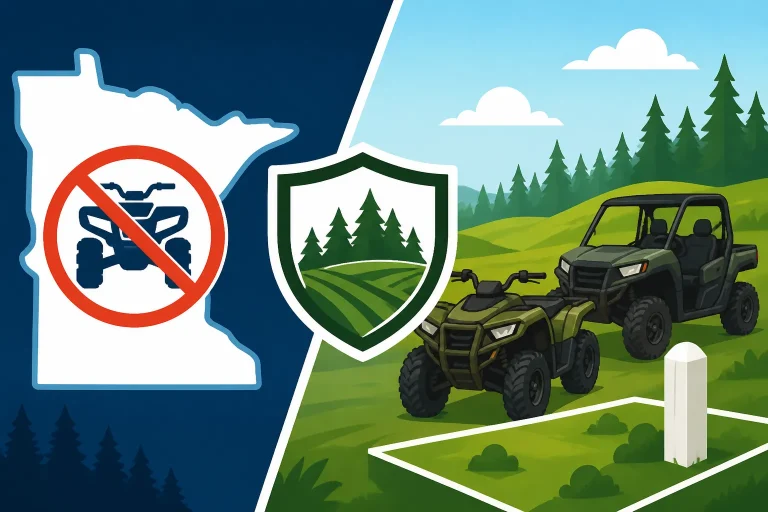
Minnesota’s nonresident ATV trail pass is generally a requirement for nonresident riders using trails covered by the pass rules. A limited exception may apply when a nonresident operates an ATV on qualifying private land owned by the rider or an eligible immediate family member. The important point is that the exemption is tied to the land and the kind of riding taking place there, not simply to having a family connection in Minnesota.
If you are visiting a parent’s property, for example, riding entirely within the property may fall under the private-land exception. Riding from that property onto a public trail is different. Once your route uses a trail that requires a pass, the family relationship or the trail’s location across private property does not automatically exempt you.
The distinction matters because “private land” can describe two very different situations:
- Private property used privately: The owner allows family members to ride within the property’s boundaries, away from public trails and rights-of-way.
- Private property crossed by a public-use trail: A trail may run across privately owned land but be open for public riding under an agreement or trail program. It is still a designated trail, not simply a private family riding area.
A trail’s ownership and access status are not always obvious from the seat of a machine. Check the route and its current status before riding, rather than assuming that a trail is private because it crosses a farm, cabin parcel, or wooded tract. Which Minnesota Trails Require a Pass can help clarify the difference between private riding and trail use.
The exemption is most useful for a visit that stays entirely on qualifying family property. It is not a general pass waiver for every ride that starts at a relative’s home, uses a relative’s land as a staging point, or passes through land owned by someone in your family.
| Riding situation | Is the family-land exemption likely to apply? | What to check |
|---|---|---|
| Riding only within qualifying family-owned private property | It may apply | Whether the owner and property meet the current exemption rules |
| Riding a designated public or grant-in-aid trail across family property | Do not assume it applies | Whether that trail requires a pass |
| Riding on a friend’s property with permission | Permission alone may not qualify | Whether the property meets the ownership requirement |
| Leaving the family property to ride a public right-of-way | The private-land exception may no longer cover the ride | Road, registration, equipment, and pass rules |
| Riding on a public trail and returning to the property | A pass may be required for the trail portion | The route’s designation and current rules |
For the broader private-property rules, see Minnesota Rules on Private Land. For a more specific comparison, Do You Need a Pass on Deeded Minnesota Ground? addresses why owning land does not necessarily make every nearby route private.
Who counts as family, and what must be true
The phrase “family land” is common in conversation, but it is not a reliable legal test by itself. A cousin’s acreage, a friend’s hunting lease, or a parcel owned by a family business may feel like family property without meeting the exact definition used for an exemption.
Before relying on the exception, confirm two separate details:
- Whether the landowner qualifies under the current rule. Do not assume every relative counts. The applicable definition may be narrower than everyday use of “family,” and a relationship such as cousin, uncle, or in-law should not be treated as automatically eligible.
- Whether the property itself qualifies. The land must be privately owned in a way that meets the rule. A lease, informal permission, shared cabin arrangement, or business ownership may not be equivalent to ownership by the rider or a qualifying family member.
If you are unsure about the relationship, property record, or ownership structure, ask the Minnesota DNR before the trip. Give the agency the actual relationship and explain how title to the property is held. That is more useful than asking only whether “family land” is exempt.
Permission and ownership are also different. A relative might let you ride on land owned by a neighbor, or a friend might give you permission to use a private trail. That permission may help establish that you are not trespassing, but it does not necessarily satisfy an ownership-based pass exception. See Riding a Friend’s Land by Permission for the separate question of access permission.
Likewise, owning a piece of land does not automatically authorize every kind of riding on it. Follow the owner’s restrictions, avoid adjoining parcels unless you have permission, and stay off any marked or designated trail unless you meet the requirements for that trail. If the property borders public land, a right-of-way, or a trail corridor, confirm the boundary rather than treating the whole area as one continuous private riding space.
Keep the landowner’s permission clear even when you believe the pass exception applies. A straightforward written message or agreement can help avoid misunderstandings about where riders may go, which machines are allowed, and whether guests may accompany you. Permission does not replace a required pass, registration, safety certification, or other legal requirement, but it can address the separate question of whether you may be on the land.
The exemption does not replace other requirements
A pass exemption is only about the pass. It does not, by itself, settle whether the ATV is properly registered, whether the rider meets safety requirements, or whether a route is open to motorized use.
Registration is a separate question
Minnesota registration rules depend on the machine and where it will be operated. An out-of-state registration may be relevant when a visitor brings a machine into Minnesota, but it does not automatically answer every question about use on Minnesota trails or private property. Check the rules that apply to the machine’s registration status and planned riding area. Minnesota Registration for an Out-of-State Machine covers the separate registration issue.
Do not treat a pass, registration, and any decal as interchangeable documents. They serve different purposes, and an exemption from one requirement does not necessarily remove another. If your trip includes any public land, public trail, or road right-of-way, confirm the applicable requirements for that portion of the route.
Safety and equipment rules still apply
Age and training requirements can apply even when the ride takes place on private property. The rider’s age, the type of machine, and the riding location can affect what is required. Review Minnesota ATV Safety Training Requirements before a young or inexperienced rider uses a machine.
Other rules may apply to the machine and the way it is operated, including passenger limits, helmets for certain riders, and restrictions on riding in public rights-of-way. A family-property exemption is not permission to use public roads or trails without meeting the relevant rules.
A trail across private land can still be a trail
Some Minnesota trails are developed or maintained for public use even though they cross privately owned land. The landowner’s agreement allows public access under particular conditions; it does not necessarily turn the trail into a private driveway for the owner’s relatives or guests.
Grant-in-aid trails are an important example. Their route may include private parcels, and the trail program may involve local clubs and landowners. Riders should follow the posted route and current conditions, not cut across adjoining ground or assume that a private parcel makes a public-use trail exempt. Grant-in-Aid Trails and Who Maintains Them explains how these trails are organized.
If your family property connects to a trail, plan the ride as two separate parts: the private-property portion and any portion on a designated trail or public right-of-way. Check pass rules for the trail portion before leaving the property. A short connection can still count as trail use.
How to check before riding
A little advance checking is easier than sorting out an exemption at a trail entrance. Use this process when a visitor plans to ride on family property:
- Identify the exact parcel. Confirm its boundaries and who holds legal ownership. Do not rely only on a cabin name, family nickname, or the fact that someone in the family manages the property.
- Confirm the relationship requirement. Ask whether the person who owns the land qualifies under the current definition. If ownership is held by a trust, company, or multiple people, explain that arrangement when you check.
- Map the intended route. Mark where the ride begins and ends, and note any trail, public land, road right-of-way, or neighboring parcel it might enter.
- Check the trail designation. Use current maps and signs, and confirm whether the route is a public or grant-in-aid trail. Do not assume a trail is private because it crosses family-owned property.
- Check the machine and rider requirements separately. Verify registration, pass, training, age, and equipment requirements for each rider and machine. Rules may differ depending on whether the ride remains on private property or enters a public area.
- Ask the Minnesota DNR when a detail is unclear. Describe the ownership, family relationship, machine registration, and route. A specific question is more likely to get a useful answer than a general question about whether family land is exempt.
- Carry useful records. Keep registration information and any required pass available. If the land relationship or permission is likely to be questioned, retain a practical record of who owns the property and who has allowed access.
For visitors, the most common mistake is treating a family visit as an all-purpose exemption. A relative may own the cabin, but the planned ride may still include a trail that requires a pass. Another common mistake is assuming permission from any landowner meets an exemption that is based on ownership.
If your entire outing stays within qualifying family-owned private land, the exception may mean you do not need the nonresident trail pass for that private-property riding. If you plan to ride a trail, public land, or a right-of-way, treat that as a separate trip segment and verify the requirements before setting out. Minnesota’s Non-Resident ATV Trail Pass provides more detail on the pass itself, while Minnesota Rules for Visiting Riders can help visitors review other requirements.
When the route is uncertain, the safest practical choice is to confirm the rule or obtain the required pass before using the trail. That avoids relying on an exemption that may apply to the property but not to the route you actually ride.
Disclaimer
This article is for general informational purposes only and does not constitute professional advice. Laws, prices and regulations vary by location and change over time. Consult a qualified professional for guidance on your specific situation.