Trailering a Quad Across the Border
Trailering a quad across a state line involves more than getting it onto a trailer. You need to secure the machine, meet the road rules for the route, and understand what documents and trail permits apply after arrival. The key point: hauling a quad across a border does not automatically give it permission to ride on public trails in the destination state.
Before you leave: separate transport rules from riding rules
When a quad is on a trailer, it is cargo. The rules that apply to the trailer and tow vehicle are different from the rules that apply when you unload and ride the quad. Treat those as two separate checks.
For the trip, look at the requirements for the tow vehicle, trailer, load, and route. After arrival, check the destination’s rules for operating an ATV or UTV, including registration, trail passes, age and safety requirements, and where riding is allowed.
A registration from your home state may help identify the machine and show that it is registered there, but it does not necessarily substitute for a destination-state trail pass or satisfy every local riding requirement. Minnesota’s rules and the rules in neighboring states are not interchangeable. For Minnesota-specific details, see Minnesota Rules for Visiting Riders and Reciprocity Minnesota Does Not Offer.
A useful starting checklist is:
- Confirm that the trailer is suitable for the quad’s weight, dimensions, and tire placement.
- Check that the trailer’s required plate, lights, and safety equipment are in order for the route.
- Carry the machine’s registration or ownership paperwork and identification.
- Secure the quad so it cannot roll, shift, or bounce free.
- Find out whether the destination requires a trail pass, permit, or safety certification.
- Check whether the specific trail or riding area is open to your type of machine.
Do not assume that crossing a state line on a trailer is the same as riding across it. The first is a transportation question; the second depends on the laws and land rules where the machine will be operated.
Make a route-specific road check
Trailer requirements can vary by state and sometimes by trailer type, weight, or use. Before departure, check the rules that apply to the states on your route, not only your home state and destination. If you are using a rental trailer, ask the rental provider what equipment and documents come with it, but verify any legal requirements yourself.
At a minimum, inspect the trailer’s tires, lights, coupler, safety chains, and ramps. Make sure the tow vehicle is rated for the combined load. A quad’s listed weight may not include added accessories, fuel, cargo, or equipment mounted to the machine, so consider the actual loaded weight rather than relying on a bare-machine figure.
Pay attention to width and height as well. A machine with a tall windshield, roof, cab, tracks, or other attachments may fit differently than a standard quad. Check that the load does not block the tow vehicle’s lights or plate, and that any required trailer lights remain visible.
Secure the quad for the full trip
A quad can move on a trailer even when it appears stable at the driveway. Road vibration, braking, turns, and uneven pavement can loosen straps or shift the machine. Use tie-down points designed for the load, and follow the machine and trailer manufacturers’ instructions where available.
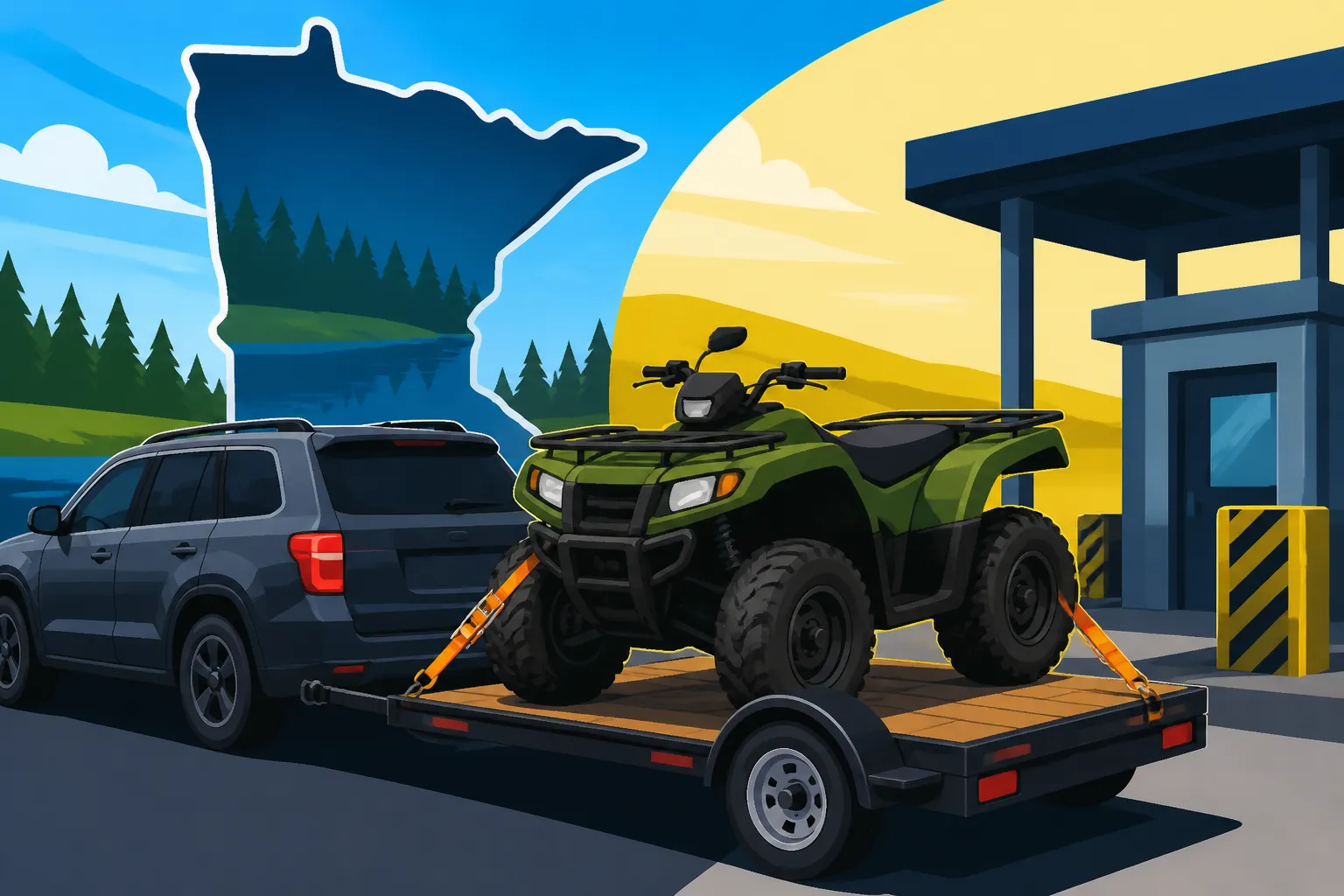
A dependable setup usually has four securement points, with the machine held down at both the front and rear. The exact attachment points depend on the machine and trailer. Avoid routing straps over fragile plastic, brake lines, wiring, or parts that can bend or rub through. Do not rely on a single strap, the parking brake, or the machine’s transmission to keep it in place.
Use straps that are in good condition and rated for the task. Look for damaged stitching, cuts, fraying, bent hooks, or worn ratchets before loading. Keep the straps clear of sharp edges, and use protective sleeves or padding where contact could cause wear. If the machine has soft suspension, some riders compress it modestly while strapping, but do not overtighten or use a method that could damage suspension components. Follow the manufacturer’s guidance.
| Check | What to look for | Why it matters |
|---|---|---|
| Trailer capacity | The trailer can handle the quad and any additional cargo | Prevents overloading the trailer |
| Weight placement | The load is balanced and the trailer remains stable when hitched | Reduces sway and handling problems |
| Tie-down points | Straps attach to suitable, sturdy points | Helps prevent damage and movement |
| Strap condition | No cuts, fraying, damaged stitching, or faulty ratchets | Worn gear can fail under road vibration |
| Wheels and chocks | Tires are restrained against rolling where appropriate | Adds stability while straps are tightened |
| Lights and plate | Visible and working after loading | The load should not conceal required equipment |
| Final check | Straps remain tight after a short drive | Settling can loosen a load |
Wheel chocks can help keep a machine in position while you attach the straps, but they are not a replacement for proper tie-downs. If you shop for straps or chocks through Amazon or another retailer, check the working-load information and inspect the actual hardware when it arrives. A product listing or a high breaking-strength figure is not a reason to ignore the equipment’s intended use or the trailer maker’s instructions.
Once the quad is loaded, check the tongue weight and balance according to the trailer manufacturer’s guidance. A load that is too far forward or too far back can affect towing stability. Do not guess based only on how the trailer looks; an unstable setup can be difficult to correct once you are on the road.
Before leaving, walk around the entire rig. Check the coupler, safety chains, lights, straps, ramps, and any loose gear. Stop soon after departure in a safe place and inspect the load again. Repeat the check during longer trips, especially after rough pavement or a hard stop.
For more hauling preparation, see Tying a Machine Down for the Interstate and Trailer Registration for Hauling ATVs in Minnesota. If you are carrying more than one machine, Two Quads on One Trailer Deck covers the added space and placement questions.
Paperwork and permits after you arrive
Keep documents organized and easy to reach. Depending on where you are traveling and riding, useful items may include:
- The quad’s registration or other proof of its legal status.
- Ownership paperwork, especially if the machine was recently bought or borrowed.
- Your driver identification and any required riding or safety certificate.
- A trail pass or permit, if required for the riding area.
- Permission from a private landowner, if the route uses private land.
The documents required for hauling are not necessarily the same as those required for riding. A state may have rules for trailers and road travel, while its parks, forests, or trail systems have separate operating requirements. Keep the quad’s papers secure, but do not assume that having them in the truck or trailer makes the machine eligible to ride everywhere.
Minnesota-bound trips
If you are bringing an out-of-state quad to Minnesota, identify the exact place you plan to ride before you set off. Minnesota trail rules can depend on the machine, its registration, the land manager, and whether the route is a designated trail. A trail pass may be required even when the machine has paperwork from another state. Verify the current requirement for the particular trail system rather than relying on another rider’s experience or a general statement about reciprocity.
Start with Minnesota’s Non-Resident ATV Trail Pass and Which Minnesota Trails Require a Pass. For the registration side, Minnesota Registration for an Out-of-State Machine explains the distinction between bringing a machine into the state and registering it there. If you are unsure what your machine’s current registration covers, check directly with the relevant state agency or trail manager.
Do not confuse a trail pass with permission to ride on every kind of public land. Some areas have separate rules or restrictions, and a pass does not authorize trespassing or riding on closed routes. Before unloading, confirm the trail is open and suitable for your machine’s class and width. Reading a Minnesota OHV Trail Map and Checking Minnesota Trail Status Before You Drive can help with that planning.
Minnesota-bound trips from neighboring states
A short trip from a neighboring state can still involve different rules. Do not assume your home registration automatically satisfies Minnesota trail requirements, and do not assume a Minnesota registration will be accepted in the same way everywhere else. For a Minnesota machine headed out of state, check the destination state’s registration, permit, and riding rules before travel.
If your plans include more than one state, make a simple list of each place where you expect to ride and check each one separately. This is especially useful for a trip that combines a state forest, a county trail, and a privately operated riding area. The operator or land manager can tell you whether a separate permit or access condition applies.
If the quad is borrowed or rented, ask who is responsible for obtaining any required pass. The answer may depend on the program and the machine’s status, so confirm it with the rental company or issuing agency. See Minnesota Pass Rules for a Rented Machine and Trail Passes for a Borrowed Machine for Minnesota-focused questions.
A practical border-trip plan
A little planning can prevent a frustrating arrival with a properly hauled machine that cannot legally ride where you intended. Work through the trip in this order:
- Choose the riding area. Name the trail system or land unit, not just the town you are visiting.
- Check access and closures. Confirm that the route is open to ATVs or UTVs and to your machine’s dimensions.
- Verify permits and registration rules. Check the destination agency or trail manager for requirements that apply to your machine and where it is registered.
- Check the tow route. Review trailer requirements for the states you will travel through, including any rules relevant to your trailer’s size and load.
- Inspect the rig. Confirm the trailer, hitch, tires, lights, chains, straps, and load balance are ready.
- Pack paperwork and equipment. Keep documents accessible, and bring tools or a spare strap appropriate for the trip.
- Recheck after loading. Inspect the rig before departure and again after a short drive.
- Unload only in an authorized place. Use a designated staging area or other location where unloading and parking are allowed.
Plan for conditions as well as rules. A trail that is open may still be difficult or unsuitable after heavy rain, thaw, or storm damage. If the ride depends on a remote trailhead, confirm parking and access before towing there. For broader trip preparation, see Planning a Minnesota Riding Trip and Minnesota Trailhead Parking and Staging.
The main trade-off is time spent checking requirements against the risk of arriving with the wrong permit, an unsuitable trailer setup, or no legal place to unload. A quick call or official status check before departure is usually easier than changing plans at the trailhead.
Disclaimer
This article is for general informational purposes only and does not constitute professional advice. Laws, prices and regulations vary by location and change over time. Consult a qualified professional for guidance on your specific situation.