Minnesota’s Ditch Riding Rules
It’s a common scenario for many Minnesota ATV and UTV owners: you want to zip down the road a short distance to a friend's cabin, the local gas station, or just to link up to a trail system, but you're not sure if it’s legal to ride in the ditch. The rules around riding your off-highway vehicle (OHV) on public road rights-of-way can feel like a tangled web, leaving you wondering if you're risking a hefty fine or worse. This comprehensive guide is here to untangle those rules, clarify what's allowed and what's definitely not, and help you understand how to navigate Minnesota’s ditch riding regulations safely and legally.
Understanding Minnesota's Road Right-of-Way
Before we dive into the specifics of ditch riding, it's crucial to understand what "road right-of-way" actually means in Minnesota. This isn't just a legalistic term; it's the fundamental concept that dictates where you can and cannot operate your ATV or UTV near a road. Many riders mistakenly believe that if they’re not on the paved surface, they’re automatically fine, but that’s not always the case.
Defining the "Right of Way" for OHVs
The "right-of-way" generally refers to the entire strip of land that a road or highway department controls. This isn't just the asphalt or concrete; it extends beyond the shoulders to include the ditches, culverts, and often a significant swath of grass or trees flanking the road. For ATV and UTV riders, understanding this definition is paramount. The law specifically addresses whether you can ride within this broader right-of-way, not just whether you're on the "road" itself. It's the space the public has the right to travel over or use, and local and state agencies have jurisdiction over it for transportation purposes.
Think of it like this: when you're driving your truck, you're obviously on the pavement. But the ditch next to that pavement is also part of the road's domain. When the state or county acquires land for a road, they typically buy or condemn a strip that's wider than just the driving lanes. This extra width is for drainage, snow storage, utility lines, and future expansion. It's this entire corridor that we're talking about when discussing ditch riding. This distinction is critical because merely being off the paved surface doesn't automatically grant you permission to ride your OHV.
Road Surface Versus the Ditch: What's the Difference?
Minnesota law draws a very clear line between the road surface and the ditch. The road surface is exactly what it sounds like: the part of the road that's designed and maintained for vehicular traffic, including the paved or gravel lanes and the shoulders. On the vast majority of Minnesota roads, operating an ATV or UTV directly on this surface is prohibited, with very few, specific exceptions that we’ll discuss later. This is for safety reasons, as OHVs are not designed for the speed or traffic conditions of public roads.
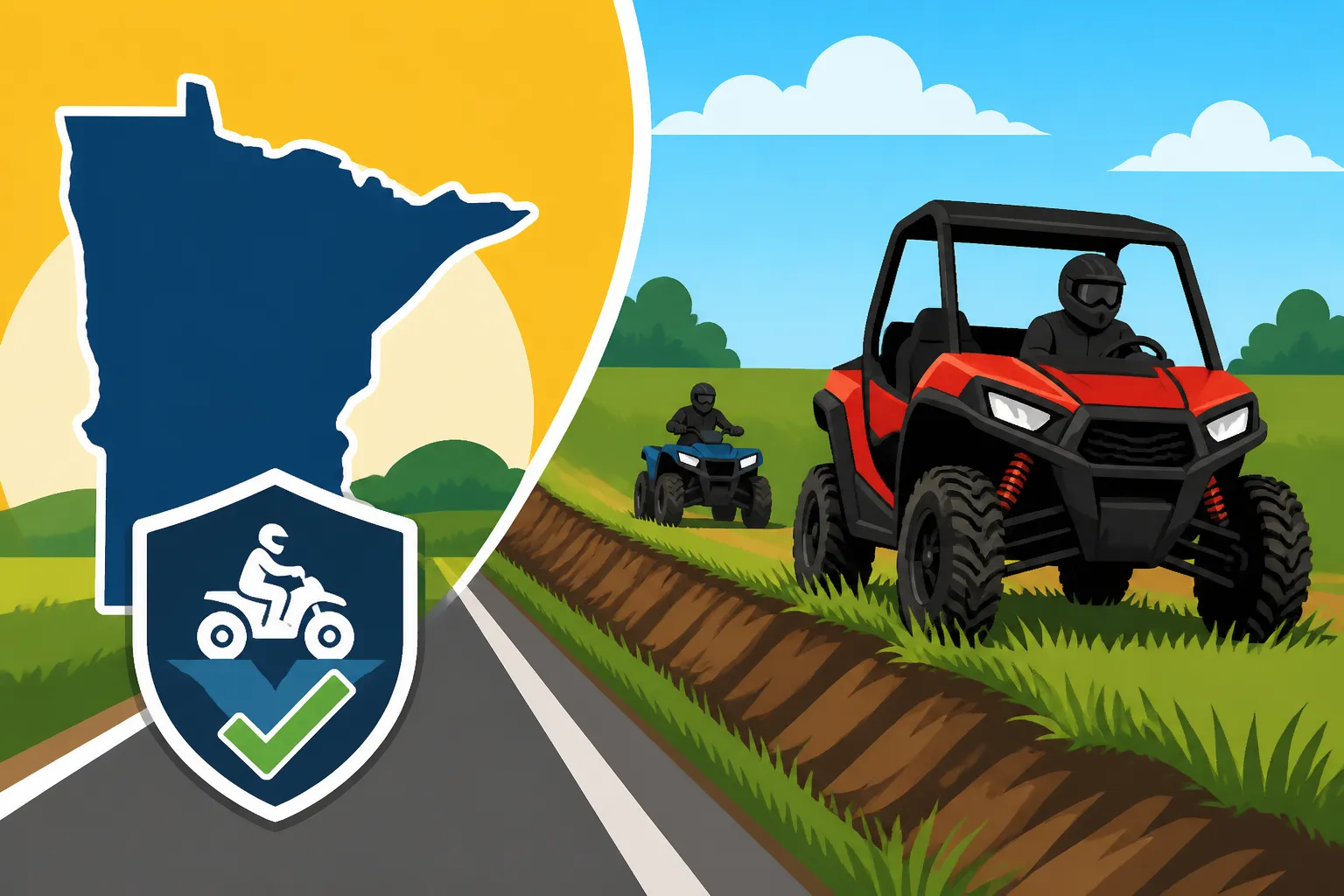
The "ditch," however, is a different story. In Minnesota, the ditch is generally defined as the area from the outer edge of the shoulder to the point where the public right-of-way ends, typically marked by fences, utility poles, or property lines. This is the area where, under specific conditions and on certain types of roads, you might be allowed to ride your ATV or UTV. It’s important to note that this isn’t an open invitation to ride anywhere off the pavement; there are strict rules about which ditches, when, and how. The laws try to balance the desire for OHV access with the safety of all road users and the protection of private property adjacent to the right-of-way.
Seasonal Versus Year-Round Ditch Access
One common point of confusion for riders is whether ditch access changes with the seasons. While some natural resources areas or specific trails might have seasonal closures, the general rules for ditch riding on public road rights-of-way in Minnesota are largely consistent year-round, barring specific local ordinances. For example, during winter, snow often fills ditches, making them prime for snowmobiling, but the rules for ATVs and UTVs remain separate.
However, there can be practical considerations. A ditch that is perfectly rideable in the dry summer months might become an impassable bog after a heavy spring rain, or turn into a slippery, icy hazard in winter. While the law might not explicitly prohibit riding in a muddy ditch, common sense and a respect for the environment (and your machine!) should dictate your choices. Remember, causing damage to the right-of-way, especially during vulnerable times like spring thaw, could lead to fines or restrictions. Always check for specific local rules, as some townships or counties might have their own seasonal restrictions or recommendations, especially during spring thaw.
Who Can Legally Ride an ATV or UTV in Minnesota's Ditches?
It's not just about where you can ride; it's also about who is allowed to operate an ATV or UTV in Minnesota's road ditches. Just like driving a car, there are age requirements, training mandates, and licensing considerations that apply to OHV operation, especially when near public roadways. Understanding these requirements will prevent you from inadvertently breaking the law and facing penalties.
Age and Driver's License Requirements
Minnesota has specific age requirements for operating ATVs and UTVs on public lands and rights-of-way. Generally, you need to be at least 12 years old to operate an ATV, and there are additional rules about supervision for younger riders. For those venturing into road ditches, the rules become a bit more nuanced. If you’re riding in the ditch of a public road, and that road is legally open to OHV use (which we’ll cover more deeply), there are usually stipulations regarding the operator’s age and whether they hold a valid driver’s license.
For example, a person 12 years of age or older but under 16 years of age may operate an ATV in the ditch of a public road if they have a valid ATV safety certificate and are accompanied by an adult (at least 18 years old) riding on a separate ATV or UTV. Once a rider turns 16, and possesses a valid driver's license (or instructional permit), the accompanying adult requirement usually no longer applies, assuming they also have their safety certificate. The nuances are important here: simply being 16 doesn't automatically mean you're clear to ride solo in the ditch without a license, as the law links some ditch-riding privileges to standard driving privileges. For a full breakdown, you might find [Driver's License Rules for Minnesota Road Riding] helpful.
ATV Safety Training Requirements
Beyond age, Minnesota mandates ATV safety training for many riders. Specifically, anyone born after July 1, 1987, must complete an approved ATV safety course to operate an ATV or UTV on public lands, including road ditches. This training covers essential safety practices, environmental awareness, and a thorough understanding of Minnesota’s OHV laws. It’s not just a hoop to jump through; it genuinely prepares riders for safe and responsible operation.
Carrying proof of this certification is vital. Conservation Officers and other law enforcement personnel can and do ask for it during routine checks. If you're stopped in a ditch and don't have your safety certificate when required, you could face a citation. This applies equally to residents and non-residents, although out-of-state certifications are often recognized if they meet Minnesota's standards. Ensuring every eligible rider in your group has this certification is a simple step to avoid legal trouble and ensure everyone's safety.
Accompanied Riding for Minors
For younger riders, particularly those between the ages of 12 and 15, Minnesota law often requires adult supervision when operating an ATV or UTV in public road ditches. This isn't just about general safety; it's a legal requirement that must be met. The accompanying adult must typically be at least 18 years old and riding on a separate ATV or UTV. This means a parent or guardian can’t simply be driving a truck on the adjacent road while their child rides the ditch alongside them; they need to be actively supervising from another OHV.
This rule is designed to ensure immediate intervention in case of an accident or unexpected hazard, and to guide younger riders in adhering to traffic laws and property boundaries. It's a layer of protection for the rider, other road users, and private landowners. Familiarizing yourself with these specific requirements, particularly if you have children or grandchildren who ride, is critical before heading out. Overlooking this detail is a common reason for citations issued to families enjoying a day out.
When and Where Can You Ride the Ditch? Minnesota's Specifics
This is where many riders get confused, and understandably so. Minnesota's rules for ditch riding are not a blanket allowance across all roads. They depend heavily on the type of road, the time of day, and specific local ordinances. Ignoring these distinctions can quickly turn a fun ride into an illegal one.
Time of Day Limitations
Just like other forms of traffic, there are often restrictions on when you can operate an ATV or UTV in a road ditch, particularly after dark. Generally, Minnesota law prohibits operating an ATV or UTV in the ditch of a public road between one-half hour after sunset and one-half hour before sunrise, unless the machine is equipped with legal lighting. However, even with proper lighting, local ordinances or specific road classifications might have stricter night riding rules.
This "one-half hour" rule is important to remember. It means that even if you've got a fantastic light bar from SuperATV that illuminates the entire ditch like daylight, you still need to be mindful of the clock. Many riders get caught out simply by misjudging the sunset. If you plan to ride near dusk or dawn, ensure your machine is fully compliant with [Lighting Rules for Minnesota Night Riding], including working headlights and taillights, and that you're aware of any local curfews. The aim is to make sure OHVs are visible to other road users during periods of reduced light, minimizing accident risks.
Township and County Roads: Limited Access
Most of Minnesota's ditch riding opportunities exist along township and county roads. These are generally the "lesser" roads compared to state highways, often gravel or lightly traveled paved routes. Here, Minnesota law often permits ATV and UTV operation in the ditch, provided all other rules (age, training, equipment, etc.) are met. However, this permission is not absolute. Individual townships and counties retain the authority to adopt ordinances that either restrict or further permit OHV use on their rights-of-way.
It’s an absolute must to check with the specific township or county where you plan to ride. What’s allowed in one county might be prohibited just across the line in another. Many counties or townships will have maps or lists of approved routes, or designated "trail towns" where ditch riding is explicitly allowed to access services. For example, some cities like Appleton, Minnesota have adopted ordinances that allow ATVs on certain streets to connect to trails or access local businesses. Always assume restrictions unless you have confirmed permission. Ignoring this local check is a prime reason riders receive citations, because local law enforcement will know their specific ordinances.
| Road Type | Ditch Riding Status (General MN Law) | Considerations |
|---|---|---|
| Township Roads | Generally Permitted | Check local ordinances, may have specific restrictions or designated routes. |
| County Roads | Generally Permitted | Check local ordinances, may have specific restrictions or designated routes. |
| State Highways | Strictly Prohibited | No ditch riding, no road surface riding, only direct crossing at 90 degrees. |
| Interstate Highways | Strictly Prohibited | Absolutely no ATV/UTV access on any part of the right-of-way. |
| Posted Private Property | Prohibited | Requires explicit permission from landowner, even if adjacent to a ditch. |
State Highways: Strictly Prohibited
This is perhaps the most important rule to remember: you absolutely cannot operate an ATV or UTV in the ditch of a state highway in Minnesota. State highways (those marked with a numerical shield, like Highway 2 or Highway 169) are completely off-limits for OHV travel, both on the road surface and in the ditch. This prohibition is strictly enforced and carries significant penalties.
The only exception to this rule is the ability to cross a state highway directly, typically at a 90-degree angle, from one permissible riding area to another. This crossing must be done safely, yielding to all traffic, and at the nearest point of access. You cannot ride along the ditch for any distance before or after the crossing. This strict rule exists due to the higher speeds and increased traffic volume on state highways, where an OHV operating in the ditch would pose a severe safety hazard to both the OHV operator and motorists. Getting caught riding a state highway ditch will almost certainly result in a ticket, and it’s a dangerous gamble to take. You can learn more about this in [Minnesota Rules on State Highways].
Machine Requirements for Ditch Riding in Minnesota
Just having an ATV or UTV isn't enough; your machine needs to be equipped according to Minnesota law to be legally ridden in a public road ditch. These requirements are in place for safety, noise control, and to ensure your machine isn't damaging the environment. Make sure your quad or side-by-side meets these standards before you head out.
Lighting and Reflectors
As mentioned with time-of-day restrictions, proper lighting is non-negotiable for operating an ATV or UTV in a ditch, especially when light conditions are low. Minnesota law requires all ATVs and UTVs to have at least one headlight capable of illuminating objects at a certain distance and at least one taillight visible from a specified distance. If you're riding after dark, these must be fully functional. It's not just about seeing where you're going; it's about being seen by others, including motorists and other OHV riders.
Beyond the basic lights, reflectors can also be a good idea, particularly if your machine isn't equipped with robust factory lighting. Reflective tape or additional reflectors, especially on the rear and sides, can significantly increase your visibility to others. While the law specifies minimums, enhancing your visibility, especially when operating near roads, is a smart safety practice. Many aftermarket accessories, like those from SuperATV, offer upgraded lighting solutions that far exceed minimum requirements, providing both better visibility for you and making you more visible to others, which is a huge bonus for ditch riding safety.
Mufflers and Spark Arresters
Minnesota also has strict rules regarding the noise level and exhaust systems on ATVs and UTVs. All machines must be equipped with a muffler in good working order that prevents excessive noise. Modified or "straight pipe" exhausts are illegal and can result in fines. The goal here is to reduce noise pollution, especially in residential areas or near lake homes, where excessive noise can be a major nuisance. This helps maintain good relationships with the communities you ride through and ensures that OHVs are not disruptive.
In addition to mufflers, all ATVs and UTVs must be equipped with a U.S. Forest Service-approved spark arrester. This device is critical for preventing wildfires by trapping glowing carbon particles that might escape the exhaust system. Riding without a proper spark arrester is not only illegal but also incredibly irresponsible, particularly in Minnesota’s often dry forests and grasslands. [Mufflers and Spark Arresters in Minnesota] offers more detailed information on these requirements. Always check your machine's exhaust system to ensure it's in compliance; it's a small check that prevents big problems.
Passenger Rules on a Ditch Ride
Passenger rules are another area where ATVs and UTVs differ significantly, and these rules carry over to ditch riding. Generally, ATVs are designed for a single operator unless they are specifically manufactured for a passenger (e.g., a "two-up" model with a designated passenger seat and handholds). Attempting to carry a passenger on a single-rider ATV, even in a ditch, is illegal and extremely dangerous. It compromises the machine's balance and handling, making it much harder to control.
UTVs, or side-by-sides, on the other hand, are designed to carry multiple passengers, typically in a seating arrangement similar to a car, with seatbelts. For UTVs, ensure all passengers are properly seated and belted, and that the total number of occupants does not exceed the manufacturer's design capacity. Just like in a car, children often have specific seating and restraint requirements. Always adhere to the manufacturer's guidelines and Minnesota's passenger laws to ensure everyone's safety while ditch riding. [Passengers on a Minnesota Road Section] covers these rules in more detail.
Safety and Etiquette for Ditch Riders
Riding in a road ditch carries inherent risks that differ from dedicated trails. Sharing the right-of-way with vehicle traffic, encountering driveways, and navigating varying terrain all require a heightened sense of awareness and specific safety practices. Good etiquette also plays a huge role in maintaining positive public perception of OHV riders.
Visibility and Blaze Orange
When you're riding in a ditch alongside a public road, you are operating in close proximity to cars, trucks, and other vehicles moving at much higher speeds. Your visibility to these drivers is paramount. Minnesota law often requires ATV and UTV operators to wear blaze orange or another highly visible color, especially during hunting seasons. Even outside of hunting season, it’s an incredibly smart practice to make yourself as conspicuous as possible. A blaze orange helmet, vest, or jacket can make all the difference in alerting an oncoming or passing motorist to your presence.
Think about how easily an OHV in a grassy ditch can blend into the background, especially on winding roads or in hilly terrain. Anything you can do to stand out, whether it's wearing bright colors, adding extra reflective tape to your machine, or using a tall whip flag, enhances your safety. This is a simple, low-cost measure that could literally save your life by preventing a motorist from inadvertently turning into your path or veering into the ditch.
Speed Limits in the Ditch
While ditches don’t typically have posted speed limit signs, it doesn't mean you can open up your throttle. Minnesota law usually imposes a maximum speed limit for ATVs and UTVs operating in a road ditch, which is often significantly lower than the speed limit for the adjacent road. This lower limit is due to the unpredictable terrain of ditches (culverts, hidden rocks, soft ground), the proximity to other traffic, and the need for quick reaction times.
Furthermore, common sense and conditions should always dictate your speed. A muddy, uneven ditch full of unexpected dips and bumps demands a much slower pace than a smooth, dry one. Slowing down when passing residences, farmsteads, or other property owners is not just polite, it can be a legal requirement and definitely helps maintain good relations. [Speed on a Minnesota Road Right of Way] covers specific limits, but generally, ditch riding should be a much more cautious and controlled experience than trail riding.
Respecting Private Property
Even though you’re riding in the road right-of-way, remember that adjacent land is almost always private property. This means you must never, under any circumstances, veer off the right-of-way onto someone’s land without explicit permission. This includes avoiding cutting across fields, driving through yards, or parking your machine on private driveways unless invited. Trespassing is illegal and can lead to fines, legal action, and a significant backlash against the OHV community.
The ditch might look like open land, but its boundary with private property is sacred. Be mindful of fences, posted signs, and natural boundaries. If you need to stop, do so in a way that doesn't impede traffic, obstruct views, or look like you're encroaching on someone's space. A friendly wave to a landowner you pass goes a long way. Building positive relationships with residents along ditch routes is essential for preserving ditch riding privileges for everyone.
Common Pitfalls and Penalties for Illegal Ditch Riding
Riding outside the rules can lead to more than just a stern talking-to. Minnesota has clear penalties for OHV violations, and ditch riding mistakes are no exception. Knowing these common pitfalls can help you avoid costly tickets and other legal troubles.
Unregistered Machines and Missing Stickers
One of the most frequent reasons for a citation is operating an unregistered ATV or UTV. All off-highway vehicles used on public lands and rights-of-way in Minnesota must be registered with the Minnesota Department of Natural Resources (DNR) and display a valid registration sticker. [Registering an ATV in Minnesota] and [Where a Minnesota ATV Registration Sticker Goes] provide extensive details on this process. This includes machines ridden in road ditches.
If your machine's registration is expired, or if the sticker isn't properly affixed and visible, you're in violation. A DNR Conservation Officer or local law enforcement officer can stop you and issue a ticket. The fines for an unregistered machine can be substantial, and it’s an easily avoidable mistake. Always double-check your registration status before you head out, and make sure your sticker is in place and legible.
Riding on the Pavement: A Big No-No
As discussed earlier, with very limited exceptions (like crossing), riding your ATV or UTV directly on the paved or graded surface of most public roads in Minnesota is strictly prohibited. This is a serious safety violation because OHVs are not designed for road speeds, they lack the same safety features as cars, and they can be difficult for motorists to anticipate. The ditch is one thing; the driving lane is entirely another.
The penalties for riding on the road surface are often higher than for other OHV violations, reflecting the increased danger posed. You could face significant fines, points on your driving record, and even impoundment of your machine. Don't be tempted to hop onto the asphalt, even for a short stretch, just because the ditch is challenging or water-filled. It's a risk that's simply not worth taking. [Can You Ride the Road Surface in Minnesota?] goes into more detail about these prohibitions.
DUI and Open Container Rules
Just like operating a car, operating an ATV or UTV in Minnesota's road ditches (or any public land) while under the influence of alcohol or drugs is illegal. Minnesota's DWI laws apply to OHVs, and the legal limits for blood alcohol content are the same. A DWI on an ATV carries severe penalties, including fines, loss of driving privileges, and even jail time, similar to a car DWI. Law enforcement, including DNR Conservation Officers, actively patrols for impaired OHV operation.
Furthermore, open container laws that apply to motor vehicles also extend to ATVs and UTVs. You cannot have an open container of alcohol in an OHV while it's being operated on public lands or rights-of-way. This means no cracking open a cold one until you're safely parked back at your campsite or private property. Understanding [Minnesota Alcohol Limits for ATV Operators] is critical to responsible and legal ditch riding. These laws are rigorously enforced to prevent accidents and ensure the safety of everyone sharing the roads and ditches.
Navigating Intersections and Crossings
Ditch riding often means encountering intersections, driveways, and even railroad tracks. These are critical points where specific rules apply, and where vigilance is especially important to ensure your safety and comply with the law. Knowing how to navigate these situations correctly is key to a smooth and legal ride.
Crossing a County Road on an ATV
When you're riding in the ditch of one county or township road and need to cross another public road, you must treat it like any other intersection. This means coming to a complete stop, looking both ways, and yielding to all vehicular traffic on the intersecting road. You should cross the road at a 90-degree angle, making the crossing as direct and quick as possible. You cannot turn onto the intersecting road and ride along its ditch unless that ditch itself is a legally designated OHV route.
The key here is directness and safety. Don't meander across the road or attempt to ride in the ditch of the cross-street if it's not a legal OHV route. Be predictable, use hand signals if appropriate, and always prioritize yielding to other vehicles. Motorists may not expect an ATV or UTV to emerge from a ditch, so extra caution is warranted. [Crossing a County Road on a Minnesota ATV] offers further guidance on this common maneuver.
Crossing a Minnesota State Highway
As stated before, riding in the ditch of a state highway is prohibited. However, the law does allow you to cross a state highway. This is a very specific maneuver: you must cross at the nearest point of safe access, making a direct crossing at approximately a 90-degree angle to the highway. You must stop, yield to all traffic on the highway, and cross when it is safe to do so.
This is arguably the most dangerous maneuver a ditch rider will face. State highways carry faster traffic, and drivers may not be looking for an OHV crossing. Choose your crossing point carefully, ensuring you have clear lines of sight and ample time to get across. Never attempt to ride parallel to the highway, even for a few feet, before or after a crossing. It must be a direct entry and exit from the ditch on either side. Always exercise extreme caution and consider if there's an alternative route that avoids state highway crossings altogether. See [Crossing a Minnesota State Highway] for more details.
Railroad Grade Crossings
Railroad tracks present another unique hazard and set of rules for ditch riders. When you encounter a railroad grade crossing, you must come to a complete stop, look in both directions along the tracks, and listen for approaching trains. You must yield to all trains and avoid crossing the tracks until it is completely safe to do so. Never attempt to "beat" a train, and be aware that trains can be much quieter and faster than you might anticipate.
Beyond safety, there’s also the issue of legality and trespass. Riding on railroad tracks or along the railroad right-of-way (the land immediately adjacent to the tracks) is strictly prohibited and constitutes trespassing. Railroad property is private property, and railroad companies are very serious about prosecuting trespassers due to the extreme danger involved. Always cross at designated crossings and never ride parallel to the tracks. The consequences of a mistake at a railroad crossing are catastrophic.
The "Why" Behind Minnesota's Ditch Rules
Understanding the intent behind Minnesota's complex ditch riding regulations can sometimes make them easier to follow. These rules aren't just arbitrary; they are designed to balance the recreational desires of OHV enthusiasts with public safety, environmental protection, and the rights of property owners.
Protecting Road Surfaces and Infrastructure
One primary reason for prohibiting OHV travel on road surfaces (and restricting it in ditches) is to protect road infrastructure. ATVs and UTVs, particularly those with aggressive tires or tracks, can cause significant damage to paved and gravel road surfaces, shoulders, and especially to the underlying ditch structures, culverts, and drainage systems. This damage leads to costly repairs that fall on taxpayers.
The design of road ditches is also crucial for drainage. Operating heavy OHVs in soft or wet ditches, especially during spring thaw or after heavy rains, can rut the ground, compact soil, and disrupt natural water flow, leading to erosion and further damage to the roadbed. The rules aim to prevent this wear and tear, preserving the lifespan of roads and keeping maintenance costs down for communities. [Minnesota Road Restrictions During Spring Thaw] highlights how seriously this is taken.
Balancing Access and Safety for All
Minnesota has a strong tradition of outdoor recreation, and the state recognizes the popularity of ATVs and UTVs. The ditch riding rules are an attempt to balance providing access for these machines with ensuring the safety of all road users – motorists, pedestrians, bicyclists, and other OHV operators. Unrestricted OHV use in all ditches would create chaos and significantly increase the risk of serious accidents.
The specific restrictions on state highways, the time-of-day limits, and the emphasis on visibility are all direct efforts to mitigate these safety risks. By confining OHV use to certain ditch types and requiring specific safety measures, the state attempts to create an environment where different forms of transportation can coexist with minimal conflict. It’s a constant negotiation between providing recreational opportunities and upholding public safety standards.
The Role of Conservation Officers and Enforcement
Minnesota DNR Conservation Officers, along with local sheriff's deputies and state troopers, are the primary enforcers of OHV laws in Minnesota. These officers are often very knowledgeable about local terrain, common riding areas, and the specific rules that apply in their jurisdiction. Their role is not just to issue tickets, but also to educate riders and ensure safe, responsible use of public lands and rights-of-way.
You might encounter an officer at a trail access point, or they might simply pull up behind you while you're riding in a ditch. Be prepared to show your safety certificate, registration, and driver’s license if asked. Being polite and cooperative goes a long way. Understanding that they are there to enforce rules designed for everyone's safety and environmental protection can help foster a more positive interaction. [Minnesota Conservation Officer Enforcement in Minnesota] details more about their powers and duties. They are an integral part of maintaining the system that allows for ditch riding at all.
Disclaimer
This article is for general informational purposes only and does not constitute professional advice. Laws, prices and regulations vary by location and change over time. Consult a qualified professional for guidance on your specific situation.