Does a Minnesota Certificate Expire?
Does a Minnesota Certificate Expire?
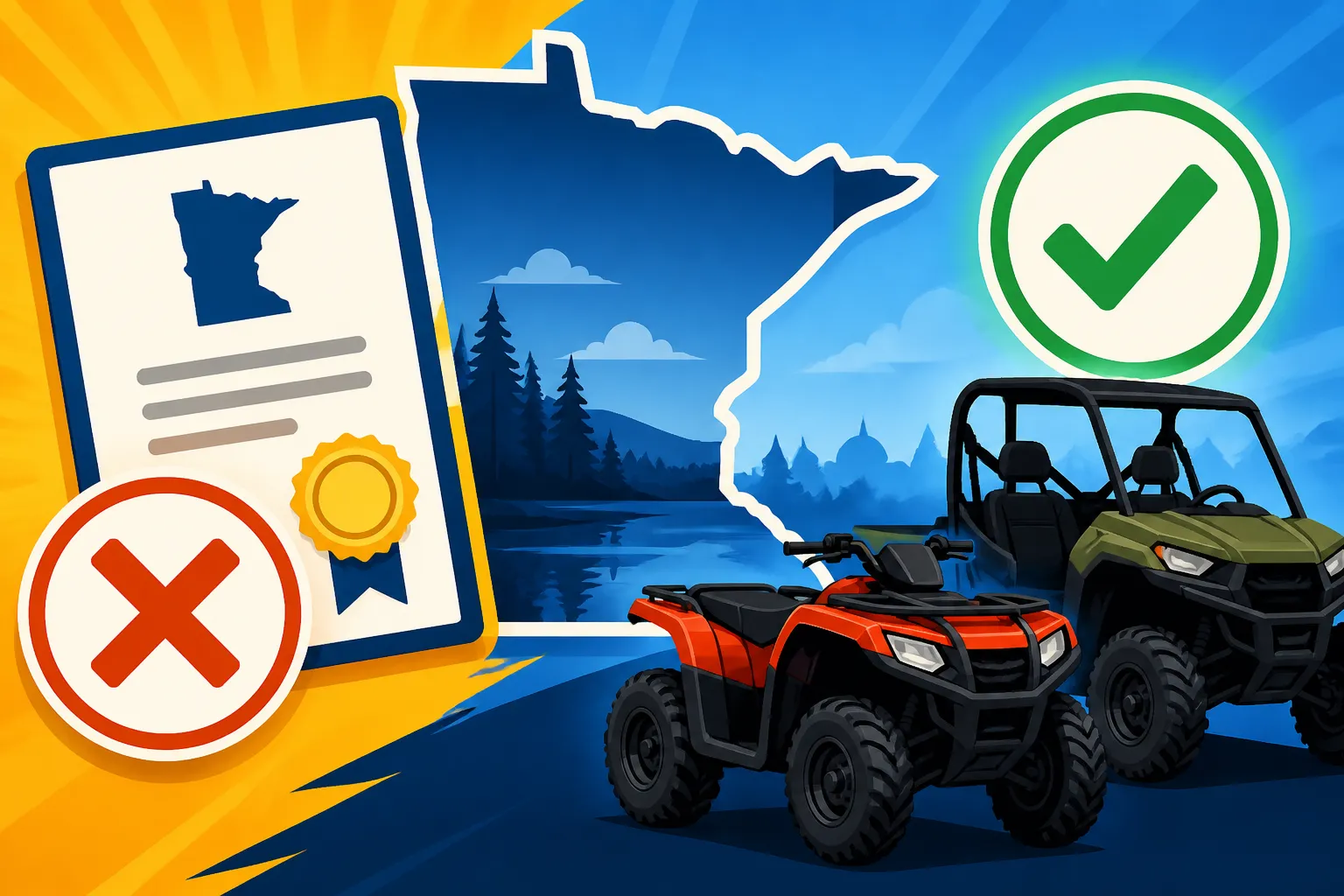
If you completed Minnesota ATV safety training years ago, you may be wondering whether you need to take the course again before riding. In general, the certificate does not expire. The important catch is that a valid training certificate is only one part of riding legally; age, machine registration, trail-pass rules and the place you ride can all matter too.
Does a Minnesota ATV safety certificate expire?
Minnesota’s ATV safety certificate generally does not have a routine expiration date. Once you have completed the required, state-recognized training and earned the certificate, you normally do not need to repeat the course just because time has passed.
That does not mean every piece of paper that says “ATV training” automatically counts as a Minnesota certificate. The course and credential must meet Minnesota’s requirements. If you completed training in another state, took a course years ago and cannot find your record, or have a card that does not clearly identify the program, confirm that it is accepted before relying on it.
The certificate is also different from a registration, trail pass or permit. Those items can have their own renewal periods, machine-specific conditions or limits on where they apply. A permanent training certificate does not make an expired registration current, replace a required trail pass, or grant permission to ride on private land.
| Item | Does it generally expire? | What to check before riding |
|---|---|---|
| Minnesota ATV safety certificate | Generally, no routine expiration | That your certificate is recognized and your record can be verified |
| Machine registration | May need renewal | Current status, registration type and decal |
| Trail pass | Depends on the pass and its rules | Whether the route requires one and whether it applies to your machine |
| Landowner permission | Applies to the specific property and permission given | That you have permission for the location and activity |
| Age-related riding eligibility | Depends on the rider and where they operate | Current age, supervision and training rules |
For the broader course requirement, see Minnesota ATV Safety Training Requirements. If you are unsure whether the birthdate rule applies to you, The July 1987 Birthdate Rule explains the age-and-training distinction.
The safest practical approach is to treat your certificate as a lasting credential but verify your specific record if there is any doubt. This is especially useful before a trip, when borrowing a machine, or when riding an unfamiliar trail system. A certificate that exists in a training record is more useful than a vague memory of taking a course, so keep the original or a clear digital copy where you can find it.
What the certificate does and does not cover
An ATV safety certificate shows that you completed an eligible training requirement. It does not give a rider blanket permission to operate every kind of off-highway machine, on every route, at any age or under any conditions.
Think of it as one item in a set of requirements. Before you ride, check the rules that apply to the person, machine and location. A rider can have a valid certificate and still be ineligible to ride a particular machine or trail, or be missing another required document.
Age and training requirements
Minnesota’s training rules depend in part on the rider’s age and birthdate. The certificate requirement applies to some riders operating on public riding areas, but it is not a universal rule that every person of every age must complete the same course. There are also additional conditions for younger riders.
Rather than using the certificate alone to decide whether a young person can ride, confirm the current requirements for the rider’s age, machine and location. Supervision and operating limits may apply in addition to training. Start with Safety Certification for Riders Twelve and Over and Minnesota Age Rules at Twelve and Sixteen if a child or teen will be operating.
A rider’s situation can also change over time. Turning a certain age may affect supervision or other operating rules without changing the certificate itself. The certificate does not expire simply because the rider has a birthday, but age-based rules may change what that rider is allowed to do.
Registration and trail passes
A safety certificate does not register the machine. Registration is a separate record tied to the ATV and its permitted use. Before heading out, check that the machine’s registration is current and appropriate for the places where you plan to ride. Registering an ATV in Minnesota covers the registration process, while Minnesota Public Use Versus Private Use Registration explains why the type of use matters.
A trail pass is separate again. Some riding areas and trail systems have pass requirements that depend on the machine and route. A certificate does not substitute for a pass, and having a pass does not prove that the rider has completed required training. Check Which Minnesota Trails Require a Pass before planning a ride, especially if your route connects different land types or trail networks.
These distinctions matter when a group is made up of riders with different documents. One person may have a current certificate but need to confirm registration; another may have a properly registered ATV but still need to meet a training or pass requirement. Check each person and machine separately rather than assuming that one document covers the group.
Permission and access
Training does not grant access to private property. You still need permission to ride on land where permission is required, and you need to follow restrictions for the property, trail or public riding area. Similarly, a trail pass does not authorize riding off the designated route.
The certificate also does not override closures, seasonal restrictions or route-specific limits. If a trail is closed, restricted to certain machines or not open to ATVs, your training credential does not change that. Check the riding area’s current information before loading up.
When you may need to check or repeat training
Most riders do not need to retake an eligible course just because their certificate is old. There are, however, situations where checking the credential—or completing training again—may be sensible or necessary.
You took a course outside Minnesota
A certificate from another state may be accepted, but do not assume that every out-of-state course meets Minnesota’s requirements. Course content, the issuing organization and how the credential is recorded can differ. Confirm recognition before you ride rather than finding out during a trip that your proof is not accepted.
The topic is especially relevant to visiting riders and people who moved to Minnesota after taking a course elsewhere. Out-of-State Certificates Minnesota Accepts provides a starting point, and Minnesota Rules for Visiting Riders covers other requirements that can apply to nonresident riders.
When asking whether a certificate is accepted, have the issuing state, course name, completion date and any identifying number available. If you have a card or certificate, keep a readable image of both sides. Those details can make it easier to determine whether the credential corresponds to an approved ATV course rather than a general safety class.
Your proof is missing or hard to read
A lost certificate does not necessarily mean you have lost the qualification. The first step is to look for the training record or an official copy through the program that issued it. If you cannot locate the record, contact the relevant training provider or Minnesota’s recreation safety program to ask how to verify completion and obtain replacement proof.
Do not rely on an old photograph that cuts off your name, course information or other identifying details. If a credential is damaged, faded or belongs to someone with a similar name, resolve that before you ride. See Replacing a Lost Training Certificate for help with the replacement question.
If you took an online course, check the email account you used when registering and any account associated with the provider. Search for the completion confirmation or certificate, then save a copy in a place you can access without a strong mobile signal. Online course details are covered in Minnesota Online Safety Training.
You completed a course for a different vehicle
Safety credentials are not interchangeable just because the vehicles are all off-highway machines. An ATV course, a dirt-bike course and a snowmobile course may have different content and requirements. Before relying on a credential, check that it applies to the vehicle you intend to operate.
The same caution applies if you took a general outdoor safety course or a class offered as part of a club event. The class may be useful, but that does not establish that it satisfies Minnesota’s ATV training requirement. Look for clear confirmation that it is the recognized ATV safety course, and ask the provider if the wording on your certificate is unclear.
You want a refresher
A certificate can remain valid even when your knowledge needs refreshing. If you have not ridden for a long time, are taking a larger or different machine, or will be riding with a young family member, reviewing safe operating practices is worthwhile.
A refresher does not necessarily mean repeating the official certification course. You can review the course material, read the machine’s owner’s manual, attend an appropriate clinic or practice in a safe, permitted area. Minnesota’s Minnesota Hands-On Riding Clinics can help riders looking for practical instruction. For online course information, see Minnesota Online Safety Training.
Consider a refresher if your riding has changed substantially. For example, operating a side-by-side with passengers involves different risk decisions from riding a small ATV alone. A machine with a cab, seat belts, different controls or a different center of gravity may call for new habits, even though your safety certificate has not expired.
How to confirm and keep your certificate
If you are not certain what your credential proves, verify it before riding. A quick check at home is easier than trying to resolve a paperwork question at a trailhead or during an enforcement contact.
- Find the original proof. Look for the certificate, card, course-completion email or training account. Note the issuing organization and course name.
- Check that it is an ATV credential. Make sure the course is specifically recognized for ATV safety training, rather than a general safety class or a course for another vehicle type.
- Confirm the record if anything is unclear. Contact the training provider or the appropriate Minnesota program if you cannot tell whether the credential is accepted, or if the name or details do not match.
- Save a usable copy. Keep the original in a safe place and store a clear digital copy that you can access offline. A screenshot or scan can help you retrieve details, but follow any current rules about what proof must be carried or shown.
- Check the other riding requirements. Confirm the rider’s eligibility, machine registration, pass needs and route access. A certificate alone does not settle those questions.
If you are preparing for a ride with several machines, make a short document check for each rider and ATV. Verify that the rider has the required training credential, that the machine has the right registration, and that any pass or permission needed for the route is in order. Do not assume that the certificate is attached to the ATV; it is the rider’s training record.
It is also sensible to keep a certificate separate from a machine’s paperwork. An ATV may be sold, borrowed or replaced, while the rider’s certificate remains relevant to that rider. Conversely, a certificate belonging to the seller or owner does not satisfy a different rider’s training requirement.
For the machine’s documents, Keeping the Paperwork With the Machine offers related guidance. If you ride public trails, keep your certificate information easy to retrieve and check whether a physical copy is expected for the particular situation. Requirements for what to carry can vary from the question of whether the certificate itself expires.
Plan around the rules that can change
The certificate’s long-term validity is only one piece of a ride plan. Registration status, pass rules, trail access and youth operating conditions can depend on current regulations and location. Confirm those details close to the ride rather than relying on an old checklist from a previous season.
A useful pre-ride check is:
- Rider: Is the rider’s age and training status compatible with the machine and route? Does any supervision requirement apply?
- Machine: Is the ATV properly registered for its use? Is the registration information legible and current?
- Route: Is the intended trail open to this kind of machine? Is a trail pass required?
- Permission: Does the route cross private land or an area with specific access conditions?
- Proof: Can you show or verify the certificate and other required records if asked?
If you are a visitor, check both the certificate and the nonresident rules. A home-state credential may address training, while Minnesota may separately require a trail pass or other documentation for a specific route. Those are independent questions. Minnesota Rules for Visiting Riders and Minnesota’s Non-Resident ATV Trail Pass can help you sort them out.
If you are a Minnesota resident planning to ride in another state, do not assume Minnesota training rules or passes apply there. The destination state may recognize your certificate, require different proof or impose additional restrictions. Verify the destination’s current requirements before traveling. The same applies when a Minnesota trip includes a rented or borrowed machine: ask who is responsible for registration and passes, and confirm that the rider—not just the owner—meets training rules.
Good records prevent avoidable delays, but they do not replace checking the rules for the specific ride. Keep the certificate as a lasting record, and treat every other requirement as a separate question with its own answer.
Frequently Asked Questions
Do I have to renew a Minnesota ATV safety certificate?
Generally, no. Minnesota’s ATV safety certificate does not normally require periodic renewal. Confirm that your credential is the recognized certificate and check current age, registration and trail-access requirements separately.
Does a certificate expire when I turn 16 or 18?
The certificate itself generally does not expire because of a birthday. However, age can affect supervision or other operating rules. Check the rules that apply to your age and riding location.
Is a certificate from another state valid in Minnesota?
It may be, but acceptance depends on whether the course and credential meet Minnesota’s requirements. Verify an out-of-state certificate before relying on it for a Minnesota ride.
What should I do if I lost my certificate?
Look for the completion record or contact the provider or relevant Minnesota program to ask how to verify your training and replace the proof. A missing card does not automatically mean you must retake the course.
Does my certificate cover an ATV trail pass?
No. Training certification and trail passes are separate. Check whether your route requires a pass and whether your machine and circumstances qualify.
Disclaimer
This article is for general informational purposes only and does not constitute professional advice. Laws, prices and regulations vary by location and change over time. Consult a qualified professional for guidance on your specific situation.