Leaving Your Trail Pass in the Truck
Leaving a Minnesota trail pass in the truck is easy to do, but whether that creates a problem depends on the machine and the pass. Some passes must be available for an officer to inspect; others must be displayed on the vehicle. Knowing the difference—and what to do when the pass is out of reach—can help you avoid riding before your paperwork is in order.
What it means if your pass is in the truck
A trail pass is not the same thing as registration. Minnesota’s requirements depend on the machine, where it is registered, and where you plan to ride. According to the Minnesota Department of Natural Resources, off-highway vehicles used in Minnesota must be registered with the DNR or the operator must possess a trail pass when riding on state and grant-in-aid trails.
If your machine is registered in Minnesota, the DNR says you do not need a trail pass. If you are visiting with an ATV, off-highway motorcycle (OHM), or off-road vehicle (ORV) registered elsewhere, you may need a Minnesota non-resident pass to ride state or grant-in-aid trails. A non-resident machine’s home-state registration does not, by itself, replace that trail pass requirement.
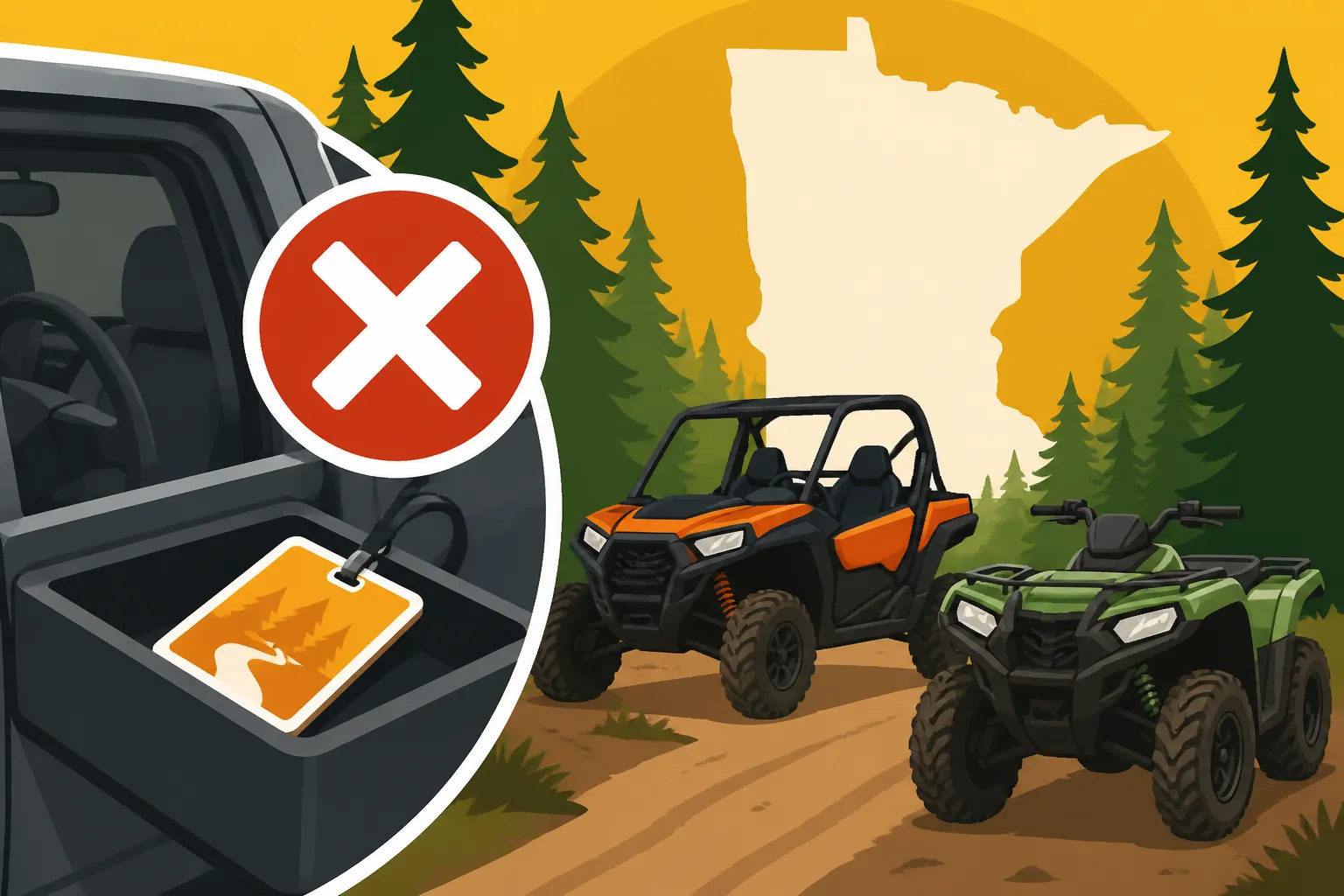
The practical issue is that buying a pass and having it available are separate matters. For an ATV or OHM, the pass does not have to be displayed on the machine, but the Minnesota DNR says it must be available if an officer requests it. A pass sitting in a truck at the trailhead may not be available to show during a trail check. For an ORV, the DNR requires the pass to be displayed on the vehicle where it is readily visible. Leaving that pass in the truck means it is not displayed as required.
| Machine or situation | What the Minnesota DNR requires | If the pass is in the truck |
|---|---|---|
| Minnesota-registered ATV, OHM, or ORV | The Minnesota DNR says a trail pass is not needed for a machine registered in Minnesota. | A trail pass in the truck is not the issue; confirm that the machine’s Minnesota registration is current and applies to it. |
| Non-resident ATV or OHM on a state or grant-in-aid trail | The Minnesota DNR requires a non-resident trail pass, which must be available if requested but need not be displayed on the machine. | The pass may be out of reach when an officer asks to see it. |
| Non-resident ORV on a state or grant-in-aid trail | The Minnesota DNR requires a non-resident trail pass displayed where it is readily visible on the vehicle. | The vehicle is missing its required displayed pass until it is attached. |
| Riding a qualifying trail portion on certain family-owned property | The Minnesota DNR says no trail pass is required on a portion of a trail owned by you, your spouse, child, or parent. | A pass may not be necessary for that specific qualifying portion, but this does not establish an exemption for other trail segments. |
If you are unsure whether a machine qualifies as an ATV, OHM, or ORV, do not guess based on how it looks or what you call it. Check the machine’s classification and the DNR’s requirements before riding. Minnesota ATV Classes and What They Mean and Minnesota’s Non-Resident ATV Trail Pass can help clarify which rules apply.
The safest routine is to check the machine before leaving the staging area: confirm its registration or pass status, and for an ORV, check that the pass is actually on the vehicle. If the pass is back in the truck, take care of that before entering a state or grant-in-aid trail.
Which passes must be carried or displayed
The difference between “available if requested” and “displayed on the vehicle” matters. An ATV or OHM rider does not need to attach the trail pass to the machine, according to the Minnesota DNR. But the rider must be able to produce it if an officer asks. That is why leaving it in a parked truck can turn a pass you have purchased into one you cannot readily show.
For an ORV, having the pass with you is not enough if it is not on the vehicle. The Minnesota DNR requires the ORV pass to be displayed where it is readily visible. If you remove it when transporting the machine or leave it in the cab of a tow vehicle, put it back in the required place before riding.
Do not assume that a purchase confirmation, a photograph, or a digital copy will substitute for the pass. The facts that matter are whether the pass is available for an ATV or OHM, or displayed on an ORV. If you want to rely on a particular proof method, confirm with the DNR that it satisfies the current requirement before you ride. Carrying a Minnesota Trail Pass on the Machine covers the practical question of keeping proof with you.
Pass requirements can also change with the machine’s registration and the location. The Minnesota DNR says that non-resident OHVs legally registered in another state or country and not in Minnesota for more than 30 days are not required to purchase Minnesota registration. That does not remove the non-resident trail-pass requirement for riding an ATV, OHM, or ORV on state or grant-in-aid trails. In other words, not needing Minnesota registration is not the same as being exempt from a Minnesota trail pass.
A pass is also not required when riding a portion of an ATV, OHM, or ORV trail owned by you, your spouse, child, or parent, according to the Minnesota DNR. Treat this as a limited exemption for the qualifying portion, not a blanket pass for a route that later joins public or grant-in-aid trails. Check the land and route carefully before relying on the exemption. Do You Need a Pass on Deeded Minnesota Ground? and Minnesota Passes and Minnesota Trails That Cross Private Land can help with those boundary questions.
The DNR says non-resident trail passes are valid for the calendar year from January 1 to December 31. A pass you bought for one calendar year should not be assumed to cover riding in a later one. Before a trip, check both that the pass is still valid and that it applies to the vehicle you are riding.
What to do when you realize the pass is missing
If you discover the pass is in the truck before you enter the trail, the cleanest fix is to return to the truck and bring it to the machine. For an ATV or OHM, keep the pass somewhere you can access if an officer requests it. For an ORV, display it on the vehicle before riding. If the truck is a long way from the trail, do not treat the distance as a reason to proceed without fixing the problem.
If you discover the issue after you have started riding, stop somewhere safe and do not continue on a state or grant-in-aid trail until you can meet the applicable requirement. If practical, return to the truck or have someone bring the pass to you. An ATV or OHM rider needs the pass available, and an ORV rider needs the pass displayed. A pass that you have paid for but cannot produce or display in the required way may not solve the immediate problem.
If the pass is lost rather than merely left behind, the Minnesota DNR says duplicate trail passes are available for purchase. Confirm the current process and how to obtain the duplicate before relying on it; do not assume a duplicate can be issued instantly or that a receipt alone will satisfy an officer. If you are on a trip, build in time to resolve the issue rather than continuing to ride while you sort it out. Replacing a Lost Training Certificate is about a different document, but for pass-specific options see Buying a Minnesota Trail Pass Online or Minnesota License Agents That Sell Passes.
The DNR says trail passes can be purchased online 24 hours a day and in person at Game and Fish License Agents and Deputy Registrar offices. Online purchase options do not guarantee that a pass will be immediately available in the form you need, so verify the delivery or display requirements before choosing that route. If you are already at the trailhead, an in-person option may be more useful if an agent is nearby, but check availability and current procedures first.
Keep the pass and any related paperwork in a place that is secure but reachable without unloading the machine or searching through packed gear. A waterproof document pouch or small organizer, including one available from Amazon, can help keep paper passes together with registration documents. For an ATV or OHM, store it where the operator can retrieve it during a ride. For an ORV, make sure the required pass remains displayed rather than merely stowed inside the vehicle.
A simple pre-ride check to avoid the problem
Make a quick pass check part of loading and staging, especially when the machine is borrowed, rented, or brought from out of state. A simple routine is more reliable than trying to remember whether the pass was moved after the last ride.
- Identify the machine and its registration. Confirm whether you are riding an ATV, OHM, or ORV and whether it is registered in Minnesota. The Minnesota DNR says a Minnesota-registered machine does not need a trail pass. If the machine is registered elsewhere, check the non-resident rules for the trail you plan to use.
- Confirm the route. A pass may be required for state and grant-in-aid trails, while the DNR identifies a limited family-property exemption. Do not assume that a route is exempt simply because part of it crosses private land.
- Check the pass itself. Confirm that it is valid for the current calendar year and for the vehicle being ridden. The Minnesota DNR says non-resident passes run from January 1 to December 31.
- Put it where it needs to be. Keep an ATV or OHM pass available to the operator if requested. Display an ORV pass where it is readily visible on the vehicle, as required by the Minnesota DNR.
- Check before moving away from the truck. Look at the vehicle and the documents, not just the gear bag. If the pass is missing, retrieve it or resolve the issue before riding onto a trail where it is required.
This routine is especially useful when several people share a machine or one person handles the paperwork while another drives. Agree on who is carrying the ATV or OHM pass, or who will check the ORV display, before the group leaves the staging area. For a rented or borrowed machine, ask the owner or rental provider what registration and pass documentation applies rather than assuming the pass transfers with the keys. [Minnesota Pass Rules for a Rented Machine] and Handing the Keys to a Visiting Rider address those situations.
A trail pass is only one part of being ready to ride. Registration, safety certification, age requirements, and trail access rules may also apply. The Minnesota DNR requires ATV safety certification for people born after July 1, 1987, to operate an ATV on public lands. Check the rules that apply to the operator and the route as well as the pass. Minnesota ATV Safety Training Requirements and Minnesota Rules for Visiting Riders are useful next steps.
The bottom line is straightforward: a pass left in the truck is not automatically a problem for every vehicle, but it can leave an ATV or OHM rider unable to show required proof and leaves an ORV without its required display. Check the machine’s registration, identify the applicable pass rule, and make sure the pass is accessible or attached as required before you start riding.
Sources
- Minnesota Department of Natural Resources — Off-highway vehicle registrations & fees | Minnesota DNR (checked November 3, 2026)
- Minnesota Department of Natural Resources — Non-resident OHV State Trail Passes | Minnesota DNR (checked November 3, 2026)
- Minnesota Department of Natural Resources — Off-highway vehicle (OHV) trail planning | Minnesota DNR (checked November 3, 2026)
Disclaimer
This article is for general informational purposes only and does not constitute professional advice. Laws, prices and regulations vary by location and change over time. Consult a qualified professional for guidance on your specific situation.