Where Minnesota Trail Pass Revenue Is Spent
Minnesota trail-pass revenue supports more than the tread beneath your tires. If you buy a pass, it is reasonable to wonder whether the money pays for trail work, signs, enforcement or administration—and whether it stays near the route you ride. Here’s how to understand the funding without assuming each purchase goes straight to one trail.
How Minnesota trail-pass revenue enters the system
A trail pass is a required permit for certain riders and machines on certain public routes. It is not a donation to the trailhead where you buy it, and it does not work like a ticket whose price is assigned to a particular stretch of trail. Revenue is handled through state funding and program rules, so the money supports eligible work across the system rather than following each rider’s exact route.
For nonresidents, the pass is one part of the rules for riding Minnesota trails. Which routes require a pass, and which riders may be exempt, depend on the route and circumstances. Check Minnesota’s Non-Resident ATV Trail Pass and Which Minnesota Trails Require a Pass before setting out; a pass does not replace registration or other requirements that apply to your machine.
The broader trail system has more than one source of funding. Trail-pass revenue is only one part of the picture. Other ATV-related receipts and public funding may support eligible projects too, and different sources can have different rules about what they may pay for. That is why it is more accurate to say trail-pass revenue helps support Minnesota’s trail program than to assume that every dollar collected goes directly to a specific club or maintenance crew.
The details matter when comparing receipts with visible work. A pass purchase may support the program that makes trail access possible, but it does not mean that the same amount is spent immediately on the trail you ride. Funding may be budgeted, awarded, spent and reported at different stages. The route closest to your home or cabin is not necessarily the route receiving the most work in a given period.
What the money can help pay for
Trail funding can support both work riders notice on the ground and less visible tasks needed to keep a trail system operating. The eligible uses and funding source for a project matter; not every trail expense is automatically paid from pass revenue.
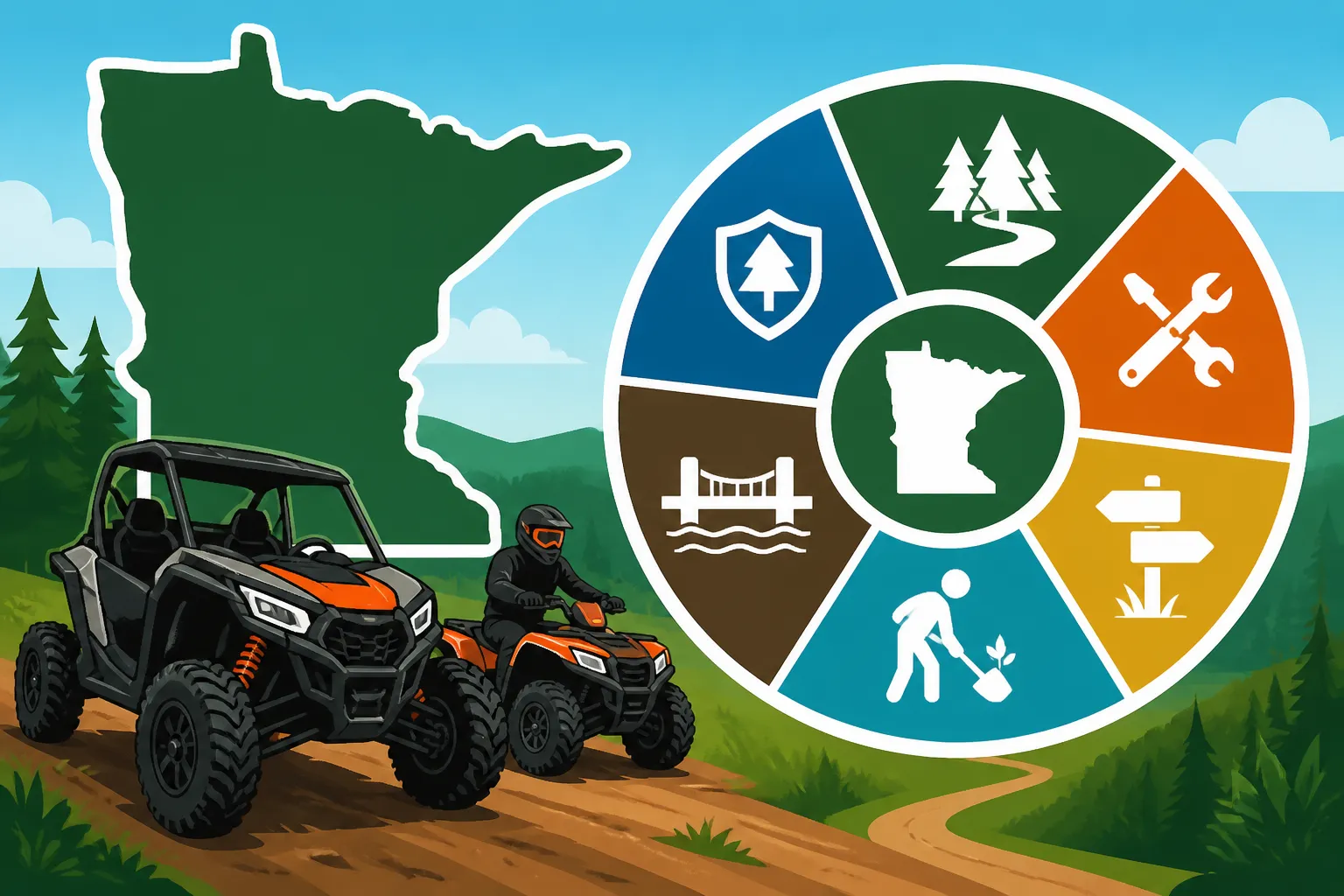
| Type of work | What riders may notice | Why it matters |
|---|---|---|
| Trail maintenance | Tread repair, drainage work and clearing | Helps keep routes usable and limit damage |
| Signs and route marking | Directional signs, maps and closure notices | Helps riders stay on legal routes and understand conditions |
| Trail development or improvement | Work on approved routes and supporting features | Can improve access or address recurring problems |
| Grants to local partners | Funding for eligible work by local units or clubs | Local partners may maintain routes the state does not work on directly |
| Program administration | Planning, grant review and coordination | Helps manage public funding and track approved work |
| Enforcement and compliance | Patrol and work related to trail rules | Supports lawful riding and can help address resource damage |
Maintenance is one of the most visible uses, but trail work is not just grading a path. Depending on the site and the approved project, it may involve fixing drainage, addressing erosion, clearing downed vegetation, repairing a crossing or responding to damage. A well-drained trail may look uneventful to riders; that can be a sign that preventive work is doing its job.
Signs and route information are also part of a usable system. A trail can be physically passable but still difficult to ride responsibly if riders cannot tell where it goes, whether it is open or where it connects to another route. Signage and maps can help reduce wrong turns and keep machines on designated routes. For planning, see Reading a Minnesota OHV Trail Map and Checking Minnesota Trail Status Before You Drive.
Some of the work is delivered through grants. The Minnesota DNR’s Grant-in-Aid system involves local partners, including government units and clubs, in developing or maintaining eligible trails. That arrangement helps connect state program funding with people who know local routes and conditions. It also means a rider may see club members doing field work even though the trail is part of a broader public program. Grant-in-Aid Trails and Who Maintains Them explains the roles involved, while Minnesota Grant-in-Aid Club Funding covers the club side.
Planning and administration are less visible, but they are part of managing a public trail program. Someone has to assess projects, review applications, coordinate work, keep records and determine whether funded work meets program requirements. Those tasks do not improve a trail surface by themselves, but they help direct limited funds toward eligible work and document how public money is used.
Enforcement is another part of the system, though it should not be treated as the main purpose of every pass dollar. Rules and compliance work help protect designated routes and surrounding land. Riding outside an open route can damage resources and threaten continued access, regardless of whether a rider has purchased the right pass. For details on where the rules apply, see Minnesota Permit Rules on Grant-in-Aid Trails.
Why the nearest trail may not get your pass money
It is natural to connect a purchase with the place where you use it: buy a pass before a weekend ride, then expect that trail to receive the proceeds. In practice, public trail funding usually works at a program or account level. Money may be combined with other eligible funding, allocated through a grant process and spent on approved work in different places and at different times.
A few factors can affect what riders see:
- Funding eligibility: A project must fit the rules for the funding source. A needed repair does not automatically qualify for every account or grant.
- Local partnerships: Some trail maintenance is carried out by local units or clubs through an approved arrangement, not by a state crew working directly on every route.
- Timing: Applications, approvals, seasonal work windows and reporting can separate the time money is collected from the time work appears on the trail.
- Trail conditions: A route with drainage or erosion problems may need more attention than one that has remained in good shape.
- Closures and access decisions: A trail may be temporarily closed or restricted for conditions or resource concerns. Pass ownership does not guarantee that every route will be open.
The grant model has a practical trade-off. Local partners can bring knowledge of trail conditions and help organize work, but projects still depend on available funding, approvals, volunteers or contractors, and suitable conditions. That can make the visible results uneven from one area to another. Uneven work does not, by itself, show where a particular pass payment went.
This is also why a trail pass should not be treated as a personal service fee. It gives a qualifying rider permission to use routes when the pass is required; it does not buy a guaranteed level of maintenance, reserve a route or create permission to ride on private land. Check Minnesota Rules on Private Land if your route includes land that is not part of an open public trail.
How to follow the funding and understand what you see
If you want to know where money is going, look for program and project information rather than trying to trace one pass purchase. The Minnesota DNR is the starting point for current trail-pass rules, trail program information and funding updates. For local work, the relevant grant or trail partner may have details about approved projects, maintenance plans or volunteer days. Minnesota DNR OHV Contacts can help you find the right office or program contact.
When reviewing an update or asking a question, it helps to be specific. Identify the trail or area, describe the type of work you are asking about, and ask whether the question concerns trail-pass revenue, an ATV account, a grant or another source. Those terms are not interchangeable. A project’s funding may involve more than one source, and the answer may depend on the year or grant cycle.
You can also look for several kinds of information:
- The funding source: Does the update identify a trail-pass receipt, a dedicated ATV account, a grant or another public source?
- The recipient: Is the work being done by the DNR, a local government partner, a club or a contractor?
- The project status: Is the work proposed, approved, underway or complete?
- The location and scope: Does it cover a particular segment, a trail system or general program support?
- The reporting period: Is the figure about money collected, money awarded or money actually spent?
Those distinctions make public reports easier to read. A grant award is not necessarily the same thing as completed work, and a project budget may include funds from more than one source. Similarly, a general program update may not break expenses down by individual trail. If an update does not answer a route-specific question, ask the agency or local partner whether project-level information is available.
For riders, the practical takeaway is straightforward: trail-pass revenue contributes to the system that supports access, maintenance and related program work, but it is not a direct payment to the route you happen to ride. Staying on open routes, following closure notices and reporting damage through the appropriate channel help protect the value of that investment. A pass is one piece of responsible access; it is not a substitute for checking current trail status or understanding the rules that apply to your ride.
Disclaimer
This article is for general informational purposes only and does not constitute professional advice. Laws, prices and regulations vary by location and change over time. Consult a qualified professional for guidance on your specific situation.