Rules for a Machine Kept at a Resort
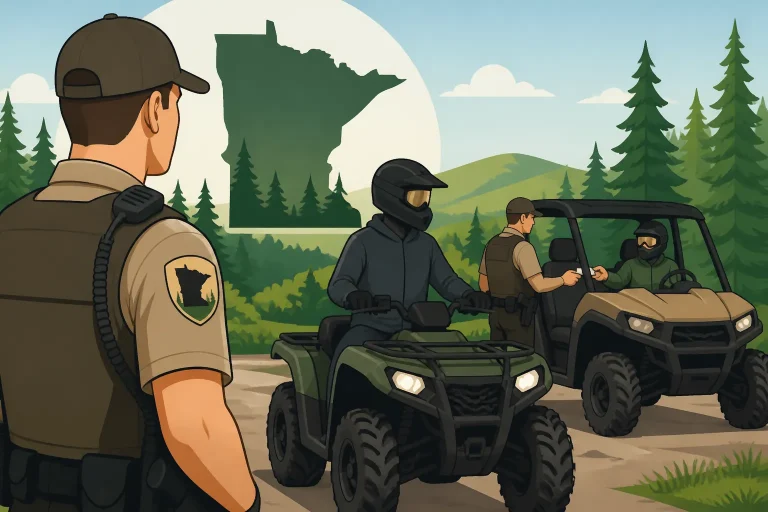
A machine kept at a Minnesota resort may stay on private grounds, go out on public trails, or do both. Those uses can trigger different registration and pass requirements, and a resort’s location does not automatically make its property or nearby routes open to riding. Here’s how to sort out the rules before a guest starts the engine.
Start with where and how the machine will be used
“Kept at a resort” describes where the ATV or UTV is stored, not which rules apply to it. The key questions are what kind of machine it is, who owns or operates it, and where it will be ridden.
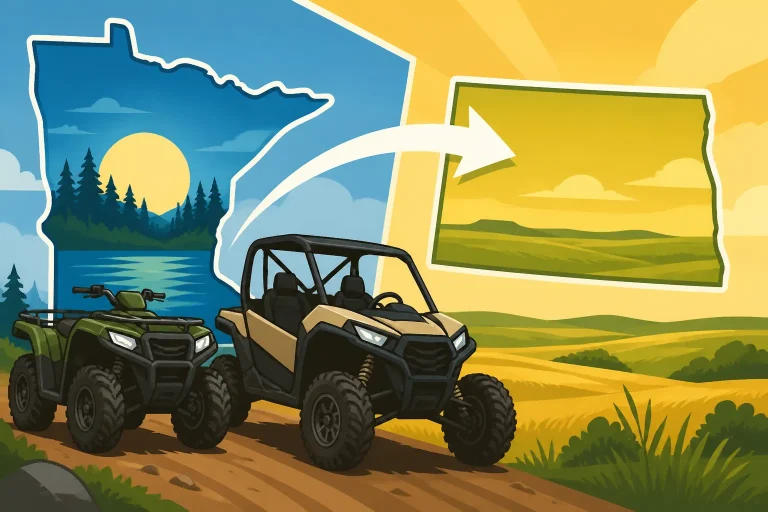
A machine used only on land the resort controls may be treated differently from one taken onto a public trail or road right of way. But private property does not mean every ride is automatically exempt from registration, permission, or safety requirements. The exact requirements can depend on the machine and the use. For an overview of the distinction, see Minnesota Public Use Versus Private Use Registration and Registering a Machine Kept Only on Your Land.
Before relying on a private-use status, work through these questions:
- Does the resort control the land? A resort may own some grounds and lease or share others. Permission should come from the landowner or the person authorized to manage the area.
- Will the route leave the resort’s grounds? A short connection to a trail, forest road, or town can bring a different set of rules into play. A route that looks like a convenient shortcut is not necessarily an authorized route.
- Will the machine use a public trail? Registration and trail-pass requirements can depend on the machine’s registration and the particular trail. Check the trail status and requirements before setting out.
- Is it a guest machine, a rental, or a resort-owned fleet machine? The person keeping the machine at the resort is not necessarily the person responsible for every requirement. Clarify who manages its paperwork and what the rider must carry or obtain.
- What type of machine is it? An ATV and a full-size off-road vehicle may not follow identical rules. Do not assume that a rule, pass, or exemption for one category applies to another.
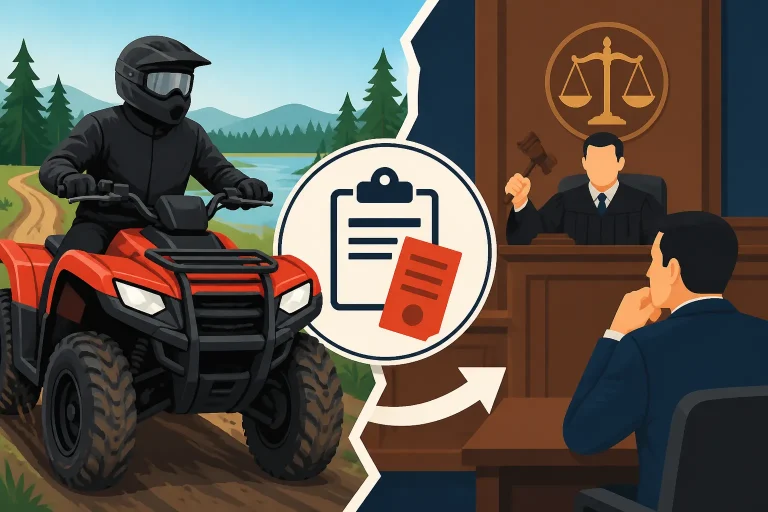
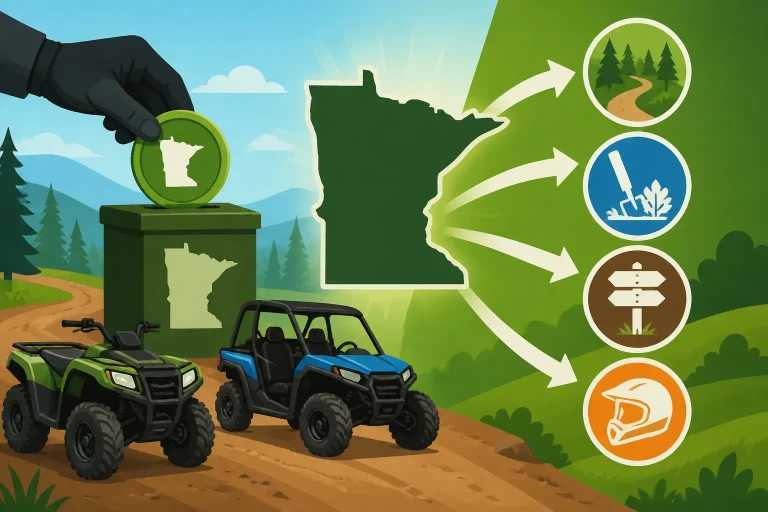
It also helps to separate three things that are easy to mix up: registration, a trail pass, and permission to ride. Registration identifies the machine under applicable state rules. A trail pass may be needed for certain machines on certain trails. Permission is about whether the rider may use the land or route at all. Having one does not automatically provide the others.
For a clearer breakdown of the trail-pass distinction, see Which Minnesota Trails Require a Pass and Machines Registered in Minnesota and the Pass. Requirements can vary with the machine’s registration, the trail system, and the type of ride, so verify the current rules with the Minnesota DNR before the first trip.
Private resort grounds and public trails are not interchangeable
A resort may offer its own trails or riding area, sit near a public trail, or provide access to a route that crosses land managed by someone else. Those setups are not equivalent. A resort’s directions or a guest’s permission to ride on resort grounds should not be treated as permission to continue onto every nearby path.
| Where the machine will be ridden | What to confirm before riding |
|---|---|
| Resort grounds controlled by the resort | Whether the resort permits ATV or UTV use, which areas are open, and whether registration or other requirements apply to that use |
| A trail entirely on private land | Who controls the land, whether the rider has permission, and whether any trail-specific requirements apply |
| A public trail or state forest route | Whether the route is open to that machine, whether registration and a trail pass are required, and whether seasonal closures apply |
| A road right of way or town route | Whether local and state rules allow that machine and rider on the specific segment |
| A route that crosses more than one type of land | Who controls each segment and which rules apply at each point |
A trail can cross private land and still be part of a managed trail system. Conversely, a visible path on or near resort property may not be open to guests. Follow posted signs and resort instructions, and do not ride around gates, barriers, or closure signs. For broader context on permission and private property, see Minnesota Rules on Private Land and Minnesota Rules for Visiting Riders.
If a route connects to a public trail, check its status before riding. Trail openings and closures can change with conditions or management decisions. A resort employee may know the usual route, but riders should still confirm that it is open and appropriate for their machine on the day they ride. A trail map can help with planning, but it does not replace signs, current closure notices, or permission from the land manager.
Road connections need particular care. Minnesota has separate rules for riding on or crossing roads, and a route that briefly enters a road right of way is not automatically allowed just because it is the most direct way to reach a trail. Confirm whether the road segment is open to ATV or UTV use and whether any local restrictions apply. For details on a specific type of road riding, see Riding an ATV on the Road in Minnesota.
Decide who handles registration, passes, and rider requirements
When a machine stays at a resort, responsibility can be split among the resort, the owner, and the rider. A written or clearly explained arrangement helps prevent a guest from assuming that everything is covered simply because the machine is parked there.
Registration and machine paperwork
First identify how the machine is registered, if registration is required for its intended use. A machine registered for one purpose should not be assumed to meet the requirements for another. If it will move from private resort grounds onto public land or trails, check whether its registration status is appropriate for that use. Minnesota DNR ATV Registration Explained covers the broader registration topic.
The resort should also know whose name is on the record and who can answer questions about the machine. If a guest brings a personally owned machine, the guest may need to supply or maintain the relevant paperwork. If the resort owns or rents out the machine, the resort should make the arrangement clear before handing over the keys.
Keep documents accessible and legible, but do not treat paperwork as a substitute for checking the rules on the ground. See Keeping the Paperwork With the Machine for practical document-handling considerations.
Trail-pass requirements
A trail pass is a separate question from registration. Some riders and machines may have different pass obligations depending on registration and where they ride. The fact that a machine is stored at a resort does not decide whether a pass is required. Nor does a resort’s own riding area necessarily have the same requirements as a nearby public trail.
If a guest is visiting from outside Minnesota, do not assume that the machine’s home-state registration is enough for every Minnesota trail. Check the requirements for that machine and route, including Minnesota’s Non-Resident ATV Trail Pass. If a pass is required, confirm how to obtain it and whether proof must be carried or displayed before leaving the resort.
Rider eligibility and safe operation
Even when the machine’s paperwork is in order, the rider must meet applicable age, training, and operating requirements. A rental agreement or a resort briefing does not replace required safety certification. Minnesota’s rules can depend on the rider’s age and other details, so check Minnesota ATV Safety Training Requirements before allowing a youth or visiting rider to operate the machine.
The resort should make practical expectations clear: who may drive, whether passengers are allowed on that machine, what protective equipment is expected, and where the rider may go. A guest may be unfamiliar with the machine, local terrain, trail etiquette, or weather conditions. A short orientation can reduce risk, but it does not authorize riding in a closed area or excuse a rider from following applicable rules.
For a guest using a borrowed or resort-provided machine, responsibility should be easy to understand:
- State whether riding is limited to resort-controlled grounds or includes approved public routes.
- Identify any route the rider must not use, including roads, neighboring land, or closed trails.
- Explain who confirms registration and pass requirements.
- Make age, training, passenger, and equipment expectations clear before departure.
- Tell riders how to respond if they encounter a gate, closure notice, or uncertain boundary.
Use a pre-ride check for the resort and the rider
A simple check before each ride can catch misunderstandings that paperwork alone will not. The resort and the rider should verify the machine, the route, and the person operating it.
- Identify the machine. Confirm whether it is an ATV or another type of off-road vehicle, and check its registration status.
- Set the riding area. Establish whether the ride stays on resort-controlled property or uses a public route. If it leaves the property, identify every route segment.
- Check access and closures. Confirm landowner permission, posted restrictions, and current trail conditions. Do not rely on an old map or an assumed connection.
- Confirm pass requirements. Check the rules for the specific machine and trail, including any requirements that apply to an out-of-state machine.
- Check the rider. Make sure the operator meets applicable age and training requirements and understands the machine’s controls and limits.
- Review passengers and safety equipment. Confirm that passengers are permitted on that machine and that riders have suitable protective equipment.
- Agree on what to do if plans change. If the route is blocked or unclear, turn back rather than detouring onto an unverified road or private property.
For resort operators, it is useful to keep a consistent process rather than answer the same questions differently for each guest. A brief written handout can specify where machines may be used, who to ask about trail access, and what the resort does not provide. Avoid promising that a route is open year-round or that every guest’s paperwork is covered unless that has been checked.
For guests, ask direct questions before unloading or accepting a key:
- Is the machine approved for the route I plan to ride?
- Does the resort control the entire route, or does it connect to public land?
- What registration and trail-pass requirements apply to this machine?
- Are there current closures, seasonal limits, or local restrictions?
- What age, training, passenger, and equipment rules apply to me?
If the answer to any of these is uncertain, pause and verify it with the appropriate land manager or the Minnesota DNR. A few minutes of checking is safer than assuming that “the resort lets people ride” covers every trail, road, and machine.
Disclaimer
This article is for general informational purposes only and does not constitute professional advice. Laws, prices and regulations vary by location and change over time. Consult a qualified professional for guidance on your specific situation.