Passes for a Full-Size Off-Road Vehicle
A full-size off-road vehicle does not automatically qualify for the same pass as an ATV or side-by-side. In Minnesota, the key questions are how the machine is classified, where it is registered, and whether you plan to ride state or grant-in-aid trails. Get those details straight before heading out, and you can avoid buying the wrong pass or assuming a pass grants access everywhere.
First, confirm your vehicle’s category and registration
Minnesota’s trail-pass rules apply to off-highway vehicles, but the pass options and display requirements differ by vehicle category. A machine described casually as a “full-size off-road vehicle” may not necessarily be treated as an ATV. Check the vehicle’s registration and the Minnesota DNR’s classification before choosing a pass.
This matters particularly for full-size rigs such as 4x4s. The DNR identifies off-road vehicles, including 4×4 jeeps or trucks, as a category of eligible OHV in its damage-account program. That fact alone does not tell you which trails a specific vehicle can use, or whether it meets the requirements for a particular pass. Verify the classification and trail rules for the vehicle you plan to operate.
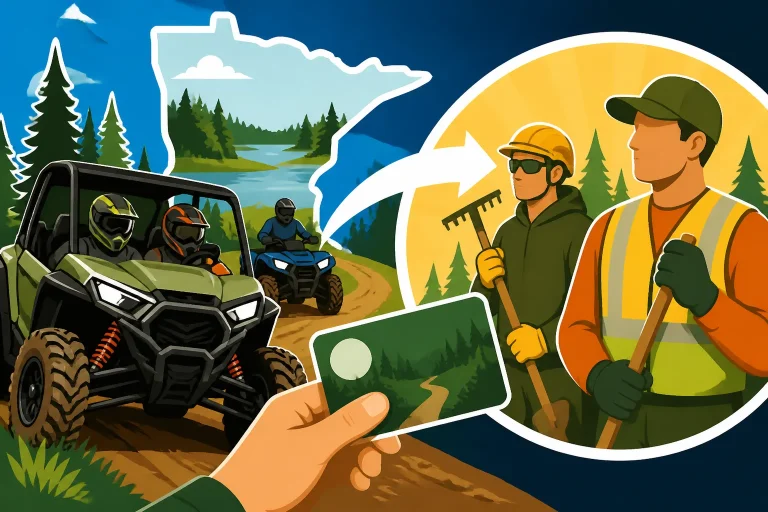
The basic Minnesota rule is that an OHV must be registered with the DNR, or the operator must have a trail pass when operating on state and grant-in-aid trails, according to the Minnesota Department of Natural Resources. For a machine registered in Minnesota, a trail pass is not needed. For a nonresident vehicle legally registered in another state or country, the pass requirement can still apply when riding those trails.
Before purchasing, work through these questions:
- What kind of vehicle is it? Confirm whether the machine is an ORV, ATV, or another OHV category rather than relying on a seller’s description or the vehicle’s size.
- Where is it registered? Minnesota registration means no separate trail pass is required. An out-of-state registration does not automatically remove the pass requirement for state and grant-in-aid trails.
- Where will you ride? The nonresident pass rule applies to state and grant-in-aid trails. A pass is not a general permit to ride on private property, closed routes, or trails that do not allow your vehicle.
- What pass option applies? Minnesota lists separate ORV pass options. Make sure the product and term shown at purchase match your vehicle category and intended use.
If you are bringing a machine from another state, the registration question is separate from the trail-pass question. See Minnesota Registration for an Out-of-State Machine and Minnesota’s Non-Resident ATV Trail Pass for related situations. For a wider overview of visitor requirements, Minnesota Rules for Visiting Riders can help you identify other rules to check.
Who needs a Minnesota ORV trail pass
According to the Minnesota Department of Natural Resources, nonresidents operating an ATV, OHM, or ORV on state or grant-in-aid trails need a nonresident trail pass. A nonresident OHV that is legally registered in another state or country and is not in Minnesota for more than 30 days does not have to obtain Minnesota registration, but that registration exception does not eliminate the trail-pass requirement for a nonresident riding the covered trails.
The practical distinction is:
| Your machine and use | Trail-pass takeaway |
|---|---|
| Machine registered in Minnesota | A separate trail pass is not needed. |
| Nonresident machine on state or grant-in-aid trails | A nonresident trail pass is required. |
| Riding a portion of an eligible trail on land owned by you, your spouse, child, or parent | A trail pass is not required for that portion. |
| Riding a route that is closed or does not allow your vehicle category | A pass does not make the route available to you. |
The family-land exemption is specific: it applies when riding a portion of an ATV, OHM, or ORV trail owned by you, your spouse, child, or parent, according to the Minnesota Department of Natural Resources. It should not be read as a broad exemption for all private land, all trail sections, or land owned by a friend or other relative.
A trail pass also is not a substitute for registration where registration is required. If you buy a used ORV, the Minnesota Department of Natural Resources says you must register it in your name within 30 days. For used ATVs and off-highway motorcycles, the stated period is 15 days. If your purchase involves an ORV transferred and renewed in Minnesota, the DNR’s fee is $42.50 as of November 2026. Those are registration matters, not the same as buying a nonresident trail pass.
For more detail on how registration interacts with trail access, see Machines Registered in Minnesota and the Pass and Which Minnesota Trails Require a Pass. If the vehicle is a side-by-side and its classification is unclear, Minnesota Public Use Versus Private Use Registration may help you identify the separate registration issue, but confirm the category assigned to your actual machine.
Pass options, cost, and where to buy
The Minnesota Department of Natural Resources lists a one-year ORV trail pass for $21.00 and a three-year ORV trail pass for $31.00. A duplicate ORV trail pass costs $2.50. These figures are the DNR amounts as of November 2026. Because pass categories and terms can be easy to confuse, check the current ORV selection and validity details before paying.
The same DNR fee list also includes ATV and OHM passes, but those are not substitutes for an ORV pass just because a vehicle has four wheels or is used off-road. The ATV one-year pass is $31.00, while the OHM one-year pass is $21.00; duplicate passes for either category cost $2.50. Use those figures only if the vehicle is actually classified in that category.
For a nonresident pass, the DNR says validity runs for the calendar year, from January 1 through December 31. The listed ORV choices include both one-year and three-year options, so check the product details during purchase rather than assuming the term or end date. If you are planning a trip near the end of the year or expect to return in another season, confirm exactly what the pass covers.
Passes can be purchased online at any time, or in person from Game and Fish License Agents and Deputy Registrar offices, according to the Minnesota Department of Natural Resources. Online purchases incur an additional service fee of 3% plus $1.65, according to the DNR. In-person purchase may suit riders who want help identifying the correct product; online purchase is an option when you have already confirmed the vehicle category and pass type.
A practical buying sequence:
- Confirm that your machine is classified as an ORV and not an ATV or OHM.
- Check whether it is registered in Minnesota. If it is, a separate trail pass is not needed.
- If it is a nonresident machine, confirm that your planned route includes state or grant-in-aid trails and that the trail allows your vehicle.
- Select the ORV pass and term that match your situation.
- Keep your purchase confirmation and follow the display rule for the pass.
For online purchase details, see Buying a Minnesota Trail Pass Online. If the pass is misplaced, duplicate passes are available for purchase; Minnesota Passes for a Second Machine is a related topic, though a second vehicle may need its own applicable pass rather than sharing one.
Amazon is not a substitute for an official pass purchase. A decal holder, document pouch, or other riding accessory bought through a retailer cannot serve as the DNR-issued pass. Use the DNR’s stated sales channels for the pass itself.
Display the pass and check the route before riding
ORV trail passes must be displayed on the vehicle where they are readily visible, according to the Minnesota Department of Natural Resources. This differs from ATV and OHM passes, which do not have to be displayed on the machine but must be available if an officer requests them. That distinction is another reason not to choose a pass based only on the vehicle’s appearance.
Mount the ORV pass so it is easy to see and unlikely to be hidden by gear, dirt, or vehicle components. If you receive instructions with the pass, follow them. Keep proof of purchase accessible as a backup, but do not treat a receipt as a replacement for the required visible display.
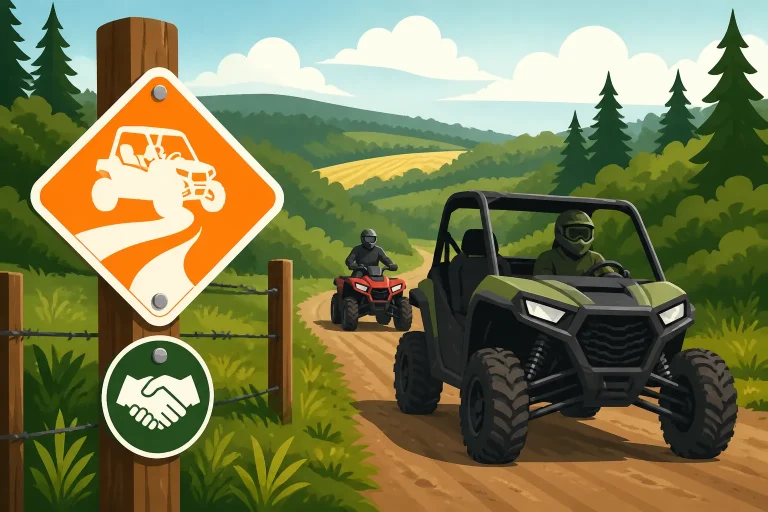
A valid pass does not grant permission to ride every route. Minnesota state forests are classified for OHV use. In a closed state forest, OHVs are not permitted. In a limited forest, riders may use roads and trails posted open; in a managed forest, riders may use roads and trails not posted closed, according to the Minnesota Department of Natural Resources. Those classifications make it important to check route-specific access, not just the pass requirement.
The DNR provides an off-highway vehicle trail atlas to help identify riding opportunities in Minnesota. Check current trail information before traveling, especially if you are headed to a state forest or a route with seasonal closures. Temporary road and trail closures are updated on Thursdays after 2 p.m., according to the Minnesota Department of Natural Resources, so a route that was open during an earlier visit may not be open now.
Some other rules can affect a trip as well. For example, the DNR says groomed snowmobile trails are closed to off-highway vehicles and highway-licensed vehicles starting December 1. Rules for winter access can vary by route, so confirm the status and permitted vehicle types before setting out. A pass does not override a closure, seasonal restriction, or vehicle-specific trail limit.
If your route involves a campground, do not assume that trail-pass access allows you to ride around the campground. The DNR says OHVs in campgrounds must be legally registered and may use only designated roadways, campground spurs, and parking areas; recreational or utilitarian riding within the campground or off those routes is not permitted. For trip planning, Minnesota Trail Pass Rules at a State Forest and Carrying the Pass While You Ride cover closely related issues.
In short, the safest approach is to verify the vehicle category, registration status, pass term, and route access separately. A nonresident ORV rider on Minnesota state or grant-in-aid trails generally needs the appropriate ORV pass, must display it where readily visible, and still needs to follow the rules for the specific trail.
Sources
- Minnesota Department of Natural Resources — Off-highway vehicle registrations & fees | Minnesota DNR (checked November 3, 2026)
- Minnesota Department of Natural Resources — Non-resident OHV State Trail Passes | Minnesota DNR (checked November 3, 2026)
- Minnesota Department of Natural Resources — OHV trail locations map | Minnesota DNR (checked November 3, 2026)
- Minnesota Department of Natural Resources — Off-highway vehicle (OHV) trail planning | Minnesota DNR (checked November 3, 2026)
Disclaimer
This article is for general informational purposes only and does not constitute professional advice. Laws, prices and regulations vary by location and change over time. Consult a qualified professional for guidance on your specific situation.