Minnesota Trail Rules Once the Snow Arrives
Minnesota’s trails may look open once snow covers them, but winter conditions do not automatically make every route legal for an ATV or UTV. Trail designations, closures, permits, and machine access still matter. Here’s how to check where you can ride, what changes after snowfall, and how to prepare for cold, snow, and ice.
Snow does not automatically open a trail
A trail covered in snow can look inviting and seem easier to ride than it does in summer. But snow on the ground is not permission to use a route. The trail’s designation and current status still determine whether an ATV or UTV may be there.
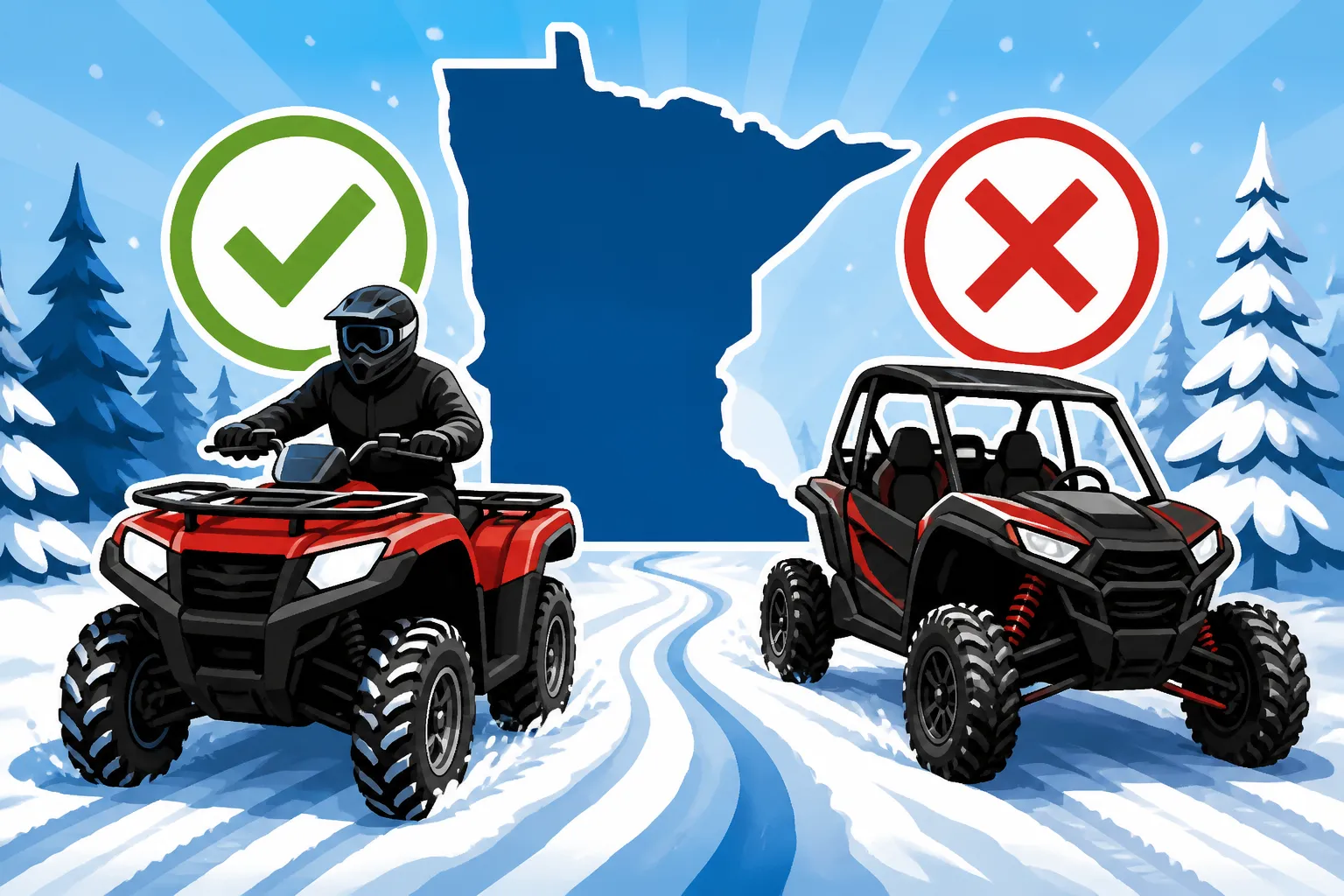
Minnesota routes can have different rules depending on who manages them and what they are designated for. A route may be open to ATVs, limited to certain machine types, shared with other users, or reserved for snowmobiles. Some trails close seasonally or temporarily because of weather, maintenance, land conditions, or other restrictions. A snow-covered route may also cross land where motorized use is not allowed.
That means winter riding starts with checking the route, not judging it by appearance. Look for current information from the managing agency or trail authority, and confirm that the notice applies to the specific segment you plan to ride. The statewide or regional map can help with planning, but a local closure notice or posted sign may change what is available on the day.
For a practical pre-trip routine, use Checking Minnesota Trail Status Before You Drive and Reading a Minnesota OHV Trail Map. When you’re riding in state forest land, review State Forest Rules Minnesota Riders Follow as well. A trail’s presence on a map does not guarantee that it is open to your machine in winter.
A few distinctions help avoid common mistakes:
- Snow-covered does not mean open. A trail can be closed even if it is physically passable.
- A snowmobile trail is not automatically an ATV trail. Follow the route’s posted designation and applicable local rules.
- A winter route may have different access than its summer route. Seasonal use can vary by segment and land manager.
- A grooming track is not an invitation to ride on it. Groomed routes may be intended for snowmobiles or another specific use.
- A trail that looks unused is not necessarily unregulated. Lack of tracks, signs, or traffic does not establish permission.
If conditions change during your ride, treat a new sign or closure notice as controlling. Do not assume the route remains available because you entered it earlier, or because other riders have gone through. If access is unclear, stop and verify rather than continuing into a restricted area.
Check the route, machine, and permits before leaving
Winter planning should include three separate checks: whether the route is open, whether your machine is allowed, and whether you need a permit or pass. These are related questions, but one does not answer the others.
Start with the exact trail or road segment. Check the map and current notices from the land manager, trail sponsor, or local authority responsible for that route. If a trail crosses different jurisdictions, check each relevant section. A route may change status at a forest boundary, county line, road crossing, or connector.
Next, confirm the machine type is allowed. ATV and UTV access can differ, and a trail may have width or other restrictions. Do not assume that a route open to one type of off-highway vehicle is open to every machine. If your UTV is wider than a typical ATV, confirm the trail’s allowed width before driving to the trailhead.
Then check the pass or permit requirement. Minnesota’s non-resident trail pass rules may apply to visiting riders on designated trails, while other situations may have different requirements or exemptions. A pass is not a substitute for permission to ride a trail that is closed or not open to your machine. For the details, see Minnesota’s Non-Resident ATV Trail Pass and Minnesota Permit Rules on Grant-in-Aid Trails. If you are visiting from another state, Minnesota Rules for Visiting Riders can help frame the other requirements to verify.
| Question | What to verify | Why it matters |
|---|---|---|
| Is the route open today? | Current closure notices, posted signs, and local trail status | Snow can conceal a closed trail or a temporary restriction |
| Is my machine allowed? | Vehicle type, width limits, and route designation | ATV access does not always include UTV access |
| Do I need a pass or permit? | Your residency, the trail type, and the current rule | Having a pass does not authorize riding outside permitted routes |
| Is the route shared? | Which users are allowed and any seasonal conditions | Snowmobile traffic and groomed surfaces call for extra care |
| Can I park and unload there? | Trailhead rules and available staging space | A legal trail ride can still start with an improper parking choice |
Keep proof of required passes or permits where you can access it, and make sure the pass is valid for the machine and use in question. If you ride a borrowed or rented machine, clarify who is responsible for obtaining any required pass before the trip. Do not assume a permit attached to a different vehicle covers yours.
For a local route, a useful sequence is:
- Identify the trailhead and the full route you expect to ride.
- Check the route’s designation and whether it allows your machine.
- Review current closures and seasonal notices for every segment.
- Confirm whether you need a pass or other authorization.
- Check trailhead parking and staging rules.
- Recheck conditions before departure in case notices have changed.
A winter plan also needs a turnaround option. If a route is closed, too icy, drifted over, or unsafe for your machine, know where you can return without crossing private property or using an unauthorized connector. A backup route is helpful only if it is independently confirmed as open.
Snow, grooming, and shared trails
Winter changes how trails work even when the rules stay in place. Snow can hide ruts, drainage features, rocks, branches, and trail markers. A route that was easy to read in summer may be difficult to follow after a snowfall. Grooming can also create a smooth surface that is vulnerable to damage from unauthorized traffic.
Be especially careful around routes used by snowmobilers. Snowmobile trails may be maintained for that use, and a groomed trail does not automatically become an ATV or UTV route. Follow posted signs and the trail manager’s current designation. If an ATV or UTV is allowed on a shared route, ride in a way that leaves room for other users and does not damage the groomed surface.
Do not ride on a trail simply because it has tracks from another vehicle. Those tracks could have been made by an authorized machine, a trail worker, or someone riding where they should not. A vehicle’s tracks do not prove that a route is open to your machine.
Snow depth and temperature can affect trail condition, but they are not reliable measures of legal access. A route may be open but unsafe after drifting or thawing. It may also be closed even when the surface looks firm. Follow official notices rather than using a general rule of thumb about how much snow is enough.
Winter surface conditions can change quickly:
- Fresh snow can hide hazards. Slow down where you cannot see the trail surface.
- Wind can fill in tracks and signs. Do not continue if you can no longer identify the route.
- Thawing can make a trail soft and vulnerable. Avoid rutting the surface and follow any closure notice.
- Ice can form in low spots or near water. Treat slick patches as a traction hazard, not a shortcut.
- Groomed snow can be damaged by tires or tracks. Use a route only when the managing authority allows your machine.
- Plowed access roads may have separate rules. Do not assume that a road used to reach a trail is open to off-highway vehicles.
Some trails close during spring thaw to prevent damage, but winter weather can also produce unstable or saturated ground. The purpose of a closure is not always obvious from the trail surface. Minnesota Trail Closures in Spring Thaw explains why posted closures matter even when a route appears passable. Apply the same caution to winter notices: do not make your own exception based on how the ground looks.
If you use tracks or other winter equipment, check both the machine’s fit for the trail and the trail’s access rules. A track conversion may improve flotation in some conditions, but it does not grant access to a route that is closed or restricted. See Tracks on a Machine in Deep Snow for equipment considerations, and verify route rules separately.
Shared trails also call for a more defensive riding style. Snow can muffle engine noise and reduce visibility around bends. Give other users room, slow down near intersections, and avoid stopping where another rider may not be able to see you. If you meet a snowmobile or another vehicle in a narrow section, move to a safe place without leaving the designated trail or damaging the edge.
Riding on lakes and ice is a separate decision
Frozen lakes can look like a convenient link between trails, a fishing spot, or a way to reach a cabin. But an ice surface is not the same as an authorized ATV trail. Access depends on local rules, land ownership, posted restrictions, and the condition of the ice. A route that is legal on land may not allow travel across a nearby lake.
Do not treat a frozen lake as safe just because other vehicles have crossed it or because there are existing tracks. Ice thickness can vary across a single lake, especially near shorelines, inlets, outlets, current, vegetation, and areas affected by pressure changes. Snow can hide weak spots and make surface conditions difficult to judge. The machine’s weight and configuration also affect the risk.
Before taking a machine onto ice, confirm that access is allowed and review local guidance for the specific water body. Ask the relevant local authority or land manager when the rule is unclear. Do not use a trail map as proof that lake travel is permitted. For more on the distinct rules and hazards, see Minnesota Rules for a Machine on Ice and Ice Thickness a Machine Needs.
A responsible ice plan includes more than checking the surface near the launch. Consider:
- Whether motorized travel is allowed on that water body.
- Whether local restrictions apply to the access point or season.
- Whether the route crosses areas with current, springs, vegetation, or open water.
- Whether changing weather could make the return route unsafe.
- Whether someone knows your route and expected return time.
- Whether you have a way to respond if the machine breaks down or becomes stranded.
Avoid using an ice road or informal track as a substitute for a designated land route unless access is clearly allowed. If you are uncertain whether a crossing is permitted or safe, choose a route that stays on an authorized trail. No shortcut is worth risking a machine, a passenger, or a rescue.
A shoreline or boat launch may also have its own access rules. Respect barriers, signs, and seasonal closures. Do not ride across private land to reach the lake unless you have permission, and do not assume that a route used by anglers is open to every motorized vehicle.
Cold-weather preparation and trail etiquette
A winter ride puts more pressure on both the machine and the rider. Cold can affect starting, battery performance, traction, visibility, and how quickly a small problem becomes serious. Build the day around the conditions you expect, and shorten the route when weather or daylight makes a long ride a poor choice.
Before leaving, check the machine’s condition and carry tools suited to your equipment. Inspect tires or tracks, brakes, lights, controls, and fuel. Look for damage or loose parts that could become a failure in cold conditions. If the route is remote, plan for limited cell service and a delayed return rather than counting on quick roadside help.
Dress for the time you may spend stopped, not only for the temperature while moving. Wind chill, snow, and wet clothing can make a breakdown dangerous. Use a properly fitted helmet and eye protection, and choose gloves, boots, and layers that allow you to operate the controls. Pack dry layers and a way to protect essential items from snow and moisture.
A winter kit can include:
- A charged phone stored so it stays usable, while recognizing service may be limited.
- A map or navigation device with the route saved before departure.
- A first-aid kit and basic repair tools.
- A flashlight or headlamp and spare power.
- Food, water, and extra insulating layers.
- Recovery equipment appropriate for the machine and terrain.
- A small emergency shelter or wind protection for longer rides.
- A plan shared with someone who is not on the trip.
For a more complete list, use What to Carry on a Remote Northwoods Ride. If the route is unfamiliar, review Minnesota Trailhead Parking and Staging and plan where to unload, turn around, and regroup without blocking other users.
Ride at a speed that lets you stop within the visible distance. Snow can cover holes, rocks, branches, and drainage structures, while glare or falling snow can make it harder to see the route. Leave extra space between machines so a sudden stop does not cause a collision. Keep the group together at junctions and confirm that everyone knows the intended route.
Avoid spinning tires or repeatedly trying to force a machine through deep snow. That can damage the trail, bury the vehicle, or make recovery more difficult. If you cannot proceed without leaving the designated route or causing damage, turn around. Do not cut a new track around a drift, blocked gate, or closed section.
Be considerate around homes, cabins, livestock, and other users. Follow posted speed limits and local restrictions. Reduce speed near trailheads, road crossings, and areas where people may be walking or working. Keep noise down where practical, and do not idle for long periods beside homes or quiet recreation areas.
If another rider is in trouble, stop only where you can do so safely and keep your machine out of the travel path. Offer help without putting yourself into an unsafe recovery. For a serious emergency, contact emergency services when possible and provide the trail name, nearest access point, and your location.
Frequently Asked Questions
Can I ride an ATV on a Minnesota snowmobile trail?
Not automatically. A snowmobile trail’s designation does not by itself authorize ATV or UTV use. Check the specific route’s current rules and posted signs before riding.
Does snow make a closed trail legal to use?
No. Snow cover does not cancel a closure or change the route’s designation. Follow current notices and do not enter a closed segment.
Does a trail pass let me ride any winter trail?
No. A pass only addresses a pass requirement where it applies; it does not grant access to a closed trail or a route that does not allow your machine. Check both the pass rules and the trail rules.
Can I use ATV tracks on my machine to reach a trail?
Tracks do not create access rights. Confirm that your machine and its configuration are allowed on the route, and check current conditions before setting out.
Is a frozen lake an alternative to a closed trail?
Not unless lake travel is allowed and the ice is safe for your circumstances. Check local access rules and ice conditions separately; existing tracks do not prove either.
Disclaimer
This article is for general informational purposes only and does not constitute professional advice. Laws, prices and regulations vary by location and change over time. Consult a qualified professional for guidance on your specific situation.