Minnesota Rules on Wildlife Management Areas
Minnesota Wildlife Management Areas can look like open public land on a map, but public ownership does not mean you can ride an ATV or UTV wherever you choose. OHV use is generally prohibited in WMAs unless a trail or area is specifically posted for it. Knowing how to verify that exception—and what a registration or trail pass does and does not allow—can help you avoid an illegal ride.
Can You Ride an ATV or UTV in a Minnesota WMA?
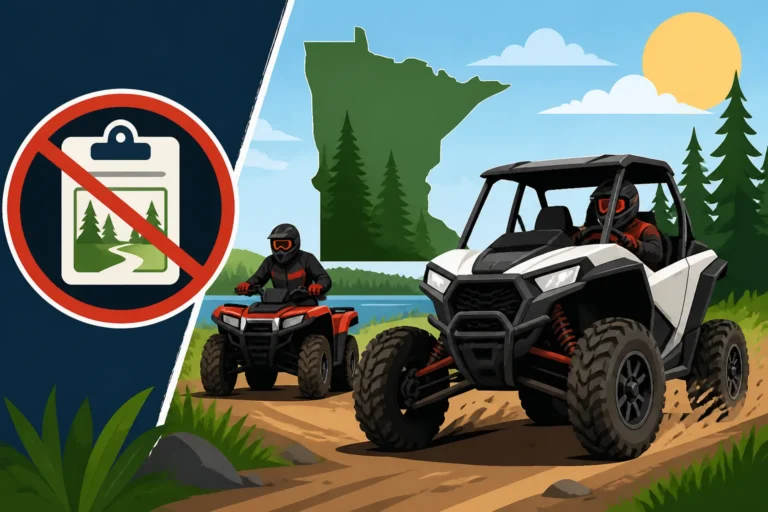
Usually, no—not unless the route or area is specifically designated for off-highway vehicle use. The Minnesota Department of Natural Resources says OHV use is generally prohibited within Wildlife Management Areas, except on posted trails and in areas specifically designated for that use.
That rule is easy to misunderstand because WMAs are public lands, and nearby roads or trails may be open to motorized travel. But public access for hunting, wildlife viewing, or walking does not automatically include motorized access. An ATV or UTV registration, a trail pass, or permission to enter a WMA for another purpose does not by itself authorize you to ride there.
Treat the posted designation as the deciding factor. If you cannot confirm that the route is open to your type of machine, don’t assume it is legal because it appears on a map, follows an old road, or has tire tracks. A road or trail on the ground is not necessarily a route designated for OHVs.
The same caution applies to trails with names that sound like riding routes. Hunter Walking Trails provide relatively easy access to grouse and woodcock areas, but they are not permission for OHV travel. The Minnesota Department of Natural Resources notes that many Hunter Walking Trails are gated to help prevent OHV access. A gate or closure sign is a clear reason to turn around, not an obstacle to work around.
Before planning a ride, separate three questions:
- Is this land open to the public for the activity you have in mind?
- Is this particular route open to OHV use?
- Is it open to your vehicle type and under the conditions shown on the current signs or map?
A “yes” to the first question does not answer the other two. If a WMA has a posted OHV trail, stay on that designated route and follow any local signs or closures. Do not leave the route to reach a hunting spot, shortcut around a barrier, or explore an unmarked track.
For broader orientation, Finding a Minnesota DNR Trail Map and Reading a Minnesota OHV Trail Map can help you understand how to locate mapped riding opportunities. Maps are useful planning tools, but signs and current closures matter too. If a map and a sign appear to conflict, stop and confirm the current designation before proceeding.
The Highway-Licensed Vehicle Exception Is Narrow
The WMA rule includes a limited exception for highway-licensed motor vehicles. The Minnesota Department of Natural Resources says these vehicles may be operated on established roads at speeds up to 20 miles per hour in specific WMAs, including Carlos Avery, Hubbel Pond, Mille Lacs, Red Lake, Roseau River, and Thief Lake.
This exception is not a general authorization for ATVs or UTVs. A machine that is an OHV does not become eligible for the highway-licensed vehicle exception simply because it can travel on a road, has lights, or resembles a road vehicle. The exception concerns highway-licensed motor vehicles on established roads in specific WMAs; it does not open all WMA roads or trails to all motorized vehicles.
If you are driving a highway-licensed vehicle, stay on established roads and observe the stated speed limit and posted restrictions. If you are riding an ATV or UTV, look for a route or area specifically designated for OHV use. When you cannot tell whether the vehicle or route qualifies, do not rely on the exception without checking the current WMA information.
It is also important not to confuse access rules in different types of public land. Minnesota state forests are classified for OHV use, and their rules can differ from WMA rules. For example, the Minnesota Department of Natural Resources says OHVs are not permitted in state forests classified as closed; in limited forests, they may use roads and trails posted open; and in managed forests, they may use roads and trails not posted closed. Those state-forest classifications do not determine whether you can ride inside a WMA.
A route that passes near or between different kinds of public land may cross a boundary without an obvious change in terrain. Check the map and boundary information before you go, and watch for signs along the route. The state-forest rules discussed in Minnesota Trail Pass Rules at a State Forest are useful context, but they should not be treated as WMA authorization.
Registration and Trail Passes Do Not Create WMA Access
Registration and trail-pass requirements are separate from land access. Having the correct paperwork may be necessary for legal OHV use, but it does not turn a closed or undesignated WMA route into an open trail.
According to the Minnesota Department of Natural Resources, OHVs used in Minnesota must be registered with the DNR, or the operator must possess a trail pass when operating on state and grant-in-aid trails. The requirement depends on the machine and where it is being operated. A trail pass is not a substitute for permission to use a particular route, and it does not override WMA restrictions.
For nonresidents, the distinction is especially important. The Minnesota Department of Natural Resources says that nonresident OHVs legally registered in another state or country and not in Minnesota for more than 30 days do not need Minnesota registration. However, nonresidents operating an ATV, OHM, or ORV on state or grant-in-aid trails need a nonresident trail pass. A trail pass is not needed when the machine being ridden is registered in Minnesota.
Those trail-pass rules apply to the kinds of trails identified by the DNR; they do not independently grant access to a WMA. Before using a trail that may enter or cross a WMA, confirm both that the route is open to your vehicle and that your machine meets the applicable registration or pass requirements. For more detail, see Minnesota’s Non-Resident ATV Trail Pass, Which Minnesota Trails Require a Pass, and Minnesota Rules for Visiting Riders.
The table summarizes the distinction:
| Situation | What to check | What it does not mean |
|---|---|---|
| A route is inside a WMA | Whether it is posted or specifically designated for OHV use | Public ownership alone does not make it rideable |
| Your machine is registered | Whether the route is open to that vehicle type | Registration does not provide land access |
| You have a trail pass | Whether the trail is a state or grant-in-aid trail and whether the pass rule applies | A pass does not open a prohibited WMA route |
| You are a nonresident | Whether your out-of-state registration and trail-pass situation meet DNR rules | Nonresident status does not create an exemption from WMA restrictions |
| You are in a highway-licensed vehicle | Whether you are on an established road in a WMA where the exception applies | The exception does not authorize general OHV riding |
If you are unsure which pass rules apply to a planned route, start by identifying the trail type rather than buying a pass and assuming it covers every public-land segment. The DNR offers trail-pass purchases online and in person through Game and Fish License Agents and Deputy Registrar offices, but the purchase process is separate from checking land access.
How to Check a WMA Route Before You Ride
A careful route check is more dependable than relying on a trail line in a general mapping app. The Minnesota Department of Natural Resources says Hunter Walking Trail map data are updated annually and typically published in August. That information can help you plan for walking access, but it should not be mistaken for an OHV trail designation.
Use a practical check before loading your machine:
- Identify the WMA and the exact route you intend to use. Do not plan only around a nearby town, trailhead, or general area.
- Look for an official map or posted information that specifically identifies the route or area as open to OHVs.
- Check whether the route crosses a boundary or enters a different land type. Different public-land classifications can have different access rules.
- Look for gates, closure notices, and signs at the entrance and along the route. Do not pass a barrier or continue beyond a closure.
- Confirm that the route is open to your vehicle type, rather than assuming an ATV, UTV, OHM, and highway-licensed vehicle are treated alike.
- Check current restrictions before leaving. Temporary road and trail closures can change, so an older map may not show the current conditions.
- Carry the documents and pass information that apply to your machine and route, and be ready to show them if requested.
If no official information confirms OHV access, choose a route that is clearly designated for riding instead. The DNR’s off-highway vehicle trail atlas can help locate riding opportunities, including state and grant-in-aid trails. Minnesota has more than a hundred state and grant-in-aid trails available for riding, according to the Minnesota Department of Natural Resources, but that general availability does not mean every trail or nearby public parcel is open.
If your planned ride includes connecting roads, crossings, or trail segments, check each part rather than treating the entire route as one continuous trail. A legal trail can lead close to a WMA without authorizing travel inside it. When in doubt, turn around and use a confirmed route rather than relying on tire marks or another rider’s presence.
The simplest rule is also the safest one: ride in a WMA only where OHV use is specifically posted or designated. A valid registration or pass can satisfy paperwork requirements, but only a valid route designation answers the access question.
Sources
- Minnesota Department of Natural Resources — Off-highway vehicle registrations & fees | Minnesota DNR (checked November 3, 2026)
- Minnesota Department of Natural Resources — Off-highway vehicle (OHV) trail planning | Minnesota DNR (checked November 3, 2026)
Disclaimer
This article is for general informational purposes only and does not constitute professional advice. Laws, prices and regulations vary by location and change over time. Consult a qualified professional for guidance on your specific situation.