What to Carry on a Remote Northwoods Ride
A remote Northwoods ride can turn stressful fast when a phone loses service, a tire goes soft, or the group realizes it has taken the wrong forest road. Packing for those problems does not mean loading every tool in the garage. This guide covers the navigation, safety, repair, recovery, and comfort essentials that help Minnesota riders handle a long way back to the trailhead.
Plan for limited service and changing conditions
Carry more than one way to navigate
Do not make a cell phone your only navigation plan. In parts of northern Minnesota, including stretches of the Nemadji State Forest and Paul Bunyan State Forest, reception can be unreliable. A phone map may work offline if you download the map area before leaving, but only if the phone has battery power and the app has the right trail information.
Before the ride, save your route and nearby trail connections for offline use. Tools such as onX Offroad can help riders view mapped routes and prepare for areas where cellular data may not be available. Open the downloaded map while you still have service to confirm it is stored on the device, and bring a charging cable and power bank. A map app is useful, but it is not a substitute for checking trail access and closures before you go.
Carry a paper map as a backup, especially if you are riding unfamiliar forest roads or a route with multiple junctions. Mark your intended route and the trailhead or staging area before you leave. If your phone fails, a paper map can still help the group identify where it is and which direction it needs to go. For more preparation, see [Carrying a Paper Map in the Northwoods] and [Getting Turned Around in a State Forest].
Share the plan before you ride
Tell someone who is not joining the ride where you are starting, which general route you plan to follow, and when you expect to be back. Give them the names of the people in your group and the vehicles you are using. A vague message such as “We’ll be somewhere north of town” is much less useful than a clear trailhead, planned area, and return window.
Agree on what that person should do if you have not checked in by the expected time. A late return does not always mean an emergency—groups stop for repairs, weather, or a wrong turn—but a contact who knows the plan can make sensible decisions rather than guessing. If you change plans during the ride, send an update whenever you have service.
A satellite messenger or personal locator device may be worth considering for a remote trip, particularly when riding alone or far from busy trailheads. Learn how it works before you need it, keep it charged, and carry it where you can reach it. It is not a replacement for planning, but it can provide a way to send a message or request help when ordinary phone service is unavailable. Read [Cell Service in the Minnesota Northwoods] and [Do You Need a Satellite Messenger in the Northwoods?] when deciding what backup makes sense for your route.
Pack for breakdowns, flats, and getting stuck
Bring a compact repair kit for your machine
A useful repair kit is matched to the machine you are riding. Start with the owner’s manual or a basic tool list for your model, then pack the tools needed for common adjustments and simple roadside fixes. A multi-tool, the correct wrenches and sockets, pliers, zip ties, electrical tape, and a small flashlight can solve more problems than a bulky collection of tools that do not fit your machine.
For tire trouble, carry a tire plug kit if it is appropriate for your tires, plus a compact air source and a way to check pressure. Know how to use the kit before the ride; discovering that a tool is unfamiliar while standing in wet leaves is a frustrating time to learn. If you carry a spare tire or other model-specific equipment, make sure it can be secured safely and does not interfere with passengers or cargo.
A small kit should also include spare fuses suited to your machine, basic gloves, and any essential parts or supplies recommended for your setup. Keep repairs within your skill level. A loose fastener or a puncture may be manageable, while a serious steering, brake, or engine problem may require stopping and arranging help. For more on tire preparation, see [Flat Tires on a Rocky Forest Trail].
Carry recovery gear you can use safely
Mud, roots, and soft ground can leave a machine unable to move under its own power. A winch can help, but it is only useful when it is in working order and the operator knows how to use it. Inspect the line, controls, mounting points, and power connections before leaving. Pack gloves, and use a tree-saver strap rather than wrapping a winch line directly around a tree.
A rated tow strap can be useful for a controlled pull, but avoid improvised attachments to racks, bumpers, or other parts not designed for towing. Keep bystanders clear of a tensioned line, and never stand in the direct path of a loaded strap or cable. If the machine is deeply buried, tilted, or caught near a steep bank, stop and reassess instead of adding force in a way that could cause a rollover or injury.
Recovery gear should match the terrain and the group’s experience. A short, familiar route on firm ground has different needs from a wet, remote route with deep ruts. At minimum, know where your gear is, how it attaches, and who in the group will operate it. See [Recovery Gear for Deep Mud] for more on preparing for a stuck machine.
| Situation | Useful items to carry | Before you leave |
|---|---|---|
| Lost or uncertain route | Offline map, paper map, compass, charged phone | Download maps and mark the trailhead |
| Flat tire | Plug kit, air source, pressure gauge, gloves | Practice using the kit at home |
| Dead phone battery | Power bank, charging cable | Charge both phone and power bank |
| Stuck machine | Suitable winch or tow strap, gloves, tree-saver strap | Inspect gear and review safe use |
| Minor injury | First-aid kit, personal medication | Check contents and expiration dates |
| Unexpected delay | Water, food, warm layer, light | Pack for more time outdoors than planned |
Prepare for injury, weather, and a longer-than-planned day
Make first aid practical, not just a box in the cargo area
A first-aid kit should be easy to reach and suited to the group. Include supplies for scrapes, blisters, cuts, and other minor problems, along with any personal medication riders may need. A few pairs of nitrile gloves, sterile dressings, bandages, medical tape, antiseptic wipes, and tweezers are useful basics. Store supplies in a waterproof pouch or container so they remain usable after rain, mud, or a wet crossing.
The kit does not replace training. Riders should know how to control bleeding, protect a person from further injury, and communicate the location to emergency responders. If someone is hurt, first move the group out of immediate danger and assess what happened. Do not rush to move a person who may have a serious neck, back, or head injury unless staying in place creates an immediate threat.
Consider the distance from the trailhead and how long help may take to reach you. A small kit that is adequate for a short ride near a town may not be enough for a remote day with a larger group. Each rider should know where the kit is, rather than assuming someone else will find it. See [First Aid Far From the Trailhead] for a more detailed look at first-aid planning.
Pack for cold, rain, hunger, and delays
Northwoods weather can feel different once you are moving through a forest, getting splashed, or stopping to fix a machine. Bring a warm layer even when the forecast seems mild, plus rain protection that can be reached without unpacking everything. Gloves can become wet or dirty during repairs, so an extra pair is often a welcome addition.
Carry water for each rider and more food than you expect to need. A ride that runs late because of a flat tire or route confusion can stretch well beyond the lunch stop. Choose snacks that travel well and do not require cooking. If anyone in the group has a medical condition, allergy, or dietary need, make sure the person has the items they rely on rather than assuming the group’s shared supplies will cover it.
A headlamp or flashlight is more useful than relying on a phone light, particularly when both hands are needed for a repair. Pack spare batteries or confirm the light is charged. A basic whistle can also help riders signal to one another if they become separated in a wooded area. The goal is not to prepare for every imaginable emergency; it is to avoid making a manageable delay harder because the group has no water, light, or dry layer.
Use a checklist before loading the machine
Match your load to the route and group
The right kit depends on the ride. A short loop near a well-used staging area may call for less equipment than a long outing through unfamiliar forest roads. Consider the number of machines, the riders’ experience, the weather, the route’s distance from services, and whether anyone is riding alone. If you are traveling in a group, coordinate shared items such as a larger first-aid kit or recovery gear, but do not assume that one person will always be close by.
Keep heavy items low and secure. Loose tools, bottles, or recovery gear can shift when a machine climbs a hill or travels over ruts. Check that cargo does not block lights, interfere with steering, or make it difficult for a passenger to sit securely. Keep emergency items accessible; the first-aid kit and communication device should not be buried under camping gear.
Before driving to the trail, check the route and access conditions. Trail closures, seasonal restrictions, and wet-weather conditions can affect whether a planned ride is appropriate. A mapping app, including onX Offroad, can be part of route preparation, but confirm access with reliable local or land-manager information rather than assuming every mapped line is open to riding. See [Checking Minnesota Trail Status Before You Drive] for a pre-trip routine.
Run through this final packing check
Use this list as a starting point, then adjust it to your machine and route:
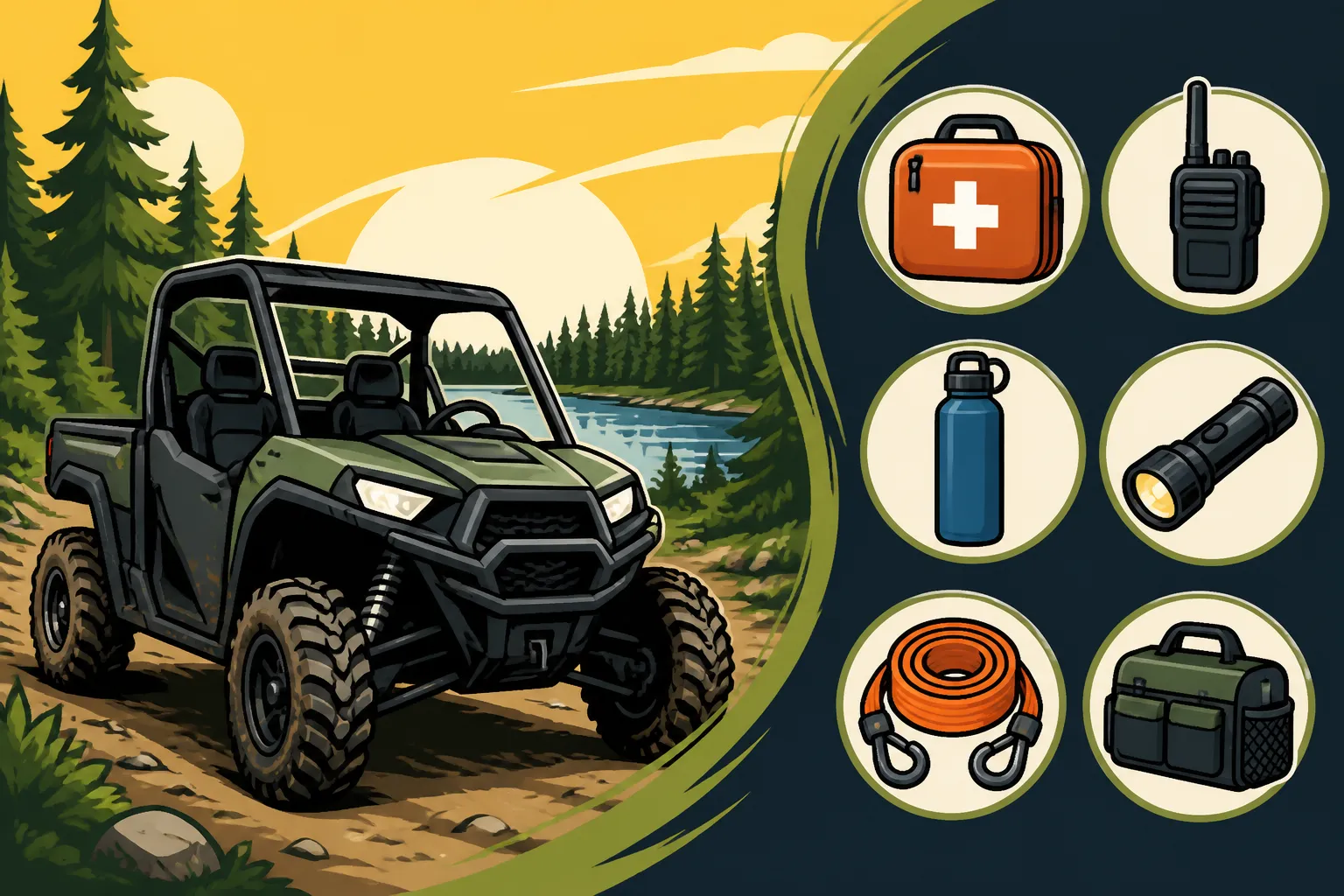
- Navigation: Phone with offline maps, charging cable, power bank, and paper map.
- Communication: Charged phone, planned check-in contact, and satellite messenger if the route warrants one.
- Repair supplies: Machine-compatible tools, tire repair supplies, air source, spare fuses, and flashlight.
- Recovery equipment: Appropriate winch or tow strap, gloves, and a tree-saver strap where relevant.
- First aid: Waterproof kit, personal medication, and a plan for communicating your location.
- Food and water: Enough for the expected ride and a meaningful delay.
- Weather protection: Warm layer, rain gear, and spare gloves.
- Visibility and signaling: Headlamp, whistle, and any required machine safety equipment.
- Route details: Trailhead, planned route, return time, and a contact who knows the plan.
- Machine check: Tires, lights, brakes, fuel, winch, and secure cargo.
Fuel planning deserves special attention on a remote ride. Do not assume that a convenient station will be open or close to the route, and do not plan to use the final part of the tank as your reserve. Account for detours, slow riding, towing, and the possibility that a group will need to turn around. For practical planning, see [Fuel Planning for a Minnesota Trail Day].
The best remote-ride kit is one you understand and can reach when something goes wrong. A map that has not been downloaded, a tire tool nobody knows how to use, or a first-aid kit buried under cargo will not help much in the moment. Prepare before leaving service, share the plan, and bring enough supplies to handle a delay without turning it into a crisis.
Disclaimer
This article is for general informational purposes only and does not constitute professional advice. Laws, prices and regulations vary by location and change over time. Consult a qualified professional for guidance on your specific situation.