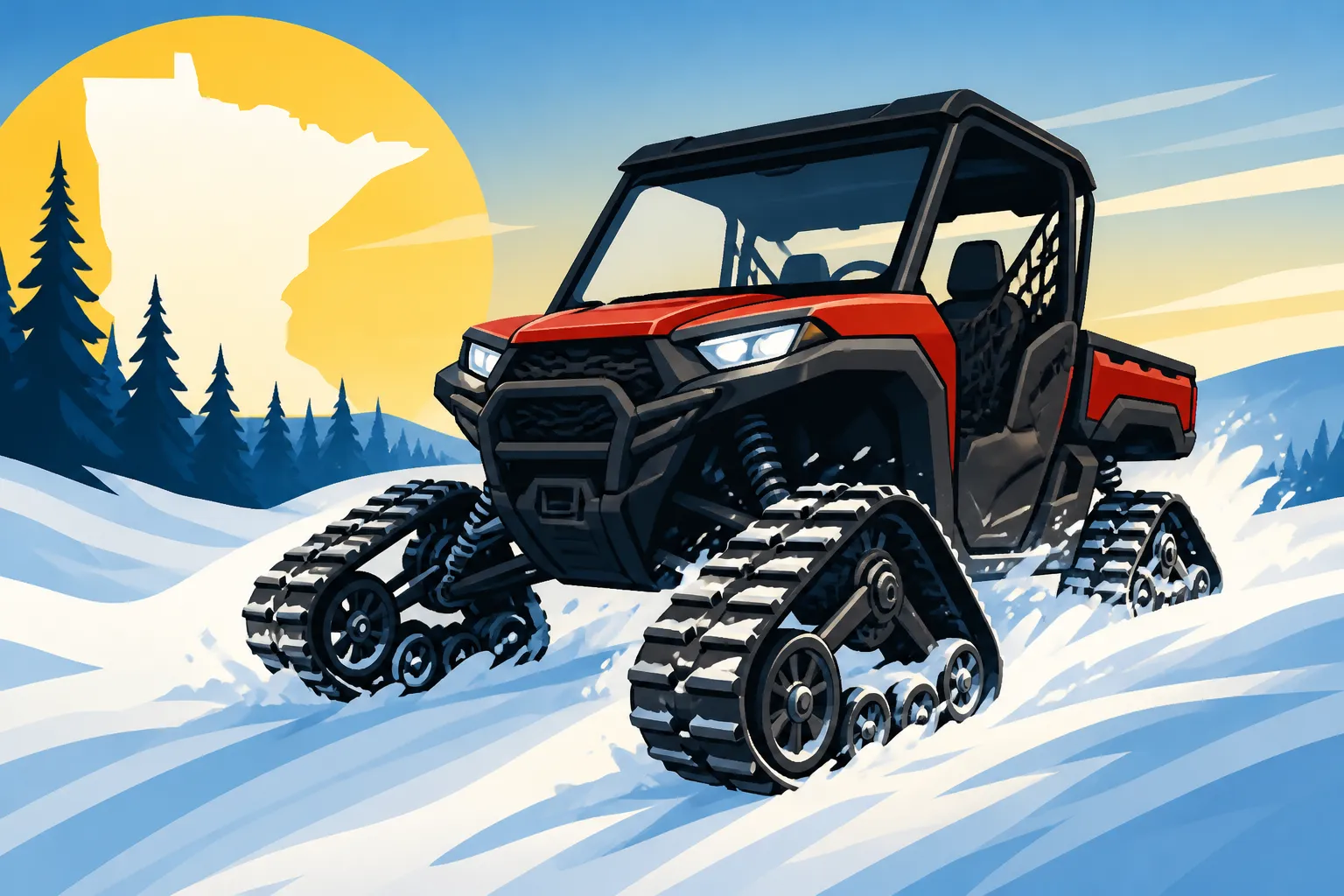
Tracks on a Machine in Deep Snow
When the Minnesota snow piles up, many ATV and UTV owners find their machines, which are usually unstoppable during the warmer months, suddenly struggling. That feeling of being stuck, or simply unable to reach your favorite hunting shack or ice fishing spot because the drifts are too deep, is a common frustration here in the Land of 10,000 Lakes. This guide will dive deep into equipping your machine with tracks for navigating deep snow, and crucially, what that means for legally riding on Minnesota's roads and ditches.
The Allure of Tracks: Conquering Minnesota's Deep Snow
Let's be honest, winter in Minnesota is gorgeous but it can also be a real challenge for getting around, especially if you live off the beaten path or your recreational pursuits don't stop when the snow starts falling. Standard ATV or UTV tires, no matter how aggressive the tread, can only do so much when you're facing truly deep, fluffy powder or heavy, wet drifts. This is where track systems come into play, transforming your wheeled machine into an absolute snow-gobbling beast.
Imagine not having to worry about sinking down to your axles, or being able to glide over a fresh foot of snow with surprising ease. Tracks offer a dramatically increased footprint, distributing the machine's weight over a much larger surface area. This means flotation, baby, pure and simple. You're not just digging through the snow; you're riding on top of it, which is a game-changer for ice fishermen, hunters, cabin owners, and anyone who wants to extend their riding season beyond the typical three seasons. Brands like SuperATV offer a range of track systems, catering to different machine sizes and rider needs, allowing you to essentially turn your ATV or UTV into a hybrid snow machine.
What Exactly Are ATV/UTV Track Systems?
At their core, track systems replace your ATV or UTV's wheels with four triangular or oval-shaped track units, similar in concept to a miniature tank or a snowmobile's track system, but adapted for each corner of your four-wheeler. Each unit typically consists of a durable rubber track wrapped around several internal drive and idler wheels. The machine's axles connect to a drive sprocket within each track unit, propelling the tracks forward.
These systems are engineered for harsh conditions, providing unparalleled traction and flotation in snow, mud, and even soft sand. They typically feature aggressive lugs on the rubber tracks to grip the terrain, and their design lifts the machine higher off the ground, increasing ground clearance. While some basic track systems are designed primarily for snow, many modern systems are "four-season," meaning they can handle snow, mud, rocks, and dirt, although they excel most in snow and soft, wet conditions. The installation usually involves removing your wheels and bolting the track units directly onto the wheel hubs. It's not a quick swap like changing a tire, but it's generally a procedure that a mechanically inclined owner can perform or have done by a dealer.
Why Riders Turn to Tracks for Minnesota Winters
The reasons Minnesota riders are drawn to track systems are as plentiful as the snowflakes that fall each winter. First and foremost is accessibility. For those with remote cabins, deer stands deep in the woods, or a favorite ice fishing spot miles from the nearest plowed road, tracks mean the difference between getting there and staying home. Standard tires often mean endless shoveling, getting stuck, or simply being unable to traverse the deep snow that accumulates off the main roads.
Beyond simply getting through the snow, tracks offer a more stable and controlled ride in challenging winter conditions. The large contact patch provides superior grip, reducing the chance of sliding on icy patches or getting bogged down in slush. This enhanced control can make winter riding not just possible, but genuinely enjoyable. Furthermore, for those who use their machines for utility tasks like plowing driveways or hauling firewood, tracks can dramatically increase the machine's capability, allowing it to work more efficiently in heavy snow without losing traction. It extends the usability of your investment across all twelve months of the year, transforming a seasonal recreational vehicle into a true year-round workhorse or adventure machine.
Navigating Minnesota's Rules: Tracks, Roads, and Ditches
Now, here's where things get a bit trickier, and it's a question I hear all the time: "If I put tracks on my ATV or UTV, can I still ride it on the road or in the ditch in Minnesota?" It's a fantastic question, and one that doesn't have a simple "yes" or "no" answer, primarily because Minnesota's Off-Highway Vehicle (OHV) laws were primarily written with wheeled machines in mind. The crucial point is that putting tracks on your machine doesn't automatically reclassify it as something else, like a snowmobile. It generally remains classified as an ATV or UTV, but its unique characteristics can affect how certain rules apply.
Minnesota law is fairly specific about [Minnesota's Ditch Riding Rules] and general road access for ATVs and UTVs. These rules often hinge on factors like the machine's width, weight, whether it's registered for public use, and the operator's age and licensing. The challenge with tracks is that they fundamentally change the dynamics of the machine, even if its legal classification technically remains the same. While the Minnesota Department of Natural Resources (DNR) doesn't have a separate set of laws specifically for tracked ATVs/UTVs on public roads, the general OHV laws still apply. This means understanding how your tracked machine fits into the existing framework, and where a conservation officer might raise an eyebrow.
Does Adding Tracks Change Your Machine's Legal Classification?
For the most part, no. If your machine was manufactured and sold as an ATV (Class 1 or Class 2) or a UTV, adding an aftermarket track system does not typically change its fundamental classification under Minnesota law. It's still considered an Off-Highway Vehicle (OHV). This is a critical distinction because if it were suddenly reclassified as a snowmobile, you'd be looking at a completely different set of rules for registration, trail access, and road use.
However, while the classification doesn't change, the perception and practical application of existing rules can become ambiguous. Law enforcement officers, particularly those less familiar with track systems, might see a machine on tracks and initially assume it falls under snowmobile regulations, especially if you're out during deep winter. It's your responsibility to be aware of the laws pertaining to your specific machine type and to be prepared to explain that it is indeed an ATV or UTV with an aftermarket track system. Having your registration papers handy, which clearly state "ATV" or "UTV," is always a good idea. For clarity on general public use rules, you might want to review [Minnesota Public Use Versus Private Use Registration].
Road and Ditch Riding Rules for Tracked ATVs/UTVs
When it comes to riding a tracked ATV or UTV on Minnesota roads or in the ditch, you're generally subject to the same rules as a wheeled machine of the same class. This means:
- Ditch Riding is Key: Like wheeled ATVs, tracked machines are generally allowed in the ditch or on the extreme right of the right-of-way adjacent to a road, not on the plowed road surface itself. There are exceptions for crossing roads or bridges, but the expectation is that you stick to the unplowed shoulder or ditch. [The Road Surface Minnesota Keeps Closed] is a good read here.
- Width Restrictions: Minnesota has width restrictions for ATVs. Class 1 ATVs are 50 inches or less in width, while Class 2 machines can be up to 65 inches. Most track systems, even on a Class 1 ATV, will keep the machine within the 50-inch limit, though some larger UTV track systems might push a Class 2 machine right up to its 65-inch limit. Always measure your total width with tracks installed to ensure compliance, especially for [Minnesota Class 1 Machines on the Right of Way] rules.
- Speed Limits: OHVs, including tracked ones, typically have reduced speed limits when operating in road rights-of-way, often 20 mph or less. Tracks themselves will inherently reduce your top speed compared to tires, but you must still adhere to posted or statutory limits.
- Lighting and Equipment: Headlights, taillights, and reflectors are still required, especially if you're operating at dawn, dusk, or night. Make sure your track system doesn't obscure any required lighting. A [Minnesota Rules for a Machine Never Trailered] guide might shed light on general equipment needs.
- Registration and Permits: Your machine must be properly registered for public use with the Minnesota DNR, just like any other ATV or UTV. If you're an out-of-state rider, you'll need a non-resident trail pass, even if you're primarily using ditches. [Minnesota's Non-Resident ATV Trail Pass Explained] covers this. Don't risk [Penalties for an Unregistered ATV in Minnesota].
- Operator Requirements: Age, safety training requirements (especially for those born after July 1987), and helmet laws (for riders under 18) remain the same. [Minnesota Helmet Rules for Riders Under 18] and [Driver's License Requirements on Minnesota Roads] are still in effect. And, of course, [Minnesota Alcohol Limits for ATV Operators] apply to all OHV operators.
The biggest practical issue often comes down to damage to the right-of-way. While tracks are less likely to tear up a gravel road or paved surface than spinning tires, operating them on hard, dry surfaces can cause excessive wear to the tracks themselves and might be viewed negatively by local authorities concerned about road maintenance, even if you are technically in the ditch. The soft ground of a snow-covered ditch or field is where tracks truly shine and cause the least impact.
Farm and Utility Exemptions
It's worth noting that Minnesota law does provide some exemptions for ATVs and UTVs used for agricultural purposes. If your tracked machine is genuinely being used for farm work, such as checking fences, hauling feed, or plowing snow on your own property or between fields, you might fall under these exemptions. [Minnesota Exemptions for Farm Machines] clarifies some of these situations. However, these exemptions typically do not cover recreational riding, even if your machine could be used for work. An important distinction here is the purpose of your ride at any given moment. A conservation officer may ask [What a Minnesota Conservation Officer Asks For], so be clear on your intent.
Practical Considerations for Hitting the Snow with Tracks
Beyond the legalities, running tracks on your ATV or UTV brings a host of practical considerations that are important for any Minnesota rider to understand. These machines are beasts in deep snow, but that power and flotation come with a different set of operating characteristics and maintenance needs. It's not just a matter of bolting them on and riding; it's about understanding the new dynamics of your machine.
First, speed and handling will be noticeably different. While tracks offer incredible traction and flotation, they reduce your top speed considerably. Don't expect to fly down a frozen lake at tire-equipped speeds. Steering also changes; a tracked machine might feel heavier and require more effort to turn, especially at lower speeds. This is due to the increased friction and the way the tracks dig into the snow. It takes some getting used to, so practice in an open area before hitting any technical trails or roads.
Secondly, maintenance becomes even more critical. Track systems, especially high-quality ones from manufacturers like SuperATV, are built to last, but they involve more moving parts than a simple wheel and tire setup. Regular inspection for wear and tear on the tracks, bearings, and sprockets is crucial. Running them on hard, abrasive surfaces like dry asphalt or concrete for extended periods can accelerate wear, so it's best to avoid such conditions whenever possible. Think of them as specialized tools; use them for what they're designed for, which is soft terrain and deep snow.
Finally, transportation can be an issue. Your tracked machine will be wider and taller than it was on wheels. Ensure your trailer can accommodate the new dimensions and weight. Also, remember that tracks can be heavy, so loading and unloading might be a bit more challenging. These are all part of the trade-off for unlocking true winter riding capability.
| Feature | Wheeled ATV/UTV (Standard Tires) | Tracked ATV/UTV (Aftermarket Tracks) |
|---|---|---|
| Primary Terrain | Dirt, gravel, light snow, mud | Deep snow, mud, bogs, soft ground |
| Road Legality | Generally permitted in ditch/right-of-way (with rules) | Generally permitted in ditch/right-of-way (same rules as wheeled) |
| Top Speed | Higher, varies by machine | Significantly lower, often 20-40 mph maximum |
| Flotation/Traction | Good in moderate conditions, struggles in deep snow | Excellent in deep snow, outstanding flotation |
| Steering Effort | Lighter, more agile | Heavier, wider turning radius |
| Ground Clearance | Standard | Often increased due to track system design |
| Wear on Hard Surfaces | Moderate tire wear, less impact on machine | Significant track wear, increased maintenance |
| Noise Level | Moderate | Can be slightly louder due to track friction |
| Fuel Economy | Better | Reduced due to increased drag and weight |
| Seasonal Use | Generally 3-season, limited deep snow | True 4-season capability, excels in winter |
| Cost | Initial machine purchase | Initial machine purchase + significant aftermarket track system cost |
What About Snowmobile Trails?
This is a common misconception. While your tracked ATV or UTV looks and performs somewhat like a snowmobile in deep snow, it is generally not permitted on groomed snowmobile trails in Minnesota. Snowmobile trails are specifically designated and maintained for snowmobiles, and allowing other types of machines, especially heavy ATVs or UTVs with tracks, could damage the trail surface or pose a safety hazard. Always respect trail signage and regulations. If you're unsure, assume ATVs/UTVs are not allowed on snowmobile trails unless explicitly stated otherwise. Check out [Minnesota Snowmobile Trails and ATVs] for more details.
Your tracked machine's primary winter domain will be unplowed roads, deep ditches, private property, and designated multi-use OHV trails that remain open in winter. [Where to Ride an ATV in Minnesota] will give you a better idea of year-round trail systems.
The Bottom Line for Tracked Machines on Minnesota Roads
Using tracks on your ATV or UTV in Minnesota offers an incredible opportunity to extend your riding season and access areas that would otherwise be impossible during heavy snow. The ability to glide over deep powder, haul gear for ice fishing, or simply explore the winter landscape is truly liberating. However, the key takeaway is that while tracks make your machine a winter warrior, they don't fundamentally alter its legal classification or exempt it from existing Minnesota ATV/UTV road and ditch riding laws.
You are still operating an Off-Highway Vehicle, and as such, you must adhere to all the regulations governing ATVs and UTVs on public lands and rights-of-way. This means staying in the ditch or extreme right-of-way, respecting speed limits, having proper registration and lighting, and ensuring the operator meets all age and training requirements. Always carry your documentation, be prepared to explain your machine's classification, and prioritize safety.
If you are primarily planning to use your tracked machine on your own land or for specific utility purposes, some rules might be more flexible. For those considering a setup, researching reputable brands like SuperATV and understanding the specific performance characteristics of various track systems will be crucial. With careful planning and adherence to the rules, your tracked ATV or UTV can truly unlock the magic of a Minnesota winter, allowing you to venture where wheeled machines simply cannot. Just be smart about where and how you ride, and you'll be set for a season of unparalleled winter adventure. For general clarity, a review of [Minnesota Road Rules Riders Get Wrong] might be beneficial before you head out.
Disclaimer
This article is for general informational purposes only and does not constitute professional advice. Laws, prices and regulations vary by location and change over time. Consult a qualified professional for guidance on your specific situation.