Lighting Rules for Minnesota Night Riding
Riding an ATV or UTV in Minnesota after the sun dips below the horizon can be an incredible experience – the quiet hum of the engine, the cool air, and the beam of your headlights cutting through the darkness. But let's be honest, it can also be a bit nerve-wracking if you're not absolutely sure your machine is set up correctly and legally for night operation. It’s easy to get confused about what's actually required versus what’s just a good idea. This comprehensive guide will illuminate Minnesota's specific lighting rules for ATVs and UTVs, helping you ride confidently and safely long after daylight fades.
The Basics of Minnesota's ATV Lighting Laws
Navigating Minnesota's vast network of trails, ditches, and permissible road sections means you'll eventually find yourself riding when visibility is low. Whether it's early morning, late evening, or just a really overcast day, having the right lights on your ATV or UTV isn't just a suggestion – it's a legal mandate that helps keep everyone safe. Understanding the basic requirements is your first step toward responsible night riding.
Headlights: Illuminating the Path Ahead
When you're out there, your headlights are your eyes, and in Minnesota, the law is pretty clear on what those "eyes" need to be. Every ATV or UTV operating after sunset or when visibility is poor must be equipped with at least one headlight. Many modern machines come with two, which is even better for spreading light and creating a wider field of vision. The key is that these headlights must be capable of illuminating objects at least 200 feet ahead of the vehicle. This isn't just about seeing what's right in front of your bumper; it's about giving you enough reaction time to avoid obstacles, wildlife, or changes in the trail ahead.
Think about riding a winding trail in a state forest like Nemadji, where fallen branches or ruts can appear quickly. A powerful, well-aimed headlight isn't a luxury; it's a necessity for identifying those hazards. Moreover, proper aim is absolutely crucial. While it might be tempting to tilt your lights up for maximum distance, you risk blinding oncoming riders or drivers, especially if you're briefly riding a ditch or crossing a road. The goal is to illuminate your path without impairing the vision of others. Imagine the frustration of being on the receiving end of a misaligned, blinding beam – it’s a quick way to create an unsafe situation for everyone.
Taillights and Brake Lights: Signals from the Rear
Just as important as seeing where you're going is being seen by those behind you. Minnesota law requires ATVs and UTVs to have at at least one taillight that emits a red light visible from 500 feet to the rear. This isn't just for trail riding; it applies wherever you're operating your machine on public lands or routes. Having a bright, functional taillight is paramount for preventing rear-end collisions, particularly when you're moving through dusty areas or riding in a group.
But it doesn't stop there. A functional brake light, or "stop lamp," is also required. This light must activate when you apply your brakes and be visible from 50 feet away. Consider a scenario where you're riding with friends on a chilly autumn evening in the Paul Bunyan State Forest. If the lead rider suddenly has to slow down for a deer crossing the trail, their working brake light gives everyone behind them crucial seconds to react and avoid a pile-up. Without it, the communication of slowing down is lost, and the risk of an accident skyrockets. For group riding, clear and consistent signaling from brake lights helps maintain safe distances and prevents unexpected jolts that can throw a rider off balance.
Reflective Elements: Passive Safety Measures
Beyond the active glow of headlights and taillights, Minnesota's regulations also mandate passive reflective elements on ATVs and UTVs. These are often built into the machine by the manufacturer – things like red reflectors on the rear and amber reflectors on the sides. While they don't generate light themselves, they become highly visible when illuminated by another light source, like the headlights of a following machine or an approaching car.
These reflectors are truly unsung heroes of night safety. Imagine your machine stalls out unexpectedly on the shoulder of a county road ditch after dark, and your battery dies, taking all your active lights with it. Those strategically placed reflectors become your last line of defense, catching the light from passing vehicles and alerting drivers to your presence. They are particularly vital in emergency situations or when your machine is parked on the edge of a trail or road, even if only for a moment. Always make sure these reflectors are clean and unobstructed, as their effectiveness depends entirely on their ability to bounce light back.
Specific Scenarios and Road-Crossing Requirements
Minnesota offers a unique mix of riding opportunities, from dedicated trails to ditch riding and even designated road routes in certain towns. Each of these environments can present slightly different expectations when it comes to your machine's lighting, especially after dark. Knowing the nuances can save you from a ticket and, more importantly, keep you safe.
Riding on Ditches and Road Rights-of-Way
Minnesota law permits ATVs and UTVs to operate on the shoulder or inside slope of a ditch alongside certain public roads. This is a common way for riders to connect trails or access local services. When you're utilizing this public right-of-way, your machine is no longer strictly on a secluded trail; it's sharing a corridor with highway traffic, even if you're separated from the main road surface. Consequently, the lighting requirements become particularly important for visibility to other road users. [Riding the Ditch of a Minnesota Right of Way] is a common practice, but it comes with responsibilities.
After dark, or during times of reduced visibility, your headlights and taillights must be fully operational and properly displayed. This ensures that drivers of cars, trucks, and other vehicles can see you from a distance, both approaching and from behind. It's not enough for your lights to simply "work"; they need to be clear of mud, snow, or debris that could obscure their visibility. A dim or obstructed light is almost as bad as no light at all. Always remember that even if you're off the paved surface, you're still in a zone where high-speed vehicles operate, making maximum visibility your personal priority.
Crossing Public Roads and Highways
Briefly crossing a public road or highway on your ATV or UTV is often unavoidable when connecting trails or accessing private property. These are high-risk maneuvers, typically requiring a full stop and careful observation for traffic. When making these crossings after dark, your machine's lighting must be fully engaged and clearly visible. This means your headlights cutting through the night and your taillight glowing brightly, ideally with a brake light ready to flash if you need to stop unexpectedly. [Crossing a Minnesota Highway Safely] requires keen awareness and a machine that is properly lit.
The heightened visibility during a road crossing isn't just about legal compliance; it’s about survival. Even if you're only on the pavement for a few seconds, you're exposing yourself to traffic traveling at much higher speeds. Your machine's lights act as a clear signal to drivers that you are present and moving. Consider adding bright reflective tape to your helmet or machine for these moments, creating additional points of light that can catch a driver's eye. While your machine's built-in lighting is the minimum, anything you can do to stand out more during these brief, vulnerable moments is a wise investment in your safety.
Night Riding in ATV-Friendly Towns
Certain towns in Minnesota have embraced ATVs and UTVs, designating specific routes within city limits for their use. Riding into a [Minnesota Cities That Allow ATVs on Streets] like Appleton after dark to grab a bite to eat or fuel up is a fantastic perk of being an ATV owner in these areas. However, when you enter these urban environments, you're transitioning from trail rules to something much closer to street vehicle regulations, even if your machine isn't fully street legal.
While the core headlight, taillight, and brake light requirements remain, some towns might have additional specific ordinances, such as needing turn signals or additional reflective markings, especially if you're on a UTV. Always check with the local municipality if you plan on riding within their designated routes after dark. The key here is blending in safely with regular vehicle traffic. Your lights need to be distinct and easily identifiable as a moving vehicle. Furthermore, while bright auxiliary lights might be great for deep woods trails, they often need to be turned off or covered in town to avoid dazzling residents and other drivers. Riding responsibly in these communities helps ensure these privileges continue for all riders.
Beyond the Minimum: Enhancing Visibility and Safety
While Minnesota's legal requirements for ATV and UTV lighting are important baselines, many riders choose to go above and beyond for enhanced safety and capability. Adding auxiliary lighting and reflective elements can dramatically improve your visibility and your ability to see in challenging night conditions, especially on rugged trails.
Auxiliary Lighting: Light Bars and Pod Lights
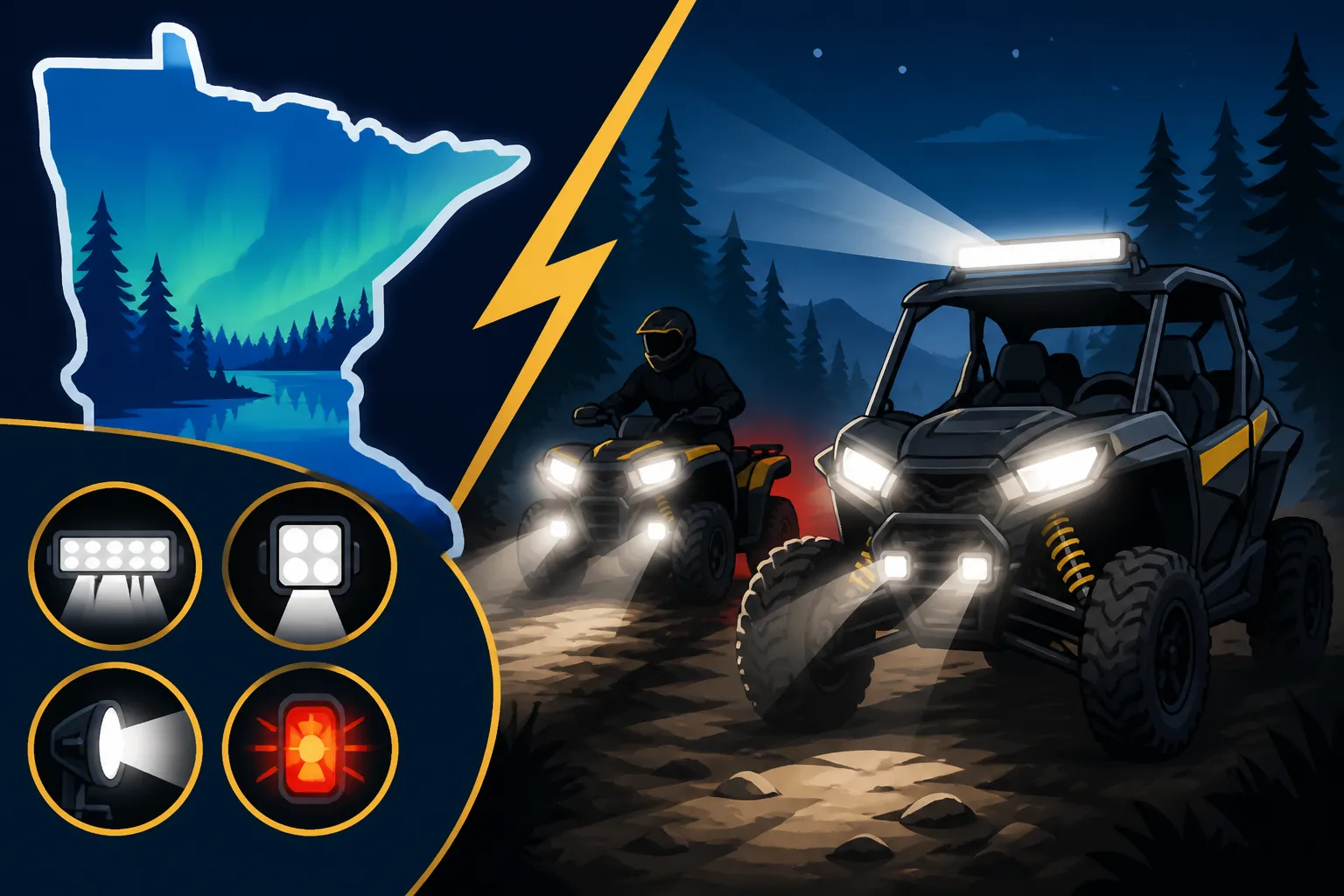
For those who frequently ride in truly remote areas after dark, the stock headlights on many ATVs and UTVs, while compliant, can sometimes feel inadequate. This is where auxiliary lighting, like LED light bars and pod lights, comes into play. These powerful aftermarket additions can turn night into day, illuminating wide swaths of trail, enhancing depth perception, and revealing obstacles that might otherwise remain hidden. Many riders look to brands like SuperATV for a wide array of durable and high-performing light bars that can be a game-changer for serious night riding.
However, there's a critical caveat: these lights are generally not legal for use on public roads, road rights-of-way, or whenever you might encounter oncoming traffic. Their intense brightness is designed for off-road use where there's no risk of blinding other operators. If you're on a deep trail in the Huntersville State Forest at midnight, a good light bar is fantastic. But the moment you approach a road crossing, a public ditch, or ride into a trail town, these lights must be turned off or covered. Misusing them can lead to citations and, more importantly, dangerous situations for others. Think of them as your "high beams" for the wilderness, to be used responsibly and with discretion.
Whip Flags and Reflective Tape for Night Visibility
Sometimes, the simplest additions can make a huge difference. Whip flags, often associated with dune riding, are increasingly popular on trails for improved visibility, especially in dusty or hilly terrain. For night riding, a flag equipped with an LED light or made from highly reflective material can significantly increase your profile, making you easier to spot, especially if you're leading or trailing a group. [Whip Flags for a Ditch Ride] are a great safety enhancement.
Similarly, adding extra reflective tape to your machine, beyond the factory-installed reflectors, is a low-cost, high-impact safety upgrade. You can apply reflective tape to the front forks, the rear fenders, the sides of your machine, or even your helmet. Brands like SuperATV also offer various reflective decals and accessories that can integrate seamlessly with your machine's look while adding that crucial passive visibility. This is particularly useful if your machine is dark-colored or if you frequently find yourself operating in conditions where dust, fog, or snow can obscure lights. Every additional point of light, especially reflective ones that don't rely on your machine's electrical system, enhances your safety envelope, making it harder for others to miss you.
Helmet-Mounted Lights and Personal Lighting
While your machine's lights are essential, don't overlook the value of personal lighting. A good quality headlamp attached to your helmet can be incredibly useful when riding at night. It illuminates exactly where your head is turned, allowing you to see around corners or into areas your fixed headlights might miss. It's also invaluable if you need to perform a trailside repair, consult a map, or dig through your pack in the dark.
Beyond helmet lights, consider other personal safety lights. Small, clip-on LED lights on your jacket or backpack can provide additional points of light, especially if you dismount your machine on the side of a trail or road at night. If you ride in a group, colored personal lights can help distinguish riders. These personal lighting solutions offer an extra layer of redundancy and practicality, ensuring that even if your machine's electrical system has a hiccup, you still have a way to see and be seen, which is critical when you're far from civilization.
Common Pitfalls and Misunderstandings
Even experienced riders can sometimes make assumptions or overlook details when it comes to night riding and lighting. Avoiding these common pitfalls is key to a safer, more enjoyable experience on Minnesota's trails and roads after dark.
The "Daylight Only" Mindset and Its Dangers
It’s easy to tell yourself, "Oh, I only ride during the day, so I don't need to worry too much about my lights." This "daylight only" mindset is a trap many riders fall into. The reality is, even a planned daytime ride can easily extend into dusk or full darkness. An unexpected breakdown, getting a little turned around, a flat tire that takes longer to fix than anticipated, or simply misjudging the sunset time can quickly turn a sunny afternoon ride into a desperate scramble to get back before it's pitch black. [Riding Back to the Cabin After Dark] is a reality many riders face.
The danger here is obvious: without proper, functioning lighting, you become a ghost on the trail or ditch. You can't see hazards, and other riders or drivers can't see you. This dramatically increases the risk of an accident. Always assume that at some point, you might find yourself riding at night, even if unintentionally. Therefore, regularly inspecting and maintaining your machine's lighting system should be as routine as checking your tire pressure or fuel level, regardless of your typical riding schedule.
Blinding Oncoming Riders and Drivers
One of the most frustrating and dangerous aspects of night riding is encountering another machine (or even a car on a road crossing) with lights that are too bright or improperly aimed. While auxiliary light bars are fantastic for illuminating desolate trails, they are designed with incredible intensity for that specific purpose. Using them when approaching other riders, or on any public right-of-way, is irresponsible and illegal. [Lighting Rules for Minnesota Night Riding] specifically address this.
The responsibility falls squarely on the rider operating the machine. You must be prepared to switch off or dim your auxiliary lights well in advance of encountering another person. Imagine being on a narrow trail and suddenly being hit with the full glare of a 30-inch LED light bar – it's disorienting, temporary blinding, and incredibly dangerous. Be mindful of your light usage, especially when trails are crowded or when you're in areas where you might encounter others. A moment of courtesy can prevent an accident and preserve the positive image of the riding community.
Maintenance and Pre-Ride Checks for Lighting
Just like any other component on your ATV or UTV, lights can fail. Bulbs burn out, wires fray, and connections corrode, especially with exposure to the elements that Minnesota riding often entails. A common misunderstanding is that if a light worked last season, it'll work this season. Not so! A critical pre-ride check, especially before any planned night riding, must include a thorough inspection of your entire lighting system.
Take a few minutes before you head out to test everything: headlights (both low and high beam, if applicable), taillights, and especially your brake lights. Have a friend stand behind your machine while you squeeze the brake lever or press the pedal. Are they bright and responsive? Check for cracked lenses, which can diminish light output or allow water in. Inspect wiring for any obvious damage. Ensure your battery is healthy, as a weak battery can lead to dim lights or complete failure. Carrying spare bulbs (if your system uses them) or a small repair kit for connections can be a lifesaver. This proactive approach to maintenance prevents unpleasant surprises when you're miles from the trailhead after dark.
Penalties for Non-Compliance and Enforcement
Ignoring Minnesota's ATV and UTV lighting regulations isn't just a safety risk; it's a legal one. Law enforcement, particularly conservation officers, take these rules seriously to protect both riders and the public. Understanding the potential consequences of non-compliance can be a strong motivator for ensuring your machine is always properly equipped.
Fines for Missing or Malfunctioning Lights
Operating an ATV or UTV after dark or during periods of reduced visibility without the legally required lighting is a violation of Minnesota state law. The penalties for such offenses typically involve fines, which can vary depending on the specific nature of the violation and whether it's a first offense or a repeat issue. While I can't provide exact dollar amounts, understand that these fines are designed to be a deterrent and can add up quickly. A missing taillight, a headlight that doesn't meet the illumination standard, or auxiliary lights used improperly in a public area can all lead to a citation. [Minnesota Penalties for a Missing Sticker] and other violations can be costly.
Imagine being pulled over by a conservation officer during a night patrol because your taillight is out. Not only does this interrupt your ride, but it can also result in a fine and, potentially, an order to cease operation until the issue is fixed, especially if it's deemed a significant safety hazard. These penalties are not arbitrary; they reflect the serious safety implications of an unlit or poorly lit machine in an environment where visibility is already compromised.
Conservation Officer Enforcement in Minnesota
Minnesota's conservation officers (DNR enforcement) play a pivotal role in ensuring compliance with ATV and UTV regulations, including lighting. They patrol trails, state forests, and public rights-of-way extensively, often after dark, specifically looking for machines that are operating unsafely or illegally. Their presence is particularly noticeable during busy riding seasons or on holiday weekends. [Conservation Officer Enforcement in Minnesota] is a reality for riders.
When a conservation officer observes a machine operating without proper lighting, they will almost certainly initiate a stop. During such an encounter, they will verify the functionality of all required lights, ensure auxiliary lights are not being misused, and check for registration, safety training compliance, and other regulatory aspects. Their goal isn't just to issue tickets; it's to educate and ensure that all riders contribute to a safe environment. Cooperating with an officer, even if you're facing a citation, is always the best approach.
Insurance Implications of Poor Lighting
Beyond legal fines, there's another significant, often overlooked, consequence of inadequate lighting: the potential impact on your ATV or UTV insurance. If you're involved in an accident at night or in low light conditions, and it's determined that your machine's lighting was either non-existent, malfunctioning, or not compliant with state law, your insurance company could potentially deny or reduce your claim. [Minnesota ATV Insurance Cost] can be significant, and you want it to cover you when needed.
Insurance policies are based on the expectation that you are operating your vehicle legally and responsibly. If your lack of proper lighting is found to be a contributing factor to an accident – for example, if another party claims they couldn't see you – your ability to recover damages or have your own repairs covered could be severely jeopardized. This could mean thousands of dollars out of your own pocket. Ensuring your lighting is always up to par isn't just about avoiding a ticket; it's about protecting your financial interests and ensuring your insurance policy actually works for you when you need it most.
Required Lighting Components for Minnesota Night Riding
| Component | Requirement | Visibility Distance | Usage Context |
|---|---|---|---|
| Headlight(s) | At least one, emitting white or amber light | 200 feet ahead | Required after sunset, before sunrise, or anytime visibility is poor |
| Taillight(s) | At least one, emitting red light to the rear | 500 feet to the rear | Required after sunset, before sunrise, or anytime visibility is poor |
| Brake Light(s) | At least one, emitting red light upon brake application | 50 feet to the rear | Required to signal braking, enhancing safety for following riders/drivers |
| Reflectors | Red to the rear, amber to the sides (typically factory installed) | N/A (passive) | Essential for passive visibility if active lights fail or machine is parked |
| Auxiliary Lights | (e.g., light bars) | Varies | Permitted off-road on private/public trails; Must be turned off/covered on public roads/ditches. |
Disclaimer
This article is for general informational purposes only and does not constitute professional advice. Laws, prices and regulations vary by location and change over time. Consult a qualified professional for guidance on your specific situation.