Passes and Minnesota Trails That Cross Private Land
A Minnesota trail can cross private land and still be an official public riding route. That can make it hard to tell whether you need a trail pass, whose permission applies, and where you may ride. The key is to separate the pass requirement from the land-access arrangement: one concerns the rider or machine, while the other defines the route you’re allowed to use.
Why a trail can cross private land
Some Minnesota trails run across land owned by private individuals, businesses, or other organizations. A landowner may allow a trail to cross a defined part of the property through an agreement, easement, or other arrangement. That does not necessarily make the surrounding property public, nor does it mean riders can leave the trail.
Grant-in-aid trails are a common example. They are designated routes supported through Minnesota’s grant-in-aid trail system and maintained by local sponsors, often clubs or local units of government. Parts of a route may cross private land where the landowner has allowed trail access. Read Grant-in-Aid Trails and Who Maintains Them for more about how that system works.
For a rider, the practical point is that the trail’s location on private property does not automatically make it a private ride. If the segment is part of an authorized trail, it remains a designated route with its own access conditions. At the same time, permission to use the trail corridor is not permission to explore the rest of the property.
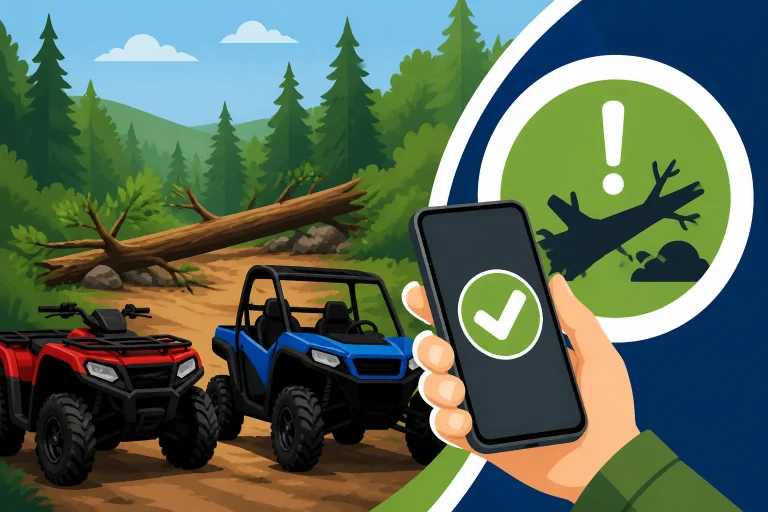
Stay on the marked route, obey signs and barriers, and do not turn onto an unmarked lane or field because it looks rideable. A landowner or trail manager may close or reroute a segment, and an official route can be subject to seasonal restrictions. Check the status before leaving home, especially after storms, during spring thaw, or when a trail passes through a sensitive area.
Private-land access and pass rules are separate questions. A landowner’s agreement helps establish where the public trail may go. It does not, by itself, exempt a rider from a pass or registration requirement. Likewise, having a valid pass does not give you permission to ride wherever you like on private land.
When a trail pass may be required
Whether you need a pass depends on details such as your residency, the machine’s registration, its vehicle category, and the type of route you plan to ride. Minnesota’s nonresident ATV trail pass is generally relevant to nonresident riders using designated ATV trails, including grant-in-aid trails. A trail’s passage across private land does not necessarily remove that requirement.
Minnesota residents and visitors can have different requirements. Minnesota registration, an out-of-state registration, and a trail pass are not interchangeable documents. A machine registered in another state may still need the applicable Minnesota pass for the route. Conversely, a pass does not replace registration where registration is required.
| Situation | What to check |
|---|---|
| You are a nonresident riding a designated ATV trail | Whether the nonresident ATV trail pass applies to you and your machine |
| Your machine is registered outside Minnesota | Whether that registration is recognized for the machine and whether a Minnesota trail pass is still needed |
| You are a Minnesota resident | Whether the machine’s Minnesota registration and use category meet the requirements for the route |
| The route crosses private land | Whether it is a designated, open trail and where the authorized trail corridor runs |
| You are riding a side-by-side or other wide machine | The machine’s Minnesota classification and whether that trail allows it |
| You are riding only on land where you have permission | Whether the route is private riding or connects to a public trail that has separate requirements |
These are starting points, not a substitute for checking the current rule for your exact setup. Minnesota separates machine categories and trail uses, so the name you use for a vehicle—“quad,” “UTV,” or “side-by-side”—may not settle its legal classification. See Minnesota ATV Classes and What They Mean and Which Minnesota Trails Require a Pass before choosing a route.
A machine that is allowed on one trail may not be allowed on another. Trail width, vehicle class, posted restrictions, and land-management rules can all matter. If your machine is wider or heavier than a typical ATV, verify the route’s vehicle limits rather than assuming that an ATV trail sign includes it.
For a closer explanation of visitor requirements, see Minnesota’s Non-Resident ATV Trail Pass and Minnesota Rules for Visiting Riders. Pass rules and available exemptions can change, so confirm current details with the Minnesota DNR before your trip. Check the current requirements for both the machine and the trail—not just the rider’s state of residence.
Permission, pass, and registration are different things
It helps to think of a ride as having three separate checks. First, are you allowed to use the land and route? Second, does the machine meet registration requirements? Third, do you need a trail pass for that ride? Passing one check does not automatically satisfy the others.
Permission is about where you may ride
On an official route crossing private property, the access arrangement usually applies to the designated corridor, not the entire property. Follow trail signs and stay within the route. If a trail is closed, blocked, or marked as rerouted, do not go around the barrier across private ground.
If you are riding on private land outside an official trail, get permission from the owner before entering. Permission from a friend to ride their acreage is not permission to use a neighboring parcel or a nearby trail. And a trail pass is not proof that a landowner has granted access.
Land access can also be more complicated where a route changes ownership or crosses multiple parcels. A trail map may help you follow the route, but posted signs and current local notices matter too. If the route is unclear, stop and check rather than guessing which side of a fence or gate is included.
Registration is about the machine
Registration rules depend on how the machine is classified and how it is used. Minnesota’s requirements for public use may differ from those for a machine kept solely on private property. Out-of-state registration may also require additional steps when a machine is brought into Minnesota.
Do not assume that a valid registration in another state alone settles every Minnesota requirement. For a visiting machine, review Minnesota Registration for an Out-of-State Machine. For a Minnesota-registered machine, Minnesota Public Use Versus Private Use Registration explains why the intended use matters.
Registration paperwork also does not grant access to land. A properly registered ATV can still be on a closed route or somewhere the rider has no permission to enter. Likewise, permission to ride private ground does not necessarily mean the machine is exempt from every registration rule.
A trail pass is about eligible trail use
A trail pass, where required, is tied to the relevant riding activity and machine category. It does not open every Minnesota trail, authorize road riding, or override a route closure. It also does not turn a private road or logging road into a public ATV trail.
Before you ride, match the pass to the machine and destination. If you are unsure whether a route is a grant-in-aid ATV trail, a state-managed route, or private property with permission, confirm that distinction using current maps and local trail information. Minnesota Trail Pass Rules at a State Forest can help when your route is in a state forest, but land-management rules still depend on the specific area and route.
How to plan a ride on a trail that crosses private land
A few checks before loading the machine can prevent an avoidable stop—or an accidental trespass.
- Identify the machine’s category. Check its width, configuration, and Minnesota classification. A side-by-side may not be treated the same as every other ATV for trail access.
- Confirm how the machine is registered. Have the relevant registration information available, and check whether Minnesota requirements apply to a machine registered elsewhere.
- Check the pass requirement. Look at current Minnesota DNR guidance for your residency, machine, and planned trail. Do not assume that private-land sections are exempt.
- Verify that the route is open. Use current trail information and pay attention to signs at the trailhead and along the route. A trail shown on an older map may be closed or rerouted.
- Follow the marked corridor. Stay on the designated trail when it crosses private property. Do not ride around a closed section or follow tracks onto adjacent land.
- Carry proof and follow posted conditions. Keep the required pass or registration information available as directed, and obey restrictions for machine width, season, speed, or trail use.
For navigation, a trail map can show the general route, but it may not answer every question about access or current conditions. Compare the map with official updates and posted signs. If a trail segment appears to cross private property but is not marked or its status is unclear, do not treat the map alone as permission to enter. Find current guidance before riding that segment.
Riders using private acreage as a starting point should be especially careful about the transition from private ground to a public trail. Permission to cross a neighbor’s land or reach a trailhead is separate from the pass requirement for the trail itself. Similarly, a landowner may allow riding on private ground but prohibit connecting to a public route through a particular gate or field.
The simplest rule is to treat each part of the ride separately: confirm permission for private land, confirm that the public trail is open and allows your machine, and confirm that your registration and pass requirements are met. For broader private-land questions, see Minnesota Rules on Private Land and Family Land and the Minnesota Pass Exemption.
Disclaimer
This article is for general informational purposes only and does not constitute professional advice. Laws, prices and regulations vary by location and change over time. Consult a qualified professional for guidance on your specific situation.