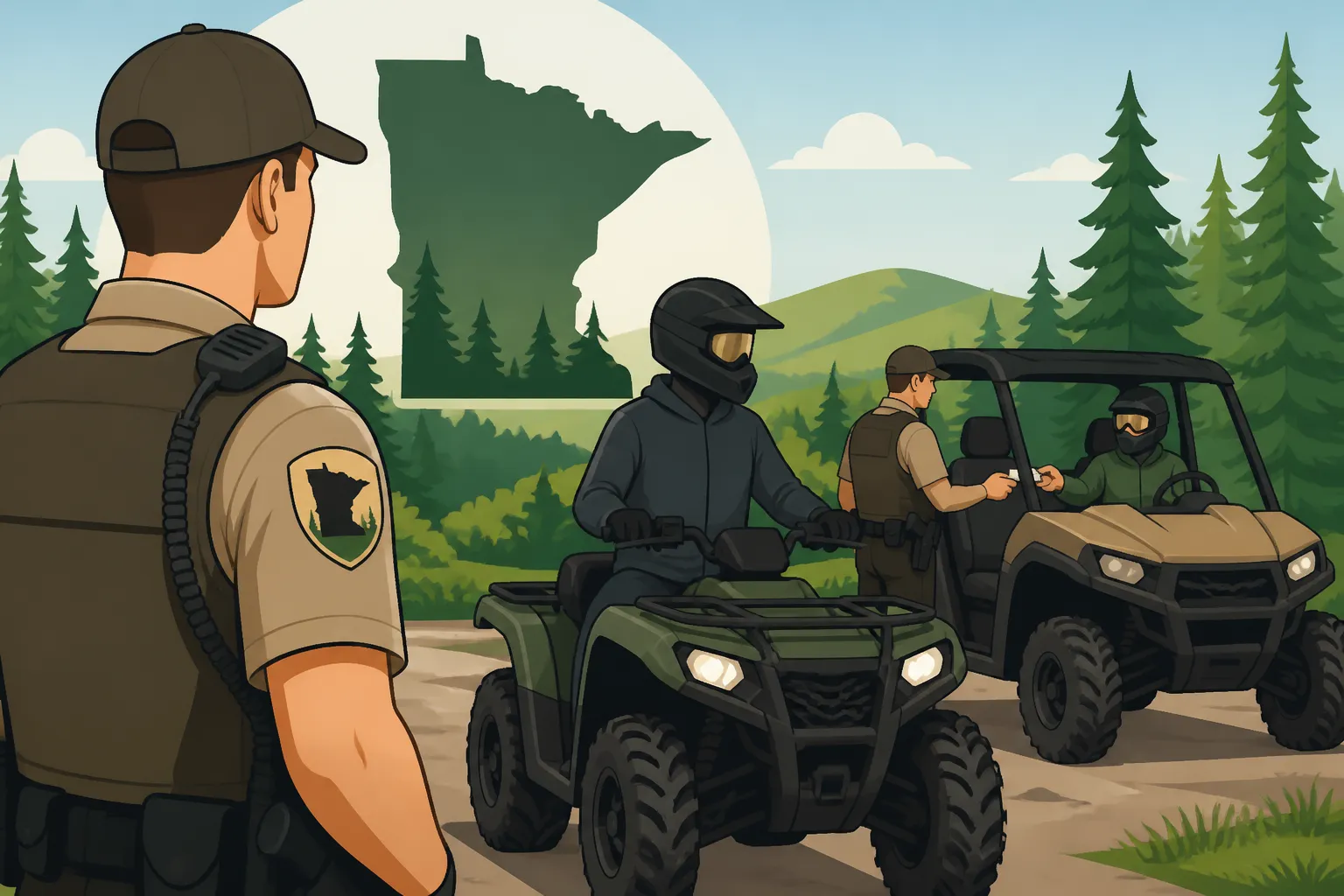
Minnesota Conservation Officer Checkpoints
A Minnesota ATV checkpoint can interrupt a ride just when you are focused on the trail. Knowing what an officer may check, which documents and permits matter, and how to respond makes the stop less stressful. The key is to prepare for the kind of land and trail you are using, since registration, trail-pass and safety rules do not all cover the same thing.
What a Minnesota ATV checkpoint may involve
Conservation officers help enforce rules on public lands and trails, including requirements for machine registration, trail passes, rider safety and responsible use. A checkpoint may be set up near a trail entrance, staging area or other access point, or an officer may contact riders while patrolling. A stop does not by itself mean you have done something wrong; it may be a compliance check.
The details can depend on where you are riding and what kind of machine you have. An officer may ask about registration or a trail pass, check the machine’s displayed decal or pass, and ask whether a rider meets applicable training or age requirements. The officer may also notice riding behavior or equipment that raises a separate safety or rule question.
| What may be checked | Why it matters | What to do before riding |
|---|---|---|
| Registration and decal | Requirements depend on the machine and how or where it is used | Confirm the machine’s registration status and display its decal as required |
| Trail pass | Some trails and riders require a pass; it is separate from registration | Check the rules for the trail and rider, and keep required proof accessible |
| Safety training | Training requirements apply to some riders on public land | Confirm whether the rider needs certification and bring proof if applicable |
| Rider and machine conduct | Speed, access, passengers, and equipment can be subject to rules | Review the rules for the area and ride within the machine’s limits |
| Land access | Public trails, private land and other managed areas may have different conditions | Confirm that the route is open and that you have permission where needed |
A checkpoint does not make every permit requirement universal. For example, registration and a trail pass are different obligations. A machine’s registration does not automatically satisfy a trail-pass requirement, and a pass does not replace registration when registration is required. For an overview of the distinction, see Minnesota DNR ATV Registration Explained and Which Minnesota Trails Require a Pass.
The type of machine and the riding location matter too. Rules can differ for a machine used on public trails, a machine kept on private land, or equipment that falls under a particular use category. If you are unsure what category applies, check Minnesota ATV Classes and What They Mean and Minnesota Public Use Versus Private Use Registration before the trip.
Prepare your machine and paperwork before leaving
The simplest way to avoid a drawn-out stop is to sort out the requirements before you reach the trailhead. Start with the planned route, not just the machine. A ride may pass through land with different rules, and trail status or access conditions can change. Confirm that the route is open and that each part of the trip allows your type of machine.
Next, check registration. Confirm that the machine is registered for the use you intend, that the registration is current, and that the decal is displayed where required. If the machine was recently bought, borrowed, brought from another state or kept only on private property, do not assume its paperwork automatically covers public-trail use. The relevant steps may differ by situation. See Documents a Minnesota Registrar Wants for paperwork questions, and Minnesota Registration for an Out-of-State Machine if the machine is registered elsewhere.
Then check trail-pass rules for your specific trip. Some riders may need a Minnesota trail pass on certain trails, while exemptions or other rules may apply in other situations. Do not rely on a pass from a previous machine or a different rider without checking the current requirements. Minnesota’s Non-Resident ATV Trail Pass explains the visitor issue, while Carrying a Minnesota Trail Pass on the Machine covers how to keep pass information available during a ride.
Safety training is another separate check. Requirements can depend on the rider’s age and other circumstances, so do not assume that a parent’s or companion’s certificate covers another person. Review Minnesota ATV Safety Training Requirements and make sure any rider who needs certification has completed it. If proof is available electronically, keep it accessible even when cell service is unreliable; a downloaded copy or paper record may be more practical in a remote area.
A useful pre-ride routine is:
- Confirm the route is open and permitted for your machine.
- Check registration status, decal placement and any trail-pass requirement.
- Confirm that each rider meets applicable age and training rules.
- Bring any relevant proof in a secure, accessible place.
- Inspect basic safety equipment and make sure the machine is in suitable condition.
- Tell the group who has the paperwork and how to reach it without unloading gear.
Keep documents protected from water, mud and vibration. A small waterproof pouch in a consistent storage spot is often easier to manage than papers scattered among bags. Do not leave important records somewhere you cannot reach while seated on the machine. If you are deciding which records are sensible to carry, Do You Carry Papers on a Minnesota Trail? offers related guidance.
A phone can be useful for digital records, but it should not be your only plan if the trail has weak coverage or the battery is low. Save documents for offline access, bring a portable power source if appropriate, and consider a paper backup for anything you may need to show. The goal is not to carry every document you own; it is to be able to answer reasonable questions about the machine and riders without holding up the group.
How to handle a stop calmly
When an officer signals you to stop, slow down in a controlled way and pull over where it is safe. Avoid stopping in the middle of a narrow trail or on unstable ground if you can safely move to a nearby wider spot. Keep the machine stopped, follow instructions, and let the officer approach rather than reaching suddenly into a bag or storage compartment.
Be courteous and direct. Listen to the question before answering, and provide accurate information. If the officer asks to see a pass or paperwork, explain where it is and retrieve it only when it is safe and clear to do so. If you are riding in a group, have one person speak for the group unless the officer asks others to respond. That reduces confusion and prevents several riders from talking over one another.
You can ask a polite clarifying question if you do not understand what the officer is requesting. For example, ask whether the officer wants registration information, proof of a pass, or a training certificate. If you do not have an item immediately available, say so plainly rather than guessing or claiming it is on another machine. An honest explanation is more helpful than an argument or an inaccurate answer.
A checkpoint can also reveal a problem that needs attention. If the decal is hard to see, the pass is missing, or you discover that a rider’s training status is unclear, do not assume that continuing the ride is acceptable. Ask what the issue is and what the officer expects you to do next. The appropriate response depends on the circumstances; it may mean correcting something before continuing, changing the route or ending the ride.
Keep the interaction focused. A checkpoint is not a good time to debate a complicated rule based on memory or what another rider said. If you disagree with a decision, remain calm, ask for an explanation, and make a note of the relevant details afterward. If you receive a citation, read the paperwork carefully and follow the instructions and deadlines stated on it. For more on consequences tied to registration, see Minnesota Penalties for a Missing Sticker.
Common checkpoint problems and how to prevent them
Many avoidable problems come from treating registration, trail passes and safety training as interchangeable. They are not. Before riding, check each requirement separately and for the actual machine, rider and route. A registration decal on the machine is not a substitute for a required trail pass. A trail pass is not proof that the machine is registered. A rider’s training certificate does not resolve a registration issue.
Another common problem is assuming that a route is open because it appears on an old map or because a friend rode it recently. Closures, seasonal conditions and local restrictions can affect access. Check current trail information before departure, and pay attention to signs at the trailhead or along the route. If an officer explains that a trail or segment is closed, do not ride around a barrier or continue on the assumption that the restriction does not apply to you.
Borrowed machines and group rides need extra planning. The owner may have kept the registration or pass information, while the person operating the machine may not know where it is. Before leaving, agree on who is responsible for confirming the machine’s status and where the relevant proof is stored. For a borrowed machine, check the rules that apply to that machine and rider rather than relying on the owner’s recollection.
Out-of-state visitors should be especially careful not to assume their home registration covers every Minnesota trail requirement. Review Minnesota’s visitor rules before traveling, and confirm whether a Minnesota pass is needed for the planned ride. The same caution applies when a Minnesota resident takes a machine across a state line: registration or a pass in one state does not necessarily satisfy another state’s requirements. Minnesota Rules for Visiting Riders is a useful starting point for visiting riders.
If you are stopped and learn that something is missing, do not try to solve the problem by moving the decal, borrowing another rider’s pass or giving an answer you cannot support. Ask the officer what the concern is and what your options are. After the stop, use the details to fix the underlying issue before the next ride. Check the official Minnesota DNR information or contact the relevant office if you need to verify a rule, because requirements can depend on the machine and where it is used.
A little preparation makes checkpoints routine rather than disruptive. Know your route, check the requirements that apply to each rider and machine, and store any useful proof where you can reach it. Then stop safely, listen, and answer clearly if an officer asks questions.
Disclaimer
This article is for general informational purposes only and does not constitute professional advice. Laws, prices and regulations vary by location and change over time. Consult a qualified professional for guidance on your specific situation.