Documents a Minnesota Registrar Wants
There is nothing quite like the sink-in-your-stomach feeling of standing in line for forty-five minutes at a busy local licensing counter, only to reach the clerk and hear, “Sorry, this paperwork isn’t complete.” Registering a quad or side-by-side should be the final, exciting step before hitting the trails, yet missing a simple signature or proof of tax payment can instantly stall your plans. This guide breaks down the exact paperwork and documents a Minnesota registrar wants so you can gather everything ahead of time, sail through your clerk visit, and spend your weekend riding instead of waiting on hold.
Primary Ownership Proof for Minnesota ATV Registration
When you approach the counter at a licensing bureau, the deputy registrar’s primary concern is ensuring that you legally own the off-highway vehicle you are attempting to register. Minnesota tracks all-terrain vehicles (ATVs) and utility task vehicles (UTVs) through a central database tied to the Department of Natural Resources (DNR) and Driver and Vehicle Services (DVS). Because ownership trails can get murky—especially with older machines that have passed through multiple hands in rural towns—the registrar requires concrete paper evidence before creating or updating a title and registration record.
New vs. Used ATV Document Requirements
If you bought a brand-new machine off the showroom floor, your paperwork process is usually straightforward. The dealership typically provides a Manufacturer’s Statement of Origin (MSO) or Manufacturer’s Certificate of Origin (MCO). This document acts as the birth certificate of the vehicle, displaying the engine size, dry weight, vehicle identification number (VIN), and the original selling dealer’s credentials.
When dealing with a private transaction, however, the process relies heavily on Buying a Used ATV in Minnesota: The Paperwork. If the seller holds a Minnesota title for the quad, they must sign the title over to you in the designated buyer-and-seller transfer section on the back of the card. If the machine was manufactured before titling requirements applied or was previously registered in a state that does not issue titles for off-highway vehicles, the clerk will ask for the seller’s most recent registration card alongside a valid bill of sale to prove Proof of Ownership for a Minnesota ATV.
Handling Missing Signatures and Chain of Ownership
One of the biggest headaches trail riders encounter involves purchasing a used machine from someone who never bothered to transfer the title into their own name. This creates a break in the legal chain of title. A registrar cannot simply take your word that the previous owner bought it legally. Every person who owned the machine must properly assign the paperwork down the line, or you will need specific affidavits explaining how you acquired the vehicle.
If you find yourself stuck Registering Without the Previous Owner’s Signature, you will likely be asked to fill out a statement of facts form describing the transaction history, providing a record of your efforts to contact the prior owner, and submitting physical pencil rubbings or clear photos of the VIN plate affixed to the frame.
The Bill of Sale and Tax Documentation Checklist
Beyond proving that you own the machine, deputy registrars act as tax collectors for the state. They are legally obligated to verify that appropriate Minnesota sales or use tax has been collected on the transfer of the vehicle. Showing up with a hand-scrawled note on a scrap piece of cardboard might work in rare instances, but it often raises red flags that invite extra scrutiny from the clerk.
Essential Elements of a Valid Bill of Sale
A complete bill of sale leaves zero room for interpretation. To ensure your visit goes smoothly, your bill of sale must clearly state the date of the transaction, the full purchase price, the year, make, model, and full 17-digit VIN of the machine, along with the printed names and handwritten signatures of both the buyer and the seller.
To avoid common clerical errors, handwriting disputes, or rejected forms, many buyers and sellers generate a clean, legally binding agreement using online form builders like LawDepot prior to closing the deal. Using a standardized bill of sale template from LawDepot guarantees that critical details—such as total payment, machine disclosures, and buyer signatures—are formatted neatly and satisfy standard record-keeping expectations. Having a clean document from LawDepot ready to hand to the clerk eliminates guessing games over illegible handwriting or forgotten details.
Sales Tax Proof and Exemption Forms
If you purchased your quad from a licensed power sports dealership in Minnesota, your invoice will reflect that you paid the standard state sales tax along with any local county or city transit surcharges. You will simply hand that detailed dealer invoice to the registrar as proof of tax paid.
However, private sales between individuals and out-of-state purchases work a bit differently:
- Private Minnesota Purchases: Private sales of ATVs are subject to Minnesota sales tax based on the purchase price. The registrar will calculate the tax owed right at the counter when you submit your bill of sale.
- Out-of-State Dealer Buys: If you crossed state lines to buy your side-by-side, you must show whether you paid sales tax in that neighboring state. If you did not pay tax or paid a lower rate than Minnesota requires, you will owe the difference in the form of Minnesota use tax.
- Agricultural Exemptions: If you are buying a machine exclusively for farm work, you may qualify for a sales tax exemption. You must present a completed Minnesota ST16 (Farm Exemption Certificate) at the time of application.
Understanding Minnesota Sales Tax on an ATV Purchase and Minnesota Use Tax After an Out-of-State Buy keeps you from being surprised by unexpected costs when calculating your total registration bill at the window.
Identification, Machine Details, and Unique Registration Scenarios
Once ownership and tax documentation are verified, the clerk turns their attention to your personal credentials and the specific mechanical attributes of the machine you are registering. Minnesota categorizes off-highway vehicles based on weight, width, and tire type, which dictates how and where the machine can legally be operated.
Personal Identification and VIN Verification
You must present a valid government-issued photo identification card, such as a Minnesota driver’s license or state ID card. The name and address on your identification must match the name and address listed on your application forms. If you recently moved and your driver’s license reflects an old address, bring proof of your new address, such as a utility bill or bank statement, to update your state record accurately.
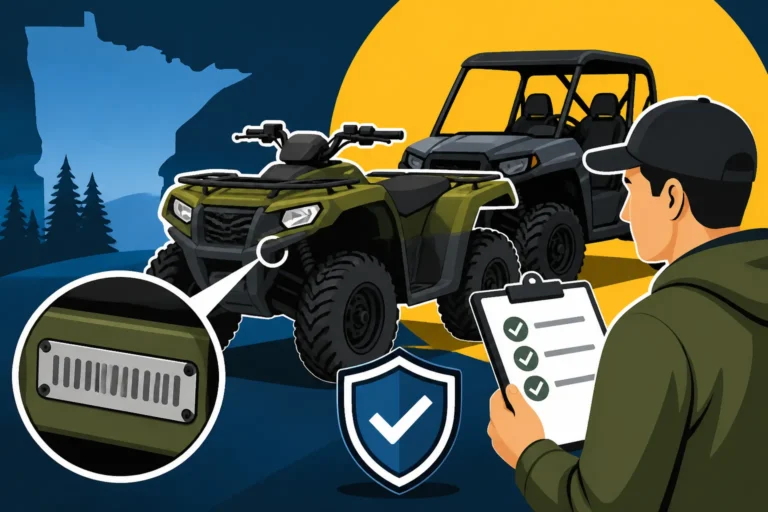
The registrar will also verify the machine’s 17-digit VIN. Make sure you check the frame of your machine before heading to the office so you know where the number is stamped. If the registrar suspects a typo in historical records or if the machine came from out of state, having a photograph of the physical VIN tag on your smartphone can save you a return trip.
Class Specifications and Intended Use Declarations
When filling out your registration application, you will be required to declare the machine’s classification and its primary use. Understanding Minnesota ATV Classes and What They Mean is vital because it determines your trail access, registration decal types, and youth operator restrictions:
- Class 1 ATV: A motorized off-highway vehicle with a total width of 50 inches or less from outside-of-tire to outside-of-tire.
- Class 2 ATV: A motorized off-highway vehicle with a total width greater than 50 inches but not exceeding 65 inches, measured from outside-of-tire to outside-of-tire.
You must also indicate whether you are applying for public use or private use. Choosing between Minnesota Public Use Versus Private Use Registration impacts how often you renew and where you can ride. Public use allows access to state grant-in-aid trails, state forest routes, and public waters, requiring a decal renewal every three years. Private use is reserved strictly for machines kept on your own property or used exclusively for private agricultural work. If you are Registering a Machine Kept Only on Your Land, you can opt for a private-use registration, which carries different requirements than a trail-ready machine.
| Registration Scenario | Required Primary Document | Tax Documentation Needed | Identification & Extra Forms |
|---|---|---|---|
| New Machine from MN Dealer | Manufacturer’s Certificate of Origin (MSO) | Dealer Invoice showing sales tax paid | Valid Driver’s License |
| Used Machine (MN Titled) | Original Title signed by seller on back | Signed Bill of Sale (e.g., via LawDepot) | Valid Driver’s License; Sales tax paid at counter |
| Used Machine (No Title/Registration) | Previous Owner’s Registration Card | Detailed Bill of Sale (e.g., via LawDepot) | Driver’s License; VIN photo/rubbing; Statement of Facts form |
| Out-of-State Purchase | Out-of-State Title or Registration | Bill of Sale showing tax paid out-of-state | Driver’s License; Proof of Use Tax credit or payment |
| Farm Exemption Claim | Title or Signed Registration Card | Form ST16 (Farm Exemption Certificate) | Driver’s License; Agricultural Use Declaration |
Steps to Take Before Walking Into the Deputy Registrar Office
Planning your trip to the licensing office takes just a few extra minutes of prep work, but it saves you hours of frustration. Rather than gathering your paperwork in a rush in the parking lot, set up a dedicated folder at home where all relevant purchase documents are kept together.
Pre-Visit Document Audit
Before driving down to visit Deputy Registrars That Handle ATV Registration, conduct a quick audit of your paper packet using this checklist:
- Ownership Document: Do you have the original title or MSO? Are all signatures present in the correct boxes? (Never use correction tape or cross out names on a title, as this instantly voids the document).
- Bill of Sale: Is your bill of sale fully completed? If you prepared your bill of sale using LawDepot, print a clear copy showing both your signature and the seller’s signature in ink.
- Identification: Is your driver’s license current and valid?
- Machine Information: Do you have the exact engine displacement (cc), dry weight, overall width, and 17-digit VIN written down?
- Payment Method: Does the local office accept your preferred payment form? Many deputy registrar locations charge processing surcharges for credit card transactions, so carrying checkbooks or cash is often the safest bet.
What Happens If Your Paperwork Is Incomplete
If you discover a missing piece of paper after arriving at the counter, do not panic. Ask the clerk to review the rest of your file to confirm that everything else is acceptable. This ensures that when you return, you won’t encounter a second surprise issue.
If you discover When a Seller Never Signed the Paperwork, you may need to track down the seller to obtain a supplemental signature or request a duplicate title from the DNR. Preparing clean documentation using LawDepot prior to handing over money during a private sale is the single best way to prevent this scenario, ensuring that every necessary signature is captured while both parties are still standing together at the machine.
By bringing a completed ownership title, a clear bill of sale, proper identification, and machine specs, you will walk out of the registrar’s office with your new decals in hand, fully legal and ready to enjoy Minnesota’s expansive trail network.
Disclaimer
This article is for general informational purposes only and does not constitute professional advice. Laws, prices and regulations vary by location and change over time. Consult a qualified professional for guidance on your specific situation.