Minnesota Resource Damage Citations
A resource-damage citation can turn a ride into a costly, stressful problem, especially if you are unsure whether your machine caused the damage or what to do next. In Minnesota, the right response depends on where you were riding, what was damaged and what the citation says. Here’s how to understand the issue, respond carefully and reduce the risk of another citation.
What a Minnesota resource-damage citation means
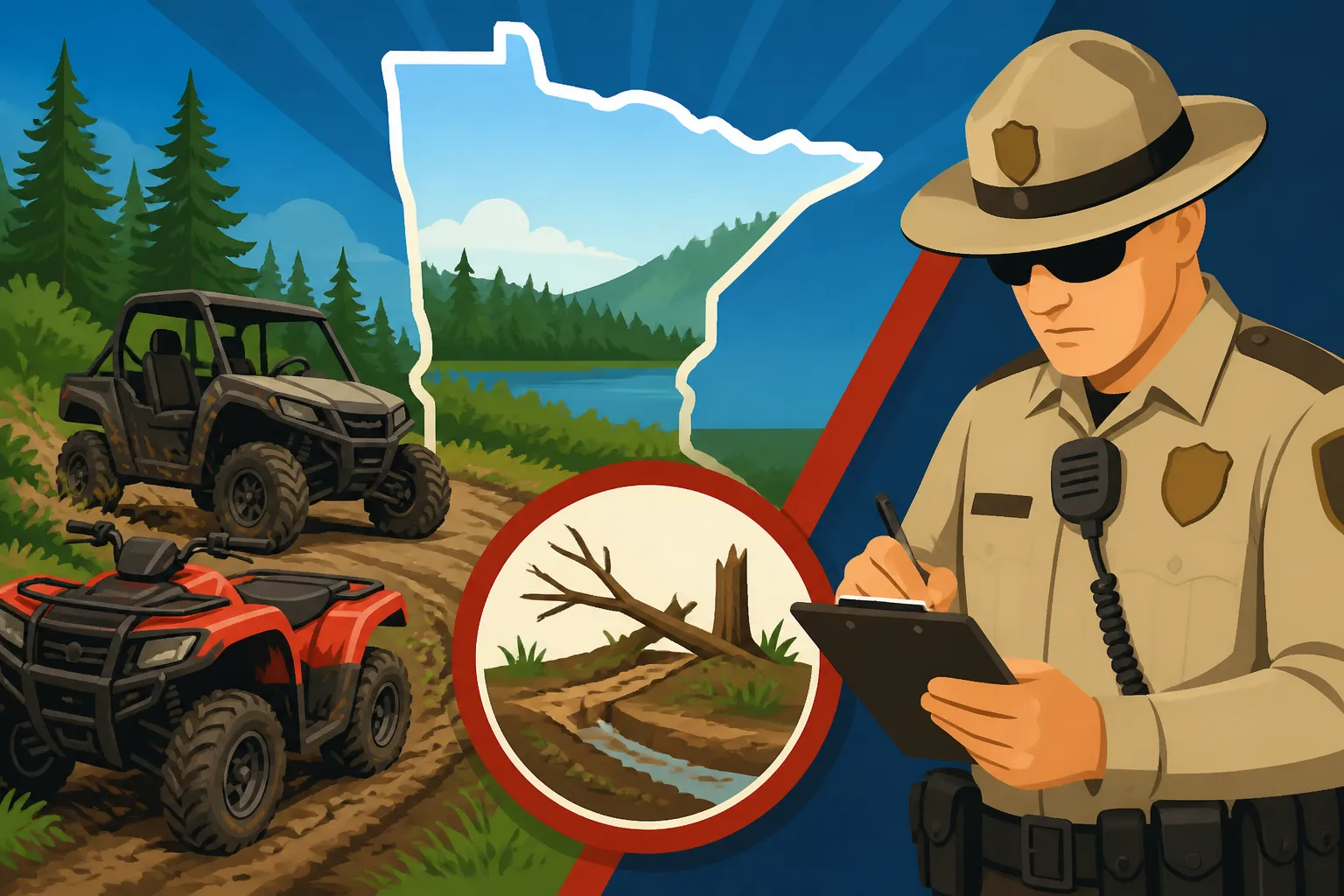
A resource-damage citation concerns harm to land, vegetation, water or other protected resources. For an ATV or UTV rider, that might involve leaving an authorized route and making ruts in a wet area, damaging a trail edge, tearing up vegetation or disturbing a stream crossing. A citation may also relate to using a route or area that is closed or not open to the machine.
The key point is that being able to ride an ATV or UTV in a general area does not mean every route, surface or crossing is open. Permission can depend on the land manager, the trail designation, seasonal conditions and the machine you are operating. A route may be open to one type of off-highway vehicle but closed to another. A trail may also be temporarily closed because of wet conditions or other resource concerns. Check current notices and signs rather than relying only on an old map or a previous visit. Minnesota Trail Closures in Spring Thaw explains why a route can be closed even when it appears rideable.
A citation is not the same as a casual warning, and you should not assume it is resolved because you have left the area. Read the document carefully to see what conduct is alleged, what law or rule is cited, and what response it requires. Depending on the circumstances, a case may involve a monetary penalty, an order to appear, or other consequences. The alleged damage may also raise a separate question of repair or restitution. The citation itself should not be treated as a complete explanation of every potential consequence.
Resource-damage issues can overlap with other violations. For example, an officer may allege that a rider was in a closed area, outside the designated trail, or riding without a required pass, as well as causing damage. A missing pass and physical damage are different issues, even if they arise from the same ride. For background on the separate pass requirement, see Minnesota’s Non-Resident ATV Trail Pass and Fines for Riding Minnesota Without a Pass.
| Situation | Why it may matter | What to check |
|---|---|---|
| Riding outside a signed or designated route | The ground may be closed or sensitive, and travel may cause damage | Trail signs, maps and land-manager notices |
| Riding a route during a closure | Wet or unstable ground can be damaged even if the trail was open earlier | Current closure status and temporary notices |
| Crossing a wetland, stream or soft shoulder | A machine may leave ruts or disturb vegetation or water | Whether the crossing is allowed and how it is marked |
| Riding in a group | Several machines can enlarge ruts or spread damage beyond the first track | Whether the group stayed on the route and followed closures |
| Stuck machine recovery | Spinning tires or repeated attempts can worsen damage | A recovery plan that avoids widening the damaged area |
The table describes common risk situations, not automatic proof of a violation. The actual facts, applicable rules and location matter. A rut on a trail does not by itself establish who made it or whether the route was open. Likewise, a rider may cause damage without realizing the area was restricted. Neither assumption substitutes for reviewing the allegation and the evidence.
How citations arise and what happens next
Officers or land managers may become aware of damage through patrols, reports, trail inspections or observation of riders in a restricted area. Minnesota conservation officers enforce many outdoor recreation rules, but the person issuing or handling a citation can depend on the location and the authority responsible for that land. An enforcement contact may involve questions about where you rode, which route you used, who was operating the machine and what happened when the damage occurred. Minnesota Conservation Officer Checkpoints offers additional context on enforcement contacts.
Conditions can change quickly. A route that was passable earlier in the season may become vulnerable after rain or during spring thaw. In winter, snow cover may hide route edges or make it harder to tell where travel is allowed. A route’s appearance is not reliable proof that it is open. Review notices before heading out, and treat a posted closure as controlling even if other riders have gone through. For winter conditions, see Minnesota Trail Rules Once the Snow Arrives.
A citation should identify the alleged violation and provide instructions for what to do next. Those instructions matter more than general advice from another rider or a social media post. Check the document for:
- The alleged conduct and location.
- The law or rule listed.
- Whether you must respond, pay, appear or provide other information.
- The court or office handling the matter.
- Any response date or hearing information.
- Instructions for disputing the allegation or requesting a hearing.
Do not assume that paying is the only option, or that ignoring the document will make it go away. If you are considering disputing it, follow the instructions and deadlines on the citation. If you are unsure what a line means, contact the court or issuing agency using independently verified contact information. For a serious allegation, substantial damage, repeated violations or uncertainty about your rights, consider getting advice from a qualified attorney familiar with Minnesota outdoor recreation or natural-resource matters.
A damage allegation may be based on observations, photographs, statements or other information. If you believe the wrong person or machine has been identified, or that the route was open, write down the details while they are fresh. Record the date, time, machine, route, weather and who was with you. Keep maps, photographs, messages and other materials that could help explain what happened. Do not alter or delete relevant records because you are worried they might be misunderstood.
If the citation describes damage you did not see, ask through the proper channel what location and conduct it concerns. A precise location is important: “near the trail” may not tell you whether the allegation concerns a designated route, the trail shoulder or land beyond it. You can ask for clarification without arguing at the roadside. Keep interactions calm and do not guess, exaggerate or claim certainty about facts you do not know.
What to do after receiving a citation
Start by reading the citation in full, including any instructions on the back or attached notice. Mark the response date and keep the original in a safe place. Make a copy or photograph for your records. If there are multiple documents, keep them together and note when each one arrived.
Then make a factual timeline. Write down where you entered and left the route, where you stopped, what the ground looked like, whether there were signs or barriers, and whether you saw other riders. Include details that could cut either way. A clear record is more useful than a version written later from memory.
Photographs can help explain conditions, but do not return to a closed or restricted area to take them. Do not ride back over a damaged spot to recreate what happened. If you already have lawful photos from the day, preserve the original files and note when and where they were taken. A map or GPS record may also help establish the route, but it does not automatically prove that the route was open or that a machine stayed on it.
Follow the citation’s process for responding. If it gives you a way to contest the allegation, use that process rather than relying on an informal conversation or a phone message. Keep copies of anything you submit and make a note of when and how you sent it. If the citation requires a court appearance, do not treat a payment or phone call as a substitute unless the court confirms that it resolves the requirement.
Be careful about discussing the incident publicly while the matter is unresolved. Online posts can omit context and may be saved or shared. Stick to accurate facts when communicating with the court, agency, insurer or a lawyer. If you are asked to make a statement and are concerned about the consequences, you can ask for legal advice before giving a detailed account.
If the machine became stuck, avoid making the situation worse. Spinning the tires, driving farther off the trail or attaching a winch to vegetation can enlarge the damaged area. Stop, assess safe recovery options and seek help if needed. A sensible recovery may mean waiting for assistance rather than trying repeated maneuvers. If damage has occurred, do not conceal it or move signs or barriers. Use the appropriate reporting channel if you need to report damage or a blocked route; Reporting Trail Damage in Minnesota covers that separate process.
The condition of the route is relevant both to prevention and to a fair account of events. A machine may be capable of traversing a muddy section, but that does not mean the ground can withstand traffic without harm. Trail ratings can help riders choose routes suited to their equipment and experience, but they do not override closures or authorize leaving the trail. See Minnesota Trail Difficulty Ratings before planning a ride on unfamiliar terrain.
How to lower the risk of a resource-damage citation
Plan around the route, not just the destination. Confirm that the trail is open, appropriate for your machine and accessible from the staging area you intend to use. Check current signs at the trailhead and along the route. If a sign or closure notice conflicts with an older map, stop and follow the current restriction until you can verify the route’s status with the responsible land manager.
Stay on the marked route. Avoid riding around mud, puddles, gates or other obstacles unless a marked detour directs you to do so. Bypassing a wet patch can create new tracks in vegetation or soft ground, and a path made by other tires is not proof that the detour is permitted. If a section appears unsafe or badly damaged, turn around where it is safe and report the condition through the appropriate channel.
Ride in a way that limits ground disturbance. Avoid rapid acceleration and wheelspin on soft surfaces. Keep a safe distance from the machine ahead so you can respond without swerving off the trail. In a group, agree that everyone will stop at closures and intersections rather than following the lead machine automatically. A rider at the front may miss a sign, and a group can spread damage across a wider area in a short time.
Pay attention to seasonal conditions. Spring thaw, heavy rain, flooding and snowmelt can make surfaces vulnerable even where a trail normally handles traffic. If a section is saturated or the machine is leaving deep ruts, do not keep testing it. Turn around rather than trying to power through. A trail closure is not a suggestion to find a nearby way around it; it is a reason to choose another open route or postpone the ride.
Make sure the machine and its operator meet the requirements for the route. A pass, registration or other credential does not grant permission to travel outside an authorized area. A machine that is legal to use on one trail may not be allowed on another. Verify the route’s restrictions before riding and carry any required documentation. Minnesota’s Non-Resident ATV Trail Pass can help visiting riders understand the pass question, while Minnesota Trail Closures in Spring Thaw is useful when seasonal conditions affect access.
When in doubt, stop before entering an uncertain area. Check the map, signs and official notices, or contact the land manager. If you cannot confirm that a trail is open, choose a route you can verify. That pause may cost a few minutes; repairing a damaged area, contesting a citation or dealing with a court date can take much longer.
Disclaimer
This article is for general informational purposes only and does not constitute professional advice. Laws, prices and regulations vary by location and change over time. Consult a qualified professional for guidance on your specific situation.