Fines for Riding Minnesota Without a Pass
A trail pass is easy to confuse with ATV registration, especially when you’re visiting Minnesota or riding a machine registered elsewhere. But riding a trail without a required pass can lead to a citation, and buying one later may not erase the violation. Here’s how to tell when a pass may be required, what enforcement can involve, and what to check if you receive a ticket.
When Minnesota Requires an ATV Trail Pass
Minnesota’s trail-pass requirement depends on the machine, where it’s being ridden and how it is registered. A pass is not a universal permit for every ATV ride in the state, and having a pass does not replace registration or permission to use a trail.
In general, a nonresident ATV may need a Minnesota trail pass to use trails covered by the requirement. Rules for a Minnesota-registered machine can differ. The details also depend on whether the route is a grant-in-aid trail, another public riding area or private land. Check the current requirements for the particular machine and route before setting out. Minnesota’s Non-Resident ATV Trail Pass and Which Minnesota Trails Require a Pass explain the main distinctions.
| Situation | What to check | Why it matters |
|---|---|---|
| ATV registered outside Minnesota | Whether a Minnesota trail pass is required for the route | An out-of-state registration may not satisfy Minnesota’s pass requirement |
| ATV registered in Minnesota | Whether the registration covers the machine’s use on that trail | Registration and trail-pass rules are related but not interchangeable |
| Riding a grant-in-aid trail | The trail’s pass requirements and current status | A pass requirement may apply to a designated trail even when a nearby route has different rules |
| Riding private land | The landowner’s permission and any applicable requirements | Permission to ride does not automatically settle every registration or pass question |
| Riding during a special no-registration period | What the event waives and what it does not | A temporary registration exemption should not be assumed to waive pass, safety or access rules |
A useful first step is to identify the machine’s registration state and the exact trail or riding area. A map may show where a trail goes, but it does not necessarily show whether that trail is open, whether a pass is required or whether a machine of your type is allowed. Trail designations and conditions can change, so confirm the route before you travel.
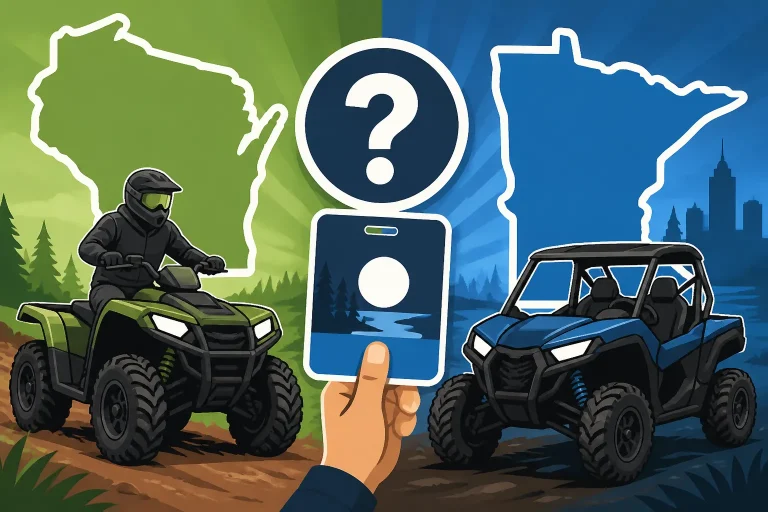
For visitors, the safest approach is not to assume that a home-state registration, permit or trail sticker will be honored in Minnesota. Minnesota does not necessarily offer reciprocity for every out-of-state credential. Review Minnesota Rules for Visiting Riders and Reciprocity Minnesota Does Not Offer, then confirm the current rule for your machine.
A pass also does not make an otherwise prohibited ride legal. It cannot authorize riding a closed trail, entering land without permission or operating a machine that is not properly registered. Check the separate rules for the route and vehicle, rather than treating a pass as an all-purpose permit. Minnesota Permit Rules on Grant-in-Aid Trails covers an important category of routes where requirements can be easy to overlook.
What Can Happen If You Ride Without a Required Pass
If an officer determines that a pass was required and missing, you may receive a citation. The fine and any other consequences depend on the specific violation, the circumstances and the rules in force when the ride occurred. There is no safe assumption that the officer will give only a warning, or that every citation will have the same outcome.
The ticket may refer to a pass violation, but the stop can also reveal separate issues. For example, an ATV might have a registration problem, be on a closed route or be operated in a way that violates another rule. Those issues may be addressed separately. A trail pass does not cure them, and resolving one problem does not necessarily dispose of another.
Possible costs can include more than the fine printed on a citation. Depending on the case, there may be court costs or other consequences associated with the separate violations. If the ticket requires a court response, missing the response date can create additional problems. Read the document carefully instead of relying on a general estimate from another rider.
The table below summarizes the main risks without implying that every case produces the same result.
| Issue found during a ride | Possible consequence | Practical response |
|---|---|---|
| Required pass is missing | A citation and a fine may follow | Read the ticket and follow its response instructions |
| Registration is missing or invalid | A separate registration citation may be possible | Check the machine’s registration record and applicable rules |
| Machine is on a closed or unauthorized route | A separate access or trail-use violation may be possible | Stop riding there and verify where the route is open |
| Several violations are alleged | Each may have its own process or consequence | Treat every listed charge as a separate issue |
| Pass was purchased after the stop | It may help with future rides, but may not undo the earlier violation | Keep proof, but do not assume the citation is automatically dismissed |
The precise result can depend on facts such as the route, the machine’s registration, the pass status at the time of the stop and what the citation alleges. If anything is unclear, contact the court or agency named on the ticket for procedural information. For advice about contesting a citation or its effect, speak with a qualified professional.
What to Do If You Receive a Citation
A citation is not a reason to ignore the matter, even if you believe you had a pass or think the officer made a mistake. Start by reading the entire document. Look for the violation listed, the date, the location, the response deadline and the instructions for paying or contesting it. If there are multiple charges, note each one separately.
Then gather records related to the ride. Useful items may include:
- Proof of the machine’s registration and the state that issued it
- The trail-pass purchase confirmation, receipt or other available proof
- The route name, trail map and any trail-status information you checked
- Photos of the machine and any displayed pass or registration decal
- Notes about when and where the stop occurred
- The citation and any documents provided during the stop
If you believe you had a valid pass, check that the proof matches the machine and the relevant riding period. A receipt for another machine, an expired credential or a pass purchased after the stop may not establish that the required pass was valid at the time. Keep any purchase confirmation anyway, and ask the appropriate agency or court how it should be submitted if you are responding to the citation.
If you did not have the required pass, getting one before your next ride is still important, but it may not cancel a citation for the earlier ride. Do not alter a decal or represent that a pass was valid when it was not. Follow the instructions and deadline on the ticket, and ask the court or agency about process rather than guessing.
If you need a pass for future riding, review Buying a Minnesota Trail Pass Online or check with an authorized seller. Confirm that you have selected the correct pass for the machine and that it covers the intended riding. Carrying a Minnesota Trail Pass on the Machine can help you understand what to have available while riding.
How to Avoid a Pass Citation Before the Next Ride
A short check before loading the machine is easier than sorting out a citation on the trail. Confirm the machine’s registration, the pass rules for that machine and the rules for the route. If you are riding with a group, check each machine individually; one rider’s registration or pass does not automatically cover another machine.
Use this process before a Minnesota ride:
- Identify the machine’s registration. Check whether it is registered in Minnesota or another state, and make sure the registration is current where required. For a closer look at the distinction, see Machines Registered in Minnesota and the Pass.
- Confirm the route. Find the specific trail or riding area, then check whether it is open and whether its pass rules apply to your machine.
- Verify the credential. If a Minnesota trail pass is required, buy the appropriate one before riding and keep the confirmation or required proof accessible.
- Check for other requirements. A pass does not replace registration, safety requirements, landowner permission or restrictions on a closed area.
- Recheck close to departure. Weather, maintenance and seasonal restrictions can affect trail access. Do not rely on an old map or a past ride as proof that the same route is open now.
Be especially careful with temporary exemptions. A “no registration” weekend, where available, is not a blanket suspension of every ATV rule. It may apply only to a specific registration requirement and period, while pass, access, safety or equipment requirements continue to apply. Check [Minnesota No Registration Weekend and the Pass] before treating an event as an exemption.
Likewise, a private-land ride and a public-trail ride may have different requirements. Permission from a landowner is important, but it does not automatically make public-trail rules irrelevant if the route connects to public land. If a route crosses several types of property, confirm each segment rather than assuming the rules stay the same from start to finish.
The practical takeaway is simple: determine whether the pass is required for your machine and route before riding, and treat a citation as a deadline-driven matter. A pass can be a small part of trip planning, but confusing it with registration or assuming an out-of-state credential is enough can turn a ride into an avoidable enforcement problem.
Disclaimer
This article is for general informational purposes only and does not constitute professional advice. Laws, prices and regulations vary by location and change over time. Consult a qualified professional for guidance on your specific situation.