Must a Parent Ride a Separate Machine in Minnesota?
Minnesota parents often wonder whether supervising a young ATV rider means they must bring a second machine. The practical answer depends on the child’s age, where the ride takes place and whether the child is operating or riding as a passenger. Here’s how to think through the separate-machine question, what supervision does—and does not—mean, and what to check before setting out.
The short answer: a separate machine is not automatically required
Minnesota’s youth ATV rules focus on who may operate a machine and when an adult must accompany a young operator. They do not create a simple rule that every parent must ride a separate ATV whenever a child rides. But “no automatic separate-machine rule” does not mean that every setup is allowed: age, machine type, location and passenger rules can change what is legal.
The first distinction is whether the child is operating the ATV or riding as a passenger. If the child is driving, check the requirements that apply to a young operator and confirm what qualifies as adult accompaniment in that situation. If the parent is driving and the child is a passenger, the child is not operating—but the machine must be designed to carry a passenger, and the rider must follow the applicable passenger rules.
| Situation | What to check | Is a second machine automatically required? |
|---|---|---|
| A young rider is driving on a public trail or other public riding area | Age-specific operating rules, safety training and adult-supervision requirements | Not automatically; confirm what accompaniment means for the rider’s age and location |
| A parent is driving with a child as passenger | Whether the ATV is designed and equipped for a passenger, and whether the child meets the relevant passenger requirements | No, if the setup is lawful; a second machine is a separate choice |
| A child is riding on private property | The child’s age, the landowner’s permission and any applicable operating rules | Not automatically, but private land does not make every age or machine combination safe or lawful |
| The ride includes a road right-of-way, frozen water or a trail | Rules for that specific setting, plus the child’s age and machine | Do not assume rules are the same as on private land |
For the operator-age details, see Minnesota Age Rules for Young Riders, Accompanied Riding for Minnesota Youth and Minnesota ATV Safety Training Requirements. The details matter: a parent’s presence does not, by itself, replace a required safety certificate, make an age-restricted machine legal for a child, or authorize riding somewhere the machine is not allowed.
If you need a one-sentence planning rule, use this: Don’t buy, borrow or bring a second machine just because you assume Minnesota always requires one—but don’t count a parent riding on the same machine as proof of compliance until you have checked the specific rule for that child and ride.
That distinction is important because “accompanied” can be easy to interpret casually. A parent may think it means simply being on the ride. The law and official guidance may set more specific conditions for the rider’s age or location. Confirm the current Minnesota DNR instructions before relying on an assumption, especially if the child will operate the ATV on a trail, public land, frozen water or a road right-of-way.
What supervision does—and does not—mean
Supervision and machine choice are related, but they are not the same issue. An adult can be physically close and still have the wrong arrangement for a particular child or machine. Conversely, a child might ride with a parent on one machine without the parent needing to operate another one, provided the passenger setup and all other applicable rules are satisfied.
If the child is operating
When a child is at the controls, start with the child’s age and the type of riding area. Minnesota has age-specific rules for young operators, and requirements can differ between private property and public riding areas. Check Minnesota Rules for Riders Under 12 or Minnesota Road Rules for Riders Aged 12 to 15 where relevant, rather than treating all children under 16 as one category.
Also check the safety-training rules. A parent’s presence is not a substitute for any certification required of the operator. The child may need to complete the applicable training before riding in certain public settings. See Minnesota Online Safety Training and Safety Certification for Riders Twelve and Over for related information.
Before putting a child behind the handlebars or steering wheel, verify:
- The child is allowed to operate that type of ATV at their age.
- The child has completed any required training or certification.
- The parent or other adult meets the supervision requirement for that situation.
- The route is open to the machine and the child is allowed to ride there.
- The machine fits the child’s size and ability, and its controls are manageable.
- Any passenger, if allowed, is permitted on that particular machine.
A child who can reach the controls is not necessarily ready to operate the ATV safely. A machine that is too large, heavy or powerful can be difficult for a young rider to control, especially on uneven ground or when stopping quickly. Legal eligibility is a minimum, not a recommendation to ride at the upper edge of a child’s ability.
If the child is a passenger
A parent may be able to carry a child rather than have the child operate a separate ATV, but only if the machine is designed for a passenger and the applicable rules allow the arrangement. Many ATVs are designed for one rider. Adding a passenger to a single-rider machine can interfere with balance, handling and the driver’s ability to control the vehicle.
Check the manufacturer’s passenger guidance and the machine’s seating, footrests and handholds. Do not treat a second seat improvised with an accessory as proof that the ATV is legally or safely configured for two people. A side-by-side with proper seating and restraints is different from a one-seat quad carrying an extra person.
For children riding in a side-by-side, confirm that the child can be properly secured by the available seat belt or restraint system. A helmet and eye protection are also important. Minnesota’s requirements for young riders are covered in Minnesota Helmet Requirements Under 18. The passenger arrangement should never prevent the driver from maintaining control or keeping the child secured.
If the machine is not designed to carry a passenger, the safer choice is not to double up. That still does not automatically mean the parent must ride a separate ATV: the parent could drive a suitable passenger machine, or the family could choose a ride that does not involve carrying the child on an unsuitable vehicle.
If the ride is on private land
Private property can have different rules from public riding areas, but permission from the landowner does not make every age, machine or riding arrangement appropriate. Check Minnesota Rules on Private Land and confirm the rules that apply to the child and the machine. Private land also does not remove the need for close supervision, suitable protective gear and a safe riding area.
Be especially cautious about assuming that a child who may ride on private property can operate the same ATV on a public trail or road right-of-way. The rules may change as soon as the route leaves the property. A family ride can cross several different kinds of land in one outing, so establish the route before leaving rather than deciding at the trail entrance.
How to plan the ride without guessing
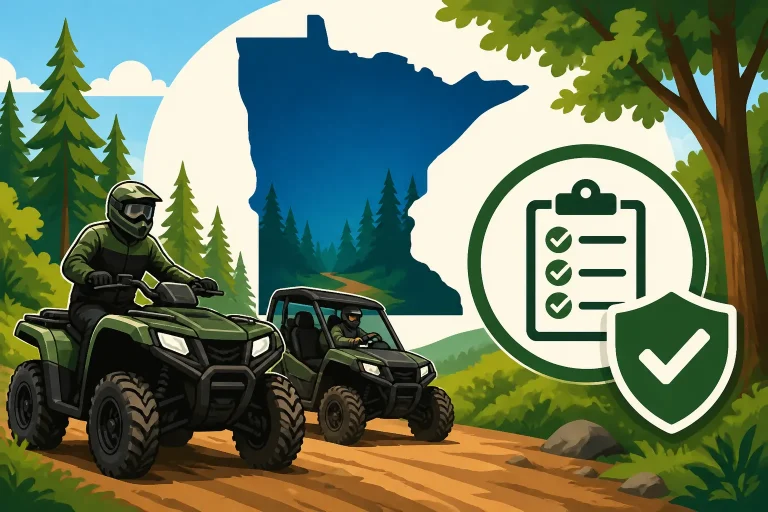
A separate machine can make it easier for an adult to stay close to a young operator, but it is only one possible arrangement. The right choice is the one that meets the rules, fits the child and keeps the adult able to supervise effectively. Use this checklist before riding.
- Identify the child’s role. Decide whether the child will operate an ATV or ride as a passenger. Those are different situations, with different considerations.
- Check the child’s age against the activity. Use the current Minnesota guidance for the child’s age, machine class and riding location. Avoid relying on a rule remembered from another state or from a previous season.
- Confirm training requirements. If the child will operate, check whether training or certification is required for that activity. Do not assume a parent can satisfy an operator training requirement on the child’s behalf.
- Confirm what adult accompaniment requires. Check the current official wording for the child’s age and location. If it specifies a qualifying adult, proximity or another condition, make sure your plan meets it.
- Check the machine’s passenger capacity. If the child will ride with an adult, confirm that the ATV is designed for two occupants and that the child can use the intended seat and restraints.
- Map the route. Identify whether it includes a public trail, public land, a road right-of-way, frozen water or private property. Rules and access can differ by setting.
- Plan for the adult to supervise in practice. Even when a separate machine is not required, consider whether the adult can stay close enough to notice trouble, communicate clearly and respond quickly.
- Carry the relevant documents and equipment. Check applicable registration, pass and safety requirements, and make sure each rider has appropriate protective gear.
A parent riding a separate machine can be a practical choice when the child is learning or when the route requires the adult to remain nearby. It lets the adult set the pace, choose where to stop and keep an eye on the child without asking a passenger arrangement to do two jobs at once. The trade-off is that a second machine adds another vehicle to transport, maintain and control. It may also be a poor fit if the child is not ready to operate independently.
Riding together on one machine can be simpler, but only when the vehicle is made for passengers and the child can be secured properly. It is not a shortcut for riding two-up on a single-rider quad. If you are unsure whether the specific machine qualifies, check its manual and manufacturer information before the trip.
For a ride that uses a Minnesota public trail, also confirm whether the machine needs registration or a trail pass. These requirements are separate from youth supervision. Start with Minnesota Rules for Visiting Riders if you are coming from out of state, or Minnesota’s ATV Safety Training Requirement for a broader overview of training rules. A child being accompanied does not automatically satisfy either requirement.
The most common planning mistake is treating “parent present” as the answer to every legal and safety question. A parent may need to accompany a young operator, but that does not necessarily determine whether the child may operate that machine, whether a passenger is allowed, whether training is required or whether the route is open. Check each point separately.
When the official information leaves the same-machine question unclear, contact the Minnesota DNR or another appropriate official source before riding. Explain the child’s age, whether the child will drive or ride as a passenger, the ATV type and the location. Those specifics are more useful than asking only whether “a parent has to ride along.”
Disclaimer
This article is for general informational purposes only and does not constitute professional advice. Laws, prices and regulations vary by location and change over time. Consult a qualified professional for guidance on your specific situation.