A Minnesota Registration in Two Names
Trying to register an ATV or UTV in Minnesota with more than one name on the paperwork can feel like navigating a maze, especially when you and your partner, family member, or friend are splitting the cost and responsibilities. It’s natural to want both parties legally recognized, but the process isn't always as straightforward as just scribbling two names on a form. This guide will walk you through how Minnesota handles co-ownership on ATV registrations, what documents you need, and what you should consider to protect everyone involved.
Why Registering in Two Names Matters in Minnesota
When you invest in an off-highway vehicle (OHV) with someone else, whether it's for hunting trips, cabin adventures, or just hitting the trails, it's about more than just who gets to ride. Clearly establishing who owns the machine from the get-go can prevent a whole heap of headaches down the road. Minnesota's Department of Natural Resources (DNR) registration system focuses primarily on who is responsible for operating the machine and paying the fees, but the underlying legal ownership is handled a bit differently.
Clarity of Ownership and Liability
Imagine you and a buddy go in on a fantastic new side-by-side. You both contribute to the purchase price, you both plan to use it. If only one name is on the registration, what happens if there's an accident? Who is ultimately responsible for the machine if it's damaged or causes damage to someone else's property? While insurance is a huge piece of this puzzle, the legal ownership documented elsewhere can play a significant role. If only one name is on the official state record, that person often bears the primary responsibility in the state's eyes, even if you have an informal agreement with your co-owner. This is why getting things straight upfront provides a layer of protection and clarity for everyone involved, especially when dealing with liability.
Official Minnesota Requirements
When it comes to the actual DNR registration, Minnesota often focuses on a primary owner for administrative purposes. This means that while you might have two names on a bill of sale or title, the registration card and sticker might only list one primary individual. However, this doesn't mean the state ignores your joint ownership entirely. The key is that the underlying legal documents, such as the bill of sale and certificate of origin (or title if applicable), are what truly establish who owns the machine. These are the documents that prove beyond a doubt that you and your co-owner have a vested interest in the vehicle. It's vital to ensure these foundational pieces of paperwork accurately reflect all owners.
Avoiding Future Headaches
Nobody likes paperwork, and it's easy to put off sorting out the finer details when you're excited about a new machine. But trust me, taking the time now to properly document multi-person ownership can save you from a major hassle later. Think about what happens if you decide to sell the ATV or UTV down the line. If only one person's name is on the legal ownership documents, that person might technically be able to sell it without the other's consent. Or, even more seriously, what if one owner passes away? Without clear documentation, the machine could get tied up in probate, leaving the surviving owner in a really tough spot. Proper documentation, especially a detailed bill of sale or a specific co-ownership agreement, avoids these kinds of painful scenarios.
How to Add a Second Name to Your Minnesota ATV Registration
Adding a second name isn't always about literally seeing both names on the small DNR registration card you carry in your wallet. It's more about ensuring that the legal proof of ownership — the documents that precede the registration itself — clearly identifies all owners. The Minnesota DNR primarily registers machines to individuals for operational purposes, but the underlying ownership is confirmed through other paperwork.
The Initial Registration Process for Co-Owners
When you and a co-owner purchase an ATV or UTV, the very first and most crucial step is to make sure both your names appear on the original bill of sale. This is true whether you're buying new from a dealer or used from a private seller. The bill of sale is your fundamental proof of purchase and ownership. For a new machine, the manufacturer's certificate of origin (MCO or MSO) should also reflect both owners. If buying a used machine that has a title (some larger UTVs might), ensure both names are properly signed onto the title transfer section by the seller.
When you then go to register the machine with the Minnesota DNR, you'll fill out an application. While the system might prompt for a "primary" owner for mailing addresses and main contact, you can often indicate multiple owners on the form or through supplemental documentation. It's best to be explicit with the deputy registrar about your intention for joint ownership. They can guide you on how the specific form fields should be completed to best reflect this arrangement. The key is that the DNR record will link back to the proof of ownership (bill of sale/title) that does list both of you. You might find a service like LawDepot helpful in drafting a solid [What a Minnesota Bill of Sale Should Carry] that explicitly includes both parties and their agreed-upon ownership structure.
Documents You'll Need
To ensure both names are properly accounted for, you'll need to present several documents when you go to register. Here's a rundown:
- Bill of Sale: This is non-negotiable. It must clearly list both owners as purchasers. This document is your primary legal proof.
- Certificate of Origin (New Machines): For a brand-new ATV or UTV, the MCO or MSO from the manufacturer will need to show both names.
- Certificate of Title (Used Machines, if applicable): If the machine has a title, both owners should be listed, and both should sign as purchasers. Not all ATVs are titled in Minnesota, so check [Minnesota Title Rules for an Off-Highway Vehicle].
- Minnesota OHV Registration Application: This form will be filled out at the deputy registrar's office. Make sure you discuss with the clerk how to best indicate multiple owners.
- Identification: Both owners should bring their valid Minnesota driver's licenses or state IDs.
Having all these documents in order and ensuring all parties are named correctly from the beginning streamlines the process significantly. It removes ambiguity and provides a clear paper trail for shared ownership.
Visiting a Deputy Registrar
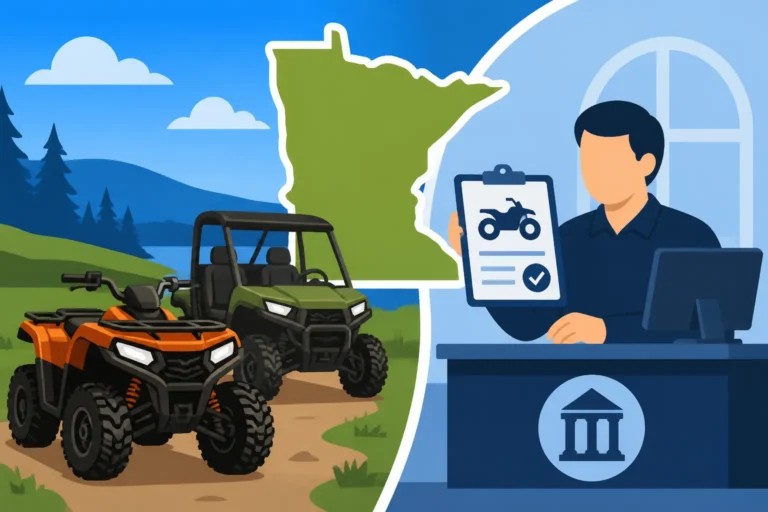
While some aspects of Minnesota ATV registration can be handled online (like renewals), when you're dealing with a new registration and joint ownership, visiting a physical [Deputy Registrar Offices That Register ATVs] is often the best approach. These offices have experienced staff who can walk you through the forms and ensure everything is correctly entered.
It’s often a good idea for both owners to go to the deputy registrar's office together. This way, any questions about names, signatures, or ownership percentages can be addressed on the spot. They can advise you on how the DNR system will reflect joint ownership, even if only one name primarily appears on the registration card. They can also ensure that the scanned ownership documents (bill of sale, title) are correctly linked to the registration record, providing future proof of co-ownership.
Understanding Different Ownership Structures for Joint ATVs
When you own an asset like an ATV with another person, there are specific legal ways that ownership can be structured. These structures have major implications, especially if one owner wants to sell their share or, more critically, if one owner passes away. Understanding the difference between these can save you a lot of grief and ensure your intentions are legally honored.
Tenants in Common vs. Joint Tenancy with Right of Survivorship
These are the two most common ways people own property together, and they have very distinct outcomes:
- Tenants in Common: With this structure, each owner holds a distinct, separate share of the property. For example, you might own 50% and your co-owner owns 50%, or you could have different percentages. The crucial part here is that if one owner dies, their share does not automatically pass to the surviving owner(s). Instead, their share becomes part of their estate and will be distributed according to their will or, if there's no will, by Minnesota's laws of intestacy. This means the surviving owner might end up sharing ownership with the deceased's heirs.
- Joint Tenancy with Right of Survivorship: This is a very popular option for married couples or close partners. In this arrangement, all owners collectively own the entire property. The key feature is the "right of survivorship." If one owner dies, their interest in the property automatically passes to the surviving owner(s) without the need for probate. The surviving owner simply needs to present a death certificate to update the ownership records.
The choice between these two should be clearly stated on your bill of sale or in a separate co-ownership agreement. For example, a bill of sale might explicitly state, "Purchased by John Doe and Jane Smith as Joint Tenants with Right of Survivorship." This is where custom legal documents, perhaps created through a service like LawDepot, can be incredibly valuable to define your specific ownership intentions.
The Role of the Bill of Sale and Title
The Minnesota DNR registration is mainly an operational permit to ride on public lands and trails. While it records an "owner," the true legal definition of who owns the machine, and how, rests with the core documents of sale and transfer. The bill of sale is your foundational [Proof of Ownership for a Minnesota ATV]. If both your names are on the bill of sale, and it specifies "joint tenants with right of survivorship," then that's your definitive legal proof.
Even if the DNR registration card only shows one name, the underlying legal documents are what matter. When you go to sell the machine, both individuals listed on the bill of sale (and title, if applicable) will need to sign off on the transfer. This ensures that both parties agree to the sale and receive their share of the proceeds. Without proper documentation, you could run into serious issues when trying to [Transferring a Minnesota ATV After a Sale].
What Happens if an Owner Passes Away
This is often the scenario that highlights the importance of choosing the right ownership structure.
- Joint Tenancy: If the ATV was registered with joint tenancy, the surviving owner would typically just need to provide a death certificate to a deputy registrar to have the deceased owner's name removed from the records. The ATV then becomes solely the property of the survivor. This avoids the time and expense of probate. You can learn more about this in [Transferring a Minnesota ATV After a Death].
- Tenants in Common: If the ATV was owned as tenants in common, the deceased owner's share would go through their estate. This means it might be distributed to heirs as specified in a will, or according to state law if there's no will. The surviving co-owner would then technically own the ATV with the heirs of the deceased, which can become complicated, especially if there are disagreements about the machine's use, maintenance, or sale. This complex situation can be smoothed over with a clear ownership agreement made in advance, which can be custom-drafted with assistance from legal document providers like LawDepot.
Practical Considerations for Shared ATV Ownership
Beyond the legalities of initial registration, shared ownership comes with a host of practical considerations that are worth discussing and even documenting with your co-owner. Addressing these points upfront can prevent misunderstandings and ensure a smooth riding experience for everyone.
Insurance Implications
When you have multiple owners, it’s absolutely crucial to ensure your [Insuring an ATV in Minnesota] policy reflects this. You’ll want to make sure both owners are listed on the policy, either as named insureds or as authorized operators. If only one owner is listed, and the other has an accident, there could be gaps in coverage, particularly for liability. Most insurance companies are familiar with joint ownership and can set up the policy to cover all parties adequately. It's wise to call your insurance agent as soon as the purchase is complete to review your options and confirm that everyone who will be riding is covered.
Consider hypothetical situations: What if your buddy, who is a co-owner, has an accident on a trail? If he's not explicitly covered, you might find yourself in a bind regarding property damage or medical claims. Clear communication with your insurer, and providing them with all owner names, ensures that your shared investment is protected, and that both of you are covered against unforeseen circumstances.
Resale and Transferring Ownership
When the time comes to sell your jointly owned ATV or UTV, both individuals listed on the original bill of sale (or title) will need to sign the new bill of sale transferring ownership to the buyer. This is a critical safeguard. It ensures that one owner cannot unilaterally sell the machine without the other's consent. This mutual agreement protects both your financial interests. If you bought the machine from a private seller, you know how important a clear transfer of ownership is. The same rules apply when you become the seller. You definitely don't want to be in a position where you're trying to prove ownership to a buyer if the paperwork is unclear, which is why a robust, signed [Minnesota Registration After a Private Sale] is key.
If, for some reason, one owner wants to buy out the other's share, you'll also need a documented transfer. This usually involves a new bill of sale from the selling co-owner to the buying co-owner, detailing the transaction and effectively removing one name from the ownership. Then, the buying co-owner can register the machine solely in their name.
Customizing Your Ownership Agreement
While the bill of sale covers the legal transfer of ownership, it might not delve into the nitty-gritty of shared responsibilities. For co-owners, especially those who aren't spouses (where assets are often treated as marital property), drafting a separate, more detailed co-ownership agreement can be incredibly beneficial. This document can outline:
- Usage Rules: Who gets to use the machine when? Are there limits on borrowing it out?
- Maintenance Responsibilities: Who pays for routine oil changes, tire replacements, or repairs? How are major repair costs split?
- Expense Sharing: How are registration fees, insurance premiums, and fuel costs divided?
- Dispute Resolution: What happens if you can't agree on something related to the ATV?
- Exit Strategy: What happens if one person wants out? How is the value determined, and how is a buyout handled?
Creating such an agreement may seem like overkill, but it's a fantastic way to prevent conflicts down the line. It clarifies expectations and provides a roadmap for various scenarios. You can draft a simple agreement yourself, or use a customizable template from a service like LawDepot to ensure all the essential clauses are covered. This foresight in documenting your shared understanding can go a long way in preserving both your friendship (or relationship) and your investment. For a spouse, simply [Adding a Spouse to the Record] may be less formal, but for friends, a more explicit agreement is wise.
Disclaimer
This article is for general informational purposes only and does not constitute professional advice. Laws, prices and regulations vary by location and change over time. Consult a qualified professional for guidance on your specific situation.