Minnesota Rules for Crossing a Railroad Grade
You're out enjoying a beautiful Minnesota day on your ATV or UTV, cruising along a ditch or trail, when suddenly—a railroad crossing. Your heart might do a little skip because you're not entirely sure what the rules are for safely and legally navigating those tracks on an off-highway vehicle. It's a common point of confusion for riders, and honestly, the stakes are incredibly high when you're talking about trains. This guide will walk you through everything you need to know about crossing railroad grades in Minnesota, helping you stay safe, legal, and confident on your rides.
The Unique Legal Landscape of Minnesota Railroad Crossings for ATVs
Navigating railroad tracks isn't like crossing a regular road; there are specific rules and inherent dangers that demand extra caution from ATV and UTV riders in Minnesota. Many riders often assume that if they can ride in a ditch or on a specific trail, then crossing whatever lies in their path, including railroad tracks, is fair game. This isn't always the case, and misunderstanding these nuances can lead to dangerous situations, hefty fines, or even worse.
Railroad property is almost universally private property, and Minnesota statutes have clear guidelines about how any vehicle, especially an off-highway vehicle, must interact with these critical infrastructure points. Unlike public roads where you have an implied right of passage, railroad crossings come with a whole different set of obligations. It's not just about what you think is safe; it's about adhering to the letter of the law and respecting the immense power of a train. Remember, a train cannot swerve, and it takes an incredibly long distance to stop, so the burden of safety falls squarely on you, the operator.
Understanding the "Public Highway" Distinction
One of the biggest areas of confusion stems from how Minnesota law defines a "public highway" in relation to railroad crossings. Generally, state law permits ATVs and UTVs to operate on the shoulder or ditch of a public road, and these roads often intersect with railroad tracks. However, the legal definition typically restricts ATV and UTV operation on the actual paved or gravel surface of most public roads, meaning your right to cross a railroad grade on that surface might be limited to specifically designated crossings.
This means that if you're riding a ditch that intersects with tracks, you generally can't just cross anywhere. You must locate a legally established and marked crossing, often where a public road officially intersects the tracks. Trying to cross in an unmarked area, even if it looks like a simple ditch line, is often considered trespassing on railroad property and can carry severe penalties. [Minnesota Trespass Rules Along Ditches] touches on this broader concept, but it's especially critical at railroad grades.
Railroad Property and Right-of-Way
Railroad companies maintain extensive rights-of-way that extend beyond the tracks themselves, sometimes encompassing a significant area on either side. This land is private property, and unauthorized entry is considered trespassing. Many a rider has mistakenly assumed that because a trail or ditch leads right up to the tracks, they have permission to cross. Always assume that unless there's clear signage indicating a designated, public ATV/UTV crossing, or you're at a clearly marked public road crossing, you are on private property.
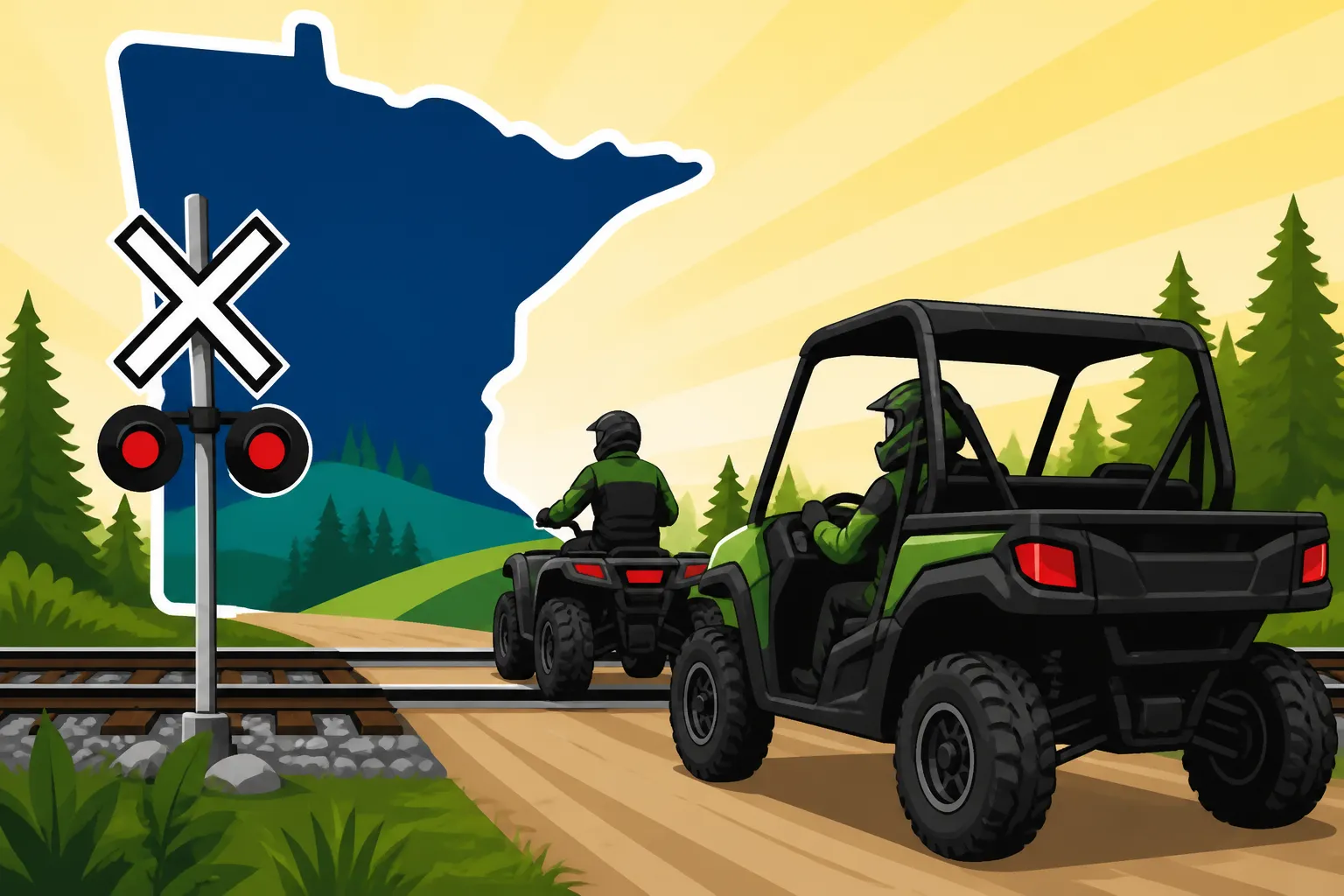
It's crucial to differentiate between a general trail or ditch and a legitimate, marked crossing. Look for typical railroad crossing signs—the circular "RR" advance warning signs, the crossbuck signs, and often yield or stop signs. If those aren't present, you should treat it as an unapproved crossing and find an alternate route. Ignoring these distinctions isn't just a minor infraction; it can escalate quickly into serious legal trouble and put your life at risk.
The Absolute "Stop, Look, Listen" Mandate for All Crossings
Regardless of whether you're at a well-marked public road crossing or a designated trail crossing, the fundamental rule for all railroad grades in Minnesota (and, frankly, everywhere else) is the "Stop, Look, Listen" mandate. This isn't just a quaint old saying; it's a critical safety and legal requirement that you must follow every single time. It's the most important thing you'll do at a railroad crossing.
Many riders, especially those in a hurry or familiar with a certain route, might be tempted to just slow down and glance, but that's not good enough. The law is explicit because the danger is constant. Trains are fast, often quieter than you'd expect until they're very close, and they can appear from either direction without much warning, even on tracks that seem inactive. Your life, and the lives of anyone riding with you, depends on taking this mandate seriously.
How to Properly "Stop" Your Machine
Stopping isn't just tapping your brakes. It means bringing your ATV or UTV to a complete halt before reaching the tracks. The key here is where you stop. You must stop at a point where you have a clear view of the tracks in both directions, but far enough back from the nearest rail that you are out of the "danger zone." This usually means stopping at least 15 feet but not more than 50 feet from the nearest rail. Look for a white stop line painted on the pavement or gravel if you're at a road crossing. If there's no line, use your best judgment to stay a safe distance back.
Once stopped, you should also consider putting your machine into neutral or park, or at least ensuring your brakes are fully engaged, so you don't accidentally creep forward. This gives you time to fully assess the situation without any movement. It might seem overly cautious, but rushing this step significantly increases your risk. In unfamiliar territory, this brief moment of stillness allows you to fully engage your senses before proceeding.
The Critical Act of "Look and Listen"
With your machine completely stopped, now comes the crucial part: looking and listening. You need to actively scan the tracks in both directions for approaching trains. Don't just glance; turn your head fully, looking as far down the tracks as you possibly can. If there's anything obstructing your view, such as buildings, trees, or parked vehicles, be extra cautious. You might need to edge forward slightly with extreme care to get a better vantage point, but only after you've thoroughly checked what you can see.
Listening is just as important. Turn off your engine or at least idle it down so you can hear clearly. Take off your helmet for a moment if necessary to improve your hearing, especially if your machine or helmet creates a lot of noise. Listen for the distinct sound of a train horn, the rumble of an approaching locomotive, or the clang of crossing bells. Even if you don't see anything, listen. A train can sometimes be heard before it's seen, particularly in areas with curves or dense vegetation.
Yielding to All Trains and Crossing Safely
The law is unequivocal: you must yield the right-of-way to any approaching train. This means if you see or hear a train, you wait. Period. Do not try to race a train, even if it looks far away. Trains are deceptively fast, and misjudging their speed and distance is a fatal error. Once you've confirmed that no train is approaching from either direction, and there are no crossing gates or flashing lights indicating a train, then and only then can you proceed.
When you cross, do so decisively and in a low gear. You want to maintain a steady speed and avoid stalling on the tracks. Look at the condition of the crossing itself. Are there rough rails, uneven surfaces, or deep gravel? Approach at an angle if necessary to prevent getting a tire stuck or bottoming out your machine, especially if you have a low-slung sport quad. A well-designed skid plate, perhaps from a company like SuperATV, can offer some protection against impacts on uneven crossings, but prevention through careful crossing is always best. Cross quickly, but not recklessly, ensuring you clear the tracks entirely before resuming your normal pace.
Practical Considerations for a Safe Crossing
Beyond the legal mandates, there are numerous practical considerations that can make the difference between a safe, uneventful crossing and a dangerous incident. Experienced riders develop a sixth sense for these situations, but even seasoned veterans can be caught off guard. Thinking ahead and preparing for potential issues will help you navigate railroad grades with confidence.
One common frustration for riders is the condition of the crossing itself. Many crossings, especially in rural areas or on less-traveled routes, can be incredibly rough. The track beds might be exposed, the planks between the rails might be rotten or missing, and the approaches can be deeply rutted or covered in loose gravel. This uneven terrain can easily throw off your balance, cause a loss of traction, or even damage your machine if you hit it wrong. Always be prepared to adapt your riding style to the specific conditions of each crossing.
Inspecting the Crossing Before You Commit
Before you commit to crossing, take a moment to visually inspect the grade itself. Look for hazards like loose gravel, deep ruts parallel to the tracks (which can trap your tires), missing railroad ties, or broken crossing planks. Assess the angle of approach—is it steep? Is it off-camber? These factors will influence how you should cross. If the crossing looks too hazardous for your machine or skill level, it's always smarter to find an alternative route. [Minnesota Road Rules Riders Get Wrong] often includes discussions on assessing hazards, which applies well here.
Consider the width of your machine. A tight gap between the rails and the road surface can snag tires if you don't cross at a sufficient angle. Machines with a wider stance, like many side-by-sides, need to be particularly mindful of avoiding the edges of crossing planks or the open gaps that can appear. Good ground clearance helps, but it doesn't solve issues with tire-snagging gaps. If you've invested in aftermarket suspension components, like those offered by SuperATV, you might have improved articulation or clearance, which can be an advantage on rough, uneven crossings, but they don't negate the need for visual inspection.
What if You Get Stuck or Your Machine Stalls?
It's every rider's nightmare: getting stuck or stalling on railroad tracks. If this happens, your absolute top priority is getting yourself and any passengers to safety immediately. Get off the tracks and move far away from them, ideally in the direction the train is coming from, but angled away from the tracks, so you won't be hit by debris. Once you're safe, and only if there's no immediate train threat, you can consider trying to move your machine.
If your machine stalls, try to restart it quickly. If it's stuck, try to get traction by rocking it gently or shifting your weight. However, if a train is approaching, abandon the machine. Your life is not worth saving your ATV or UTV. Call 911 immediately to report a stalled vehicle on the tracks, providing as much detail as possible about your location. You should also look for a blue sign near the crossing that provides a crossing ID number and an emergency contact number for the railroad company. This information allows authorities to contact the railroad and potentially stop or slow down an approaching train. A solid winch and recovery gear, perhaps from a brand like SuperATV, is always a smart addition to your machine, not just for railroad crossings, but for any unexpected trail situation, but safety always comes first.
Penalties, Enforcement, and What's at Stake
Minnesota takes railroad safety very seriously, and the penalties for violating rules at railroad crossings can be significant. It's not just about a simple traffic ticket; you could face serious charges, especially if your actions create a hazard or cause damage. Conservation officers, local law enforcement, and even railroad police actively patrol these areas, and they have the authority to issue citations.
The stakes are far higher than just a fine. Disregarding railroad crossing laws puts your life, the lives of your passengers, and even the train crew at extreme risk. Train collisions are almost always catastrophic for the off-highway vehicle and its occupants. Beyond the immediate danger, a conviction for a railroad violation can impact your driving record, lead to points, and potentially affect your insurance rates.
Common Violations and Their Consequences
Some of the most common violations at railroad grades include:
- Failure to Stop: Not coming to a complete stop before the tracks.
- Failure to Yield: Not waiting for an approaching train.
- Circumventing Gates: Going around activated crossing gates. This is incredibly dangerous and often carries very severe penalties.
- Trespassing: Riding on railroad property where there is no designated public crossing.
- Reckless Operation: Operating your ATV/UTV in a dangerous manner at or near a crossing.
Penalties can vary widely depending on the severity of the offense, whether it's a first-time or repeat offense, and whether it created an immediate danger or caused an accident. Fines can range from hundreds to thousands of dollars. You might also face criminal charges for reckless endangerment or trespassing, leading to potential jail time or probation. [Minnesota Fines for Illegal Road Riding] gives a broader overview of penalties, and railroad violations often fall into the higher end of that spectrum due to the inherent danger involved.
Enforcement and Reporting Unsafe Crossings
Law enforcement in Minnesota, including DNR conservation officers, are well aware of the risks associated with ATV and UTV use near railroad tracks. They conduct patrols and respond to reports of illegal or unsafe activity. Railroad companies also employ their own police forces who have jurisdiction on railroad property and can issue citations or make arrests. Ignorance of the law is never an excuse, and officers will be firm when enforcing these regulations.
If you encounter an unsafe railroad crossing—perhaps missing signs, damaged tracks, or a crossing in disrepair—it's important to report it. You can contact the railroad company directly (look for the emergency contact sign at the crossing), your local law enforcement agency, or the Minnesota Department of Transportation (MnDOT). Reporting these issues helps ensure that all riders can cross safely in the future.
Table: Key Actions for Safe Railroad Grade Crossings
| Action | Description | Why It's Important |
|---|---|---|
| STOP | Bring your machine to a complete halt at least 15 feet (but no more than 50 feet) from the nearest rail. | Provides a safe distance from oncoming trains and allows you to fully assess the situation without momentum. |
| LOOK | Actively scan tracks in both directions, turning your head fully. Check for signals and gates. | Trains are fast and can be deceptively close. Visibility might be obstructed. Confirms no train is visually present. |
| LISTEN | Turn off or idle your engine, remove your helmet if necessary. Listen for train horns, rumbling, or crossing bells. | Trains can often be heard before they are seen, especially around bends or in noisy environments. |
| INSPECT | Visually check the crossing surface for hazards like loose gravel, deep ruts, or broken planks. | Prevents getting stuck, losing control, or damaging your machine on uneven terrain. |
| YIELD | If a train is approaching or crossing signals are active, wait. Period. | Legally required and paramount for your safety. Never try to beat a train. |
| CROSS DECISIVELY | Once clear, cross the tracks quickly and smoothly in a low gear, maintaining a steady speed. Angle your approach if necessary. | Minimizes time spent on the tracks and reduces the risk of stalling or getting a wheel caught. Ensuring your machine is in top mechanical shape is paramount, and that includes having reliable brakes and steering components. Aftermarket parts, often from reputable brands like SuperATV, can sometimes offer enhanced durability for the demands of off-road riding, but always ensure they meet or exceed OEM specifications for safety. |
| BE PREPARED | Carry recovery gear (winch, strap) and know the emergency railroad contact number (blue sign at crossing) to report stalled vehicles. | Essential for safely recovering from unforeseen incidents and quickly notifying authorities if your machine is stuck on the tracks. |
Navigating railroad grades on your ATV or UTV in Minnesota requires a blend of legal adherence, common sense, and extreme caution. By understanding the rules, actively practicing "Stop, Look, Listen," and being prepared for potential hazards, you can ensure your rides remain enjoyable and, most importantly, safe.
Disclaimer
This article is for general informational purposes only and does not constitute professional advice. Laws, prices and regulations vary by location and change over time. Consult a qualified professional for guidance on your specific situation.