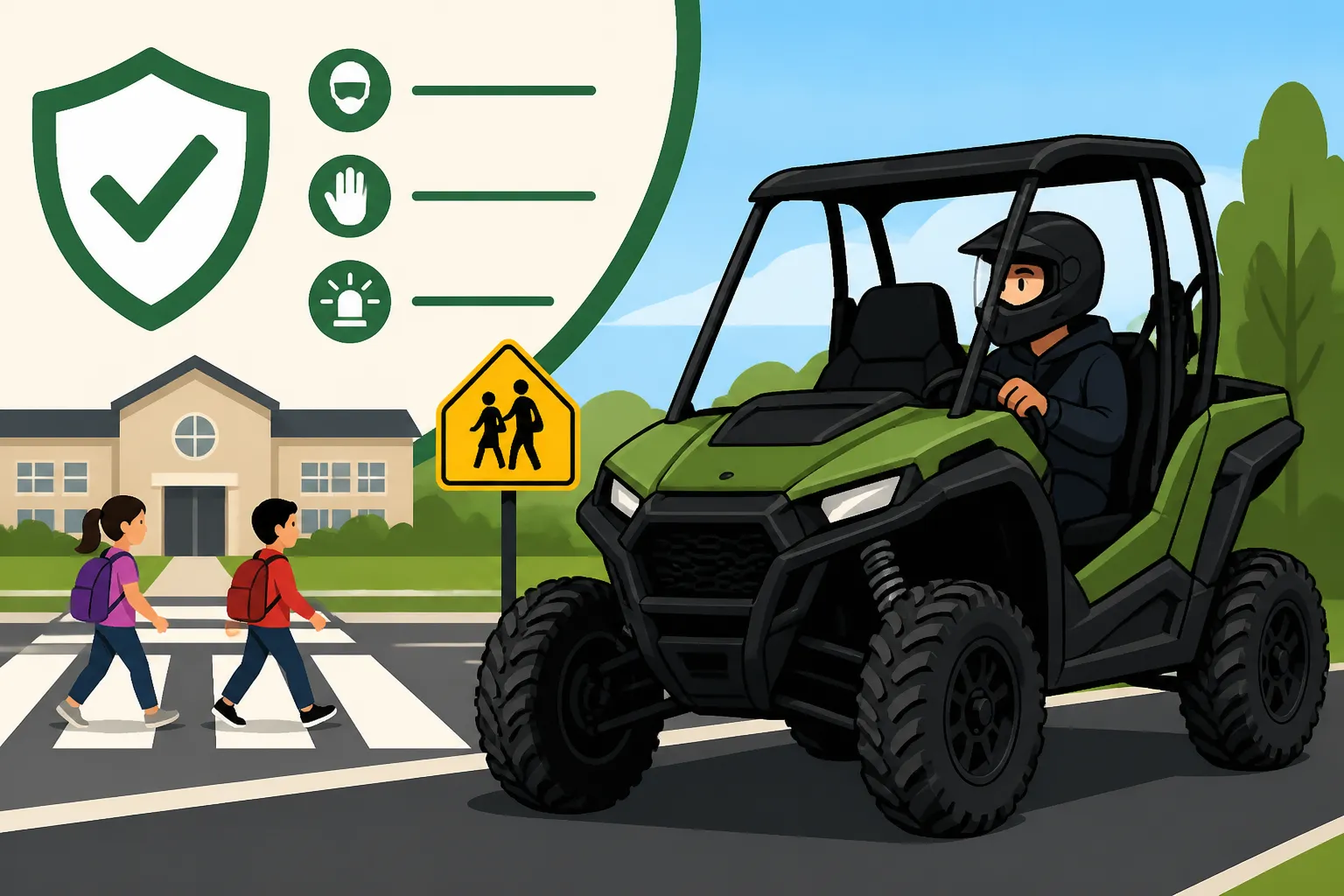
Rules for a Machine on a School Route
It’s a common scenario: you live just a few blocks from the local elementary school, or maybe you use your ATV or side-by-side to run a quick errand, and that route inevitably takes you right past the school entrance. You might be thinking, "It's just a short stretch, what's the big deal?" But the truth is, operating an off-highway vehicle (OHV) on roads, especially those in proximity to schools, carries a unique set of legal complexities and significant safety risks in Minnesota. This guide is here to help you understand precisely what the rules are, why they exist, and how to navigate these situations responsibly, keeping both your machine and the community safe.
The Legal Landscape of ATVs Near Schools in Minnesota
Navigating Minnesota’s roads with an ATV or UTV is already a nuanced topic, with specific rules governing where you can and cannot ride. When you add school zones into the mix, these complexities amplify considerably. It's not just about general road laws; it's about safeguarding our most vulnerable road users.
Why School Zones Are Different
Think about any school in your town. From roughly 7:30 to 9:00 AM and again from 2:30 to 4:00 PM, those streets become a hive of activity. Kids are walking, biking, waiting for buses, and parents are pulling in and out of drop-off lines. This isn't just regular traffic; it's highly unpredictable pedestrian traffic, often involving young children who might not always be paying close attention to their surroundings.
Because of this heightened vulnerability, municipalities often enact stricter speed limits, enforce specific traffic patterns, and place additional restrictions on vehicle types around schools. An ATV or UTV, even if street-legal for certain applications elsewhere, immediately stands out in such an environment, drawing attention from law enforcement and potentially causing alarm among parents. The state's general rules about riding the ditch or crossing roads don't automatically grant you carte blanche in these sensitive areas. You might be perfectly within your rights to ride a ditch section a mile down the road, but the moment that ditch runs through a school zone, those rules often change dramatically.
Minnesota's General Road Riding Rules
To fully grasp the special rules around schools, it helps to understand the baseline. In Minnesota, ATVs and UTVs are generally not allowed on the paved surfaces of public roads or highways. There are exceptions, of course, such as designated routes in certain cities or townships, or for the purpose of crossing a road safely and directly. Most legal road use involves riding in the ditch or shoulder, following specific regulations about speed, direction, and road class.
For instance, you might know you can often ride a highway ditch in rural areas, but the state is very clear about [The Road Surface Minnesota Keeps Closed]. These general rules are designed to keep OHVs separate from faster-moving vehicular traffic and to minimize conflicts. However, these baseline allowances are almost always superseded by local ordinances, particularly in developed areas and especially around sensitive locations like schools. It’s a bit like knowing the general speed limit on a highway, but then seeing a sign for a construction zone or school zone that temporarily drops it by 20 mph—the general rule no longer applies.
Municipal Ordinances and Local Variations
This is where things get tricky. While the Minnesota DNR sets statewide OHV regulations, individual cities, townships, and counties have the authority to establish more restrictive ordinances for their local roads. And guess where these local restrictions are often most stringent? You guessed it: around schools, parks, and high-density residential areas.
A city might have a blanket ordinance prohibiting all OHV use on any city street or right-of-way, regardless of the state's ditch-riding rules. Or, they might specifically ban OHVs within a certain radius of school property. This means that even if you believe you're following state law by riding in the ditch, a local ordinance could still make your ride illegal, leading to tickets or other penalties.
For example, a small town like Appleton might have specific [Appleton and Other ATV-Friendly Minnesota Cities] that allow ATV travel on certain streets to access businesses or trails. However, even in such a progressive community, it's highly unlikely that these allowances would extend to direct travel through school zones during school hours. You must always check with your local city or county clerk's office, or their official website, for specific ordinances pertaining to OHV use within their boundaries, especially if a school route is involved. Relying solely on general state rules is a recipe for a citation and a lot of unnecessary hassle.
Safety Concerns and Practical Considerations
Beyond the legal ramifications, there are profound safety concerns that arise when ATVs and UTVs operate near schools. It’s not just about avoiding a ticket; it’s about preventing accidents and ensuring the well-being of the entire community, especially our children.
Vulnerable Pedestrians and Increased Traffic
Picture this: dozens of elementary school children, perhaps excited after school or distracted by friends, are pouring out of the building. They might dart out from between parked cars, not look both ways consistently, or be hard to see due to their small size. Now, imagine a loud ATV or UTV, even one driven cautiously, trying to navigate this scene. The potential for a tragic accident is astronomously high.
ATVs and UTVs, by their very nature, are designed for off-road use. They handle differently than cars, have different braking characteristics, and often require more attention to operate, especially when confronted with sudden, unpredictable movements from pedestrians. In the chaos of school pick-up and drop-off, the margins for error are razor-thin. It’s a situation that stresses even experienced drivers in conventional vehicles; adding an OHV significantly escalates the risk. Remember, a child's perception of danger or their ability to react quickly to an approaching vehicle is far less developed than an adult's.
Visibility and Noise
Let's be honest, an ATV or UTV is hard to miss. They have a distinct engine sound, and many riders modify their machines with SuperATV accessories like upgraded lights or exhaust systems, which might enhance performance or trail visibility but could be jarring in a quiet neighborhood or school zone. While these modifications are great for the trail, they can inadvertently contribute to problems near schools.
The noise can startle children and parents, and while you might think your machine is highly visible, its profile is different from a car. A child might not immediately recognize an approaching ATV as a vehicle to be wary of, or its speed might be misjudged. Moreover, during busy school times, the sheer volume of cars, buses, and people creates a cacophony of sounds and visual distractions. Your ATV might simply blend into the background noise for a split second too long, or be obscured by a larger vehicle, leading to a critical misunderstanding.
Consequences of Non-Compliance
The penalties for operating an OHV illegally, particularly in a restricted zone like a school route, can be steep and far-reaching. It’s not just a slap on the wrist. A conservation officer or local police officer has every right to stop you, and if you’re violating local ordinances or state law, you could be facing significant fines. [Minnesota Penalties for Reckless Riding] or [Minnesota Fines for Illegal Road Riding] can quickly add up, turning a "quick trip" into a costly mistake.
Beyond fines, repeat offenses or serious infractions could lead to the suspension of your riding privileges. And if an accident were to occur, especially involving a child, the legal and financial liability would be immense. Your insurance company might deny a claim if you were operating the machine illegally at the time, leaving you personally responsible for damages, medical bills, and potential lawsuits. It’s a heavy burden that no rider wants to bear, and it underscores the critical importance of understanding and respecting these rules.
Navigating School Routes Responsibly (and Legally)
So, what's a responsible rider to do if a school route lies between them and their destination, or even just their driveway? The answer lies in careful planning, strict adherence to laws, and prioritizing safety above all else.
Planning Alternative Routes
The absolute best advice for anyone who regularly uses an ATV or UTV near a school is to find an alternative route that completely bypasses the school zone. This might mean adding a few extra blocks or taking a slightly longer path, but the peace of mind and reduced risk are well worth it.
Take out a map of your area, whether it’s a paper one or a digital tool like onX Offroad (though it might not show every local ordinance detail). Identify the school’s exact location and its surrounding no-go zones during peak hours. Then, chart a course that uses roads or trails where OHV use is explicitly permitted, keeping you clear of school traffic entirely. This proactive approach not only keeps you in compliance but also eliminates any potential for accidental encounters with children or concerned residents. Sometimes, a little extra time on a legal route is far better than a quick dash down a questionable one.
Strict Adherence to Laws When Unavoidable
There might be rare instances where bypassing a school route is genuinely impossible, perhaps because of geographic limitations or the location of your private property. In such cases, your responsibilities multiply. First, you must ensure your machine is properly registered and insured. Beyond that, you need to understand and adhere to all applicable laws.
This means:
- Checking local ordinances: Before you even start your engine, know your city's specific rules. Is ATV use ever permitted on any part of the right-of-way in a school zone?
- Time of day: If allowed, restrict your travel to non-school hours (evenings, weekends, holidays) when pedestrian traffic is minimal.
- Following general road rules: If you must traverse a road ditch, always ride single file, keep to the far right, and obey all posted speed limits. Remember, even in the ditch, you are still subject to speed limits, which are often reduced in school zones.
- Operator requirements: Ensure you meet all age and license requirements. For instance, [Driver's License Rules for Minnesota Road Riding] apply to certain road uses, and [Minnesota Helmet Rules for Riders Under 18] are crucial for younger riders, regardless of where they're riding. A little rider on a youth machine needs extra consideration here.
If your machine is equipped with aftermarket accessories from companies like SuperATV, ensure they comply with all road regulations, particularly lighting and noise standards. While their rock sliders might be perfect for the trails, those LED light bars are probably overkill for a school route and could even be a visibility distraction for others.
Best Practices for Safety Around Kids
Even when legally allowed or in situations where you absolutely must traverse a school route, exercising extreme caution is non-negotiable.
- Slow down: Reduce your speed far below the posted limit, almost to a crawl. This gives you maximum reaction time.
- Be hyper-vigilant: Constantly scan for children, parents, and vehicles. Expect the unexpected. A ball rolling into the street, a child chasing it – these scenarios are common near schools.
- Make eye contact: If you see pedestrians, try to make eye contact to ensure they’ve seen you.
- Yield to pedestrians: Always give pedestrians the right of way, without hesitation.
- Minimize noise: Avoid revving your engine or making sudden movements that could startle children.
- Avoid peak hours: As mentioned, if at all possible, schedule your travel for outside of drop-off and pick-up times.
What If You Live on a School Route?
This is perhaps the most challenging scenario, as it blends private property rights with public safety concerns. If your home is located directly on a road that serves as a school route, you face unique considerations for operating your ATV or UTV.
Private Property vs. Public Roads
It's crucial to understand the distinction between your private property and the public right-of-way. You are generally free to operate your ATV on your own land, including your driveway, without specific registration requirements in Minnesota, assuming you're not disturbing neighbors or creating a nuisance. [Do You Need Registration on Your Own Minnesota Land?] explains this in more detail.
However, the moment your tires touch the ditch, shoulder, or road surface that is part of the public right-of-way, you are subject to all applicable state and local laws. This means even if you're just moving your machine from your garage to a trailer parked on the street, you're technically "operating" it on a public way, and the school route restrictions could come into play. It's a fine line, and one that law enforcement officers are trained to observe closely, especially near schools.
Minimal Use and Awareness
If you live on a school route and absolutely need to move your ATV or UTV, the principle of "minimal use" should guide your actions.
- Limit distance: Travel the absolute shortest distance possible on the public right-of-way.
- Timing: Again, perform these movements only outside of peak school hours.
- Visibility: Ensure your machine's lights are on, even in daylight, to maximize your visibility to any passing motorists or pedestrians.
- Low speed: Move at the slowest possible speed, essentially a walking pace.
- Direct path: If you're going to a trailer, back it into your driveway so you can load the machine directly, minimizing time spent on the street.
Consider if there are alternative ways to move your machine without starting it on the public right-of-way. Could you push it a short distance? Or, if you use your UTV for tasks like plowing your driveway, ensure you remain strictly on your property. If you have SuperATV plowing accessories, they are fantastic for your driveway, but avoid plowing sidewalks or shared public areas during school traffic times, as this would clearly be operating the machine on the school route.
The "Last Resort" Principle
Ultimately, using an ATV or UTV on a road that is a school route, even if you live there, should be considered an absolute last resort. The risks associated with children and unpredictable traffic far outweigh the convenience of a short trip. If you rely on your machine for chores, consider performing them when school is not in session or finding alternative methods if they involve accessing the public right-of-way during school hours.
This might mean adapting your routines or even investing in a small utility trailer to quickly and legally transport your machine to an approved riding area or an alternative, non-school-route road. Prioritizing the safety of children and the smooth functioning of school traffic is not just about avoiding legal trouble; it’s about being a responsible and considerate member of the community.
| Factor | General Road/Ditch Riding | School Route Considerations |
|---|---|---|
| Legal Basis | State laws, some local ordinances | Stricter local ordinances often supersede state laws; highly restricted |
| Allowed Surface | Ditch, shoulder, specific routes | Often prohibited on all public right-of-way; check local rules precisely |
| Speed Limit | Posted limits (often 30-55 mph in ditches) | Often reduced, even in ditches; extreme caution and low speed required |
| Traffic Type | Vehicular, sometimes rural pedestrian | High pedestrian (children!), bus, parent vehicle traffic |
| Operator Age/License | State requirements apply | Same, but greater scrutiny; ensure all youth are fully compliant with [Minnesota Rules for a Rider Who Turns 16] |
| Helmet Requirements | State requirements apply ([Minnesota Helmet Rules for Riders Under 18]) | Same, with absolute strictness due to vulnerable population |
| Visibility/Noise | Be aware of surroundings | Maximize awareness, minimize noise and potential distractions |
| Consequences | Fines, potential citations | Higher fines, severe liability in case of incident, public outcry |
| Best Practice | Follow all laws, ride safely | AVOID entirely; if unavoidable, extreme caution and strict compliance |
Disclaimer
This article is for general informational purposes only and does not constitute professional advice. Laws, prices and regulations vary by location and change over time. Consult a qualified professional for guidance on your specific situation.