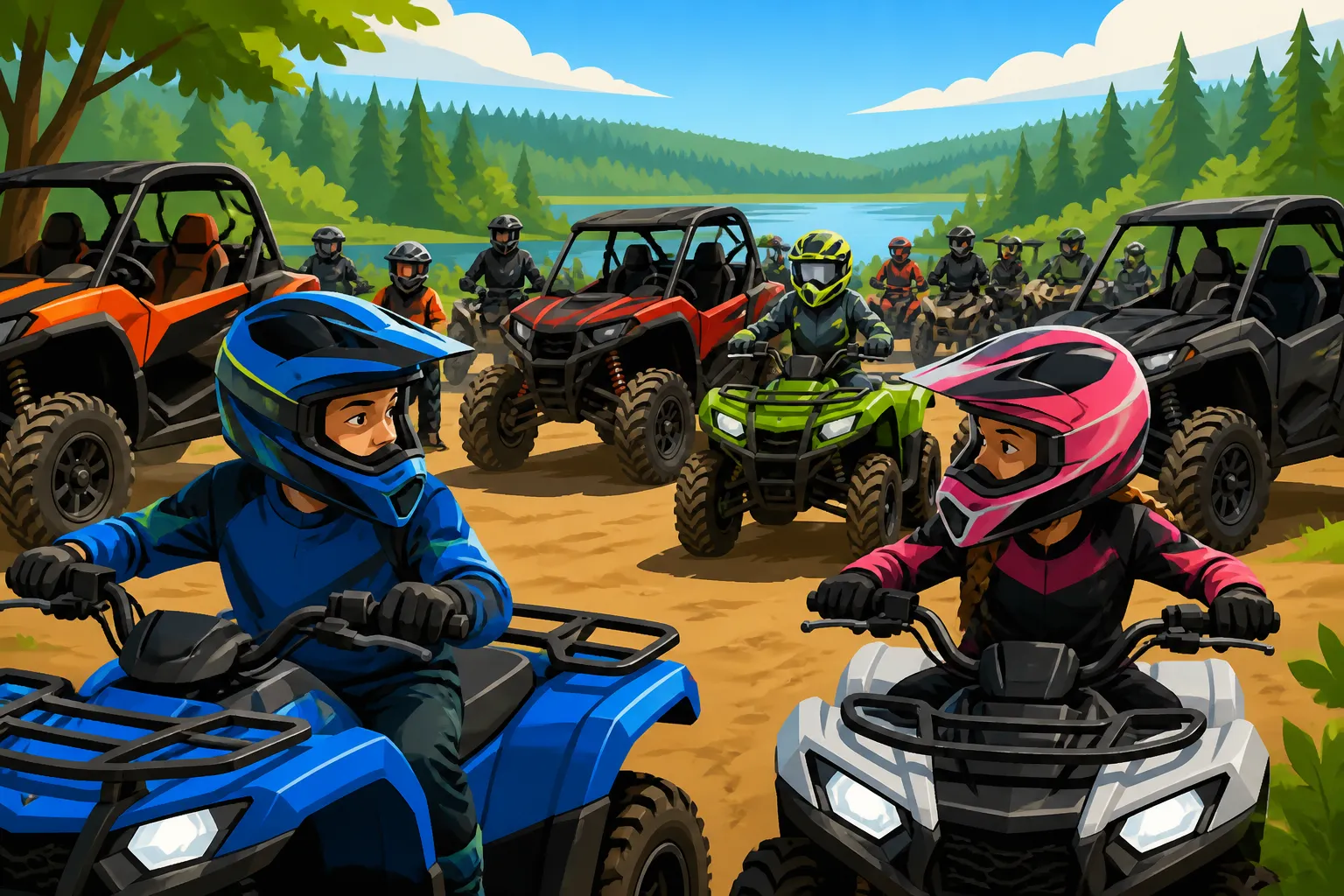
Young Riders at a Crowded Staging Area
A crowded staging area can feel like the riskiest part of an ATV or UTV outing, especially when young riders are excited to get moving. People are unloading, engines are starting, and machines may be backing or turning in tight spaces. A simple arrival routine, clear adult supervision, and a check of Minnesota’s rider requirements help families keep the staging area orderly and start the ride safely.
Why staging areas need their own safety plan
A trailhead or staging area is not just a place to park before the ride. It is a shared space where tow vehicles, trailers, pedestrians, and off-highway machines all move close together. A rider who is skilled on a trail may still be inexperienced at spotting a reversing truck or anticipating what another person will do.
Young riders can be especially vulnerable because they may be shorter than adults, less visible from a machine’s seat, and eager to follow friends or family onto the trail. Noise and activity can make it hard to hear instructions. The safest approach is to treat the whole staging area as a no-riding zone unless signs, site rules, or an authorized route clearly allow machine travel there.
Before unloading, identify the site’s entrances, exits, parking pattern, and any marked route to the trail. Follow posted directions and staff or volunteer instructions. A staging area may sit next to a trail, but that does not automatically make every parking lane or open patch of ground part of the riding route.
Families should also distinguish between getting ready and riding. Riders may need to meet Minnesota requirements for the type of machine, the place they plan to ride, and their age or training status once they leave the parking area. A staging area does not cancel those requirements. Review Minnesota Age Rules for Young Riders and Safety Certification for Riders Twelve and Over before the trip rather than trying to sort out eligibility beside a busy trailer.
Common hazards to point out to a young rider
Walk through the area with the young rider before starting the engine. Point out:
- Trucks and trailers backing into parking spaces
- Blind spots behind tow vehicles and beside enclosed trailers
- Machines being unloaded from ramps
- People walking between parked vehicles
- Children who may dart between machines
- Loose straps, ramps, and gear on the ground
- Dust, exhaust, and noise that can affect visibility or communication
Use plain, specific directions. “Stay over there” is easy to misunderstand. “Wait beside the passenger door until I call you” gives a child a clear place and a clear signal.
If a young rider cannot reliably stay with the supervising adult, follow directions, and wait when asked, it is reasonable to keep them out of the active staging area until unloading is complete. That is not a judgment about their ability to ride; it is a practical response to a crowded work zone.
A safer arrival, unloading, and departure routine
A routine makes the busiest moments more predictable. Agree on it before leaving home, then use the same steps every time. Keep young riders out of the path of a vehicle or machine while adults are maneuvering equipment.
- Choose a place to stop and settle. Park only where permitted, and keep access lanes, ramps, and marked emergency routes clear. If the area is crowded, wait for a suitable space rather than trying to unload in a traffic lane.
- Set a child’s waiting place. Before backing or opening a ramp, have the young rider wait beside a designated adult, away from the trailer and the machine’s path. Do not rely on a child to judge whether a vehicle is about to move.
- Unload one machine at a time. Keep other machines secured until the active unloading is finished. One adult should handle the machine while another supervises children, if another adult is available.
- Use a spotter when visibility is limited. The spotter should stand where the driver can see them, stay out of the vehicle’s path, and give simple signals. If the driver loses sight of the spotter, stop.
- Secure the trailer and gear. Put ramps away, stow tie-downs, and move loose equipment out of pedestrian paths. Do not leave straps where a child can trip or where a moving tire can catch them.
- Keep machines parked until the group is ready. Turn engines off while people are gathering, checking equipment, or talking through the route. Remove the key when a machine is unattended, and do not let a child sit on or start a parked machine without direct adult control.
- Do a group check before departure. Confirm that every rider is wearing required equipment, understands the plan, and knows which adult to follow. Leave in a controlled order rather than having several machines start and move at once.
| Moment | Safer choice | Avoid |
|---|---|---|
| Arriving | Follow signs and park in a permitted space | Blocking lanes or unloading where there is no room |
| Unloading | Keep children with a designated adult outside the work area | Letting a child walk behind a tow vehicle or trailer |
| Getting ready | Keep machines off while people gather | Starting several engines beside pedestrians |
| Waiting | Agree on a specific place and signal | Assuming a child will stay clear without direction |
| Leaving | Move out in an agreed order when the route is clear | Racing, circling, or riding around the lot |
For more site-specific preparation, Minnesota Trailhead Parking and Staging can help with what to expect at a trailhead. A map and a brief discussion of the route are useful too; see Reading a Minnesota OHV Trail Map for planning how the group will navigate once it is on the trail.
Put one adult in charge of the staging routine
In a group, unclear responsibility can create gaps. One adult may assume another is watching the youngest rider, while both are busy loading or talking. Decide who is supervising each child and who is handling each machine. If the group is large, an adult who is not operating a machine can be especially helpful during unloading and departure.
That person can keep children in the agreed waiting area, watch for approaching vehicles, and confirm that the group is ready before engines start. If no adult is free to supervise, pause the process. Rushing to get on the trail is not worth leaving a child to navigate a busy parking area alone.
Minnesota requirements still matter at the trailhead
Safety in the lot and legal readiness for the trail are related, but they are not the same thing. Before the trip, check the requirements that apply to the rider, machine, and destination. Minnesota rules can depend on details such as a rider’s age, whether the route is public, and the type of machine. Do not assume a young rider can operate every machine simply because an adult is nearby.
Use Minnesota ATV Safety Training Requirements to review training rules and [Minnesota Rules for a Rider Turning 16] if a rider is near an age threshold. For a broader checklist, What Minnesota Riders Need Before They Ride is useful when preparing the machine and documents.
A visiting family should also check whether its machine and riders need any Minnesota-specific pass or other documentation for the planned route. An out-of-state registration does not necessarily settle every trail-access question. Review Minnesota Rules for Visiting Riders and confirm current requirements for the particular trail system with the appropriate official source before traveling.
Keep required documents and proof where an adult can reach them without digging through a packed trailer while the group waits. A phone can be useful, but a dead battery, poor signal, or a wet screen can make digital records inconvenient. Decide in advance who is carrying the paperwork and who will answer questions if the group is checked.
Protective gear should be ready before the machine starts, not put on while a rider is balancing beside a trailer. Check that the helmet fits securely and that eye protection, gloves, and other appropriate gear are available. Minnesota has specific helmet requirements for some young riders; review Minnesota Helmet Requirements Under 18 rather than relying on another state’s rules or a family’s usual practice.
Some families use a small checklist stored with their riding gear. It might cover helmets, eye protection, water, trail information, required documents, and basic communication. If you need to replace inexpensive items such as reflective markers or a compact first-aid kit, Amazon is one possible source, but choose equipment that fits the rider and works for the conditions rather than buying by appearance alone.
Helping a young rider stay calm in a busy group
A young rider’s first job at a crowded staging area is not to hurry onto the trail. It is to listen, wait, and follow the plan. Explain this before arrival, when the conversation is not competing with engines and traffic.
Use a short set of expectations:
- Stay with the assigned adult.
- Do not cross behind a vehicle or trailer.
- Do not touch a throttle, ignition, or controls unless the supervising adult directs it.
- Wait for a clear signal before approaching a machine.
- Tell an adult if separated, rather than searching through the lot.
- Do not follow another family or group without checking first.
For younger children, a hand-hold or a position beside an adult may be more reliable than verbal reminders. Older children may be able to follow a specific waiting point and check-in plan, but should not be given responsibility for supervising younger siblings while adults are operating vehicles.
Make the plan easy to remember. Tell the child which adult to stay with, where to wait, and what to do if they cannot see that adult. Choose a landmark that is clear and safe, such as a particular parked tow vehicle—not a moving machine or a place near the road. If the staging area is too crowded to keep track of the group, regroup in a quieter permitted area before gearing up.
When to pause or change plans
A safe plan includes permission to stop. Delay unloading if the only available space is too tight, if children are running through the active area, or if an adult cannot supervise while machines are moving. If the site is unexpectedly busy, wait for a calmer moment or use another appropriate staging location.
Also pause if a young rider is upset, tired, overwhelmed by noise, or not following directions. A child who is distressed may be less able to respond to hazards. Take a break away from moving vehicles, reset expectations, and decide whether continuing is sensible.
Weather can make a staging area harder to manage. Dust, rain, darkness, or snow may reduce visibility and make surfaces slippery. Allow extra time, keep children close, and avoid moving machines until the operator can see and communicate clearly. If conditions make safe unloading or supervision difficult, postponing the ride is a sound choice.
After the ride, use the same care in reverse. Have the group return together, park in a permitted space, and keep young riders with an adult while machines are loaded. Do not let children wander among vehicles while adults are tired or focused on ramps and tie-downs. A consistent closing routine helps prevent the last few minutes of the outing from becoming the least controlled.
Disclaimer
This article is for general informational purposes only and does not constitute professional advice. Laws, prices and regulations vary by location and change over time. Consult a qualified professional for guidance on your specific situation.