Does Any State Honor Minnesota Registration?
A Minnesota ATV registration is useful when you travel, but it is not a pass to ride everywhere. Other states set their own rules for visiting machines, trail permits, safety certification and road use. The key is to check the rules for your destination and the places you plan to ride before loading your machine.
What Minnesota registration does and does not prove
A valid Minnesota registration shows that your machine is registered under Minnesota’s system. It may help satisfy another state’s requirement that an ATV or UTV be registered in its home state. Whether that is enough to ride in the destination state depends on that state’s laws and on the land or trail you want to use.
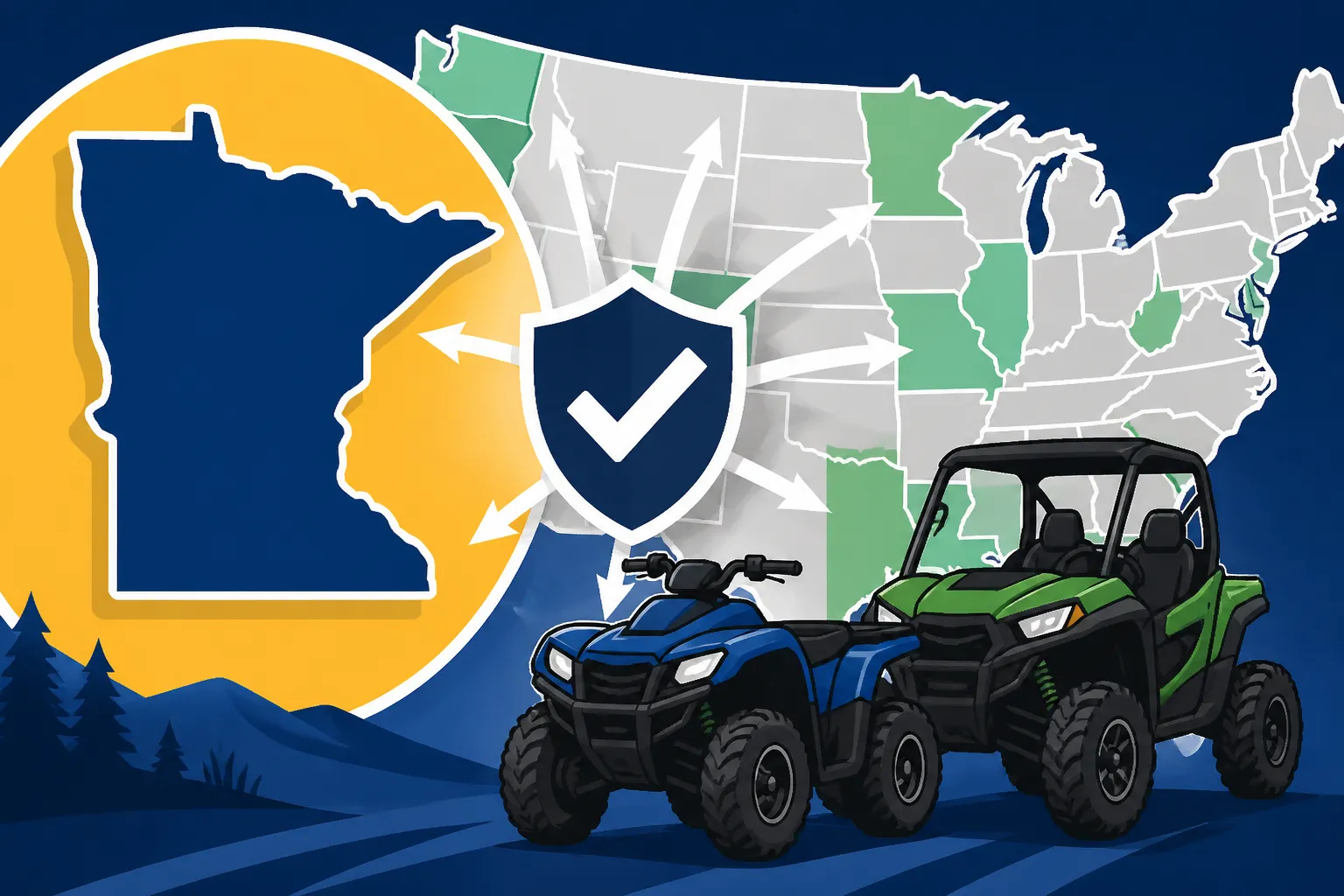
There is no single rule that makes a Minnesota registration valid for every purpose in every state. Reciprocity is not a universal pass. A state might recognize your home registration for operating on some public routes while still requiring a separate nonresident trail permit for its trails. Another destination may have different requirements based on machine type, where it is registered, or whether you are riding on public or private land.
It helps to separate four questions:
| Question | What Minnesota registration may help with | What you still need to check |
|---|---|---|
| Is the machine registered? | It documents registration in Minnesota | Whether the destination recognizes it or requires local registration |
| Can you ride a particular trail? | It may help establish the machine’s status | Trail passes, permits, closures, and vehicle eligibility |
| Can you operate on a road? | It does not make the machine street-legal everywhere | Local road rules, equipment, licensing, and route restrictions |
| Can you ride as a visitor? | It identifies the machine’s home registration | Visitor-specific rules, safety training, insurance, and age requirements |
Registration is also different from ownership paperwork. Keep your registration information available, but carry proof of ownership or purchase documents when appropriate, particularly if the machine was recently bought or its registration record is in transition. A registration decal alone may not answer every question an officer or land manager has about your machine.
The reverse situation is different, too. A machine registered in another state does not automatically meet Minnesota’s rules for riding here. If you are bringing a machine into Minnesota to use it, see Minnesota Registration for an Out-of-State Machine. Likewise, Minnesota’s visitor requirements are separate from a state’s recognition of your home registration; Minnesota’s Non-Resident ATV Trail Pass explains that distinction for riders coming here.
Why there is no blanket reciprocity
States regulate off-highway vehicles through their own statutes, agencies, land managers and trail systems. Registration systems may use different terms and vehicle categories. What Minnesota calls an ATV or a side-by-side may be classified differently elsewhere, and the classification can affect which rules apply.
A destination state may recognize a valid registration issued by another state but still require a separate permit to use a particular trail network. The permit may be tied to that trail system’s maintenance or access rules, rather than being another form of registration. A rider may therefore need both a Minnesota registration and a destination permit.
Other requirements can stand on their own:
- Trail access: A state forest, county forest, private trail network or organized riding area may have its own pass or entry rules.
- Safety certification: A destination may require training or certification for riders in certain age groups, even when the machine is registered elsewhere.
- Equipment: Helmet, lighting, noise, spark-arrester or passenger rules can differ by state and location.
- Road operation: Permission to use a road or roadside right of way is usually governed by the route’s local rules. Home-state registration does not grant general road access.
- Insurance: A registration card is not proof of liability coverage. Confirm whether insurance is required and what your policy covers away from Minnesota.
- Landowner permission: Private land access depends on permission and any conditions set by the owner.
This is why a simple question such as “Does the state accept Minnesota registration?” can have more than one answer. The state may accept it as evidence that the machine is registered, while a trail manager may still require a pass, and a town may prohibit ATVs on its streets.
The practical distinction is between vehicle registration and permission to ride. Registration concerns the machine’s status under a motor vehicle or off-highway vehicle system. Permission concerns where, when and how it may be operated. A registration can help with the first question without resolving the second.
For Minnesota riders, the most useful starting point is the specific destination, not a general list of states. Check the destination’s official off-highway vehicle agency and the manager of each trail or riding area. If your trip crosses more than one state or land system, verify each section separately. Reciprocity Minnesota Does Not Offer can help clarify why home registration and destination access should not be treated as interchangeable.
How to verify the rules before you travel
Use this process before you leave. It is more reliable than assuming a neighboring state follows Minnesota’s rules or relying on an old forum post.
- List the places you intend to ride. Write down the state, trail system, public land unit, town route or private riding area. “Riding in the state” is too broad to produce a useful answer.
- Identify your machine accurately. Note whether it is an ATV, side-by-side, utility vehicle or another off-highway vehicle, along with its width and seating arrangement. Have the registration number and vehicle identification number available if a rule depends on classification.
- Check the state’s official registration and visitor rules. Look for whether a visitor may use a valid out-of-state registration, must register locally, or needs a temporary permit. Read the rule for your specific vehicle category.
- Check each trail or land manager’s access requirements. Confirm whether a nonresident trail pass or day-use permit is required, where it must be displayed, and whether the route is open to your machine’s size and type.
- Review rider requirements. Check age limits, safety training, supervision, helmet and eye-protection rules. Do not assume Minnesota certification or age rules automatically satisfy another state’s requirements.
- Confirm road and crossing rules separately. If your route uses a public road, ditch, shoulder or street, verify that the particular route allows it. A trail map may show a connection without granting permission to ride every adjoining road.
- Check insurance and documents. Confirm your policy’s geographic coverage and any liability requirement. Bring registration proof, identification, ownership or purchase paperwork if relevant, and proof of permits.
- Recheck shortly before departure. Trail openings, closures, local ordinances and permit instructions can change. Confirm with the responsible agency or trail operator before you tow the machine.
Keep a note or screenshot of the official guidance and permit instructions with your trip materials. It is not a substitute for following posted signs or current orders, but it can help you remember what you checked and where a permit is required.
If you are traveling to a neighboring state, use destination-specific information rather than applying Minnesota rules by analogy. For Wisconsin, start with Taking a Minnesota Machine to Wisconsin. For North Dakota, see Taking a Minnesota Machine to North Dakota. These topics address state-specific questions that a general reciprocity answer cannot settle.
What to bring and common mistakes to avoid
Before the trip, make sure the information you carry matches the machine. Check that the registration is current and that the displayed decal or registration number is readable where required. If the machine has recently changed owners, resolve any paperwork questions before setting out; a sale document does not necessarily take the place of registration or a trail permit.
A compact travel file can include:
- Proof of Minnesota registration.
- Proof of ownership or a bill of sale if the machine was recently purchased.
- Any required destination permit or trail pass.
- The destination agency’s instructions on permit display and use.
- Insurance information, if applicable.
- A current trail map or route information from the land manager.
- Emergency contact details and a plan for areas with limited cell service.
The number or format printed on a Minnesota registration may not look like the format used by another state. That difference alone does not tell you whether the registration is accepted. For help identifying the Minnesota marking, see Minnesota Registration Number Format. For guidance on taking your machine across state lines by trailer, Trailering a Quad Across the Border covers practical transport considerations.
Common assumptions can turn a straightforward ride into a ticket, a denied trail entry or a long detour:
- “My registration is valid at home, so I can ride any public trail elsewhere.” Registration and trail access are separate. Check for local passes and restrictions.
- “A neighbor state must honor Minnesota’s rules.” Nearby states have their own systems. Verify the destination’s current requirements.
- “The state recognizes my registration, so the trail pass is included.” Recognition of registration does not necessarily include access fees or permits.
- “A trail map shows a route, so ATVs can use every connecting road.” Road access may be governed by separate state, county or municipal rules.
- “My machine’s classification is obvious.” A side-by-side or modified machine may fall under a different category in another jurisdiction. Check definitions rather than relying on its common name.
- “A Minnesota safety certificate covers me everywhere.” Training rules are not necessarily reciprocal. Confirm the destination’s age and certification requirements.
- “The information I used last season is still current.” Closures, permits and local rules can change. Recheck before each trip.
When official guidance is unclear, contact the state agency or the specific trail manager and describe your machine and route. Ask directly whether a Minnesota-registered visitor may ride there, whether a separate permit is needed, and what documents or equipment must be carried. Record the answer and the date you checked, then confirm again before the trip if conditions may have changed.
The short answer is that another state may recognize Minnesota registration for some purposes, but no broad assumption should replace checking the destination’s rules. Treat Minnesota registration as proof of home-state registration, then separately verify visitor permits, trail access, rider requirements, equipment, insurance and road permissions. For related Minnesota-side rules, see Riding a Minnesota Machine in Another State.
Disclaimer
This article is for general informational purposes only and does not constitute professional advice. Laws, prices and regulations vary by location and change over time. Consult a qualified professional for guidance on your specific situation.