Riding to a Minnesota Deer Camp
An ATV can make a Minnesota deer camp easier to reach, especially when the cabin, parking area, or hunting spot is far from a paved road. But a machine that gets you there is not automatically allowed on every trail, forest road, ditch, or hunting area. Plan your route around land access, registration and pass rules, hunting-season restrictions, and safe transport of firearms and harvested deer.
Plan a legal route to camp
Start by identifying the land you’ll cross—not just the final destination. A route may include private property, a public road right-of-way, a state forest, a designated trail, or a wildlife management area, and each can have different rules. Permission to hunt on a parcel does not necessarily mean you can ride an ATV across it.
For private land, get permission from the landowner before riding. Confirm which route is allowed, where you may park, and whether there are limits on riding during the hunting season. A neighbor’s field or a shortcut through a wooded parcel is not public access just because it seems convenient.
On public land, look for signs, maps, and current restrictions. Some routes are open to ATVs; others are limited to certain machine types, closed seasonally, or reserved for different uses. A public road also does not automatically mean you can ride its surface. Road-right-of-way rules and local restrictions matter, and a ditch route may be unavailable or unsafe in places. See Riding a Minnesota Deer Stand for hunting-trip access considerations, and Minnesota Rules on Wildlife Management Areas before planning to ride through or park near a WMA.
| Route or destination | What to check before riding |
|---|---|
| Private land | Get the landowner’s permission and confirm the route and parking location |
| State forest | Check the current forest map, signs, seasonal closures, and machine restrictions |
| Grant-in-Aid trail | Confirm that the trail is open and that your machine and pass status meet its requirements |
| Road right-of-way | Check state and local rules, road classification, signs, and whether the route is physically safe |
| Wildlife management area | Verify whether motorized access is allowed; do not assume that hunting access includes ATV access |
| Camp or cabin driveway | Confirm that you have permission to use the access road and that it connects legally to your planned route |
Registration and trail access are related, but they are not the same thing. A registration does not give you permission to ride on land that is closed to motorized use, and a trail pass does not override a trail closure. Requirements can depend on the machine, its registration status, where you are riding, and whether the route is a designated trail. Review Minnesota’s ATV Safety Training Requirement and Grant-in-Aid Trails and the Trail Pass, then confirm current requirements with the Minnesota DNR before you leave.
If your trip crosses more than one type of land, make a route plan rather than relying on a trail app alone. A mapped line can show where a trail appears to run, but it may not tell you whether it is open that day or whether the adjoining landowner permits access. Use current official maps and posted signs, and turn around if a route is marked closed or does not match your plan.
Check hunting-season and firearm rules
A deer-season ride needs two kinds of planning: the rules for operating the ATV and the rules for hunting. The fact that you are headed to camp does not suspend restrictions that apply during a firearm season, on public land, or in a particular area. Review Minnesota Rules During Firearm Deer Season and the current hunting regulations for the season and area where you will be staying.
Treat firearm transport as a separate issue from ATV access. Before setting out, check the current rules for transporting and carrying the firearm you plan to use, including requirements that may apply to how it is unloaded, secured, or handled. Do not rely on what is customary at another camp or on what your route has allowed in past seasons. Keep firearms secured during travel, and avoid handling them while mounting, dismounting, loading, or unloading the machine.
Build in time for low visibility and busy routes. Deer-season traffic can include trucks, trailers, farm equipment, hunters on foot, and other ATVs. Ride at a speed that gives you room to stop, keep to the authorized route, and make yourself visible without creating glare or distracting other riders. If the route includes a road crossing, stop and check carefully rather than assuming a vehicle will yield.
Age, training, helmet, and passenger requirements may also apply to riders in your group. Check the current rules for each rider rather than treating the group as a single case. A child who can handle the machine may still be subject to different legal requirements from an adult, and a passenger should ride only on a machine designed and equipped for passengers.
A camp plan should also set simple group expectations:
- Agree on the exact route and meeting point before leaving.
- Keep riders together at a safe pace, with a designated lead and sweep rider if the group is large.
- Do not ride after drinking or using impairing substances.
- Carry a charged phone or another communication option, while recognizing that coverage can be limited in remote areas.
- Share the camp location and expected return time with someone who is not on the ride.
- Stop and reassess if signs, trail conditions, or closures differ from what you expected.
Prepare the machine and camp access
A short ride to camp can still become a long wait if a tire goes flat, the battery fails, or a trail is blocked. Before departure, check the tires, brakes, lights, controls, fuel, and any belt or drivetrain components your machine requires. Carry basic tools and the repair items appropriate to your machine. For a remote route, a tire repair kit, air source, tow strap, and recovery gear can be more useful than packing extra accessories.
Pack for the conditions at camp, not just the weather at home. Minnesota fall weather can shift quickly, and a ride that begins in daylight may end after dark. Bring warm layers, rain protection, gloves, water, a first-aid kit, and a light source. Secure loose gear so it cannot fall into the trail or interfere with steering, brakes, or the rider’s movement.
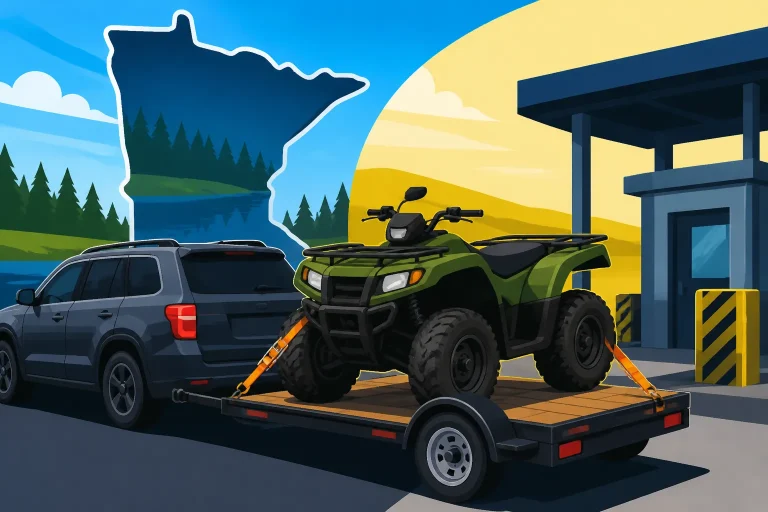
Before loading a machine, confirm that the trailer and tie-downs are suitable and that the ATV or UTV is secured for the trip. If you are riding directly from a staging area, make sure parking is allowed and that your vehicle and trailer will not block a gate, road, trailhead, or emergency access. A camp entrance may be narrow or muddy; check whether there is room to turn around without leaving the authorized route.
For a machine kept at camp, plan where it will be parked and how it will be stored when not in use. Keep keys and paperwork secure, and do not leave a machine where it blocks other campers or invites unauthorized use. If several people will ride it, confirm that everyone knows the controls and the route rules. A UTV’s cab and restraints do not make it appropriate to carry more occupants than the machine is designed for.
Pay attention to conditions on the route. Wet ground, early snow, fallen branches, and seasonal closures can change what is practical or allowed. Avoid widening a muddy trail, cutting around a barrier, or driving through vegetation to get around an obstacle. If the trail is blocked, turn back or use a verified legal alternate route. A shortcut that damages land can also put future access at risk.
Bring the deer back safely and legally
Plan the return trip before a deer is harvested. Decide where the machine can be parked, where the animal can be loaded, and which legal route leads back to camp or a processing location. This avoids last-minute decisions made in poor light or under pressure. For advice focused on moving a harvested animal, see Packing Out a Deer by Machine.
Use an appropriate rack, cargo area, or trailer, and secure the load so it cannot shift, drag, or interfere with the operator. Do not overload the machine or block its lights, controls, or visibility. A heavy or uneven load can affect braking and steering, particularly on wet leaves, mud, or uneven trail. If the animal will not fit securely, make another trip or use a different transport method.
Keep the route and destination in mind when deciding how to handle the animal. Hunting and transport rules can depend on the season, location, and circumstances. Follow current tagging, registration, and transportation requirements, and do not assume that a deer can be moved in any manner simply because it is being carried a short distance to camp. Check the current regulations before the hunt, especially if the camp is near a boundary, public land, or a road.
After the ride, clean mud and vegetation from the machine and check for damage. Remove any debris that could fall onto a trail or road, and report a blocked or damaged route through the appropriate land manager or trail contact. If the machine was used near a camp, cabin, or hunting area, park it so it does not obstruct access for other riders, hunters, or emergency vehicles.
A reliable deer-camp ride comes down to three decisions made ahead of time: where you are allowed to ride, what rules apply to your machine and riders, and how you will safely carry gear and game. Verify the route and current season rules before departure, then be ready to change plans if a closure, sign, or unsafe condition makes the planned route unsuitable.
Disclaimer
This article is for general informational purposes only and does not constitute professional advice. Laws, prices and regulations vary by location and change over time. Consult a qualified professional for guidance on your specific situation.