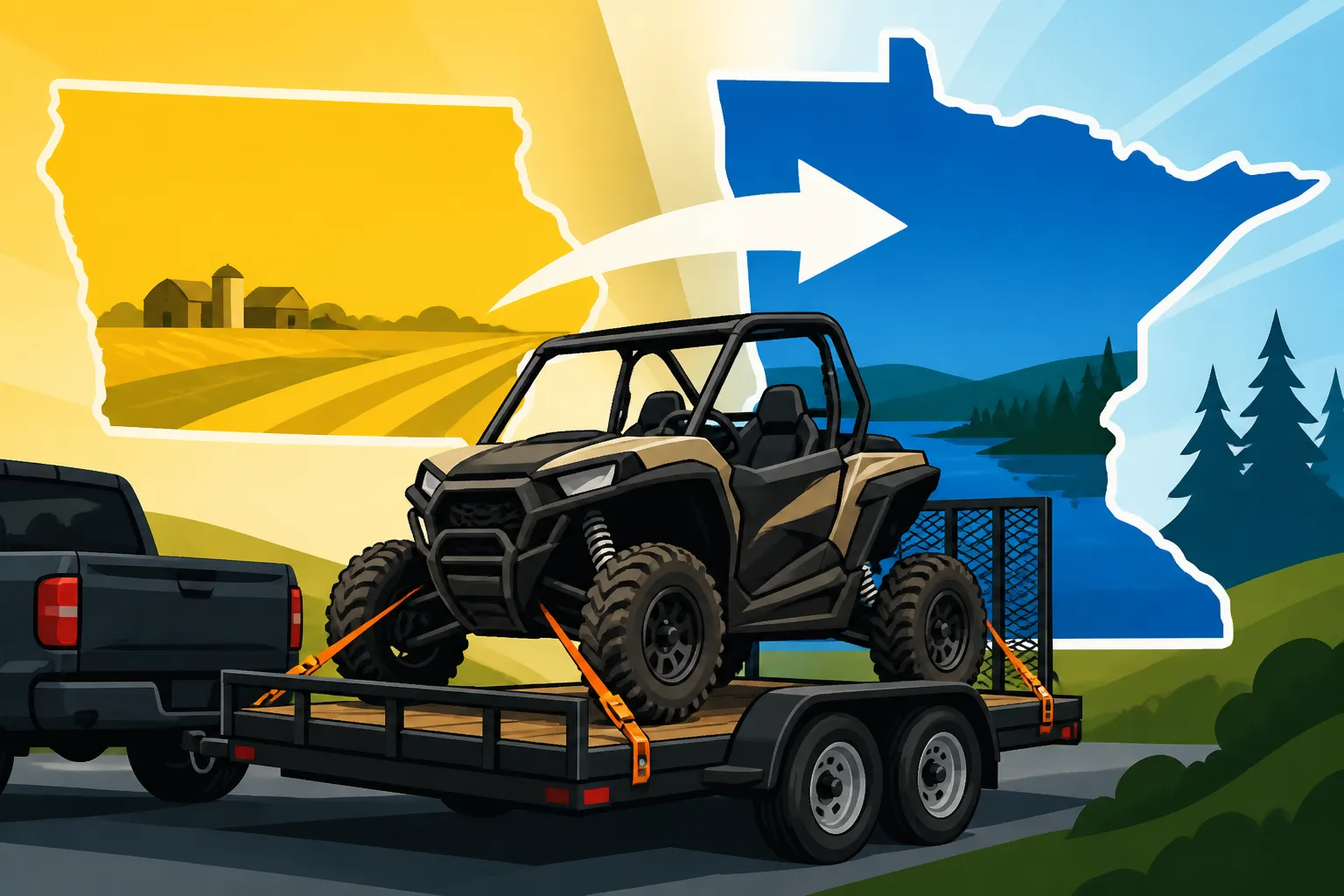
Bringing an Iowa Side-by-Side to Minnesota
Bringing a side-by-side from Iowa into Minnesota can feel like navigating a maze of paperwork and regulations, leaving many new or relocating owners scratching their heads about where to even begin. You've got your machine, you're ready to hit Minnesota's incredible trails or use it on your land, but you quickly realize that the rules aren't quite the same as they were across the border. This guide is here to demystify the process of registering your Iowa-purchased side-by-side in Minnesota, covering everything from the necessary documents to understanding tax implications and finding the right place to get it all done.
Understanding Minnesota's Registration Requirements for Out-of-State Machines
When you bring an off-highway vehicle (OHV) like your side-by-side into Minnesota from Iowa, it's not just a simple swap of license plates. Minnesota has its own system for tracking and regulating these machines, primarily through the Minnesota Department of Natural Resources (DNR) and its network of Deputy Registrars. The goal is to ensure that all machines operating on public lands, or even some private lands, contribute to trail maintenance and safety initiatives, and are properly identified in case of theft or accident.
Why Minnesota Cares Where Your Machine Came From
Minnesota's interest in where your machine originated isn't about being nosy; it's about establishing a clear chain of ownership and ensuring that any applicable taxes have been paid. Iowa's titling and registration laws, while similar in spirit, might have different specifics regarding proof of ownership, liens, and sales tax. When you bring your side-by-side to Minnesota, you're essentially integrating it into a new administrative system. This means proving that you legally own the machine, that any previous liens have been satisfied or properly transferred, and that Minnesota's sales or use tax obligations are met. Without proper documentation, it can be nearly impossible to get your machine registered for use here. This is especially true if you plan on riding on public trails, which absolutely requires a valid Minnesota registration and often a [Minnesota's Non-Resident ATV Trail Pass] if you're not fully registered here yet.
For Minnesota, the registration process serves several crucial functions. First, it creates a public record of ownership, which is vital for law enforcement and for potential buyers if you ever decide to sell the machine. Second, the fees collected from registration directly support the state's vast network of ATV and UTV trails through the Grant-in-Aid program, meaning your registration helps maintain the very trails you'll enjoy. Finally, it ensures that your machine meets basic identification requirements, making it easier to recover if stolen and helping authorities identify operators in case of incidents.
The Key Documents You'll Need to Gather
Before you even think about heading to a Deputy Registrar's office, you need to have your ducks in a row concerning documentation. Think of these papers as your machine's birth certificate, ownership history, and financial record all rolled into one. Having everything organized upfront will save you immense headaches and potential multiple trips.
The absolute bedrock document you'll need is the original Iowa Certificate of Title. This is the official proof of ownership in your name (or the name of the person you bought it from, with a proper transfer). If the Iowa title is still in the previous owner's name, it must be properly assigned to you, meaning their signature is required in the seller's section. Any errors or missing signatures here can bring your registration process to a screeching halt. Make sure the VIN on the title matches the VIN on your side-by-side exactly. You might also want to read up on [Minnesota Title Rules for an Off-Highway Vehicle] to understand Minnesota's specific expectations.
Beyond the title, a bill of sale is absolutely critical, especially if you purchased your side-by-side from a private party in Iowa. Even if you have the title, a detailed bill of sale clarifies the purchase price, date of sale, and confirms the identities of both buyer and seller. This document is crucial for calculating Minnesota's sales or use tax. For a smooth transaction, the bill of sale should include:
- The full names and addresses of both the buyer(s) and seller(s).
- The date of sale.
- A clear description of the side-by-side, including make, model, year, and the full Vehicle Identification Number (VIN).
- The agreed-upon purchase price.
- A statement that the machine is sold "as is" (or any other agreed-upon terms).
- Signatures of both the buyer(s) and seller(s).
If you’re unsure about what a proper bill of sale should entail, or if you need to create one for a transaction where the original is lacking, resources like LawDepot can offer templates that cover all the necessary legal bases. A well-drafted bill of sale, even for a private sale, offers legal protection and clarifies tax obligations. We also have a dedicated guide on [What a Minnesota Bill of Sale Should Carry] that can help ensure your document is up to snuff for Minnesota.
Finally, you’ll need proof of identity for yourself, usually a valid driver's license or state ID. If there are multiple owners, all owners typically need to be present with their ID, or have a notarized power of attorney for someone else to act on their behalf. You'll also need the odometer reading (if your side-by-side has one) and, of course, the funds to cover registration fees and any applicable taxes.
Navigating the Minnesota Sales Tax and Use Tax Landscape
One of the most common surprises for folks bringing an OHV into Minnesota from another state is the sales tax. Even if you paid sales tax in Iowa, Minnesota has its own rules, and you might still owe a "use tax" here. It's not a penalty; it's just how the state ensures a level playing field for everyone purchasing goods, regardless of where the transaction occurred.
Sales Tax on a Previously Titled Machine
Let's clarify the Minnesota sales tax situation. When you purchase an ATV or UTV from a licensed dealer in Minnesota, they're required to collect sales tax at the point of sale. However, when you bring a machine from out of state, especially if it was a private sale, the transaction often flies under the radar of Minnesota's Department of Revenue until you try to register it.
If you bought your side-by-side from a dealer in Iowa and paid Iowa sales tax, Minnesota may grant you a credit for the tax you've already paid. This is critical: you're generally not expected to pay sales tax twice on the same item. However, the credit is typically up to the amount you would have paid in Minnesota. If Iowa's sales tax rate was lower than Minnesota's, you would owe the difference to Minnesota. You'll need solid proof of the sales tax paid in Iowa, usually a line item on your dealer invoice or a receipt. Without that proof, Minnesota will assume you paid no sales tax and charge you the full amount.
For machines bought in Iowa from a private seller, it's a bit different. Iowa may or may not have collected sales tax on a private sale (depending on their specific laws and the timing of your purchase). Minnesota, however, does require sales tax on private sales. This leads us directly to the concept of use tax. For more details on this, you can check out [Sales Tax on a Private ATV Sale in Minnesota].
Calculating and Paying Minnesota Use Tax
The "use tax" is essentially Minnesota's equivalent of sales tax on items purchased outside the state but brought in for use within Minnesota. Its purpose is to prevent residents from avoiding Minnesota sales tax by simply buying high-value items in states with lower or no sales tax.
Here’s how it typically works for your Iowa side-by-side:
- Determine the Purchase Price: This is where your bill of sale is crucial. The stated purchase price is what Minnesota will use to calculate the tax. If no bill of sale is available, or if the price seems unusually low, the state might use an estimated fair market value.
- Calculate Minnesota's Sales Tax Rate: You'll apply Minnesota's current general sales tax rate to the purchase price.
- Credit for Out-of-State Tax: If you did pay sales tax in Iowa, subtract that amount (up to Minnesota's rate) from the calculated Minnesota tax.
- Pay the Remainder: The final amount is your Minnesota use tax, which you'll pay at the Deputy Registrar's office when you register the machine.
For example, if you bought your side-by-side for $8,000 in Iowa, and Minnesota's sales tax rate is currently 6.875%:
- Minnesota tax due = $8,000 * 0.06875 = $550.
- If you paid $400 in Iowa sales tax, your Minnesota use tax would be $550 – $400 = $150.
- If you paid $600 in Iowa sales tax (more than Minnesota's due), you would owe $0 to Minnesota (you don't get a refund for the difference).
- If you paid $0 in Iowa sales tax (as often happens with private sales), you would owe the full $550 to Minnesota.
It’s vital to have your proof of purchase and any sales tax paid in Iowa readily available. This will ensure you get proper credit and avoid paying more than necessary. The Deputy Registrar's office is equipped to handle these calculations and collect the use tax as part of the registration process. Detailed information about this process is available in our article [Minnesota Use Tax After an Out-of-State Buy].
The Step-by-Step Process for Minnesota Registration
Once you've gathered all your documents and have a clear understanding of the tax implications, it's time for the actual registration. This part of the process is handled by Deputy Registrars, who are authorized agents of the Minnesota DNR.
Finding Your Local Deputy Registrar
Unlike vehicle licensing, which is often handled by county service centers, ATV/UTV registration in Minnesota falls under the DNR. However, the actual processing of these registrations is typically outsourced to Deputy Registrars across the state. These offices are often found within local county service centers, some private businesses, or even certain license plate agencies.
The easiest way to find a Deputy Registrar near you that handles OHV registration is to visit the Minnesota DNR website or perform a quick online search for "Minnesota ATV registration Deputy Registrar" along with your city or county. It's always a good idea to call ahead to confirm their hours, what forms of payment they accept, and if they have any specific requirements for out-of-state machines. This simple call can save you a wasted trip, especially if you're coming from a distance. We've also compiled a helpful list of [Deputy Registrars That Handle ATV Registration] to get you started.
What to Expect at the Registrar's Office
When you arrive at the Deputy Registrar's office, be prepared for a fairly straightforward process, provided you have all your paperwork in order. Here's a general walkthrough:
- Present Your Documents: Hand over your Iowa Certificate of Title (properly assigned to you), your bill of sale, and your proof of identity. The clerk will review these documents to verify ownership, the VIN, and the purchase price.
- VIN Inspection: The Deputy Registrar may ask to physically inspect the VIN on your side-by-side, especially if it's an out-of-state machine. This is to ensure the VIN on your documents matches the machine, preventing fraud and ensuring accuracy. It's often recommended to bring your machine with you or at least know the exact location of the VIN (which is usually stamped on the frame).
- Complete the Application: You'll fill out a Minnesota OHV registration application form. This form will ask for basic information about you (owner details), your side-by-side (make, model, year, VIN), and how you intend to use it (public vs. private land, though public use is usually the default for registration).
- Calculate Fees and Taxes: The clerk will calculate the total amount due, which includes:
- Minnesota ATV/UTV Registration Fee: This is a set fee for a three-year registration period. The current amount is available on the DNR website.
- Minnesota Use Tax: As discussed, this will be calculated based on your purchase price and any tax paid in Iowa.
- Deputy Registrar Service Fee: A small, additional fee for the service provided by the Deputy Registrar.
- Payment: You'll pay the total amount. Most offices accept cash, checks, and often credit/debit cards, but always confirm payment options beforehand.
- Receive Your Registration and Sticker: Once everything is processed and paid, you'll receive your temporary registration document immediately. Your permanent registration card and the all-important decal (sticker) will typically be mailed to you within a few weeks. Make sure you understand [Where a Minnesota ATV Registration Sticker Goes] as correct placement is mandatory.
The process usually takes anywhere from 15 minutes to an hour, depending on how busy the office is and how complex your paperwork situation might be. Remaining patient and having all your documents organized will ensure the smoothest experience possible.
Special Considerations for Your Iowa Side-by-Side
Sometimes, the ideal scenario of having a perfectly signed title and a pristine bill of sale doesn't quite pan out. Life happens, and you might encounter a few bumps along the road when trying to register your machine.
When Iowa Paperwork Isn't Quite Enough
What if you bought your side-by-side in Iowa years ago, and the original title is long gone? Or perhaps you acquired it in a less formal transaction, and the bill of sale is just a handwritten note on a napkin? These situations, while not ideal, aren't necessarily insurmountable, but they will require extra effort.
- Lost Iowa Title: If the original Iowa title is lost, you'll need to apply for a duplicate title from the Iowa Department of Transportation (DOT) or the Iowa county treasurer's office where the machine was last registered. This process can take time and often requires you, as the current owner, to apply. If you're buying from a private seller in Iowa, insist they apply for a duplicate title before you finalize the sale, or accompany them to do so. Without a title, Minnesota has no way to confirm legal ownership, making registration impossible.
- Incomplete or Missing Bill of Sale: If your bill of sale is missing critical information, or you simply don't have one, this can complicate the tax calculation and ownership transfer. If possible, try to obtain a more complete bill of sale from the seller. If that's not feasible, you might need to create an affidavit of ownership or a new bill of sale detailing the transaction to present to the Deputy Registrar. For situations like this, utilizing online legal document services like LawDepot can be incredibly helpful for drafting a thorough and legally sound bill of sale that will satisfy Minnesota's requirements. These services provide templates that guide you through including all necessary details, giving you peace of mind. Our guide on [Registering a Minnesota ATV With No Ownership History] might offer additional insights for extreme cases.
- Discrepancies: Ensure all names, addresses, and especially the VIN, are identical across all documents. Even a single typo can cause delays. If you notice a discrepancy, try to get it corrected on the original document (e.g., a corrected bill of sale from the seller) before you visit the Registrar.
It's always better to over-prepare than to be caught off guard. If you have any doubts about your paperwork, it's wise to contact a Deputy Registrar's office ahead of time and explain your specific situation. They can often provide guidance on what alternative documents might be acceptable or what steps you need to take.
Registering a Machine Still Under a Loan
If you brought your Iowa side-by-side to Minnesota, and you're still making payments on it, your machine likely has a lien on its title. This means a bank or financial institution has a legal interest in your side-by-side until you pay off the loan. Registering a machine with a lien is a common occurrence, but it does add a layer of paperwork.
In Iowa, the lienholder (your bank) likely holds the original title or the lien is noted electronically. When you register in Minnesota, the Deputy Registrar will note this lien on your new Minnesota registration record. You'll need to provide the full name and address of your lienholder. The Minnesota DNR will then notify the lienholder that a Minnesota registration has been issued and that the lien has been recorded. This process is fairly standard, but it means you won't get a clear title from Minnesota until the loan is paid off. Once the loan is satisfied, your lienholder will send you a lien release, which you can then take to a Deputy Registrar to have the lien removed from your Minnesota record. You can find more information about this in [Liens on a Minnesota ATV Record].
It's a good idea to inform your lienholder that you are moving the machine to Minnesota and plan to register it there. They may have specific procedures or forms they require you to complete to acknowledge the new state of registration. Open communication with your bank can prevent any surprises down the line.
Here's a quick summary table of key documents for reference:
| Document Type | Purpose | Important Details |
|---|---|---|
| Iowa Certificate of Title | Proof of ownership transfer from seller to buyer | Must be original, properly signed by seller, VIN must match machine. |
| Bill of Sale | Confirms purchase price, date, buyer/seller details | Essential for use tax calculation; include make, model, VIN. Consider LawDepot templates for completeness. |
| Proof of Identity | Verifies the buyer's identity | Valid driver's license or state ID for all registered owners. |
| Proof of Iowa Sales Tax Paid | Provides credit for tax paid out-of-state | Dealer invoice or receipt clearly showing sales tax paid. Missing this means paying full MN use tax. |
| Lienholder Information | Records any outstanding loans on the machine | Full name and address of financial institution, if applicable. |
Disclaimer
This article is for general informational purposes only and does not constitute professional advice. Laws, prices and regulations vary by location and change over time. Consult a qualified professional for guidance on your specific situation.