Riding a Ditch Through a Construction Zone
Picture this: you’re enjoying a perfect Minnesota day, perhaps just cruising a familiar ditch route that usually offers easy access between trails or takes you into a small town for gas. Suddenly, the landscape changes – a jarring sea of orange cones, flashing lights, and heavy equipment blocks your path. It's a common and incredibly frustrating scenario for ATV and UTV riders across our great state, leaving you wondering where to go, what the rules even are, and if you’re suddenly breaking the law. This guide will help you understand the specific challenges and rules for navigating construction zones when riding your ATV or UTV in Minnesota ditches, ensuring you stay safe and legal.
The Reality of Riding Ditches in Minnesota
For many of us, ditch riding isn't just a convenient shortcut; it's a vital part of the Minnesota ATV and UTV experience. We rely on those roadside rights-of-way to connect to trails, reach gas stations, or simply enjoy a different kind of ride. But this privilege comes with responsibilities, especially when the unexpected throws a wrench in our plans.
Why Ditches Are Part of Our Riding Culture
Minnesota has a unique relationship with its ditch lines. Unlike many other states, our regulations allow for the use of ditches along most public roadways for ATV and UTV travel, with specific rules about which roads, which side of the ditch, and where you can cross. This network of accessible ditches acts as an informal grid, often bridging gaps between official trail systems or offering a direct route to that favorite bait shop on a lake. Riders often use these areas for quick trips, accessing hunting land, or simply to get from one point to another without having to trailer up. It's a practical solution for folks living in rural areas, and it adds immense value to our riding culture. You can learn more about the specifics of these rules in our guide to [Minnesota's Ditch Riding Rules].
The ease and convenience of ditch riding, however, often lead us to take these routes for granted. We develop a rhythm, a routine, and a sense of familiarity with the terrain. We know the soft spots, the culverts, and where to slow down. That predictability is shattered the moment you roll up on a major construction project, turning a routine ride into a maze of uncertainty.
The Unexpected Obstacle: Construction Zones
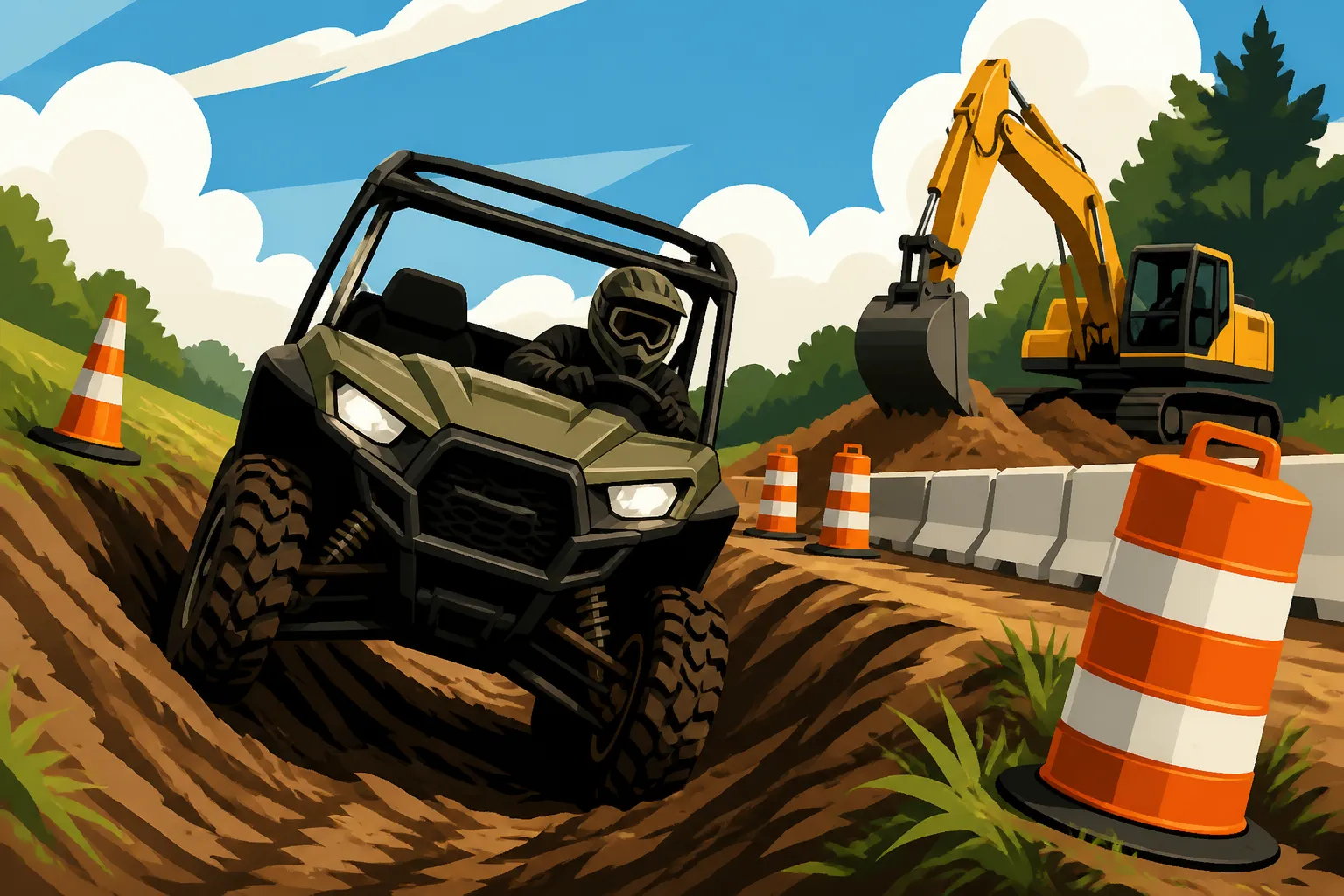
There are few things more deflating than planning a ride, only to find your usual path completely disrupted by a construction zone. Whether it's a road widening project, utility work, or bridge repair, these zones pop up with little warning for ATV/UTV riders. One day, it's an open ditch; the next, it's a trench, a pile of gravel, or a massive piece of excavating equipment. This isn't just an inconvenience; it can be genuinely dangerous and lead to legal trouble if not handled correctly.
The core frustration here is that construction planning, quite understandably, focuses on vehicular traffic. Detour signs are for cars and trucks, not usually for the specific needs of off-highway vehicles in the ditch. This leaves ATV and UTV riders feeling ignored and often forced into making quick, uncertain decisions about their route. The ground might be unstable, sharp debris could be hidden in the dirt, or there might be active work happening just out of sight. It's a stressful situation that demands a clear understanding of what you can and cannot do.
Navigating Minnesota's Rules for Construction Zones
Encountering a construction zone in a ditch isn't like encountering a closed gate on a trail. It's a dynamic, often hazardous environment with its own set of rules, many of which are implied rather than explicitly posted for ATV/UTV riders. Your primary goal must always be safety and adherence to the spirit of the law, even when specific signage for your machine is lacking.
Understanding Temporary Closures and Detours
When construction begins, the entire right-of-way, including the ditch, often becomes an active work area. This means that even if the ditch appears physically passable, it may be legally off-limits. Official signage for construction zones (the ubiquitous orange signs) serves as a broad warning that normal rules are suspended and heightened caution is required. While these signs are often aimed at road traffic, their presence generally indicates that the entire area, including the ditch, is under construction.
Temporary closures can be frustrating, especially if they block a crucial link in your route. It's imperative to respect all marked closures, even if they don't explicitly say "ATVs prohibited." Entering a clearly marked construction zone, even if just to cut through the ditch, can put you at risk of being cited for trespassing or for violating road closure statutes. Remember that even if you're not on the paved surface, you're still within the public right-of-way. It's a good idea to refresh your memory on rules like [Minnesota Rules on County Roads] and [Minnesota Rules on State Highways] to understand how these apply to rights-of-way during normal conditions, and how construction supersedes them. The bottom line is: if it's marked as a construction zone, assume the ditch is part of that zone and proceed with extreme caution, or better yet, find an alternate route.
Safety First: Hazards in a Construction Zone
The dangers within a construction zone are numerous and often hidden. It's not just about avoiding big excavators; there are many other risks:
- Uneven and Unstable Ground: Freshly dug earth, temporary fill, or disturbed soil can create unpredictable surfaces. Your machine could tip, sink, or lose traction unexpectedly. This is where having robust suspension components or skid plates, perhaps from a brand like SuperATV, might give you a false sense of security; no amount of armor can protect you from a sudden collapse or trench.
- Hidden Debris: Nails, rebar, broken concrete, discarded tools, and other sharp objects are common. These can puncture tires, damage undercarriages, or even cause severe injury if flung by your tires.
- Trenches and Excavations: Open trenches for utility lines or drainage work can be completely hidden by tall grass or loose soil. A sudden drop into one of these could result in serious injury or even death.
- Heavy Equipment: Cranes, excavators, dump trucks, and graders operate with massive blind spots. Operators are often focused on their immediate tasks and may not see a smaller ATV or UTV, especially in a ditch line. Never assume an operator sees you.
- Distracted Workers: Construction crews are focused on their jobs, not on recreational riders. They might not expect an ATV in an area they consider a workspace.
- Reduced Visibility: Dust, mud, and the sheer volume of equipment can obscure your vision and make it hard for others to see you. Consider wearing bright colors and ensuring your machine's lights are on, even during the day.
- Active Traffic: Even if the ditch is separate, you're still adjacent to active road traffic, which might be detouring or slowing down due to the construction, creating its own set of hazards.
If you decide to proceed through a construction zone (and only if it is clearly not actively blocked or signed as closed to all traffic, which is rare for ditches), you absolutely must slow to a crawl, remain alert, and be prepared to stop at a moment's notice.
When Detours Aren't Clearly Marked for ATVs
This is a common lament among Minnesota riders: official detours are almost always designed for cars and trucks. You might see a big arrow pointing passenger vehicles down a different highway, but what about your ATV in the ditch? There's rarely a sign saying, "ATV detour: follow the overgrown two-track three miles back." This lack of specific guidance can be maddening.
When a detour isn't clearly marked for ATVs, the safest and most responsible action is to assume the area is closed to all recreational use. Do not try to create your own detour through private property, unposted fields, or areas that look like they might be "close enough." This can lead directly to charges of [Minnesota Trespass Rules Along Ditches] or on private land, which can carry significant penalties.
Instead, if no clear, official ATV-specific detour is provided, you need to turn around and find an entirely different route. This might mean trailering your machine to bypass the section, or consulting a map for alternative trails or roads that allow ATVs. It's inconvenient, yes, but it's far better than risking your safety, legal trouble, or damaging someone else's property. Always err on the side of caution.
Practical Steps for Riders Facing a Construction Zone
Even with the best intentions, encountering a construction zone can throw a wrench in your day. Having a plan, both before you leave and when you're on the spot, can make all the difference.
Prior Planning and Pre-Ride Checks
The best defense against unexpected construction is proactive planning. Before you even load up your machine, make it a habit to do a quick check:
- Consult Online Resources: The Minnesota Department of Transportation (MnDOT) website often has up-to-date information on road construction projects. While it might not specifically mention ditch closures, if a major road is undergoing work, it's a good bet the adjacent ditch will be affected. Check county road department websites too, especially for smaller projects. Local ATV club forums or Facebook groups are also fantastic resources; often, fellow riders will post warnings about current closures they’ve encountered.
- Review Your Route: If you're using a GPS or mapping app, like one that runs on a tablet mounted with a robust SuperATV mount, zoom in on your planned ditch segments. Look for any recent satellite imagery updates that might show new road work. While not foolproof, it can sometimes offer clues.
- Have an Alternate Route in Mind: For any long or important ditch segment, always have a mental (or actual) backup plan. What's the next nearest trail? Is there a parallel gravel road you could legally take? Knowing your options beforehand reduces panic and bad decisions on the fly.
- Check Local Ordinances: Sometimes, small towns or counties have very specific rules about [Crossing a Minnesota Highway Safely] or riding certain roads. Construction zones might temporarily alter these or create new restrictions.
On-Site Decision Making
You've done your planning, but sometimes construction pops up overnight. Here’s how to handle it when you roll up on an orange-coned nightmare:
- Stop, Assess, Look for Signs: The moment you see construction ahead, slow down and stop at a safe distance. Don't barrel into the zone. Look for any official signage. Are there "Road Closed" or "No Trespassing" signs? Are there signs specifically for ATVs? If the entire area is clearly delineated as a work zone with barriers or cones, consider it closed.
- Observe the Activity: Are there workers present? Is heavy equipment actively operating? Is the ground being excavated? If there's active work, the area is too dangerous to enter.
- Is the Ditch Clearly Separate and Marked Open? In very rare cases, the road might be under construction, but the ditch line is clearly separate, undisturbed, and specifically not included in the fenced-off or coned-off work area, with no signs prohibiting passage. Even then, proceed with extreme caution, at walking speed, and be prepared to stop. This is the exception, not the rule.
- When in Doubt, Turn Back: If there's any ambiguity, if the ditch looks unsafe, or if there are no clear alternative ATV routes, turn around. It's frustrating to backtrack, but it’s the safest option. Trying to push through an unmarked or hazardous zone can lead to an accident, damage to your machine, or even fines. Remember, [Penalties for an Unregistered ATV in Minnesota] are just one type of citation an officer might issue for improper riding; others exist for reckless operation or ignoring lawful signs.
Communicating with Workers (When Appropriate)
In some situations, you might see a flagger or a worker at the edge of the construction zone. Is it okay to ask for directions? Generally, it's best to avoid distracting workers who are focused on safety and their tasks. However, if you see a worker who is clearly taking a break or seems approachable, you could briefly and politely ask if there's an official ATV detour.
Important Caveats:
- Do not interrupt active work. Heavy equipment operators especially need their full attention on their job.
- Keep your distance from machinery. Always assume they cannot see you.
- Respect their answer. If they say the area is closed or they don't know, don't argue.
- Do not rely on informal advice. A worker might give you a suggestion that inadvertently leads you onto private land or into a hazardous area. Always verify information yourself if possible.
It's better to consult official sources or use your own judgment than to put a worker in an awkward position or rely on potentially inaccurate information.
Equipping Your Machine for the Unexpected
While no amount of gear can override common sense or legal requirements, some accessories can certainly help you be better prepared for the unexpected twists and turns a construction zone might throw your way:
- GPS and Mapping Apps: A reliable GPS unit or a smartphone with offline maps (and a sturdy mount, like those offered by SuperATV) can be invaluable for finding alternative routes when your planned path is blocked. This allows you to quickly identify parallel roads or trails that might be open.
- Enhanced Lighting: Construction zones can be dusty, and visibility can be poor. Upgrading your machine's headlights and adding auxiliary lights (again, SuperATV offers many lighting solutions) can help you see and be seen, especially if you have to navigate through an area with reduced light or increased dust.
- Winch: A robust winch system can be a lifesaver if you accidentally get stuck in soft, unstable ground that's common in construction areas. While you should never intentionally drive into a risky area, accidents happen, and a winch can get you out of a bind without needing to call for help.
- High-Visibility Gear: Always wear bright clothing when riding near roads, but it’s especially crucial around construction zones. A bright orange or yellow helmet, jacket, or safety vest can make you more visible to heavy equipment operators and road traffic. This applies to passengers too, keeping in mind [Minnesota Helmet Rules for Riders Under 18] and [Eye Protection on a Minnesota Ride] for all riders.
- Basic Tool Kit and Tire Repair: Given the likelihood of sharp debris, having a tire plug kit and a portable air compressor can get you back on your way if you experience a puncture.
| Action | Do's | Don'ts |
|---|---|---|
| Before You Ride | Check MnDOT and county websites for road work. | Assume your usual ditch route is always open. |
| Plan an alternative route. | Rely solely on outdated maps or memory. | |
| When Approaching | Slow down immediately and stop at a safe distance. | Barrel into a construction zone without assessing. |
| Look for all orange construction signs and barriers. | Ignore signs because they don't specifically mention ATVs. | |
| In the Zone (If Open) | Proceed at a walking pace, stay alert for hazards. | Speed through, assuming you'll be seen. |
| Maintain maximum distance from equipment and workers. | Distract workers or drive too close to machinery. | |
| If Blocked/Unclear | Turn around and find an alternate legal route. | Create your own path through private property or hazardous areas. |
| Use GPS to reroute. | Argue with workers or law enforcement about access. | |
| Communication | Briefly and politely ask about official ATV detours during breaks. | Interrupt active work or demand access. |
| Safety Gear | Wear high-visibility clothing; use bright lights. | Ride without eye protection or a helmet (if required by age). |
| Carry a tire repair kit and a winch. | Underestimate the risks of unstable ground or debris. |
Encountering a construction zone on your favorite Minnesota ditch ride can be a real headache, disrupting your plans and raising questions about safety and legality. However, by understanding the rules, prioritizing safety, and preparing for the unexpected, you can navigate these challenges with confidence. Always remember that the ditch is a privilege, not an absolute right, and respecting construction zones is crucial for everyone's safety and for preserving our riding access for the future. Stay informed, stay safe, and keep those wheels turning legally!
Disclaimer
This article is for general informational purposes only and does not constitute professional advice. Laws, prices and regulations vary by location and change over time. Consult a qualified professional for guidance on your specific situation.