Where a Minnesota Trail Meets a Road
Navigating Minnesota's vast network of ATV and UTV trails is an incredible experience, offering everything from dense forest paths to open plains. But let's be real, a common headache for many riders comes when that perfect trail suddenly spits you out onto a paved or gravel road. It's confusing, potentially dangerous, and raises a lot of questions about what's legal and what's not. This guide will meticulously break down the rules and best practices for those moments when a Minnesota trail meets a road, helping you ride safely and stay on the right side of the law.
Understanding the Minnesota Landscape of Trails and Roads
Minnesota boasts thousands of miles of incredible OHV trails, thanks in large part to the dedicated work of the DNR and countless local clubs. However, our state is also crisscrossed by an extensive system of public roads, from quiet township roads to bustling state highways. These two worlds, the off-highway and the on-highway, inevitably meet, creating unique challenges for riders.
The Inevitable Crossroads: Why Trails and Roads Meet
Think about it: trails need to connect. They need to get from one section of public land to another, bypass private property, or provide access to essential services in towns. Sometimes, the most practical, or even the only, way to maintain a continuous trail system is to use a road right-of-way, cross a road, or temporarily share a section of roadway. This isn't just a Minnesota thing; it's a reality for trail systems everywhere. As riders, we want those long, uninterrupted loops, and it can be frustrating when a perfectly good trail ends abruptly at a paved road, leaving us to wonder, "Now what?" It's not always intuitive, and simply trying to follow the path of least resistance can lead to trouble. The goal here isn't to impede your fun, but to ensure everyone's safety and protect future riding opportunities by adhering to the rules in these critical transition zones.
The Legal Framework: What Minnesota Law Says Generally
At its core, Minnesota law treats ATVs and UTVs as off-highway vehicles. This means that, by default, they are not street legal for general road use. The pavement, the gravel, the shoulders – these are typically reserved for registered, street-legal vehicles. This is a crucial distinction and the baseline from which all exceptions are carved out. When a trail meets a road, the presumption is that you cannot simply continue riding on the road surface as if it were an extension of the trail. Any deviation from this general rule, such as crossing a road or riding on a designated route, is a specific exception that comes with its own set of detailed requirements. Ignoring this fundamental principle is how many riders inadvertently find themselves in violation, often facing fines or worse. It’s important to familiarize yourself with [Minnesota Penalties for an Unregistered ATV in Minnesota] and similar rules, as being unprepared can quickly ruin a good ride.
Navigating the Intersection Itself: What to Do and Look For
When your tires transition from dirt or gravel trail to the edge of a road, it's not a moment for assumption; it's a moment for attention. Minnesota has clear guidelines for how you should approach and execute these crossings.
Identifying a Designated Crossing or Route
The first and most important step is to understand if you're approaching a designated crossing or a section of road where ATV use is specifically permitted. You'll generally find clear signage indicating these areas. Look for official DNR signs, often orange or brown, with ATV symbols and directional arrows. Some signs might explicitly say "ATV Crossing" or "Shared Roadway." These signs are your best friend, signaling that you are on an approved part of the system. Without them, assume the road is off-limits. Trail maps, especially those from the DNR or reputable mapping apps, will also mark these crossing points. Never assume a well-worn path leading onto a road is an official crossing; it could be an illegal shortcut or merely an access point to private property. This is where your pre-ride planning, including studying maps and understanding [Reading a Minnesota OHV Trail Map], really pays off.
Safety Protocols at Road Crossings
Even at a designated crossing, safety is paramount. You are sharing space with faster, heavier vehicles that may not expect to see an ATV. Always approach the road cautiously.
- Stop: Come to a complete stop before entering the road or even the shoulder. Treat it like a stop sign.
- Look Both Ways: Check for oncoming traffic in both directions. Remember that vehicles, especially on rural roads, can approach at high speeds.
- Listen: Even if you can't see, you might hear approaching vehicles, especially larger trucks.
- Yield to Traffic: You must yield to all vehicles on the road. They have the right-of-way.
- Cross Perpendicularly: If you're crossing a road from one trail segment to another, do so at a right angle to the road. Do not ride alongside the road for any distance unless it's a clearly marked shared route. Get across as quickly and safely as possible.
- Avoid Impeding Traffic: Don't stop or linger on the road. Once you've confirmed it's safe, cross efficiently.
Think about how different your machine is from a car. Your visibility might be lower, and your maneuverability on pavement can feel different than on dirt. It's an important transition that requires a shift in your riding mindset. This is particularly critical when you might be [Stopping Where a Minnesota Road Crosses a Trail].
The "Ditch Riding" Conundrum and Intersections
Minnesota's ditch riding rules are a unique aspect of our state's OHV landscape. Many rural roads allow ATVs and UTVs to operate in the road ditch or right-of-way, subject to specific conditions. However, even when you're legally riding in the ditch, intersections with other roads, driveways, or even bridges can change the rules. You can't just power through an intersection while in the ditch. At road intersections, the ditch riding privilege often ends, and you must follow the same crossing rules as if you were coming directly off a trail. You still need to stop, yield, and cross safely. Also, remember that ditch riding is distinct from riding on the actual road surface. [Minnesota's Ditch Riding Rules] specifically prohibit riding on the paved or graveled surface except for very limited, specific exceptions.
Riding On the Road: Designated Routes and Exceptions
While generally prohibited, there are specific, legally defined situations where a Minnesota ATV or UTV can operate on a road. These exceptions are critical for connecting trail systems and accessing community services.
Officially Designated ATV Routes and Town Access
Many Minnesota counties and towns have recognized the value of OHV tourism and have established designated ATV routes on local roads. These are often smaller, less traveled township or county roads, or specific streets within a town. The purpose is typically to connect trails, allow riders to access gas stations, restaurants, or lodging, or provide a way around obstacles on the trail system. These routes will always be clearly marked with signs indicating ATV use is permitted. Without these signs, assume the road is off-limits. When riding on these designated routes, remember you are sharing the road with cars, trucks, and farm equipment. All normal traffic laws apply, including speed limits, stop signs, and yielding. Consider adding accessories that improve your visibility and safety when operating on these routes. SuperATV offers a range of lighting upgrades, mirrors, and even turn signal kits that can significantly enhance your machine's street-readiness, even if it's only for short, designated sections. This extra gear is a smart investment, providing peace of mind when you're riding through [Minnesota Cities That Allow ATVs on Streets] or navigating [Riding Into a Minnesota Trail Town].
Hazardous Exceptions: Bridges and Culverts
There's a specific and very important exception to the "no road surface" rule that applies to bridges and culverts. If the ditch or shoulder becomes impassable or unsafe due to a bridge, culvert, or similar obstruction, Minnesota law generally allows you to briefly ride on the far right portion of the paved or graveled road surface to safely bypass that hazard. The key here is "briefly" and "safely." You must minimize your time on the road surface, stick to the far right, and immediately return to the ditch or shoulder once the hazard is passed. This isn't an invitation to cruise the bridge; it's a safety measure. Always be hyper-aware of traffic when exercising this exception. Riders need to be cautious when [Riding Over a Minnesota Bridge] or [Passing a Culvert on a Minnesota Ditch Ride].
Staying Prepared: Gear and Awareness
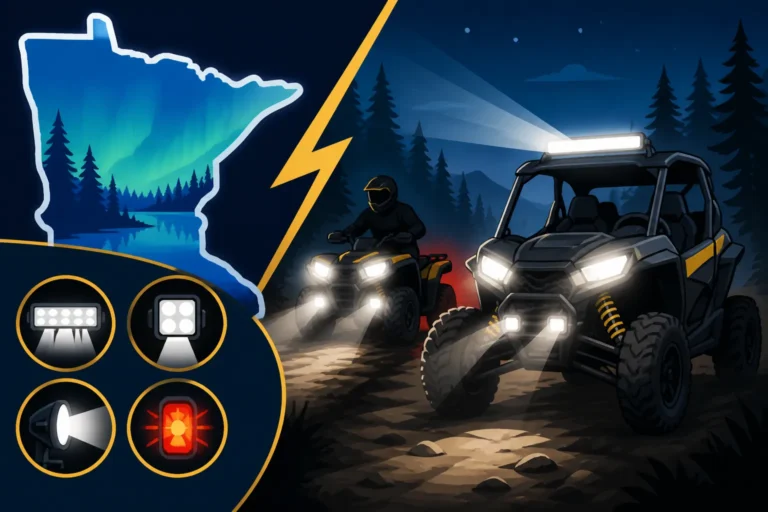
Whenever you're interacting with roads, whether crossing them or riding on a designated route, heightened awareness is essential. Your machine needs to be as visible as possible. Brightly colored riding gear, a visible helmet, and working headlights and taillights are non-negotiable. For those riding in ditches or on designated road routes, especially around dawn, dusk, or in adverse weather, a [Whip Flag for a Ditch Ride] or reflective tape on your machine can significantly improve how other motorists see you. Investing in additional lighting, like auxiliary LEDs or enhanced brake lights, is another smart move. SuperATV provides various high-quality lighting solutions that can make your machine much more noticeable to others, adding a layer of safety that could be invaluable in a split second. Remember, when you're on or near a public road, you're not just riding for yourself; you're riding for everyone else's safety too.
Common Pitfalls and Staying Legal
Despite the clear rules, it's easy to make mistakes at the intersection of trails and roads. Understanding common pitfalls can help you avoid fines, accidents, and damaging the reputation of the OHV community.
Misinterpreting "Crossing" vs. "Riding"
This is perhaps the most common misunderstanding. A "crossing" is a brief, direct movement from one side of a road to the other, or from a trail onto a designated ditch. "Riding" on the road surface, however, implies traveling along it for any significant distance. The only exceptions for riding on the road surface are the aforementioned hazardous bypasses (bridges/culverts) or on roads explicitly designated as ATV routes by local ordinance. Many riders see a clear, empty road and think, "Just a quick hop down to the next trail." But this "quick hop" is illegal unless specifically designated. The temptation to take a shortcut on a road, even for a short distance, can lead to serious legal consequences, including [Minnesota Fines for Illegal Road Riding]. It's not worth the risk, both legally and for your personal safety.
The Role of Signage and Maps
Always, always rely on official signage and up-to-date maps. Don't rely on word-of-mouth or what you think might be allowed. Signage can change, and routes can be temporarily closed. [Checking Minnesota Trail Status Before You Drive] is a crucial step for any ride. The Minnesota DNR provides excellent resources, including maps that clearly delineate where ATVs are allowed, where trails cross roads, and where designated road routes exist. Many GPS apps and devices also offer OHV-specific maps, but make sure they are current and official. Carrying a [Paper Map in the Northwoods] is always a good backup, especially in areas with spotty cell service. For easy access to your navigational tools, consider mounts and holders for your GPS or phone from SuperATV. Having your map readily visible and securely mounted can prevent missed turns or accidental ventures onto prohibited roads.
Always Ride Registered and Insured
Even on public roads that are designated as legal ATV routes, or when making a brief, legal crossing, your machine still needs to be properly registered with the Minnesota DNR and you should carry appropriate insurance. Just like a car on the highway, an ATV on a designated road route is subject to enforcement. An unregistered machine, even if ridden legally in the ditch, can lead to a citation. Make sure your registration is current and visible, and that you understand your insurance coverage. [Registering an ATV in Minnesota] and [Insuring an ATV in Minnesota] are fundamental responsibilities for every rider, providing protection not just for you but for others should an unfortunate incident occur.
Road and Trail Interaction Rules in Minnesota
| Situation | General Rule | Key Requirements |
|---|---|---|
| Trail Crosses Road | Must stop, yield to all traffic, cross perpendicularly and immediately. | Look both ways, listen, cross efficiently, adhere to traffic laws. |
| Riding in Road Ditch | Generally permitted on shoulders or ditches of public roads (except Interstate/controlled access highways). | Stay on far right, follow posted speed limits, yield to traffic, lights required at night. |
| Hazardous Road Surface | May briefly ride on far right portion of road surface to bypass impassable bridge, culvert, etc. | Minimize time on road, immediate return to ditch/shoulder, extreme caution with traffic. |
| Designated ATV Road Route | Permitted on specific roads or streets designated by local ordinance/signs. | Follow all traffic laws (speed, stop signs), yield to traffic, observe road signs, requires proper registration/insurance. |
| Non-Designated Road Use | Prohibited to ride on the paved or graveled surface of most public roads. | No shortcuts, no cruising; penalties for illegal operation. |
Disclaimer
This article is for general informational purposes only and does not constitute professional advice. Laws, prices and regulations vary by location and change over time. Consult a qualified professional for guidance on your specific situation.