Sharing a Road With Farm Equipment
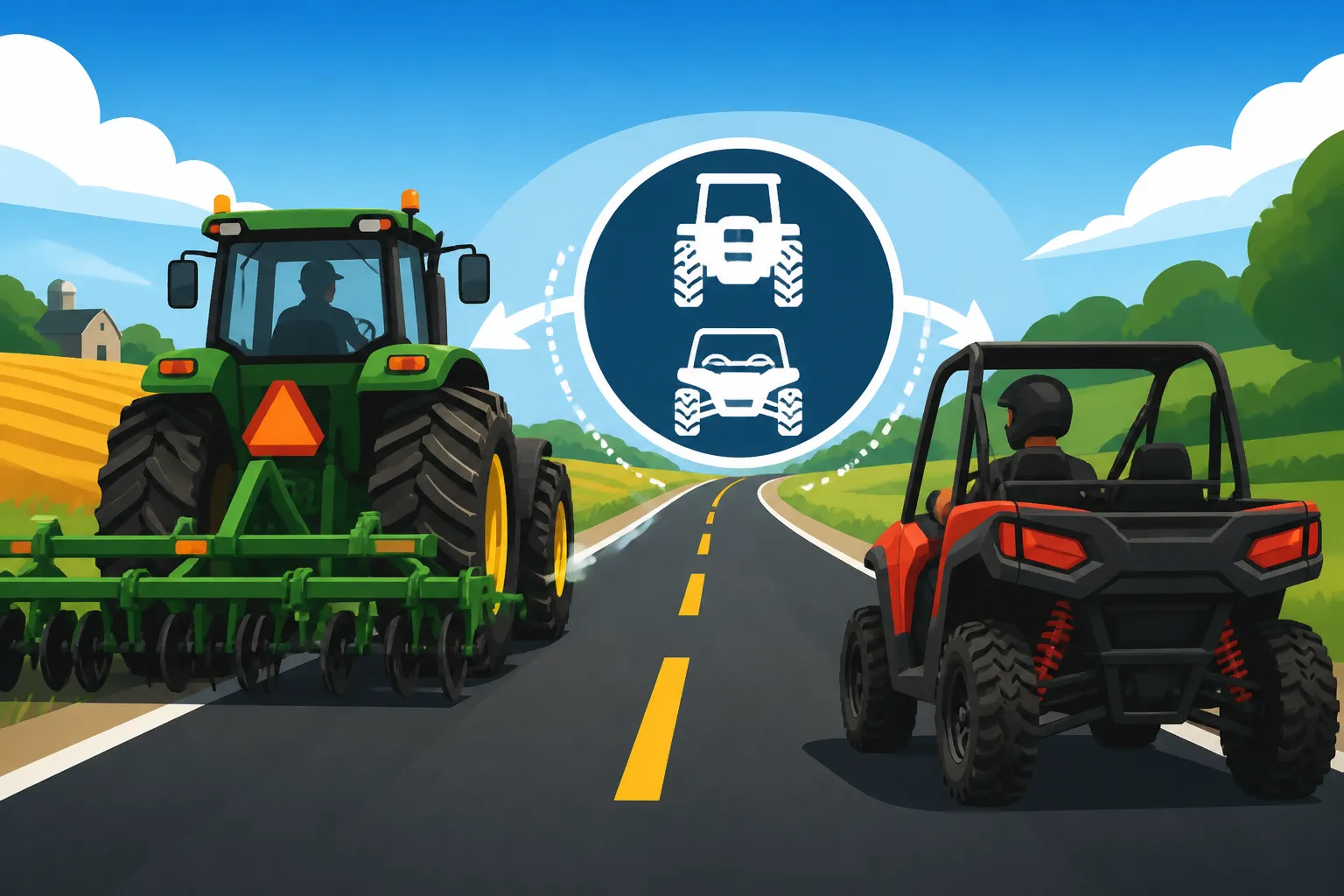
There's nothing quite like hitting the open road, or at least the ditch beside it, on your ATV or UTV in Minnesota. The fresh air, the feeling of freedom, the rolling landscapes – it’s what we live for. But then, you crest a hill or round a bend, and there it is: a massive combine, a tractor pulling a planter, or a sprayer filling the entire lane, moving at a snail's pace. This guide is all about navigating those encounters safely and respectfully, ensuring everyone gets where they're going without incident on our shared rural roads.
Navigating Rural Roads: The Reality of Sharing with Farm Equipment
Riding in Minnesota's beautiful rural areas means you're almost guaranteed to share the road with agricultural vehicles at some point, especially during planting and harvest seasons. It's a unique challenge, because farm equipment operates very differently from your average passenger car – or your ATV or UTV, for that matter. The key is to understand these differences and adjust your riding to ensure everyone's safety.
The Slow and Wide Realities of Farm Vehicles
Let's be real: farm equipment is big, it's slow, and it often takes up a lot more space than just one lane. We're talking about vehicles that can be over 10 feet wide, with implements extending even further. These machines are designed for efficiency in the field, not for zipping down a two-lane highway. Their top speeds are often significantly lower than the posted speed limit, meaning you're going to encounter a major speed differential.
This isn't just an inconvenience; it's a safety factor. A tractor moving at 20 mph on a 55 mph road creates a situation where other vehicles close the distance very rapidly. For us on ATVs and UTVs, whether we're in the ditch or briefly on the shoulder to cross a bridge, this means we need to be acutely aware of their presence. Farmers are often on tight schedules, moving from field to field, and they rely on these public roads to do their work. It’s part of the landscape here in Minnesota, and understanding their operational needs helps us ride more safely around them. [Minnesota's Ditch Riding Rules] often put us in direct proximity to these slow-moving giants.
Visibility Challenges for Both Sides
Visibility is a two-way street, and it’s a big deal when you’re sharing the road with farm equipment. From the perspective of a farmer high up in a combine cab, a low-profile ATV or UTV in the ditch or on the shoulder can be incredibly hard to see. They have massive blind spots, especially directly in front of and behind their equipment, as well as to the sides due to the sheer width of their machines and any attached implements. Their focus is often on the road ahead and navigating the sheer size of what they're driving.
Conversely, for us on ATVs or UTVs, it can be tough to see around or even clearly identify the intentions of the farm equipment operator. Are they turning? Are they slowing to pull into a field? Are they just crawling along? All that equipment can obscure brake lights or turn signals. Combine this with dust on a dry rural road or sun glare, and the situation becomes even trickier. This challenge highlights why proactive defensive riding and ensuring your own machine is highly visible are so crucial. It’s not just about what you see, but what they see of you, too.
Safe Riding Strategies When Encountering Farm Machinery
When you come across farm equipment on Minnesota's rural roads, your immediate goal should always be safety for everyone involved. This means slowing down, being predictable, and making your presence known. Don't assume the farmer sees you, and don't expect them to anticipate your moves.
Approaching and Following with Caution
The moment you spot farm equipment ahead – whether it's through the dust cloud, the flashing amber lights, or just the sheer size looming in the distance – your instinct should be to back off. Reduce your speed significantly, especially if you're approaching from behind. These vehicles can stop, turn, or suddenly slow down for field entrances without much warning, or their signals might be hard to see. Maintaining a generous following distance gives you ample time to react.
Think of it like this: if you're following a regular car, you might leave a few car lengths. With farm equipment, you should at least triple that distance, especially if they have wide implements that could swing out unpredictably. If you're riding a UTV that's capable of keeping up with traffic, it's easy to get complacent, but even a side-by-side looks small next to a tractor. Avoid riding in their blind spots, which are usually directly behind or to the sides of their massive tires or implements. If you're on a multi-rider trip, make sure everyone in your group understands the need to create a safe buffer zone. [Speed on a Minnesota Road Right of Way] is important to consider, especially when closing in on slower vehicles.
Making a Safe Pass (or Deciding Not To)
Deciding whether to pass farm equipment is one of the most critical decisions you'll make on a rural road. Often, the safest choice is simply to be patient and wait for the equipment to turn off the road or pull over when it's safe for them to do so. Farmers are usually aware they're holding up traffic and will often try to accommodate when they can.
If you decide a pass is absolutely necessary and safe, here’s the drill:
- Wait for a Clear View: You need a long, unobstructed view ahead. No blind curves, no hills, no intersections.
- Signal Clearly: Use hand signals or your machine's turn signals to indicate your intention to pass. This is crucial as their mirrors might not catch your position.
- Pass Quickly and Decisively: Once you commit, execute the pass as efficiently as possible, but never exceed the speed limit.
- Allow Ample Clearance: Give the farm equipment a wide berth. Remember, those implements stick out! Many pieces of machinery are far wider than their wheels.
- Check for Left Turns: This is a huge one. Many farm accidents happen when a vehicle tries to pass a tractor that is simultaneously making a wide left turn into a field. Watch for the front wheels turning left, or the operator's head checking over their left shoulder. If there's any doubt, don't pass.
Remember, if the shoulder or ditch isn't suitable, you're likely on the main road and subject to traffic laws. Never pass in a no-passing zone, or on the right shoulder unless it's explicitly allowed and safe. [Crossing a Minnesota Highway Safely] highlights the general caution needed on major roads.
Enhancing Your Machine's Visibility
Given the challenges of seeing and being seen, anything you can do to make your ATV or UTV more noticeable is a win. Farmers have those bright orange slow-moving vehicle triangles, and we should take a cue from that.
Consider adding extra lighting to your machine, particularly on the rear, that's visible even in bright daylight. Bright, flashing amber lights can really grab attention. Companies like SuperATV offer a range of aftermarket lighting solutions, from LED light bars to supplemental brake lights, that can make a huge difference in your visibility to others on the road. Reflective tape on your fenders or helmet can also help, especially in low light conditions.
Wearing brightly colored gear, like a neon vest or helmet, makes you stand out. While [Eye Protection on a Minnesota Ditch Ride] is critical for your own safety, making sure your gear is also visually loud adds another layer of protection. This isn't about being flashy; it's about being seen and staying safe when sharing the road with huge, slow-moving equipment.
Understanding Farm Equipment Rules and Signals in Minnesota
Just like we have rules for riding our ATVs and UTVs, farm equipment also operates under specific regulations when on public roads. Knowing these can help you anticipate their movements and understand why they might be doing what they’re doing.
Minnesota's Rules for Farm Equipment on Public Roads
Minnesota law recognizes the essential nature of farm equipment and provides for its operation on public roadways, though with certain requirements designed to enhance safety. Typically, farm vehicles are exempt from many standard vehicle registration requirements (though not always if they are used for other purposes, like a UTV used for non-farm work). However, they generally are required to display a slow-moving vehicle (SMV) emblem, which is that bright orange triangle with a red border. This emblem is a universal sign that the vehicle is traveling 25 mph or less.
Beyond the SMV sign, farm equipment often needs specific lighting, especially during nighttime or low-light conditions. This typically includes headlights, taillights, and often amber flashing warning lights that indicate a wide or slow vehicle. They are usually required to operate as far to the right of the roadway as practicable. When they cross the centerline for a wide turn, it’s not because they’re being careless; it’s often a necessity due to the size of their equipment. Understanding these nuances helps us ride with more patience and fewer surprises. [Minnesota Rules for Farm and Utility Machines] goes into more depth on these exemptions and requirements.
Deciphering Operator Signals and Intent
Farmers, for the most part, are trying to be as safe and cooperative as possible. When you approach farm equipment, watch the operator. They might use traditional hand signals to indicate turns or to wave you around when it's safe. However, due to the height and cab configurations, these signals might be harder to see or might not be perfectly clear.
| Signal | Meaning | What to Look For |
|---|---|---|
| SMV Emblem | Vehicle traveling 25 mph or less | Bright orange triangle with red border |
| Amber Flashers | Slow-moving or wide load, proceed with caution | Flashing yellow lights, often on extremities |
| Hand Out Window, Down | Slowing down or stopping | Hand extended downward, palm to the rear |
| Hand Out Window, Up | Right turn (less common for large equipment) | Hand extended upward at a 90-degree angle |
| Hand Out Window, Straight | Left turn (critical to watch for) | Hand extended straight out, parallel to the road |
| Waving Motion | Often an invitation to pass (if safe for them to pull over or proceed) | Watch for the farmer making eye contact and waving you around |
Always prioritize the physical movement of the equipment over a potentially misinterpreted hand signal. If the front wheels of a tractor are starting to turn left, for instance, do not pass on the left, even if you think you saw a wave to proceed. Their intent to turn often takes precedence over any other signal. Clear, decisive actions on your part, combined with vigilance, are your best tools.
Fostering Mutual Respect on Minnesota's Rural Routes
Ultimately, sharing the road with farm equipment comes down to mutual respect and understanding. Rural roads are vital to both the agricultural community and recreational riders like us. By being considerate, we can all contribute to a safer environment.
The Importance of Patience and Communication
Patience is probably the single most important tool in your arsenal when encountering farm equipment. You might be in a hurry to get to the next section of trail or to the ice fishing spot, but forcing a pass or getting impatient won't get you there faster if it causes an accident. A few extra minutes of waiting can prevent a lifetime of regret. Remember that these farmers are working to feed us, and their livelihood depends on moving their equipment safely.
While direct communication might be hard on the road, your actions speak volumes. A polite nod or wave to the farmer when you safely pass (or when they pull over for you) can go a long way. They often appreciate riders who are careful and respectful. Conversely, aggressive driving or risky passes not only endanger everyone but can create negative impressions of ATV and UTV riders as a whole. Let's aim to be good ambassadors for our sport. [Minnesota Fines for Illegal Road Riding] are a stark reminder of the consequences of impatience.
When a UTV Is the Farm Equipment
It's also worth remembering that sometimes, your UTV might actually be the farm equipment! Many farmers use their side-by-sides for a multitude of tasks, from checking fences to hauling feed. These machines are incredibly versatile. If you're using your UTV for agricultural purposes, you might find yourself needing to operate it on public roads to get from one field to another, just like larger farm machinery.
When your UTV is doing farm work, it falls under some of the same rules and expectations as a larger tractor. This means ensuring you have your slow-moving vehicle emblem displayed, proper lighting, and operating as far to the right as possible. For those using their machines to [Plowing a Minnesota Driveway With a Machine] or for other utility tasks, you'll want to be extra mindful of road safety. Even if you've kitted out your UTV with SuperATV accessories like a winch or a cargo bed for farm tasks, you're still part of the traffic flow and need to prioritize safety and visibility. [Using a Side-by-Side for Farm Work on a Road] is a fantastic resource to explore this specific scenario in more detail. By understanding both sides of the coin – being the recreational rider and potentially the utility operator – we can all contribute to safer and more harmonious road sharing in Minnesota.
Disclaimer
This article is for general informational purposes only and does not constitute professional advice. Laws, prices and regulations vary by location and change over time. Consult a qualified professional for guidance on your specific situation.