Registering a Homemade Frame
Building your own ATV or UTV frame from scratch? That's a truly ambitious and exciting project! But let's be honest, the dream of fabricating your perfect off-road machine can quickly turn into a bureaucratic headache when it's time to make it street-legal (or, more accurately, trail-legal) in Minnesota. This guide is here to walk you through the often-confusing process of registering a homemade frame in the North Star State, ensuring your custom creation can hit the trails legally and without a hitch.
The Unique Challenge of a Homemade Frame in Minnesota
When you're dealing with a factory-built ATV or UTV, the manufacturer takes care of a lot of the initial identity work for you. They assign a Vehicle Identification Number (VIN), provide a Manufacturer's Statement of Origin (MSO), and generally pave the way for a smooth registration process. A homemade frame, however, skips all those convenient steps. It's essentially a blank slate, and the Minnesota Department of Natural Resources (DNR) and deputy registrars need to establish its identity from the ground up. This isn't just about paying fees; it's about proving legitimate ownership, ensuring safety, and getting a unique identifier for your pride and joy.
Why "Homemade" Isn't Just a Label to the DNR
To you, "homemade" might mean a labor of love, countless hours in the garage, and a machine perfectly tailored to your needs. To the Minnesota DNR, however, "homemade" means they have no prior record, no factory-issued VIN, and no established proof of origin. They're not trying to stifle your creativity; they're ensuring that any machine operating on public lands or trails meets minimum safety and identification standards. Think about it: if every machine could just be declared "homemade" without scrutiny, it would be a huge loophole for stolen parts or unsafe builds. The DNR wants to make sure your machine isn't a hazard and that its components aren't illicit.
This scrutiny is why the process differs so much from registering a new machine bought from a dealer. With a new machine, the MSO is your golden ticket, confirming its legitimacy from the start. For a homemade machine, you become the "manufacturer" in a sense, and you have to provide a paper trail to back that up. It can feel like jumping through hoops, but it's all part of the system to maintain order and safety on our beautiful Minnesota trails.
Essential Documents You'll Need to Gather (or Create)
Since your homemade frame won't come with an MSO, you'll need to create your own "paper trail" to establish ownership and prove the machine's origins. This is perhaps the most critical step and one that many builders overlook until they're staring down the barrel of a deputy registrar's puzzled look. You'll need proof of ownership for every major component that makes up your machine.
Start by meticulously collecting receipts for everything you purchased for the build: the engine, transmission, axles, suspension components, steering rack, brakes, and even substantial frame materials if you bought them new. If you sourced used parts, you'll need a bill of sale for each significant item. For instance, if you bought a used engine from a private seller, you'll need a document detailing the engine's serial number, the seller's information, and the date of sale. [What a Minnesota Bill of Sale Should Carry] provides excellent guidance on what these documents should include. You might consider using a reputable online service like LawDepot to generate legally sound bills of sale for your used components, ensuring they contain all the necessary fields and disclaimers. Photos of the build process, from bare frame to finished product, can also be invaluable, serving as visual proof of your labor and the components used. Without this detailed documentation, proving ownership of your creation becomes incredibly difficult, and the registration process will stall before it even begins.
Navigating the VIN Assignment Process in Minnesota
Once you've got your paper trail meticulously organized, the next hurdle is getting a Vehicle Identification Number (VIN) assigned to your homemade frame. This is where your custom-built machine gets its official identity, a string of characters that will forever distinguish it from every other ATV or UTV out there. Without a VIN, your machine is essentially invisible to the state, making registration, insurance, and even recovery in case of theft nearly impossible.
Why a New VIN is Crucial for Your Homemade ATV
A VIN is more than just a number; it's the machine's unique fingerprint. It's how law enforcement identifies vehicles, how the DNR tracks registrations, and how your insurance company knows exactly which machine they're covering. For a factory-built ATV, the VIN tells a story: manufacturer, model year, assembly plant, and sequential production number. For your homemade frame, the assigned VIN serves a similar purpose, but it originates directly from the state of Minnesota. Without it, your carefully constructed ATV or UTV is just a collection of parts, incapable of legal operation on any public land in Minnesota. This assigned VIN will then be permanently affixed to your frame, making it a legitimate, trackable vehicle. It's the critical step that transforms your project into a registered asset.
This process ensures accountability. Imagine if there were no VINs – it would be incredibly easy for stolen parts to be reassembled into a "new" machine, or for unsafe, uninspected vehicles to hit the trails. The VIN assignment process acts as a safeguard, verifying that your components are legitimately acquired and that the machine can be identified if ever needed. It truly is the birth certificate for your custom build, unlocking all subsequent steps like registration and obtaining [Minnesota Title Rules for an Off-Highway Vehicle].
The Inspection and Verification Steps
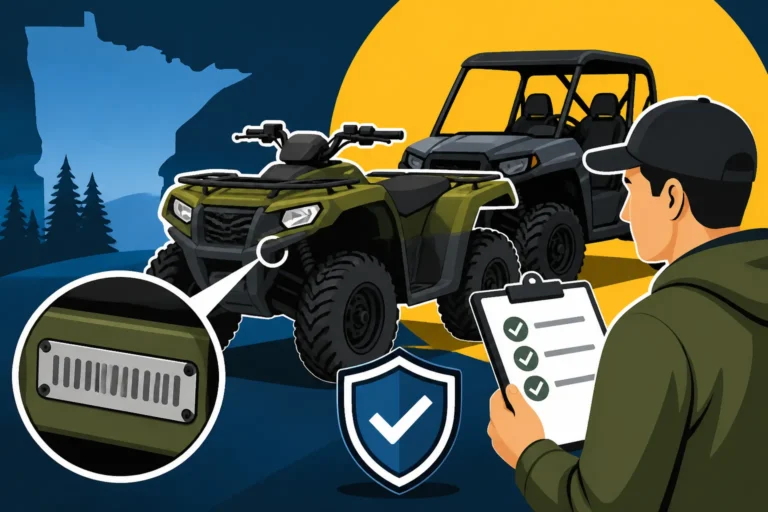
The VIN assignment process in Minnesota typically involves an inspection by a DNR conservation officer or another designated authority. This isn't just a casual glance; they're looking for several key things. First and foremost, they'll verify your ownership documentation for the major components. This is why those receipts and bills of sale are so vital. They want to ensure that the engine, transmission, and frame materials weren't reported stolen and that you legitimately acquired them. Having a comprehensive document, perhaps even one generated using a tool like LawDepot, can make this verification smoother.
Beyond ownership, the inspector will assess the machine's construction and safety features. While Minnesota doesn't have a specific "homemade ATV inspection checklist" in the same way some states might for cars, they will generally look for common-sense safety items. This includes functioning brakes on all wheels, proper lighting (headlights, taillights), a working exhaust system with a spark arrester (essential for preventing wildfires on public land), and generally sound construction. They're checking that the machine is reasonably safe for operation, not just a haphazard collection of parts. Be prepared to show them the machine, discuss your build process, and present all your gathered paperwork. They might also check for a serial number on the engine, comparing it against your documentation.
The Registration Application: Bringing Your Creation to Life
After your homemade frame has successfully passed inspection and received its official Minnesota VIN, you're finally ready for the final leg of the journey: applying for registration. This is the moment your hard work truly pays off, as your custom machine transitions from a garage project to a legally recognized off-highway vehicle ready for Minnesota's incredible trail system.
Filling Out the Application for Your Custom Build
With your new VIN securely affixed to your frame, the process largely aligns with registering any other off-highway vehicle. You'll need to visit a deputy registrar's office. Many [Deputy Registrars That Handle ATV Registration] are equipped to handle these transactions, but it's always a good idea to call ahead and explain your situation – specifically that you have a homemade frame with a newly assigned VIN – just to ensure they have the right forms and knowledge.
You'll typically fill out an application for registration, which will ask for information like the machine's make (which will be "homemade" or similar, followed by the assigned VIN), model (if you've designated one), year of manufacture (the year you completed it), and your personal information as the owner. You'll need to present your proof of VIN assignment from the DNR officer, along with your driver's license or other valid identification. This is the culmination of all your careful documentation and the inspection process. Ensure all forms are filled out accurately and completely to avoid any delays.
Fees, Taxes, and What to Expect at the Registrar
When you head to the deputy registrar, be prepared for various fees. You'll pay the standard [Minnesota ATV Registration Fee for Three Years], which covers the cost of operating your machine on public lands. Additionally, if Minnesota issues titles for your specific class of off-highway vehicle, there might be a separate title fee. Then comes the matter of sales tax. Since your machine wasn't bought as a whole unit, the sales tax is typically assessed on the total cost of the materials and components you used to build it. If you have detailed receipts showing you paid sales tax on new parts at the time of purchase, bring those along to avoid being double-taxed. If you bought used parts without sales tax, or materials that didn't have sales tax applied, be ready to pay Minnesota sales tax on their value. This is where your meticulous record-keeping truly shines.
Here's a quick comparison of what you might expect regarding documentation for a standard vs. homemade machine:
| Requirement | Standard ATV/UTV | Homemade Frame ATV/UTV |
|---|---|---|
| Proof of Origin | Manufacturer's Statement of Origin (MSO) | Detailed receipts/bills of sale for all major components |
| Identification | Factory-assigned VIN | State-assigned VIN after inspection |
| Ownership Proof | MSO, Bill of Sale (if used), Title | Receipts, Bills of Sale, VIN assignment documentation |
| Sales Tax Basis | Purchase price of the complete machine | Total cost of materials/components |
| Inspection Needed? | Generally no, unless previously unregistered | Yes, for VIN assignment and safety verification |
The deputy registrar might not encounter homemade frame registrations every day, so patience is key. Bring all your paperwork, be ready to answer questions about the build, and be confident in your documentation. Once everything is processed and the fees are paid, you'll walk out with your new registration and, in due time, your shiny new Minnesota ATV registration sticker. You'll also want to consider [Insuring an ATV in Minnesota] once it's registered.
What to Consider Before You Start Building
The allure of a custom-built machine is undeniable, offering unparalleled customization and the satisfaction of riding something you created with your own hands. However, approaching a homemade frame build with registration in mind from the very beginning can save you a tremendous amount of heartache and bureaucracy down the line. It's about building smart, not just building cool.
Planning for Registration from Day One
The single best piece of advice for anyone considering a homemade frame is to think about registration before you even cut your first piece of steel. This means keeping absolutely meticulous records of every single purchase you make, no matter how small. Every bolt, every piece of tubing, every engine component, every electrical connector – document it. Create a spreadsheet, keep a dedicated folder for physical receipts, and even take photos of your receipts if they're prone to fading. This establishes the "cost basis" for your machine, which will be crucial for calculating sales tax when you register. It also serves as undeniable proof of [Proof of Ownership for a Minnesota ATV] for all your components.
Beyond receipts, take progressive photos of your build. Documenting the frame construction, the engine installation, the suspension setup, and all the critical components going into place can serve as valuable evidence during the VIN assignment inspection. Imagine trying to explain where you got a specific part years later without any record – it's a nightmare. By planning for registration from day one, you turn a potential bureaucratic struggle into a manageable, organized process.
Understanding Minnesota's ATV Classes
As you design and build your homemade frame, it's incredibly important to consider Minnesota's different ATV classes. The dimensions and specifications of your finished machine will directly impact how and where you can legally ride it. Generally, Minnesota distinguishes between Class 1 and Class 2 machines. Class 1 machines are typically 50 inches wide or less, while Class 2 machines are wider, often side-by-sides, and can be up to 65 inches wide. These classifications determine access to certain trails and rights-of-way.
If you build a machine that exceeds 50 inches in width, it will automatically be considered a Class 2 machine. While Class 2 machines have access to many trails, some narrower trails might be restricted to Class 1 machines only. Think about the type of riding you intend to do. Are you aiming for tight, technical forest trails, or more open, wider routes? Your build decisions now will dictate your riding opportunities later. Being aware of [Minnesota ATV Classes and What They Mean] will ensure that your custom creation aligns with your riding aspirations and is compliant with state regulations. Building to a specific class standard from the outset avoids the disappointment of having a perfectly good machine that's too wide for your favorite trail.
Disclaimer
This article is for general informational purposes only and does not constitute professional advice. Laws, prices and regulations vary by location and change over time. Consult a qualified professional for guidance on your specific situation.