Minnesota Rules During Firearm Deer Season
Firearm deer season changes how an ATV or UTV ride fits into a Minnesota hunting trip. The main risks are assuming public hunting land is open to motorized travel, riding where seasonal restrictions apply, or treating a trail pass as permission to go anywhere. Check the route, land rules, machine paperwork and hunting regulations separately before you head out.
What changes during firearm deer season
Minnesota’s firearm deer season is not one blanket ATV-access period. Season dates and hunting rules depend on the current regulations and the deer permit area, while access rules depend on the land and the specific road or trail. A route that is open for riding at another time may have a seasonal restriction, and public land open to hunting may still be closed to motor vehicles except on designated routes.
That distinction matters whether you are hunting from a cabin, visiting family, or riding through an area where hunting is underway. Do not assume that a trail is open because it appears on an older map, that a gate is merely an inconvenience, or that a hunting permit gives you permission to drive beyond an authorized route. Look for current closure notices and follow signs at trailheads, roads and access points.
Before setting out, establish:
- The exact land manager and the route’s permitted uses.
- Whether the road or trail is open to your machine during the dates you plan to ride.
- Whether your machine needs Minnesota registration or a trail pass for that route.
- Whether the hunting rules for the area affect how you transport or use a firearm.
- Whether the landowner allows access if any part of your route crosses private property.
Riding and hunting are separate activities with overlapping rules. For example, having permission to hunt on private property does not automatically allow you to ride across it, and being allowed to ride on a public route does not automatically authorize hunting from the machine or outside the route. If you plan to combine a ride with a hunt, check both sets of rules rather than relying on a general understanding of “deer season.”
It also helps to separate three kinds of permission: permission to operate the machine, permission to use a route, and permission to hunt. Registration, a trail pass, or a hunting license addresses only its own requirements. None should be treated as a substitute for the others.
Where you can ride and what to check
A map can help you plan, but it cannot replace current signs or land-manager rules. Motorized access on public land is generally limited to routes designated for the type of machine and use allowed there. A public hunting area, state forest, trail corridor or roadside is not automatically open to ATV or UTV travel.
Trails, public land and seasonal restrictions
Before a deer-season ride, check the managing agency’s current map or notices for the trail or road you intend to use. Pay attention to the specific route, not just the broader name of a forest or recreation area. One section may allow ATV use while a nearby road, connecting trail or spur has a different status. If a closure or sign conflicts with an older map, follow the current restriction and use an authorized alternate route.
Wildlife management areas deserve special attention. They are managed for wildlife and public use, but motor vehicle access is restricted and may be limited to designated routes or specific purposes. Do not drive off a marked route to reach a hunting spot, retrieve equipment or get closer to a deer. Check Minnesota Rules on Wildlife Management Areas before planning a ride through one.
Grant-in-aid trails and other designated ATV trails may have their own operating status and requirements. A trail pass, when required, is not a general permit to ride on any public land. Visitors should check Minnesota’s Non-Resident ATV Trail Pass to understand how the pass question applies to their machine and trip. Registration and trail-pass requirements are separate from whether the route is open.
Roads and ditches are another separate issue. A road may be open to ordinary traffic but not to ATV or UTV use, and permission to ride a ditch does not authorize riding on the road surface. Rules can vary by road type and location, so review Riding the Ditch of a Minnesota Right of Way and the rules for the particular route. Do not use a public road as an improvised connection between trails unless the law and local rules allow it.
| Place or route | What to verify before riding |
|---|---|
| Designated ATV trail | Current opening status, machine-size limits, signs and any required pass |
| Wildlife management area | Whether motorized travel is allowed on the exact route |
| State or county forest road | Route designation, seasonal restrictions and posted closures |
| Roadside ditch or right of way | Whether ATV use is allowed there and where it is prohibited |
| Private property | The landowner’s permission for both access and the route you plan to ride |
| Hunting area reached by trailer | Legal parking, staging and access to the machine’s permitted route |
Private land and hunting access
If the ride crosses private property, get permission from the landowner for the ATV or UTV route itself. A hunter’s permission to enter land on foot may not include permission to ride, and a permission arrangement with one landowner does not automatically extend across neighboring parcels. Ask where you may ride, where to park, and whether the machine must stay on a driveway, field edge or other defined route.
The same care applies when accessing leased hunting ground, a cabin or a deer camp. A trail that looks like a farm lane may still be private, and an open gate is not proof that motorized access is allowed. If you cannot confirm permission or route access, choose another way in.
Hunting, firearms and riding safely around other people
A deer-season ride calls for more caution than an ordinary trip through a quiet area. Hunters may be walking near trails, roads and parking areas, and visibility can be limited by terrain, vegetation, weather or low light. Slow down near access points and occupied vehicles, give people room, and avoid creating unnecessary noise or disturbance where hunting is taking place.
Do not assume that a hunting rule applies only when you are carrying a firearm, or that an ATV rule answers every question about a firearm. The regulations for firearm transport can depend on the firearm, the vehicle, the activity and the circumstances. Check the current Minnesota hunting regulations before transporting a firearm on or in an ATV or UTV. If you cannot confirm the applicable rule, do not carry it on the ride until you have checked.
Likewise, do not assume that a firearm can be loaded or handled while the machine is moving. Keep people clear of the muzzle, follow safe firearm-handling practices, and never handle a firearm while operating the vehicle. A machine’s cargo area, scabbard or case does not by itself determine whether transport complies with current law.
Visibility and hunter orange
If you are hunting, follow the current requirements for blaze orange or other required visibility clothing for the season and activity. If you are riding but not hunting, do not assume that the hunting requirement automatically applies to every rider; check the current rule for your circumstances. Either way, conspicuous clothing is a practical safety choice when hunters and riders may share nearby areas. Blaze Orange on a Deer Season Ride covers the visibility question in more detail.
Good visibility also depends on the machine. Use required lights, keep reflectors and lenses clean, and ride at a speed that allows you to stop when someone appears ahead. Avoid cresting a hill or entering a blind trail junction quickly. A flag or extra reflective material may improve visibility in some settings, but it does not make an otherwise closed route legal.
Riding to a stand or retrieving game
An ATV can be useful for carrying gear or reaching an authorized staging point, but that does not mean you can ride all the way to a stand. Stay on a route where motorized access is permitted and park without blocking a trail, road, gate or access point. If you leave the machine to hunt, make sure it is parked where the land manager and landowner allow it.
For more on the separate access question, see Riding to a Minnesota Deer Stand. If you plan to transport harvested game, check the rules for the hunting area and the route before loading it. The ability to carry a deer on a machine does not grant permission to travel off-route or enter a closed area. Packing Out a Deer by Machine can help you think through that part of the trip.
Be especially careful when retrieving game near a road, trail or another hunter’s position. Do not drive toward a person who is carrying a firearm, and do not assume everyone can see or hear your machine. Agree on a meeting point and a safe route before the hunt rather than improvising in the field.
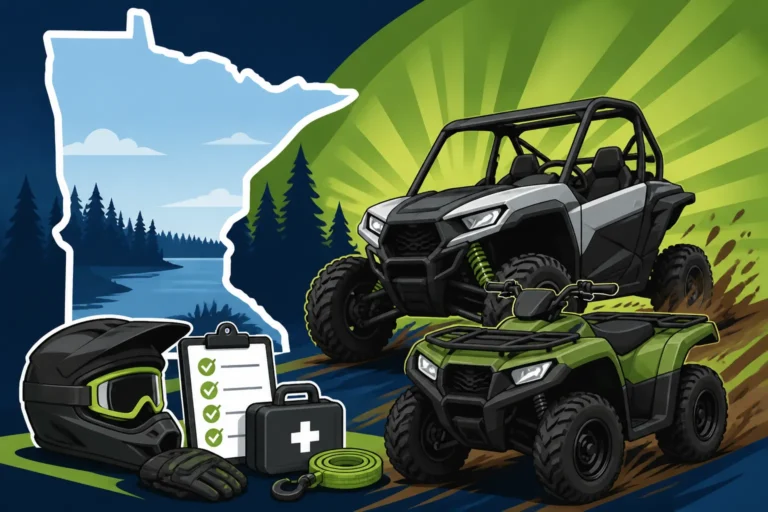
A practical pre-ride checklist
A few checks before leaving can prevent a frustrating trip or an unsafe encounter. Use current information for the specific date and location, since trail conditions and restrictions can change.
- Pin down the route. Identify every road, trail, access lane and property boundary you expect to use. Check the current map and notices from the land manager.
- Confirm the route is open. Look for seasonal restrictions, gates and posted signs. Do not ride around a closure or assume a route is open because other vehicles are present.
- Check machine requirements. Confirm registration, decal placement and any trail-pass requirement that applies to your machine and the route. If you are bringing a machine from another state, check the rules for visiting riders rather than assuming home-state paperwork is enough.
- Confirm landowner permission. Ask specifically about riding and parking, not only hunting access. Stay on the route the landowner approved.
- Review hunting regulations. Check the current firearm season dates, area rules, visibility requirements and firearm-transport rules that apply to your plans.
- Plan parking and staging. Park only where allowed, keep access points clear, and avoid blocking roads or trail entrances.
- Prepare for other users. Ride slowly near hunters, pedestrians and occupied vehicles. Use required lights and carry the safety equipment appropriate to the route and conditions.
- Have a backup plan. If a trail is closed, a sign is unclear or permission cannot be confirmed, turn around and use a verified route. Do not treat a deer-season trip as a reason to bend an access rule.
Paperwork is worth checking before the trip, particularly if the machine has recently changed owners or is registered elsewhere. Registration does not authorize use on a closed route, but missing or unclear paperwork can create a separate problem. If the machine’s status is uncertain, review Minnesota Rules for Visiting Riders or the relevant registration requirements before traveling.
A simple plan also helps keep the hunting and riding portions distinct. Decide where the machine will be parked, where you will walk, and how you will return without leaving the authorized route. Tell your group the plan, and do not let convenience turn a short detour into unauthorized riding.
The safest rule is straightforward: during firearm deer season, ride only on a route you have confirmed is open to your machine, and treat hunting access, motorized access and firearm rules as separate questions. When signs, maps or permissions are unclear, stop and verify before proceeding.
Disclaimer
This article is for general informational purposes only and does not constitute professional advice. Laws, prices and regulations vary by location and change over time. Consult a qualified professional for guidance on your specific situation.