Penalties for Cutting Off the Trail
Riding around a muddy patch or taking a shortcut can seem harmless, but leaving a marked Minnesota ATV trail may turn a normal ride into a citation, a bill for damage, or a trespass complaint. The consequences depend on where you are, what rules apply, and whether you harmed the land. Here’s what can happen and how to avoid making the situation worse.
What counts as cutting off the trail
“Cutting off the trail” generally means operating outside the route or riding area open to your machine. It can include making a new path to bypass a muddy section, widening a trail by riding its edge, taking a shortcut between switchbacks, or continuing past a closure sign. The exact boundary depends on the land and the posted route.
An open trail is not permission to ride anywhere nearby. A trail may pass through public land while neighboring areas, wetlands, restoration zones, or private parcels remain closed to motorized travel. Likewise, permission from a landowner to cross one part of a property does not automatically authorize riding elsewhere on it.
Common situations that can lead to trouble include:
- Riding around a water hole or deep mud instead of staying on the marked route.
- Leaving a trail to get around a closed gate, washout, or logging activity.
- Riding through a ditch, field, or forest opening that is not part of an authorized route.
- Following tire tracks that look established but are not marked as an open trail.
- Continuing onto a closed segment because the route appears passable.
- Crossing private land without permission, even if the trail seems to continue through it.
A detour is not necessarily allowed just because the marked path is difficult or blocked. When the official route is impassable, stop and check the posted information or contact the land manager rather than creating a new route. Trail closures can protect riders as well as soil and water. For instance, Why Minnesota Trails Close for Thaw explains why spring conditions can make even a short detour damaging. Check Minnesota Trail Closures in Spring Thaw and current notices before heading out.
A trail pass does not authorize off-trail riding
A pass or registration may be required for a particular machine or trail system, but having one does not give you permission to ride beyond the designated route. Pass requirements and land-use rules are separate issues. Confirm what applies to your route with Which Minnesota Trails Require a Pass and review Minnesota Grant-in-Aid Trail System for context about the trail network.
This distinction matters for visitors as well as Minnesota residents. Reciprocity, registration, and trail-pass rules do not override a local closure or authorize riding on land that is off limits. Before a trip, confirm both your paperwork and the route’s current status.
What penalties can follow an off-trail ride
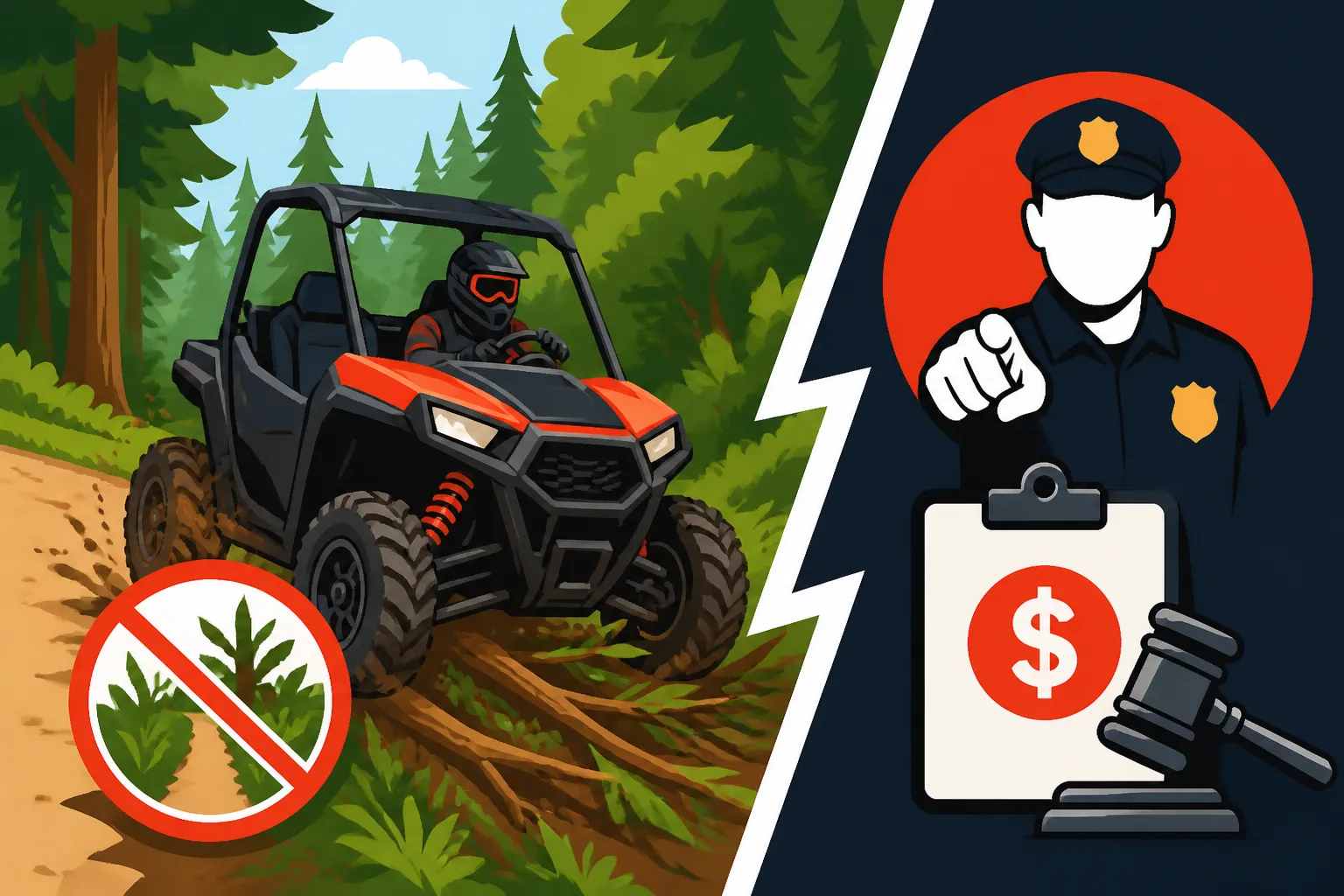
There is no single penalty that applies to every instance of leaving a trail. The response can depend on who manages the land, whether the route was clearly marked, the type of machine and area, the rider’s conduct, and the amount of damage. A warning may be possible in some circumstances, but riders should not count on one.
| Situation | Possible consequence |
|---|---|
| Riding outside an authorized route | A citation or other enforcement action under the applicable rule |
| Crossing land without permission | A trespass complaint or separate enforcement action |
| Damaging soil, vegetation, a wetland, or trail infrastructure | A citation and possible costs associated with restoration or repair |
| Ignoring a closure or posted restriction | Enforcement for violating the applicable closure or land-use rule |
| Riding without a required pass or registration | A separate paperwork-related violation, even if the rider is otherwise on the trail |
| Repeated or particularly harmful conduct | More serious enforcement consequences may be considered, depending on the facts and applicable rules |
These are possibilities, not a guaranteed penalty schedule. A conservation officer, sheriff, local authority, land manager, or other enforcement official may respond according to the location and circumstances. A rider who leaves a trail and also enters private property or damages land may face more than one issue. Minnesota Trespass Law for Riders covers the separate question of unauthorized access, while Minnesota Resource Damage Citations is relevant when damage is alleged.
Damage can make the consequences more serious
A narrow tire track through dry ground is not the same as tearing up a wet trail edge, breaking a culvert, damaging a gate, or creating a new route through sensitive ground. Still, riders should not assume that an off-trail path is harmless because it looks small. Repeated travel can widen a disturbance, and wet soils can be especially vulnerable.
If damage is identified, the matter may involve more than a simple warning or citation. Depending on the facts and the authority responsible for the land, the rider could be asked or required to cover repair or restoration costs. The scale of any assessment is case-specific; do not assume a fixed amount based only on the distance ridden or the size of the machine.
A missing pass or sticker is a separate issue
An officer may check whether a rider has the required pass, registration, or other documentation while investigating an off-trail complaint. Those requirements are separate from the rule to stay on an authorized route. Being properly registered does not erase an off-trail violation, and an off-trail ride does not automatically mean a paperwork violation occurred.
For trip preparation, check What Minnesota Riders Need Before They Ride and Minnesota Conservation Officer Enforcement in Minnesota. Keep in mind that different authorities may manage different sections of a ride, so a rule that applies on one segment might not explain the requirements for the next.
What to do if you realize you have left the route
The safest response is to stop riding farther off the marked route. Continuing can extend the disturbance, make it harder to explain what happened, and risk causing more damage. Do not assume that riding back over the same ground is the best choice in every situation: if the ground is fragile or the return path would create more damage, stop and seek guidance from the relevant land manager or enforcement official.
Use this practical sequence:
- Stop and assess the location. Look for trail markers, closure signs, maps, gates, property boundaries, and any obvious hazards. Do not push through a barrier or cross a boundary to find a quicker way back.
- Avoid making the disturbance worse. Keep the machine stationary if moving would deepen ruts or widen a track. If you can return to the authorized trail without causing further harm and without crossing restricted land, do so carefully.
- Ask for directions if the way back is unclear. Contact the land manager or an appropriate local authority. If there is an immediate safety problem, use the suitable emergency channel. Explain where you are and follow the directions you receive.
- Be straightforward if approached. Provide the information requested, avoid arguing on the trail, and ask which rule or location is involved if it is not clear. If you receive a citation, follow its instructions and keep any related documents.
- Document the circumstances. Write down where you were, what signs or markers you saw, the condition of the route, and what happened. Photos may help clarify a confusing boundary or a blocked trail, but do not leave the machine to enter a restricted area for a better picture.
- Follow up through the stated process. If you believe a citation or damage claim is mistaken, use the response or appeal process described on the notice. Keep copies of relevant maps, pass records, photos, and correspondence.
A lack of intent may help explain how a mistake happened, but it does not guarantee that enforcement will be waived. Missing signs, confusing intersections, or a sudden obstruction are worth documenting accurately. Do not alter signs, remove barriers, or post a new route marker yourself.
How to stay on the authorized route
Good route planning is more reliable than trying to decide at the last moment whether a shortcut is acceptable. Start with a map from an official or responsible trail source, then check for temporary closures and conditions shortly before you ride. Reading a Minnesota OHV Trail Map can help with map interpretation, and Checking Minnesota Trail Status Before You Drive is useful when conditions or access may have changed.
Treat signs and closures as boundaries
Follow posted signs even when the trail beyond a closure looks usable. A gate or closure marker may reflect unsafe conditions, maintenance, private-property limits, or protection of natural resources. If signs conflict with an older map or a track saved on a GPS device, do not assume the older information controls. Stop and verify the current route with the responsible authority.
At forks and trail crossings, slow down enough to identify the marked route. A track made by other riders is not proof that the route is legal or open. If the markers are missing or unclear, pause and check the map instead of following tire marks into unmarked ground.
Plan for mud, water, and seasonal closures
Mud is one of the most tempting reasons to leave the trail. Riders may try to avoid getting stuck by riding along the edge, but that can widen the route and damage the ground. If a section is too wet or difficult, turn around only where it is safe and permitted, or wait for guidance. Do not create a bypass around standing water or a closure.
Conditions can change after rain, snowmelt, or a storm. A route that was passable on a previous visit may now be restricted or unsafe. Check official notices before setting out and again at the trailhead if new signs have been posted. If the route is closed, choose another open route rather than trying to get around the restriction.
Carry usable route information
A phone map is useful, but it may lose signal, run out of battery, or show information that is out of date. Download maps in advance when possible and carry a backup that you can read without cell service. A waterproof map sleeve or device mount—available from outdoor retailers and marketplaces such as Amazon—can help keep route information accessible, but it is not a substitute for current official closure notices.
Before riding, make sure everyone in the group knows to stay on marked routes and what to do if someone becomes separated. Agree on a safe place to stop at intersections, and avoid pressuring a rider to continue through a closed or damaged section. A group that slows down to confirm the route is less likely to turn one wrong choice into a larger problem.
Finally, keep your pass and registration current where they are required, but remember that paperwork is only one part of riding legally. The central rule is simple: stay on the route that is open to your machine, and stop to verify when the route or boundary is unclear.
Disclaimer
This article is for general informational purposes only and does not constitute professional advice. Laws, prices and regulations vary by location and change over time. Consult a qualified professional for guidance on your specific situation.