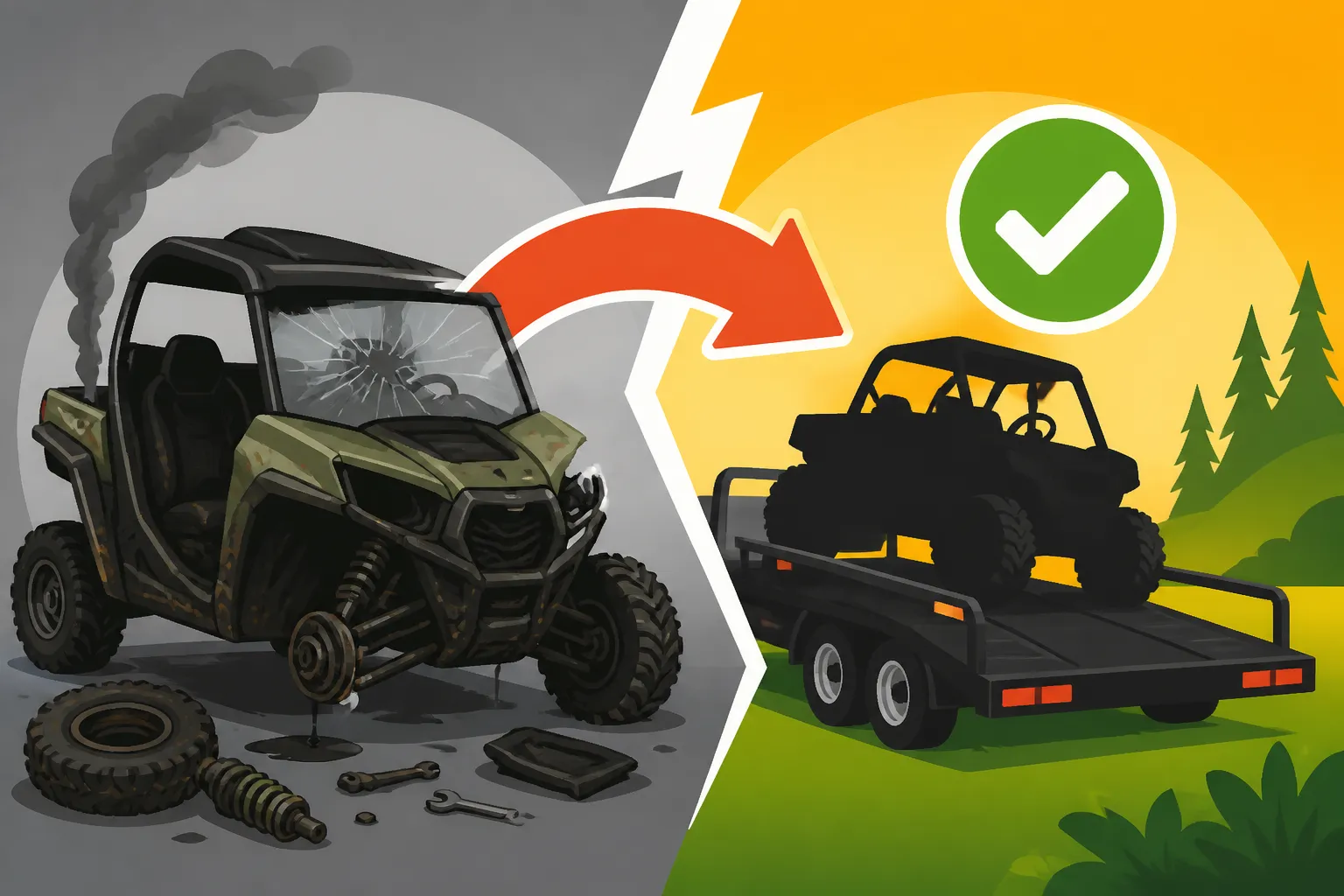
Junking a Machine Past Repair
It’s a tough day when you realize your beloved ATV or UTV has truly reached the end of the line. Maybe it’s a seized engine, a mangled frame from an unexpected encounter with a tree, or just the creeping rust and mechanical failures that have added up over years of hard use on Minnesota’s trails and fields. We’ve all been there, staring at a machine that once brought so much joy, now looking more like a very expensive lawn ornament. This guide is here to walk you through the often-confusing process of properly "junking" an off-highway vehicle in Minnesota, ensuring you handle the paperwork, liability, and disposal correctly, so you can move on without any lingering headaches.
When "Past Repair" Truly Means Past Repair (and Not Just an Expensive Fix)
There’s a natural tendency to want to save a machine that has been a loyal companion through countless adventures, whether it was tackling the muddy trails of Nemadji State Forest or diligently plowing your Minnesota driveway through a long winter. We invest time, money, and often a lot of personal elbow grease into these machines, and it can be emotionally difficult to admit that it’s simply beyond hope. But sometimes, you have to be brutally honest with yourself and the machine’s prognosis.
The Honest Assessment: Is It Really Worthless?
Before you even think about signing papers or hauling it off, sit down and do a truly honest assessment. What’s actually wrong with your ATV or UTV? Is it just a few expensive parts, or is the core of the machine compromised? A bent frame, for instance, often means structural integrity is gone, making the machine unsafe and nearly impossible to fix properly without immense cost. A completely seized engine can sometimes be rebuilt, but the labor and parts involved might quickly eclipse the value of an older machine.
Consider the classic scenario: Your reliable old quad, a workhorse for ice fishing and yard work, finally gives up the ghost with a catastrophic engine failure. You take it to the shop, and the mechanic, bless their honest heart, tells you it’ll be thousands of dollars to replace the engine, not to mention the worn-out suspension and crumbling plastics. Suddenly, that $3,000 repair bill looks insurmountable when the machine itself, even in perfect condition, might only be worth $2,500 on the used market. That’s the kind of math that shouts "past repair." You might even consider [Parting Out a Quad That Will Not Run] if you have the time and space, as sometimes individual components hold more value than the sum of the broken parts.
Understanding Minnesota's Definition of a Salvage Machine
It’s important to distinguish between a machine that's simply in bad shape and one that’s officially considered "junked" or "salvage" in the eyes of Minnesota law. While your neighbor might refer to a non-running quad as "junk," the state often has a more formal definition. A salvage title usually indicates that a vehicle has been damaged to the extent that the cost of repairs would exceed a certain percentage of its fair market value. For ATVs and UTVs, this isn't always as clear-cut as with cars, but the principle is similar.
When you're dealing with a truly "past repair" machine, the goal isn't usually to get a salvage title and rebuild it – you're aiming for full disposal. A junked machine is typically one that will never see the trails or roads again in its original form. Understanding what [Salvage and Rebuilt Machines in Minnesota] means can help clarify that your goal here is often beyond even a salvage designation; you're looking to permanently retire it from any potential registration or public use. This prevents any confusion or potential liability down the road if someone were to somehow try and piece it back together and register it under your old information.
The Paperwork Trail: Clearing Your Name (and the Machine's)
Even if your ATV or UTV is little more than a pile of rusted metal and frayed wires, you can’t just abandon it or kick it to the curb. There’s a crucial paperwork component to properly junking a machine in Minnesota, primarily to ensure you’re no longer legally tied to it. This protects you from future liability if, by some strange twist of fate, parts of your old machine were to be used in an accident, or if someone tried to illegally register it.
What to Do with Your Minnesota Registration and Title
The first and most critical step is to deal with your Minnesota registration and title. Your ATV or UTV has a unique identity through its Vehicle Identification Number (VIN), and this VIN is linked to you through its registration. Even if the machine is totally defunct, that link exists until you formally break it. For ATVs, Minnesota doesn’t issue traditional vehicle titles like it does for cars, but it does issue Certificates of Origin and maintains extensive registration records. This record serves as your [Proof of Ownership for a Minnesota ATV].
You’ll want to contact the Minnesota DNR or a Deputy Registrar's office to inquire about removing the machine from your active registration. While you might not get a refund on an expired registration, the key is to ensure it's marked as "disposed" or "junked" in their system. This officially severs your connection to that VIN. It prevents anyone from trying to use old paperwork or stickers, or worse, reporting it stolen after you've disposed of it properly. If your registration sticker is still on the machine, you might want to remove it before sending it off for scrap, just as a symbolic act of retirement.
Filling Out a Bill of Sale for Parts or Scrap
Even if you're not selling your machine to a new owner for use, but rather to a scrapyard, a parts dealer, or even just someone who wants specific components, it's wise to have a formal record. This is where a bill of sale comes in handy, even for a non-running, "junk" machine. A bill of sale for a machine being sold for parts or scrap should clearly state that the item is being sold "as-is, for parts only, with no warranty expressed or implied."
This document should include:
- The full Vehicle Identification Number (VIN) of the machine.
- A description of the machine (make, model, year, if known).
- The agreed-upon price (even if it's $0 or a nominal amount for scrap).
- The date of the transaction.
- Your full name and address (as the seller).
- The full name and address of the buyer (the scrapyard, parts dealer, or individual).
- Signatures from both you and the buyer.
Why go through this trouble for something you’re just getting rid of? Because it provides indisputable proof that on a specific date, you relinquished ownership of that particular VIN. If you were selling it to an individual for them to pick through for parts, a clear record is especially important. You can find excellent templates for a straightforward bill of sale from resources like LawDepot, which can help ensure you’ve covered all the necessary bases without forgetting a critical detail. Having this document, even for a junk sale, protects you from any lingering liability or claims of ownership down the road. It essentially acts as your final good riddance, legally speaking. This is crucial for anyone wondering [What a Minnesota Bill of Sale Should Carry] when the item being sold is no longer a fully functional machine.
Responsible Disposal: Getting Rid of the Shell
Once you’ve wrestled with the decision and handled the paperwork to legally detach yourself from the machine, the next practical step is getting it off your property. This isn't just about clearing space; it's about doing so responsibly and in compliance with environmental regulations.
Finding a Reputable Scrapyard or Salvage Dealer in Minnesota
You might be surprised to learn that not all scrapyards are created equal, especially when it comes to accepting off-highway vehicles. Some might only take cars, while others are geared towards larger equipment. Start by calling around to local scrapyards and metal recyclers in your area of Minnesota. Major metropolitan areas like Minneapolis and St. Paul will have more options, but even smaller towns often have facilities that deal with scrap metal. When you call, be explicit: "Do you accept ATVs or UTVs for scrap?"
They will almost certainly ask for proof of ownership. This usually means your registration document or a bill of sale confirming you legally own the machine. They need to verify the VIN to ensure they aren't accepting stolen property. Be prepared to provide the VIN from the machine itself. Knowing [Where the VIN Sits on a Quad] will be helpful before you haul it over. Some places might even require you to drain all fluids (oil, gas, coolant) before they'll accept it, or they might charge a fee to do so, as these are considered hazardous waste. It’s always best to ask about their specific requirements upfront to avoid a wasted trip.
If your machine has some valuable intact components, like good tires, a working winch, or a decent suspension, you might also consider contacting an ATV/UTV salvage dealer. These businesses specialize in buying damaged machines, stripping them for usable parts, and then scrapping the rest. You might get a little more money this way compared to pure scrap metal value, and it also contributes to the circular economy of parts for other riders still trying to keep their machines running.
What to Expect When You Take It In
When you finally haul your former pride and joy to the scrapyard or salvage dealer, the process is usually pretty straightforward. If it’s going for pure scrap metal, they’ll likely weigh the entire machine. The price you get will be based on the current market value of scrap steel, which honestly, for a single ATV or UTV, isn't going to be a king's ransom. Think of it as recouping a small fraction of the cost, but mostly as paying for the convenience of proper disposal.
They will perform a VIN check to confirm it matches your paperwork. Once everything checks out, they'll issue you a receipt, often called a "weight ticket" or "proof of purchase for scrap." Keep this document! It’s your final piece of evidence that you legitimately disposed of the machine. The finality of this moment can be bittersweet – the machine you once rode is now a statistic on a scale, destined to be melted down and repurposed. But rest assured, you've handled it correctly and responsibly.
| Action Type | Primary Goal | Potential Payout | Key Considerations | Required Documentation |
|---|---|---|---|---|
| Selling for Parts | Maximize value from usable components | Potentially higher | More effort; need to list parts, deal with buyers | Proof of Ownership (Title/Reg), Bill of Sale (for parts) |
| Scrapping for Metal | Quick, complete disposal for minimal hassle | Minimal (scrap weight) | Environmental disposal of fluids, less emotional effort | Proof of Ownership (Title/Reg), Scrapyard Receipt |
| Salvage Dealer Sale | Sell the whole machine for its best usable parts | Moderate | Less hassle than parting out yourself, but less payout | Proof of Ownership (Title/Reg), Bill of Sale |
What If There's a Lien? (Or No Paperwork At All?)
Life happens, and sometimes things aren't as straightforward as a clean title and a clear-cut decision to junk. What if you still owe money on the machine, or what if you've lost all the original paperwork over the years? These situations, while frustrating, do have paths forward in Minnesota.
Dealing with a Lender When Your Machine is Junk
This is a scenario many people dread: the machine is completely shot, but you’re still making payments to a bank or credit union. If there's a lien on your ATV or UTV, it means a lender has a legal claim to the machine until it’s fully paid off. Simply junking it without involving them is a big no-no and can lead to serious financial and legal trouble.
Your first step must be to contact your lender immediately. Explain the situation: the machine is totaled, past repair, and you intend to dispose of it. They might have specific procedures for handling a "total loss" scenario. Often, if you have insurance, they will work with your insurance company to settle the remaining balance. If there's no insurance coverage, or if the damage isn't covered, you will still be responsible for the outstanding loan balance. The lender might require you to provide proof of the machine’s condition (e.g., a mechanic’s report stating it’s beyond repair). They will then typically release the lien once the balance is settled, allowing you to proceed with disposal. Ignoring a lienholder is never the answer; always communicate openly and honestly. Having a clear understanding of [Liens on a Minnesota ATV Record] is absolutely essential in this situation.
Navigating a Junk Machine with Missing Ownership History
Another common headache is when you want to junk a machine that you’ve owned for years, but you simply cannot find the original Certificate of Origin or registration documents. Maybe it was a hand-me-down from a relative, or you bought it decades ago and never worried about the formal paperwork since you only rode it on your own property. Now that it’s a non-runner, you want to get rid of it, but scrapyards and salvage dealers rightly demand proof of ownership.
This situation can be incredibly frustrating. In Minnesota, the DNR maintains records of registered ATVs and UTVs. Your best bet is to contact the DNR or a Deputy Registrar’s office with the VIN of your machine. They may be able to look up the records and provide you with documentation, or at least confirm that you are the last registered owner. If you simply lost your registration, you can typically apply for [Replacing a Lost Minnesota Registration]. However, if the machine was never formally registered in your name, or if there’s no clear ownership history, the process becomes more complicated.
You might be in a situation that is essentially [Registering a Minnesota ATV With No Ownership History], even though your goal isn't to register, but to de-register. In these cases, you might be limited to selling the machine purely for parts or scrap without a formal title, clearly stating to the buyer that no title is available. This can significantly reduce its value and the number of places willing to take it. Some salvage yards might still accept it with a thorough bill of sale and your affirmation of ownership, but many will be hesitant without clear documentation directly from the state. Be upfront about the lack of paperwork; transparency is key to avoiding legal issues.
Disclaimer
This article is for general informational purposes only and does not constitute professional advice. Laws, prices and regulations vary by location and change over time. Consult a qualified professional for guidance on your specific situation.