First Aid Far From the Trailhead
A crash, deep cut, or sudden illness feels very different when the trailhead is miles away and your phone has no signal. This guide explains how to prepare a Minnesota ATV or UTV first-aid kit, respond calmly to common emergencies, and help rescuers find you in the Northwoods or another remote riding area.
Prepare before you leave the trailhead
Match your first-aid kit to the ride
A small kit tucked under a seat is better than no kit, but it may not be enough for a long, remote ride. Think about the route, the number of riders, the weather, and how long it could take to get help. A short outing close to a road calls for different preparation than a day exploring forest trails where cell service is unreliable.
Pack supplies you know how to use. A practical kit might include gloves, sterile gauze, absorbent dressings, adhesive bandages, medical tape, antiseptic wipes, tweezers, trauma shears, and a triangular bandage. Add any personal medication you may need, such as an inhaler or prescribed allergy medication. Keep the kit in a waterproof pouch that is easy to reach without unloading the machine.
For a group ride, it can help to carry more than one kit. One can stay with a rider who is injured while another goes with the person sent for help. For a fuller packing checklist, see [What to Carry on a Remote Northwoods Ride]. Keep supplies in their original packaging where possible, and check periodically for damaged packaging, depleted items, or medications that need replacing.
Bring communication and navigation backups
A phone is useful, but it should not be your only plan. In parts of northern Minnesota, cell service can be weak or absent, and a phone with a map open all day can run low on battery. Start with a fully charged phone, a charging cable or power bank, and a plan for what the group will do if no one can place a call.
Before leaving, save or download the route information you may need offline. A mapping app such as onX Offroad can be useful for reviewing trail routes and nearby access points before a ride. Check that the relevant map area is available offline before you depart rather than assuming it will load in a dead zone. A paper map and compass offer a useful backup if electronics fail or get wet.
For remote outings, consider whether a satellite messenger or other emergency communication device fits the route and group. Learn how to use it before you need it, and make sure it is charged and carried by someone who can reach it. [Cell Service in the Minnesota Northwoods] and [Do You Need a Satellite Messenger in the Northwoods?] offer more context for planning around communication gaps.
Share a realistic trip plan
Tell someone who is not riding with you where you are going, where you expect to start and finish, and when you will check in. Include the names of trail systems or forest areas, the planned route, the number of riders, and the machines you are using. “We’ll be up north all day” is not enough information for someone trying to raise the alarm.
Agree on what happens if the group is delayed. A check-in time should account for ordinary trail delays, but it should also be specific enough that your contact knows when a missed message is concerning. If plans change, update them as soon as you have service.
Using onX Offroad or another mapping tool before departure can help you identify trail names, junctions, and nearby roads to include in your plan. Do not rely on a moving map alone: write down key details or share them with your contact in a format they can access. For broader route preparation, see [Planning a Minnesota Riding Trip].
Respond to an injury without creating another one
Make the scene safer first
After a crash, take a breath and pause before rushing in. Look for immediate hazards such as moving machines, unstable terrain, fire, leaking fuel, traffic, or other riders approaching around a blind corner. If it is safe, turn off nearby machines and ask someone to warn approaching riders from a safe position.
Do not move an injured person just to make the scene look tidier or to get them back on the trail. Moving someone with a possible head, neck, or back injury can make matters worse. Move them only if remaining where they are creates an immediate danger, such as fire or an unstable machine. If there is danger, move them as carefully as possible while minimizing twisting and unnecessary movement.
Assign clear jobs. One person can stay with the injured rider, another can call emergency services or use a satellite device, and someone else can meet responders at an access point. In a small group, say names and give direct instructions. “You, call for help and tell us when you have reached someone” is more useful than asking generally whether anyone has a phone.
Check for life-threatening problems
If the injured person is unresponsive, having trouble breathing, bleeding heavily, or showing signs of a severe medical emergency, get emergency help as soon as possible. Follow the dispatcher’s instructions. If you are trained in first aid or CPR, use the skills you have learned and stay within your training.
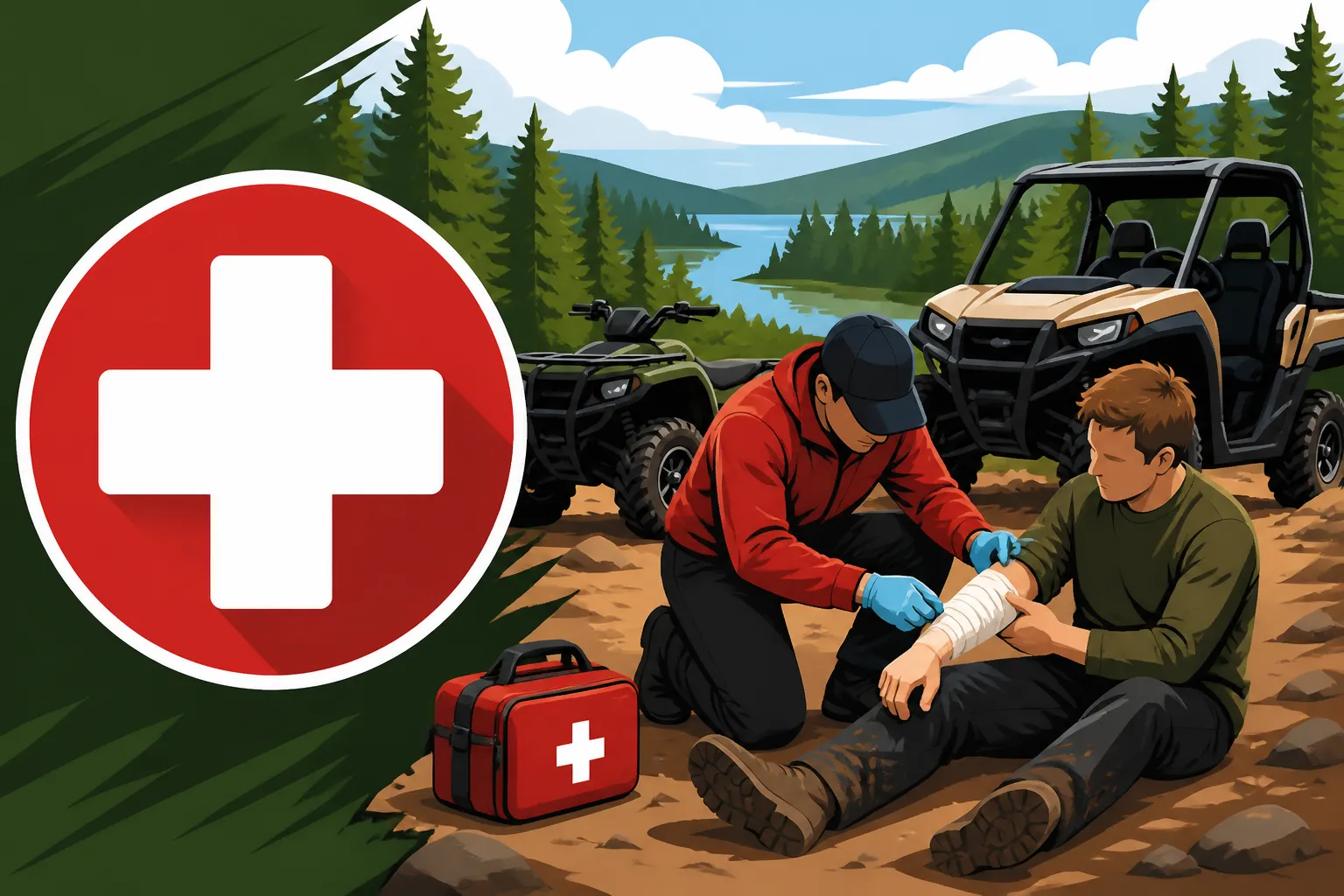
For serious bleeding, use gloves if available. Apply firm, steady pressure over the wound with gauze or a clean dressing. If blood soaks through, add more material on top rather than repeatedly lifting the first dressing to check. For severe bleeding from an arm or leg, use a tourniquet only if you have one and know how to use it, or if emergency guidance directs you. Do not remove an embedded object; apply pressure around it and wait for professional care.
Keep checking whether the person is responsive and breathing normally. If they are not breathing normally, call emergency services and begin CPR if you are trained or can follow dispatcher instructions. An automated external defibrillator may not be nearby on a remote trail, which is one reason a group should identify the closest practical access point before riding.
Protect against shock and avoid unnecessary movement
A person who has had a serious injury may become pale, clammy, weak, confused, or unusually restless. Keep them still and warm with a jacket, blanket, or other dry layer, while taking care not to overheat them. Do not give food or drink to someone who is confused, very drowsy, vomiting, or may need urgent medical treatment.
A helmet can make it harder to assess a rider’s face or airway, but removing it can also move the neck. Avoid taking it off unless it is necessary to manage an immediate threat to breathing or another urgent problem, and follow dispatcher guidance if help is on the line. Do not assume a rider is fine just because they can stand or speak. Head injuries can be serious even when the person initially seems alert.
Keep the injured rider under observation and note changes in breathing, alertness, pain, or bleeding. If emergency services are responding, share what happened and what care you have provided. If the group is unsure whether an injury is serious, err on the side of contacting emergency services rather than continuing the ride.
Handle common trail emergencies
Heat, cold, and dehydration
Minnesota riding conditions can shift quickly. On a hot day, heavy riding gear and exertion can contribute to dehydration or heat illness. Watch for headache, dizziness, weakness, nausea, unusual sweating, confusion, or fainting. Stop activity, move the person to a cooler shaded place if it is safe, loosen excess clothing, and seek emergency help for severe symptoms, collapse, or confusion.
Offer small amounts of water only if the person is alert and able to swallow safely. Do not force fluids into someone who is drowsy, vomiting, or confused. If the person’s condition does not improve promptly or seems severe, contact emergency services. A rider who is getting worse should not be left alone while others continue toward the trailhead.
Cold rain, wind, wet clothing, and long delays can also make a rider dangerously cold, even when the day did not start out bitter. Get the person out of wet clothing if practical, shelter them from wind, and add dry insulation. Handle them gently and seek urgent medical help if they are confused, very drowsy, or difficult to warm. Pack an extra insulating layer in a waterproof bag rather than assuming everyone will stay warm while moving.
Eye injuries, cuts, and sprains
Dust, branches, and debris can irritate or injure an eye. Do not rub an injured eye or try to remove an object that appears embedded. If a particle is loose, gently rinsing with clean water may help; persistent pain, blurred vision, significant redness, or a penetrating injury calls for urgent medical evaluation. Protect the eye without pressing on it.
For minor cuts, clean the wound with clean water when available, cover it with a sterile dressing, and keep an eye out for worsening pain, swelling, or signs of infection afterward. A deep wound, a wound that will not stop bleeding, or one caused by a dirty or penetrating object needs professional assessment. For a suspected sprain, stop the ride, protect the injured area, and avoid making the person walk or ride if doing so increases pain or risks further injury.
Allergic reactions and bites
A sting or bite can cause a local reaction, but trouble breathing, swelling of the tongue or throat, faintness, or widespread symptoms may signal a life-threatening allergic reaction. Use the person’s prescribed emergency medication if they have it, and call emergency services immediately. Do not wait to see whether severe symptoms go away on their own.
Ticks and insects are part of many Minnesota trail days. Carry tweezers and check exposed skin and clothing after the ride, especially after riding or walking through brush. Remove an attached tick with fine-tipped tweezers by grasping close to the skin and pulling steadily. Clean the area afterward. If someone develops concerning symptoms following a bite, contact a healthcare professional.
Get help found and returned safely
Give rescuers a usable location
A vague location can cost valuable time. Tell emergency services the trail system or forest area, the trail name or number if known, the closest junction, and the direction you were traveling. Describe nearby landmarks such as a bridge, road crossing, trailhead, or clearly marked sign. If you have coordinates, read them carefully and confirm the format before sharing.
An offline map can help riders understand where they are even without cell service, but GPS positioning does not guarantee that a call or message can be sent. Before the ride, practice finding your location and communicating it. If you use onX Offroad, review how to display or share location details and save your route area before heading out. Keep your phone protected from water and damage, and carry a backup power source.
Do not have multiple people scatter in different directions without a plan. If someone must go for help, leave a capable person with the injured rider whenever possible. The person going for help should know the agreed destination, the route back, and what information to relay. If emergency responders are already on the way, avoid sending riders out in a way that could confuse the search or delay contact.
Make a comparison of useful safety tools
| Tool | What it helps with | Important limitation |
|---|---|---|
| First-aid kit | Treating minor wounds and supporting basic care | Supplies only help when someone knows how to use them |
| Charged phone | Calling, messaging, and checking maps where service is available | Coverage and battery life can be limited |
| Offline trail map | Identifying routes, junctions, and nearby access points | It does not send an emergency call by itself |
| Satellite messenger | Communicating from some areas without cellular service | It must be charged, carried, and understood before the ride |
| Paper map and compass | Backup navigation if electronics fail | Riders need to know how to use them |
| Written trip plan | Helping an outside contact know where to start looking | It must be accurate and updated when plans change |
An app such as onX Offroad can support route planning, but it should be one part of a layered plan, not a substitute for communication equipment, first-aid knowledge, or a written itinerary. Riders who often travel into areas with limited coverage may also want to review [Riding Alone in the Minnesota Backcountry] and [Getting Turned Around in a State Forest] before setting out.
Decide when to stop the ride
A serious injury, confusion, repeated vomiting, trouble breathing, uncontrolled bleeding, or suspected head, neck, or back injury is a reason to stop riding and seek urgent help. Do not let schedule pressure, the distance back to the truck, or embarrassment about a crash talk the group into continuing. A person may appear steady at first and worsen later.
If the incident involves a crash, get medical care first and follow instructions from emergency responders. Make a note of the location, time, machines involved, and what happened while details are fresh. For information about what may be required after an incident, see [Minnesota ATV Crash Reporting]. Before another ride, check access and trail conditions through [Checking Minnesota Trail Status Before You Drive], and make sure your route plan still matches the group’s abilities and equipment.
Disclaimer
This article is for general informational purposes only and does not constitute professional advice. Laws, prices and regulations vary by location and change over time. Consult a qualified professional for guidance on your specific situation.