Carrying a Firearm on an ATV in Minnesota
It's incredibly frustrating when you want to enjoy Minnesota's vast outdoors on your ATV or UTV, whether for hunting, recreation, or just peace of mind, but you're constantly worried about whether you're legally carrying a firearm. The laws can feel like a tangled mess, leaving many riders unsure if they're following the rules or risking a hefty fine. This guide will cut through that confusion, giving you a clear understanding of Minnesota's regulations for carrying firearms on off-highway vehicles, so you can ride with confidence and stay on the right side of the law.
Understanding Minnesota's General Firearm Transportation Rules
Navigating the rules for firearms in Minnesota, especially when you add an ATV or UTV into the mix, can feel like trying to solve a puzzle with half the pieces missing. The core idea behind Minnesota's firearm laws, particularly concerning transportation, is about safety and preventing quick access to loaded weapons in certain situations. It's not just about what kind of gun you have, but how it's being transported and where you are.
Long Guns and the Unloaded/Cased Rule
For rifles, shotguns, and muzzleloaders – what we commonly refer to as "long guns" – Minnesota law generally requires them to be unloaded and cased when being transported in or on a motor vehicle. And yes, your ATV or UTV absolutely counts as a motor vehicle in this context. This is where many riders get tripped up. You might be just going from your cabin to your deer stand, a short hop, and think it's fine to have your rifle just laying across the back rack, or even in a scabbard, loaded. But legally, that's often a no-go on public lands or rights-of-way.
Imagine you're heading out to your favorite hunting spot deep in Nemadji State Forest. You've got your ATV loaded up with gear. If your hunting rifle is sitting in an open gun rack, even if it's unloaded, it's not "cased." A case means it's enclosed, protecting the firearm and making it inaccessible for immediate use. A soft-sided gun case, a hard-sided case, or even a specialized "gun boot" that fully encloses the firearm would typically meet this requirement. The intent is to keep the firearm from being readily available. This rule applies whether you're on a public trail, crossing a road, or just transporting it from your truck to your hunting shack. It’s a foundational rule that aims to prevent misuse and accidents.
Handguns and the Permit to Carry
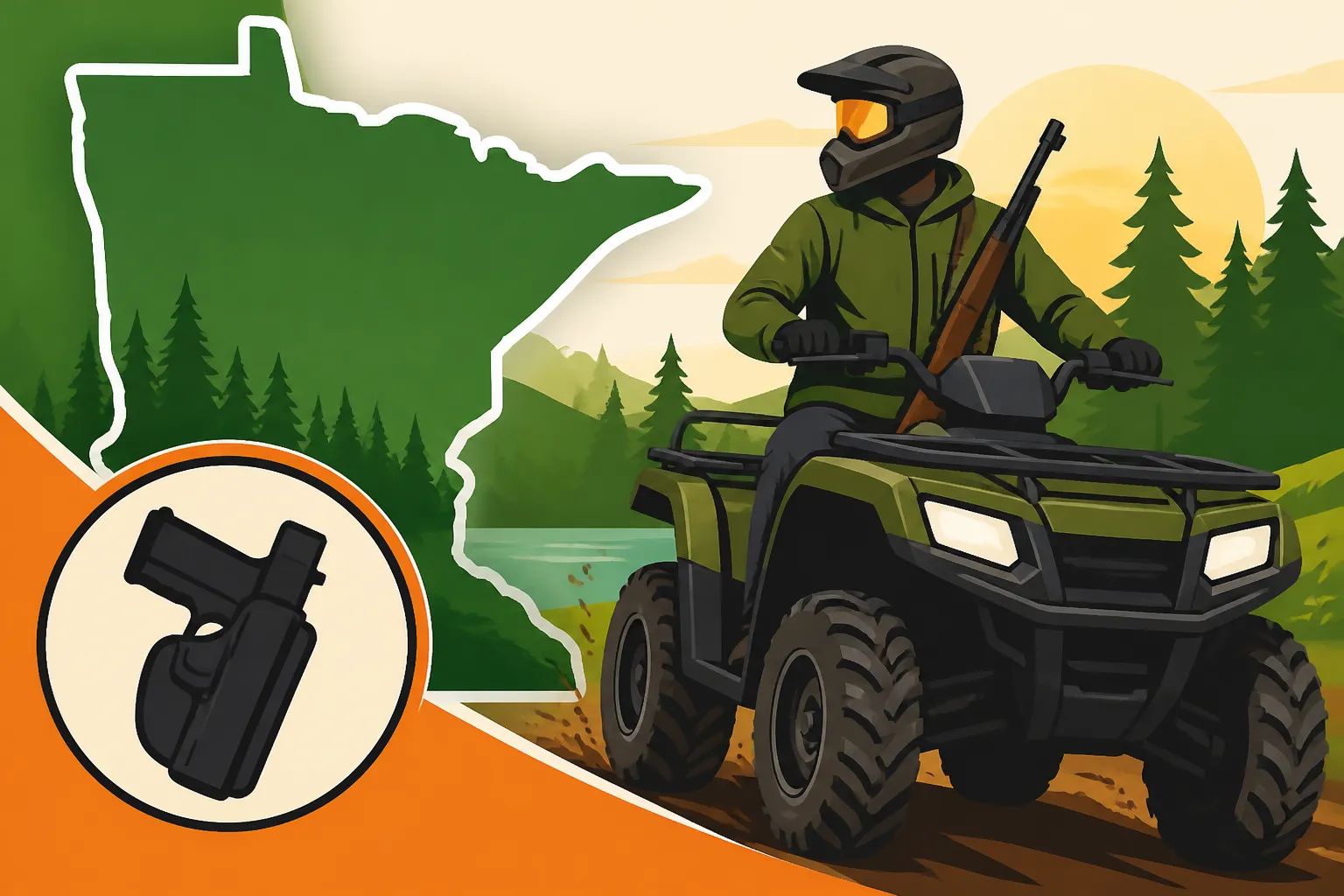
Handguns have a slightly different set of rules, largely due to Minnesota's Permit to Carry a Pistol law. If you possess a valid Permit to Carry (PPC) a Pistol, then you generally have the right to carry a pistol, openly or concealed, on your person or in your immediate control. This extends to carrying on an ATV or UTV. This means if you have your PPC, you can legally have a loaded pistol on your person, in a holster, or even in an accessible compartment on your machine, as long as it's within your immediate control.
However, if you don't have a Permit to Carry a Pistol, then the rules for handguns become much stricter, mirroring the long gun rules in many ways. Without a PPC, a handgun must generally be unloaded and fully enclosed in a container or carried in the trunk of a vehicle (which obviously doesn't apply to most ATVs/UTVs, though an enclosed storage box might suffice). This means it can't be readily accessible. So, if you're carrying a pistol for personal protection without a permit, and it's just in your jacket pocket or under your seat, you're likely breaking the law on public lands or public rights-of-way. The distinction between having a permit and not having one is absolutely critical when it comes to handguns on your machine.
Carrying During Hunting Season on an ATV or UTV
Hunting season brings its own set of rules and a whole lot of questions about firearm carry on your off-highway vehicle. Minnesota's Department of Natural Resources (DNR) has specific regulations designed to ensure fair chase, public safety, and to prevent "road hunting" or illegal taking of game. It's not just about what's legal for general transport, but what's specifically allowed (or disallowed) when you're actively hunting.
Transporting Loaded Firearms While Hunting
This is a big one, and it's where many people get into trouble. Generally, you cannot transport a loaded, uncased firearm on an ATV or UTV on public land or rights-of-way, even if you are actively hunting. This rule is in place to prevent people from driving around with a loaded gun ready to shoot from the machine. The DNR wants you to be off your machine, safely out of the vehicle, before you load your firearm and prepare to hunt.
There are some very specific and limited exceptions. For instance, a person with a disability permit might have different rules, but for the vast majority of hunters, the rule is clear: unloaded and cased while transporting on your ATV or UTV. This means you drive your machine to your chosen spot, park it, get off, then take your firearm out of its case and load it.
This applies even when you're just moving between different hunting zones or returning to your camp. If you've just harvested a deer and are heading back to your truck, your firearm needs to be unloaded and placed back in its case before you get on your ATV. Many hunters find secure gun boots or racks that fully enclose the firearm, sometimes from brands like SuperATV, to be invaluable for this, as they provide both protection for the firearm and compliance with the casing rule. Remember, even if you're on private land, if you cross a public trail or road, you need to ensure compliance with the public land rules.
Exceptions for Disabled Hunters
Minnesota does offer some specific provisions for hunters with disabilities, allowing them to use ATVs in ways that might otherwise be restricted. These exceptions often involve a special permit from the DNR. For example, a hunter with a valid permit may be allowed to transport a loaded firearm on an ATV under very specific conditions, usually tied to their inability to walk or move easily from the machine.
It's absolutely crucial for anyone considering this exception to fully understand the specific requirements and obtain the correct permits before hunting. You can't just assume an exception applies. The DNR's regulations are very clear on who qualifies and what documentation must be carried. Without the proper permit, even if you have a disability, you would still be subject to the general rules for transporting loaded and uncased firearms. Always check the most current DNR regulations and consult with them directly if you believe you qualify for such an exception.
| Scenario | Long Gun (Rifle/Shotgun) | Handgun (No PPC) | Handgun (With PPC) |
|---|---|---|---|
| On ATV/UTV, Public Land/Trail | Unloaded & Cased | Unloaded & Cased (fully enclosed container/secure storage) | May be loaded & uncased (on person or in immediate control) |
| On ATV/UTV, Private Land (non-hunting) | Unloaded & Cased (recommended for safety, varies by landowner) | Unloaded & Cased (recommended for safety) | May be loaded & uncased (on person or in immediate control) |
| Actively Hunting from ATV/UTV | Generally NOT allowed (must dismount) | Generally NOT allowed (must dismount) | Generally NOT allowed (must dismount) |
| Transporting Harvested Game | Unloaded & Cased | Unloaded & Cased (fully enclosed container/secure storage) | May be loaded & uncased (on person or in immediate control) |
Note: This table provides general guidance. Always consult current Minnesota statutes and DNR regulations.
Secure Storage and Practical Considerations
Beyond the letter of the law, there are immense practical considerations when carrying a firearm on your ATV or UTV. These machines are exposed to the elements, vibrations, dust, and potential bumps and scrapes. Protecting your firearm from damage and ensuring it's securely stored for your safety and the safety of others is paramount.
Choosing the Right Gun Rack or Case
The market is flooded with options for carrying firearms on your ATV or UTV, and not all of them are created equal or will ensure compliance with Minnesota law. For long guns, you're looking for something that qualifies as "cased." A standard open scabbard that leaves part of the firearm exposed, while convenient for quick access, typically does not meet the cased requirement on public lands.
Look for a fully enclosed gun boot or a hard-sided case that securely mounts to your machine. These types of cases protect your firearm from mud, dust, water, and impacts, all while keeping it out of immediate reach and out of sight. Brands like SuperATV offer a range of robust options designed to withstand the rigors of off-road riding, ensuring your firearm stays protected and compliant. When choosing, consider how easy it is to access the firearm after you've dismounted and are ready to hunt. Also, think about the mounting system – you don't want your expensive rifle bouncing around or coming loose on a rough trail. Make sure it's stable and won't interfere with your riding or balance.
For handguns, if you have your Permit to Carry, a secure, strong holster worn on your person is usually the most practical and accessible method. If you prefer to keep it on the machine, an enclosed, lockable storage box that's easily accessible but keeps the firearm contained can work. Without a permit, the handgun must be unloaded and fully enclosed, so a locked storage compartment or a pistol case inside a larger utility box is essential.
Safety First: Off-Road Riding and Firearms
Even when you're legally carrying, safety should always be your number one priority. Riding an ATV or UTV, especially on challenging terrain, involves inherent risks. Bumps, jolts, and potential rollovers are part of the game. A securely mounted and properly cased firearm is much less likely to be damaged or, more importantly, cause an accidental discharge in the event of an incident.
Always treat every firearm as if it's loaded, even when you know it's not. Keep the muzzle pointed in a safe direction, even when cased. When you're mounting or dismounting your firearm, make sure the safety is engaged. If you're riding with passengers, especially children, ensure they understand and follow basic firearm safety rules. The vibrations and sudden movements of an ATV can make a poorly secured firearm shift, potentially exposing the trigger or causing it to fall. Take the extra time to ensure everything is locked down tight before you hit the trail. Remember, the goal isn't just to be legal, it's to be responsible and safe.
Common Misconceptions and What to Avoid
It's easy to fall into traps of misinformation or simply misunderstand the nuances of firearm laws on ATVs. These machines often blur the lines between vehicles, recreational equipment, and sometimes even tools, leading to unique interpretive challenges.
"If I'm on Private Land, Anything Goes"
This is a really common misconception, and while private land does offer more leniency than public land, it's not a complete free-for-all. Yes, your own private land or land where you have explicit permission to hunt and ride generally exempts you from some of the stricter public land rules, particularly concerning unloaded and cased firearms while on that private land.
However, this leniency often ends abruptly where your private property meets a public road, ditch, or trail. If you cross a county road to get to another part of your property, or if your private trail merges with a [Minnesota's Grant-in-Aid Trail System], even for a moment, you generally become subject to public land regulations. This means your firearm needs to be unloaded and cased. Many hunters and landowners have been caught off guard by this, thinking their private land rules apply everywhere. Always be mindful of property boundaries and transition zones. Additionally, even on private land, common sense and safety dictate that firearms should be handled responsibly. A landowner can also set their own rules about how firearms are carried on their property.
"I Have My Hunting License, So I Can Carry Loaded"
Another prevalent myth! Simply possessing a valid [Minnesota ATV Rules During Deer Season] or small game license does not automatically grant you the right to carry a loaded, uncased firearm on your ATV or UTV on public land. The hunting license grants you the privilege to hunt, but it doesn't override the general transportation laws for firearms in motor vehicles.
As discussed, unless you have a specific disability permit, you generally must dismount your machine, step away from it, and then load your firearm before hunting. This distinction is crucial and is often enforced by Minnesota Conservation Officers. Thinking your hunting license is a get-out-of-jail-free card for firearm transport on your machine is a dangerous assumption that could lead to fines and legal trouble. Always separate the act of transporting from the act of hunting.
Penalties and Enforcement
Understanding the consequences of violating Minnesota's firearm transportation laws on an ATV or UTV is just as important as knowing the rules themselves. Conservation officers and local law enforcement take these regulations seriously, primarily for public safety and to maintain the integrity of hunting and recreational activities.
Fines and Loss of Privileges
The penalties for unlawfully carrying a firearm on an ATV or UTV in Minnesota can range from significant fines to more severe consequences, depending on the nature and severity of the violation. A first offense for transporting a loaded, uncased firearm on an ATV on public land, for instance, can result in a hefty fine. It's not just a slap on the wrist.
Beyond monetary penalties, you could also face the loss of hunting privileges, revocation of your ATV registration, or even forfeiture of your firearm or machine in certain circumstances. Imagine being out for a [Minnesota Fall Color Rides] and having your machine impounded for a simple misunderstanding of the law. These aren't just minor infractions; they are taken seriously.
Additionally, if the violation occurs in conjunction with other offenses, such as trespassing, hunting out of season, or illegally taking game, the penalties can quickly escalate, potentially leading to misdemeanor or even felony charges. It's why taking the time to truly understand the regulations is so vital. [Fines for Riding Minnesota Unregistered] are one thing, but firearm violations can hit much harder.
Enforcement by Conservation Officers
Minnesota's Conservation Officers (COs) are highly trained and experienced in enforcing game and fish laws, as well as ATV and UTV regulations. They patrol state forests, game lands, and public trails extensively, especially during hunting seasons. They are very familiar with the nuances of firearm laws on these machines.
It's common for COs to set up checkpoints or conduct random patrols, where they may stop riders to check for proper registration, safety gear, and, yes, compliant firearm transportation. If a CO approaches you, be courteous, follow their instructions, and have your necessary documentation ready, such as your [Minnesota ATV Safety Training Requirement] certificate, hunting license, and any permits.
If you are carrying a firearm, be upfront and clear about its status – that it's unloaded and cased, or, if a pistol, that you have a valid Permit to Carry. Attempting to conceal a firearm or being evasive can quickly escalate a routine stop into a much more serious situation. Transparency and compliance are always the best approach when dealing with law enforcement, particularly when firearms are involved. They're out there to ensure everyone's safety and protect Minnesota's natural resources, and knowing the rules is your best defense against unintended trouble.
Disclaimer
This article is for general informational purposes only and does not constitute professional advice. Laws, prices and regulations vary by location and change over time. Consult a qualified professional for guidance on your specific situation.