Camping Beside Minnesota ATV Trails
Camping beside Minnesota ATV trails sounds simple until you’re trying to match a legal campsite with an open route, a place to park the truck and trailer, and somewhere to dry muddy gear. This guide explains how to choose a trail-friendly campground, plan around land-use rules and seasonal closures, and avoid the frustrating surprise of arriving with a machine you can’t ride from camp.
Choose a Camping Style That Fits Your Ride
Campgrounds with nearby trail access
A developed campground can make a Minnesota ATV weekend easier, especially if you want a marked place to sleep, bathrooms, potable water or a staffed check-in. The important detail is that “near a trail” does not automatically mean “connected to a trail.” You may still need to trailer your ATV to a designated parking area, or ride a short distance on a route where motorized travel is specifically allowed.
Before booking, ask the campground or land manager how riders get from the site to the trail. Get a clear answer about whether you can ride directly from camp, whether the connecting route is open to your class of machine, and where trailers can be parked. A map that shows a trail nearby may not show a closed connector, a private parcel or a road where ATVs are not permitted.
This matters when you’re planning around well-known riding areas such as the Iron Range OHV Area near Gilbert, Nemadji State Forest, or the Soo Line North Trail. These places offer different riding experiences and arrangements, and the closest campground may not provide direct trail access. Start by comparing your intended route with [Planning a Minnesota Riding Trip], then confirm lodging and access details directly with the campground or managing agency.
Dispersed camping and a more self-reliant trip
Dispersed camping can appeal to riders who want a quieter base and don’t need showers, hookups or a host nearby. But it is not a blanket permission to camp anywhere in a state forest. Campsite rules, vehicle access, stay limits, fire restrictions and the location of legal camping areas can vary by land unit. A pull-off that looks inviting is not necessarily an approved campsite, and an ATV trail is not a place to set up camp.
Check the rules for the specific state forest or public land where you plan to stay. Confirm whether camping is permitted at your intended location, whether you must use a designated site, and how far you may bring a vehicle or trailer. Also distinguish between access for a highway vehicle and access for an ATV: the fact that you can drive a pickup to a campsite does not mean you can ride an ATV around the surrounding forest.
For a remote trip, plan for limited services. You may have no cell signal, no potable water, and no easy way to get fuel, food or help. Pack out your trash, keep food secured, and have a backup location in case a site is occupied or unavailable. [Dispersed Camping Rules on Minnesota State Forest Land] is a useful companion topic when you’re deciding whether this style of camping suits your group.
Verify Trail, Campsite and Vehicle Access Before You Go
Treat each access point as a separate question
A successful trip depends on several kinds of access lining up: the campsite must be legal, the route must be open, and your ATV or UTV must be allowed on that route. A single map symbol cannot answer all three questions. Trail designations, machine-width limits, seasonal closures and land boundaries can all affect where you can ride.
Before leaving home, make a short access checklist. Identify your campground or legal campsite, the trailhead or connector you plan to use, the designated place to park your tow vehicle, and a backup route or riding area. Check the current rules with the relevant land manager, because conditions can change after heavy rain, during spring thaw, during fire restrictions or as trail maintenance takes place.
Digital maps can help you understand the shape of a route and how it relates to roads, trailheads and nearby communities. Riders may use onX Offroad to review a possible route and orient themselves before a trip, but a map app should not replace official closure notices or permission from the land manager. If a route appears to cross a private parcel or an area with unclear access, stop and verify rather than assuming the map establishes a right to ride there.
Confirm machine fit, trail rules and passes
Not every ATV or UTV is suitable for every trail. Width restrictions can matter on narrower routes, and some riding areas distinguish between machine types or have route-specific rules. Check the requirements for the exact trail system you intend to ride, including any restrictions for full-size machines, side-by-sides or machines with tracks. If your UTV has a wider stance or aftermarket accessories, confirm its overall width rather than relying on the model name.
Also check whether you need a Minnesota trail pass, registration or safety certification for your situation. Requirements can depend on the machine, rider and location. Visitors from another state should not assume that their home-state paperwork or pass automatically satisfies Minnesota requirements. Review [Minnesota's Non-Resident ATV Trail Pass] and [Minnesota's ATV Safety Training Requirement] before the trip if either may apply to your group.
Bring required documents and equipment with you, not just a photo of a map. Keep the trail pass or other required proof in the location specified by the rules, and make sure everyone knows which routes are approved for the group’s machines. A little preparation is much easier than reaching a narrow trail with a wide vehicle, or learning at a checkpoint that a required pass was left at home.
Match Your Campground to the Trail Day You Want
Choose a base camp based on your group
For a family trip, the best campground may be the one with predictable facilities, a simple check-in process and a way to park the trailer securely—not necessarily the one closest to the most challenging riding. Families with young riders may want shorter trail options and an easy return to camp if someone gets tired, cold or overwhelmed. A group riding different speeds may benefit from a central base with several route choices.
A group of experienced riders may care more about access to longer loops, fuel stops or a staging area than about showers or electrical hookups. If you’re bringing a toy hauler or multiple machines, confirm site dimensions, turning room and parking arrangements before reserving. A site that fits a small tent and one vehicle may not comfortably accommodate a long trailer, tow vehicle and several machines.
Make the decision with the least experienced or most constrained member of the group in mind. A campground that works well for a pair of adults on a short weekend can be a poor fit for a family with children, a rider who needs frequent breaks, or a crew hauling several machines. If your trip includes varied skill levels, [Family-Friendly Minnesota ATV Trails] can help you think through the riding side of the plan.
Compare access, services and the shape of your day
A practical campsite comparison should include more than distance to the trail. Consider whether you can get fuel nearby, whether the campground allows the type of trailer you’re bringing, how late you can arrive, and whether there is a place to clean or secure muddy gear. If you plan a full day on the trail, check whether there are services along the route or whether you need to carry everything from camp.
| Camping and access feature | Questions to ask before booking | Why it matters |
|---|---|---|
| Direct trail connection | Can we ride from the campground, or must we trailer to a trailhead? | Prevents an unexpected road ride or extra vehicle trip |
| Trail compatibility | Are our ATV or UTV type and width allowed on the intended route? | Avoids arriving with a machine that cannot use the trail |
| Trailer parking | Is there room for our tow vehicle and trailer, and is overnight parking allowed? | Helps prevent crowded sites and parking problems |
| Water and waste | Is potable water available, and what are the waste-disposal arrangements? | Shapes what you need to pack and how long you can stay |
| Quiet hours and generator rules | What restrictions apply at night? | Helps the group plan power, conversation and early departures |
| Current conditions | Is the campground open, and are the connecting trails open? | Closures can change the trip even when a reservation is in place |
Use these questions to narrow down your options, then verify details with the campground or land manager. A campground’s description may not explain every ATV-specific rule. If you use onX Offroad to compare nearby routes, treat it as one planning tool among several: confirm access, openings and restrictions with the agency responsible for the land.
For a base camp near a named riding destination, research the surrounding area rather than assuming the recreation site itself has overnight camping. For instance, riding at Gilbert’s Iron Range OHV Area and finding a place to sleep are separate planning tasks. The same applies to [Nemadji State Forest Trail Network] and the Soo Line corridor: locate a lawful campsite, then verify the route and the connection between them.
Prepare for Minnesota Weather, Terrain and Camp Logistics
Pack for rain, mud, bugs and changing temperatures
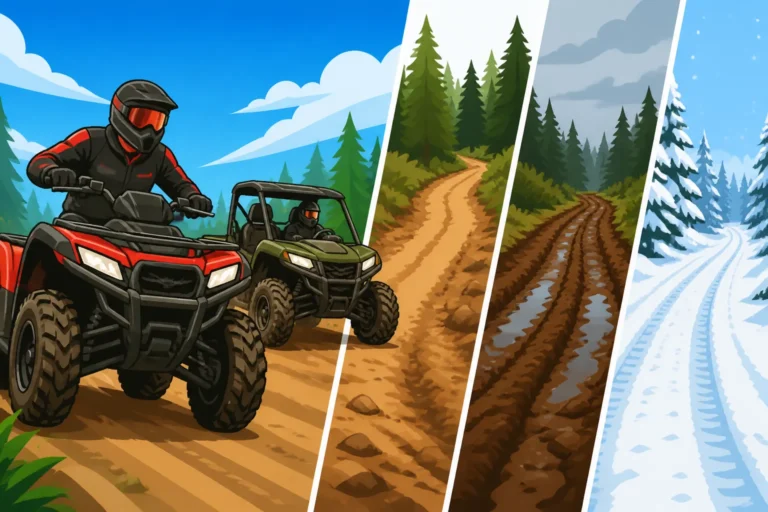
Minnesota trail conditions can shift quickly from dry and dusty to wet and muddy. A sunny forecast at home does not guarantee dry campsites or easy riding, especially in forested areas where low ground and shaded trail sections hold moisture. Pack rain layers, warm clothing, spare socks and footwear that can handle both camp chores and a muddy walk around the machine.
Keep sleeping gear and a change of clothes protected from wet equipment. A simple system helps: one covered container for clean clothes, another for tools and recovery gear, and a separate place for muddy boots and riding layers. At the end of a ride, let gear dry where permitted without blocking walkways or spreading mud through a shared campground area.
Warm-weather trips also mean insects and ticks, while cooler evenings can feel much colder after a long ride. Bring repellent, tick-check supplies and a first-aid kit. If your group will be far from services, think through how you’ll respond to a minor injury, a mechanical problem or a rider who needs to return early. [Ticks and Bug Season on the Trail] and [First Aid Far From the Trailhead] are worth reviewing when packing for a remote outing.
Plan fuel, repairs and recovery before leaving camp
Don’t assume you’ll find a fuel station beside the trail or that every machine in the group has the same range. Estimate fuel needs around your planned loop, include a buffer for detours or slow travel, and identify places to refuel before you ride. Some trail towns offer convenient services, but opening hours and availability can vary. Check the details before building your plan around a single stop.
Bring the basic supplies your group can safely use: a tire repair kit suited to your machine, a compact tool kit, water, a charged phone or navigation device, and recovery equipment appropriate to the terrain. A winch, tow strap or shovel is only useful if someone in the group knows how to use it safely. Avoid relying on an improvised tow from an unsuitable anchor point or another machine.
Share the route and an expected return time with someone who is not riding. In areas with weak cell coverage, don’t treat a phone as your only way to navigate or call for help. Download or carry usable route information before you lose service, and bring a paper map as a backup. [Cell Dead Zones in Northern Minnesota] and [What to Carry on a Remote Northwoods Ride] can help you plan for a trip where camp and trail are well away from town.
Camp Responsibly and Handle Common Problems
Follow campsite rules and be a considerate neighbor
A trail-friendly trip still needs to be a good camping trip for everyone around you. Keep machines in permitted parking areas, respect quiet hours, and avoid unnecessary engine idling near tents or neighboring sites. If you return late, unload quietly and save noisy maintenance or gear sorting for the next morning.
Campfires, generators, waste disposal and pets are all governed by the rules of the campground or land manager. Check fire restrictions before lighting a fire, use only permitted firewood practices, and never leave a fire unattended. Keep food and trash contained, and leave the campsite in good condition. These habits matter especially at busy campgrounds where a few careless groups can make a place unpleasant for everyone.
Respect private land and posted boundaries even when a trail seems to continue beyond them. A mapped line, worn track or gap in a fence does not establish permission. If you discover that your planned connector is closed or unclear, turn around and use a confirmed route rather than cutting across land or riding along a road where ATVs are prohibited. For more on understanding the public-land route system, see [Minnesota's Grant-in-Aid Trail System].
Have a backup plan for closures, weather and occupied sites
A backup plan can save a weekend when the main trail is closed, a campsite is full or heavy rain changes the route. Choose an alternate riding area or shorter loop before you leave, and identify a second place to stay if your first choice is unavailable. Keep the phone number or official contact information for the campground and land manager somewhere accessible, along with your reservation details.
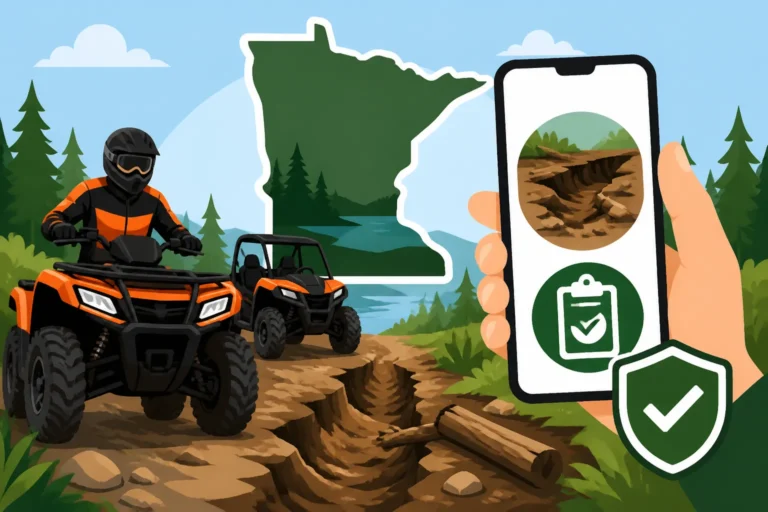
Check trail status close to departure and again before heading out for the day. Spring thaw is a common time for closures intended to protect soft ground, and a route that was open during a previous visit may not be open now. Heavy rain, fire conditions, maintenance work or other land-management needs can also affect access. Look for official notices and signs at the trailhead, and obey posted closures even if an online map still displays the route.
If you need to change plans, make the change while you still have options. For example, a group that arrives to find a trail closed might shorten the ride and visit a confirmed open route rather than attempting an unmarked detour. Keeping another campground, trailhead and fuel stop in mind gives you flexibility without encouraging unsafe or unauthorized riding. Before departure, review [Checking Minnesota Trail Status Before You Drive] and [Minnesota Trail Closures in Spring Thaw].
Use a simple pre-trip checklist
A checklist is especially helpful when several people are sharing towing, camping and riding duties. Assign one person to confirm the campsite and trailer arrangement, another to check machine and trail requirements, and someone else to organize food, water and emergency supplies. That way, the work doesn’t all land on the person who booked the trip.
Use a final check the night before you leave:
- Confirm the campsite reservation or the rules for your intended legal camping area.
- Verify trail openings, machine-width restrictions and current access requirements.
- Check registration, pass and rider-training needs for each machine and operator.
- Confirm trailer parking, arrival times, campground rules and nearby fuel options.
- Pack riding gear, rain layers, water, food, tools, recovery equipment and first aid.
- Save route information for offline use and tell someone your plan and expected return.
- Identify a backup campsite and a backup ride in case conditions change.
Camping near Minnesota ATV trails is most enjoyable when the campsite, machine and route all fit together. A little extra checking can prevent the familiar headaches: a long trailer with nowhere to park, a trailhead that’s closed, a machine that’s too wide for the route, or a group discovering too late that the campground and riding area are not connected. Give yourself time to verify the details, and you’ll spend more of the weekend riding and relaxing—and less time improvising at the side of the road.
Disclaimer
This article is for general informational purposes only and does not constitute professional advice. Laws, prices and regulations vary by location and change over time. Consult a qualified professional for guidance on your specific situation.